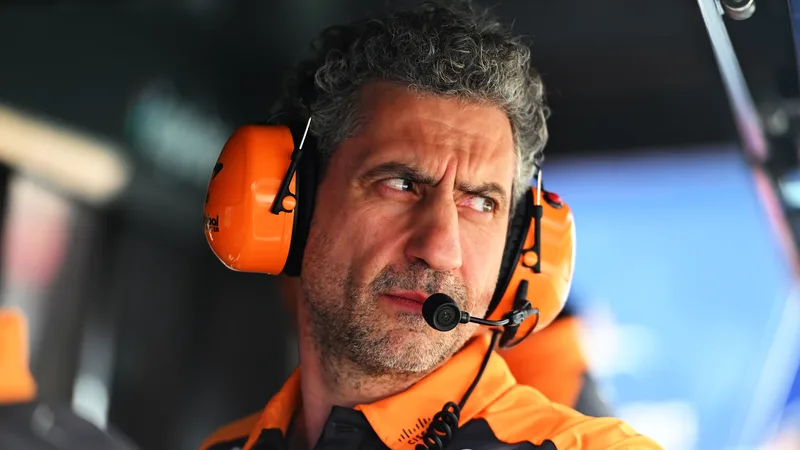
Lando Norris put McLaren on top of the Hungarian Grand Prix grid on Saturday, snatching pole from Lewis Hamilton at the Hungaroring — and yet the man running the team immediately moved to cool expectations. That gap between result and reaction tells you more about the 2026 season than the lap time does.
Stella’s Restraint Is the Real Story
There is a particular kind of team principal who celebrates publicly and explains privately. Andrea Stella is not that kind of team principal. When Norris secured McLaren’s first pole position of the 2026 season in Hungary, Stella’s response was notably measured, explicitly downplaying the notion that the squad holds any kind of advantage heading into today’s race.
That is not false modesty. That is a man who has watched this season closely enough to know that a single qualifying result at a track with unique aerodynamic characteristics does not constitute a shift in the competitive order. The Hungaroring is a circuit that rewards downforce above almost everything else — slow corners, tight sequences, minimal straight-line stress on power units. A car that looks dominant here can look ordinary at Monza a fortnight later.
McLaren fans watching from Australia — and there are plenty of them given Norris has become something of a cult figure in this country since his near-miss championship campaigns — would be wise to take Stella’s temperature check seriously rather than dismiss it as corporate caution. If anything, the team boss’s restraint suggests the development war elsewhere on the calendar is still very much open.
What “First Pole of the Season” Actually Means at This Point
The fact that Hungary produced McLaren’s first pole of 2026 is itself the uncomfortable data point sitting beneath the headlines. We are deep into a season in which the title picture has apparently begun to clarify — with the suggestion in some quarters that the championship is now Norris’s to lose — and yet the Woking outfit had not managed a single front-row lockout until the Hungaroring.
That is not the profile of a dominant car. That is the profile of a team finding its windows of competitiveness at specific circuit types while conceding ground elsewhere. The Ferrari challenge has been real. Mercedes have been a persistent presence, with Hamilton — now in scarlet, inevitably — pushing Norris right to the wire in qualifying on Saturday.
| Driver | Q3 Result | Team |
|---|---|---|
| Lando Norris | Pole | McLaren |
| Lewis Hamilton | P2 | Ferrari |
For those weighing up where this race lands in the title fight, the betting markets heading into today’s race reflected genuine uncertainty — the kind of uncertainty that makes following the F1 Hub this weekend genuinely worthwhile rather than a foregone conclusion. If you’re the sort who tracks odds as a barometer of competitive reality rather than a guide to action, those markets were sending a clear signal: nobody really knows what happens once the lights go out.
The Broader Championship Question
Here’s the thing about Stella’s careful language. It protects McLaren from the same trap that has swallowed other constructors this season — the trap of believing that one strong result signals a corner turned. The 2026 regulations have scrambled the competitive hierarchy in ways that even the teams themselves have not fully decoded. Fernando Alonso at Aston Martin has reportedly begun to understand the car’s problems after a torrid start; that alone signals how volatile this grid remains.
Norris is fast enough to be champion. The car, on its day, is clearly fast enough to put him there. But Stella standing at a microphone after a pole lap and refusing to declare the tide has turned is not pessimism. It’s the most honest thing anyone in Formula 1 has said all weekend.
Today’s Hungarian GP will tell us whether the pole position was a peak or a sign. Stella, characteristically, is not betting on either answer.
VS — Chief sports columnist, australiafootball.com
 Best Betting Sites
 Best Online Casinos
 Blackjack Sites
 Online Pokies
 Fast Payout Casinos
 PayID Casinos
 New Casinos 2026