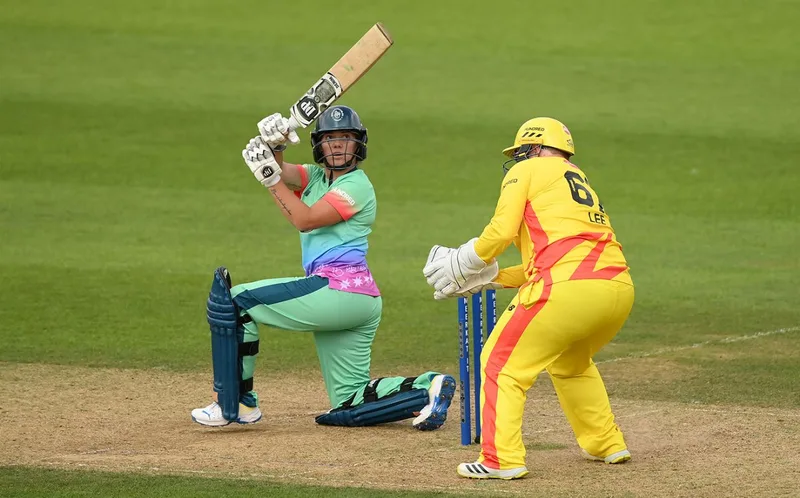
South African all-rounder Nadine de Klerk produced one of the more composed finishing innings of this Women’s Hundred season, steering London Spirit to a three-ball victory over Trent Rockets with an unbeaten 41 from just 22 deliveries.
The Innings That Decided It
There is a particular kind of pressure unique to the lower-middle order in franchise cricket’s shortest format: you inherit a chase that has drifted, the required rate is climbing, and the margin for error has effectively disappeared. De Klerk walked into exactly that situation and responded with the sort of innings that defines a player’s tournament reputation.
Forty-one not out from 22 balls is not merely a decent cameo — it is a strike rate north of 186, sustained across a meaningful stretch of deliveries when the match genuinely hung in the balance. What separates a truly authoritative finish from a fortunate slog is shot selection under duress, and by all available evidence, de Klerk’s execution carried the hallmark of the former. The three balls remaining at the close told you as much: this was not a scramble to the line but a controlled acceleration.
The South African’s broader profile makes this performance entirely unsurprising to anyone who has tracked her development through domestic and international cricket. An all-rounder who can contribute with both bat and ball across formats, de Klerk has long been regarded in South African cricket circles as a pressure-match asset. Translating that into the Hundred’s compressed, high-stakes environment requires a slightly different mental gear, and this innings confirmed she has found it.
What It Means for Both Sides
For London Spirit, the win does more than bank two competition points — it reinforces the depth of their batting unit. A team that can absorb early pressure and still close a chase through contributions from the middle and lower order is structurally harder to beat than one reliant on its top three. That resilience matters progressively more as the competition enters its decisive phase and opponents have more data to plan against your key threats.
Trent Rockets, by contrast, will be dissecting the specific passages where the match slipped. Defending a total with three balls to spare as the cushion is a failure of execution in the final few sets of balls — small margins that accumulate into a loss. The Rockets have the personnel to correct that, but corrections require honest assessment of where the pressure points emerged.
From an Australian cricket follower’s vantage point, the Women’s Hundred continues to serve as an important development theatre. The competition’s format demands the kind of situational hitting and death-bowling discipline that translates directly into Women’s Big Bash League (WBBL) improvement — the same pressure-finishing skills that coaches at clubs like the Perth Scorchers and Sydney Sixers spend considerable training time cultivating. Watching how overseas players like de Klerk handle these moments provides a tangible reference point for what the standard looks like at the competition’s sharpest edge.
Franchise Cricket’s Finishing-Art Problem
The broader tactical takeaway from this match is one that surfaces consistently across franchise formats globally: the ability to finish a chase — not just set one up — is becoming the most prized and least evenly distributed skill in short-form cricket. Openers and top-order batters receive the vast majority of coaching attention and public analysis. The player who arrives at 60 for 4 off 60 balls, needing 55 from 40, and manufactures a calm, calculated finish? That contribution is often underweighted in the public ledger while being absolutely central to a team’s win percentage.
De Klerk’s 41 not out was that contribution, precisely when London Spirit needed it.
AK — Senior tactical analyst, australiafootball.com
 Best Betting Sites
 Best Online Casinos
 Blackjack Sites
 Online Pokies
 Fast Payout Casinos
 PayID Casinos
 New Casinos 2026