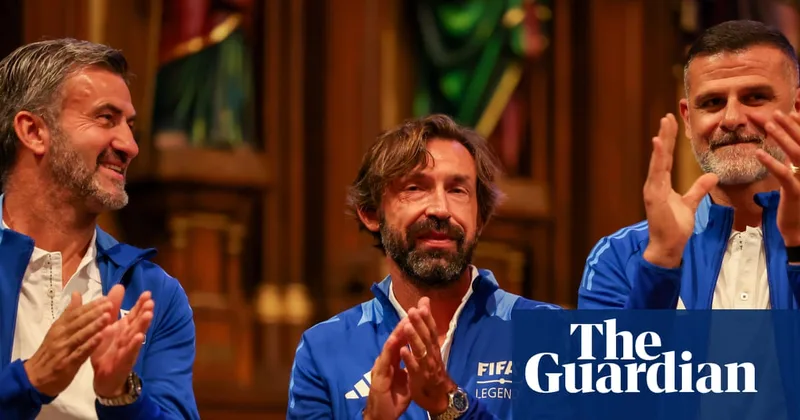
Andrea Pirlo has confirmed he is no longer in contention to coach Italy, with his commercial arrangement as a brand ambassador for Fonbet — a Russian betting firm — widely understood to be the reason his candidacy collapsed before it ever properly began.
This isn’t just a story about a football appointment gone sideways. It’s about what happens when elite sport, geopolitics, and commercial opportunism collide in a space that Italian politicians — and frankly, common sense — decided wasn’t acceptable.
The Deal That Killed the Dream
Several Italian politicians publicly raised objections to Pirlo’s role with Fonbet, arguing that a man serving as the face of the Azzurri cannot simultaneously hold commercial ties to a Russian company while Italy continues to support Ukraine. The argument is blunt and, to be fair, not unreasonable. National team coaches carry symbolic weight that goes well beyond tactics and selection. They are, whether they like it or not, public representatives of their country’s values.
Pirlo, for his part, has defended the deal. That’s his right. And you can understand the logic — elite footballers and coaches normalise these sponsorship arrangements over decades. The money is good, the brands seek prestige through association, and everyone keeps moving. But context has a way of changing the calculus. In 2026, with a war in Ukraine still grinding on, a Russian betting company’s ambassador sitting in the Italy dugout was never going to be a quiet footnote.
What’s genuinely interesting here is that Fonbet isn’t some obscure brand in the general world of sports sponsorship. It operates prominently across Russian sport, and its attempt to embed itself via Western footballing royalty — and that is what Pirlo is — carries obvious strategic value. Pirlo’s legendary status, earned across two decades at Juventus, AC Milan, and with the Azzurri, makes him genuinely attractive to any brand seeking credibility. But that same stature is precisely why this association was always going to attract scrutiny.
Mancini and Conte Now Carry the Weight
With Pirlo stepping aside, the Italian football federation turns its attention to Roberto Mancini and Antonio Conte as the primary candidates. Both men carry enormous coaching pedigree and neither requires much of an introduction to Italian football. Mancini won Euro 2020 with the Azzurri before his tenure ended acrimoniously. Conte, meanwhile, has spent recent years reminding anyone who doubted him that he remains among the elite club managers in European football.
The interesting question now is whether the Italian federation has learned anything from the Pirlo episode beyond the obvious — that candidate vetting needs to include commercial relationships. The deeper issue is about how football governing bodies treat the intersection of sport and geopolitical reality. In an era when broadcast rights, state-backed sovereign wealth funds, and sanctions regimes all bleed into the sporting arena, pretending that a coach’s sponsorship portfolio is purely private business is naive at best.
Australia has wrestled with its own versions of this — whether it’s foreign investment in football clubs, or the ongoing debate around gambling advertising in sport that continues to divide broadcasters, regulators, and fans. The principle is the same: the logos on jerseys, and the contracts in pockets, are never truly separate from the institutions those people represent.
Pirlo, once the most elegant midfielder on earth, deserved better than to see a potential second act defined by a sponsorship row. But the world he’s operating in left him precisely no room. And Italy, whatever its internal dysfunction, made the right call.
VS — Chief sports columnist, australiafootball.com
 Best Betting Sites
 Best Online Casinos
 Blackjack Sites
 Online Pokies
 Fast Payout Casinos
 PayID Casinos
 New Casinos 2026