 Croatia at the World Cup — Full History
Key Facts
- The Croatian Football Federation (Hrvatski nogometni savez, HNS) was originally founded on 13 June 1912; the modern federation re-emerged with Croatian independence and was admitted to FIFA on 3 July 1992 and UEFA on 17 June 1993.
- The senior team’s first match as an independent nation was a friendly against the United States on 17 October 1990 in Zagreb (won 2–1); pre-1990 Croatian players competed under the Yugoslavia federation.
- 2018 FIFA World Cup: runners-up — Croatia lost 2–4 to France in Moscow on 15 July 2018, the country’s first global final and the smallest population in modern times to reach a senior men’s World Cup final (approximately 4.1 million).
- 2022 FIFA World Cup: third place — Croatia defeated Morocco 2–1 in the third-place play-off in Doha on 17 December 2022.
- 1998 FIFA World Cup: third place on tournament debut, defeating the Netherlands 2–1 in the third-place play-off in Paris; Davor Šuker won the Golden Boot with six goals.
- 2023 UEFA Nations League: runners-up — Croatia lost the final 0–0 (4–5 on penalties) to Spain in Rotterdam on 18 June 2023.
- All-time top scorer: Davor Šuker (45 goals). Most-capped: Luka Modrić (196+ caps), the 2018 Ballon d’Or winner.
- Current head coach: Zlatko Dalić (since 7 October 2017), the longest-serving Croatia head coach; captain: Luka Modrić (40, AC Milan since July 2025).
- 2026 FIFA World Cup qualification: Croatia clinched their 2026 finals place with a 3–1 home win over the Faroe Islands on 13 November 2025; UEFA Group L (qualifying) — Croatia, Czech Republic, Faroe Islands, Montenegro, Gibraltar — was won with one draw. The 2026 finals tournament drew Croatia into Group L alongside England, Ghana and Panama.
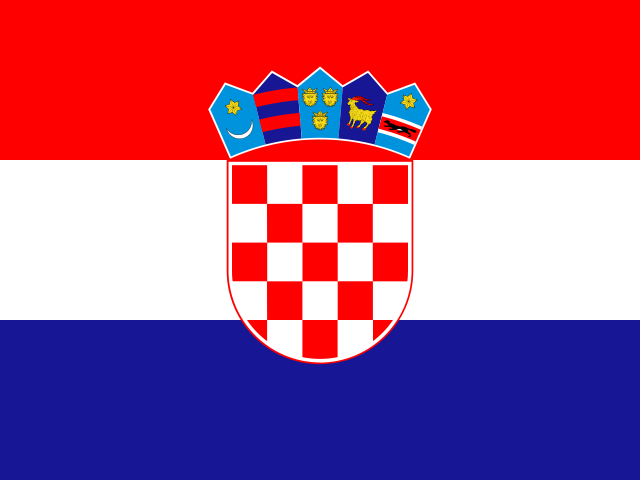
- The team’s distinctive red-and-white checkerboard kit references the Croatian coat of arms (the šahovnica, the country’s heraldic chequy field).
Croatia World Cup Vital Statistics
| Metric | Value |
|---|---|
| First international as independent nation | 17 October 1990 vs USA (Zagreb), won 2–1 |
| FIFA admission | 3 July 1992 |
| FIFA World Cup best finish | Runners-up 2018; third 1998, 2022 |
| UEFA Nations League best | Runners-up 2023 |
| 2026 WC qualification | Won UEFA qualifying Group L (with one draw vs Czechia) |
| 2026 WC finals draw | Group L with England, Ghana, Panama |
| Most caps | Luka Modrić (196+) |
| All-time top scorer | Davor Šuker (45) |
| Current head coach | Zlatko Dalić (since 7 Oct 2017) |
| Current captain | Luka Modrić |
| Home stadium | Stadion Maksimir, Zagreb (35,123) |
| Governing body | Hrvatski nogometni savez (HNS, founded 13 Jun 1912) |
Croatia at the World Cup — History And Profile
The Croatia national football team — known by the Vatreni (Blazers) and Kockasti (Checkered Ones) nicknames — is the smallest population to have reached a senior men’s FIFA World Cup final in the modern era, doing so at Russia 2018 with a country of approximately 4.1 million people. The Croatian Football Federation (HNS) was originally founded on 13 June 1912 in Zagreb but, following the absorption of Croatian football into the Kingdom of Yugoslavia (and then post-war Yugoslavia), the modern HNS only re-entered international football with Croatian independence in 1991. FIFA admitted the federation on 3 July 1992 and UEFA on 17 June 1993; the senior team played its first match as an independent nation on 17 October 1990, a 2–1 friendly defeat of the United States in Zagreb at the Stadion Maksimir.
The team’s first major tournament was Euro 1996 in England, where Croatia reached the quarter-finals on debut (lost 1–2 to Germany) with a squad including Davor Šuker, Robert Prosinečki, Zvonimir Boban and Igor Štimac — most of whom had won the FIFA U-20 World Cup (then named the FIFA World Youth Championship) for Yugoslavia in 1987. The defining tournament of that “Golden Generation” came at the 1998 FIFA World Cup in France, with the team finishing third on tournament debut. Croatia defeated the Netherlands 2–1 in the Paris third-place play-off on 11 July 1998; Šuker won the Golden Boot with six goals across seven matches.
A long stretch followed without a comparable run: group exits at Euro 2000 qualifying, the 2002 World Cup, the 2006 World Cup and Euro 2004, then a Euro 2008 quarter-final exit (lost on penalties to Turkey in Vienna on 20 June 2008). The 2010s brought the country’s modern peak, anchored by Luka Modrić — debut 1 March 2006 vs Argentina; AC Milan from July 2025 after 13 seasons at Real Madrid. Modrić won the 2018 Ballon d’Or after a season that included a fourth Champions League title with Real Madrid (May 2018) and Croatia’s run to the 2018 World Cup final.
The 2018 World Cup remains the team’s defining tournament. Under Zlatko Dalić — appointed on 7 October 2017 — Croatia won six knock-out fixtures across the campaign, three of them in extra time and two on penalties, before losing the final 2–4 to France at the Luzhniki Stadium in Moscow on 15 July 2018. Dalić remains the longest-serving Croatia head coach in the post-1990 era. Four years later in Qatar, Croatia again won three knock-out fixtures (including a quarter-final shoot-out defeat of Brazil) before losing the semi-final 0–3 to Argentina; the team won the third-place play-off 2–1 over Morocco in Doha on 17 December 2022. The 2022 World Cup squad combined the 2018 spine (Modrić, Ivan Perišić, Mateo Kovačić, Marcelo Brozović, Dejan Lovren, Andrej Kramarić, Lovro Majer) with newer inclusions (Joško Gvardiol, Borna Sosa, Mario Pašalić).
The 2023 UEFA Nations League delivered the team’s first major tournament-final appearance after a Euro programme: Croatia lost the final 0–0 (4–5 on penalties) to Spain in Rotterdam on 18 June 2023. Euro 2024 produced a group-stage exit (one win, two draws). Croatia’s 2026 FIFA World Cup qualification was sealed with a 3–1 home win over the Faroe Islands at the Stadion Maksimir on 13 November 2025; the team won qualifying Group L (Czech Republic, Faroe Islands, Montenegro, Gibraltar) with only one draw (away to the Czech Republic). The 2026 finals draw placed Croatia in Group L alongside England, Ghana and Panama — Croatia’s third successive World Cup-finals group with at least one CONCACAF or African opponent.
The current squad core is anchored by Luka Modrić (40 by the time of the 2026 finals, AC Milan from July 2025), Joško Gvardiol (Manchester City), Mateo Kovačić (Manchester City), Mario Pašalić (Atalanta), Andrej Kramarić (TSG Hoffenheim) and Lovro Majer (VfL Wolfsburg / Stade Rennais alumnus). The team plays the bulk of senior fixtures at the Stadion Maksimir in Zagreb (capacity 35,123, opened 1912 — the venue’s stadium-redevelopment plan has been a recurring HNS administrative theme through the 2020s) and rotates fixtures to the Stadion Poljud in Split, Stadion Rujevica in Rijeka and the Opus Arena in Osijek. Kit supplier Nike has produced Croatia jerseys since 2000, succeeding Adidas and Lotto. The Croatian-Australian football connection is unusually deep: Mark Viduka, Joe Šimunić, Tony Popović and Niko Kranjčar each have Australian or Australian-Croatian heritage, while Šimunić — born in Canberra — represented Croatia 105 times after declining Socceroos selection, and Popović has served as Australia head coach since September 2024. The 2026 World Cup will be Croatia’s sixth tournament finals appearance — second only to Yugoslavia in the regional record — and is widely anticipated as Modrić’s last senior international tournament.
Detailed Profile
Federation Leadership
The Hrvatski nogometni savez (HNS), originally founded on 13 June 1912, governs the senior, women’s and youth Croatian national teams. The federation was reconstituted at independence in 1991. Marijan Kustić has served as HNS president since June 2021, succeeding Davor Šuker, who held the role 2012–2021. The HNS is headquartered in Zagreb.
Crest, Colours & Kit Evolution
Croatia has worn distinctive red-and-white šahovnica (chequy) home shirts since 1990, the pattern referencing the Croatian coat of arms (the chequy field of 25 alternating red and silver-white squares). The current crest features the šahovnica shield with the HNS acronym; two stars sit above the crest in recognition of the 1998 third place and 2018 final appearance (per the federation’s recent design update). Kit suppliers in the modern era have included Lotto (1990s), Diadora and Nike (since 2000).
Stadium & Premises History
Croatia plays the bulk of senior fixtures at the Stadion Maksimir in Zagreb (capacity 35,123) — the home of GNK Dinamo Zagreb. Selected fixtures rotate to Stadion Poljud in Split (HNK Hajduk Split, capacity 34,198), Stadion Rujevica in Rijeka (HNK Rijeka, capacity 8,200) and Opus Arena in Osijek (NK Osijek, capacity 13,005). The HNS has discussed a Maksimir redevelopment project intermittently across the 2010s and 2020s without a finalised construction plan at the time of writing.
Iconic Players
- 1990s “Golden Generation”: Davor Šuker (45 goals — record, 1998 World Cup Golden Boot), Zvonimir Boban, Robert Prosinečki, Slaven Bilić, Igor Štimac, Aljoša Asanović.
- 2000s: Niko Kovač, Robert Kovač, Niko Kranjčar, Eduardo da Silva, Mario Mandžukić.
- 2010s–2020s: Luka Modrić (196+ caps, 2018 Ballon d’Or — only Croatian to win the award), Ivan Rakitić, Mario Mandžukić, Ivan Perišić, Mateo Kovačić, Marcelo Brozović, Dejan Lovren, Andrej Kramarić, Domagoj Vida.
- 2020s rising: Joško Gvardiol (Manchester City), Borna Sosa, Lovro Majer, Mario Pašalić, Josip Brekalo.
Coaches & Managers Legacy
Notable head-coach lineage in the modern era: Stanko Poklepović (1990–1991, the first head coach of independent Croatia), Vlatko Marković (1991), Mirko Jozić (1994–1996), Miroslav Blažević (1996–2000, 1998 World Cup third place), Slaven Bilić (2006–2012, Euro 2008 quarter-final), Igor Štimac (2012–2013), Niko Kovač (2013–2015), Ante Čačić (2015–2017) and Zlatko Dalić (since 7 October 2017, 2018 World Cup runners-up, 2022 World Cup third place, 2023 Nations League runners-up). Dalić is the longest-serving Croatia head coach in the post-1990 era.
Trophies & Honours
- FIFA World Cup: runners-up 2018; third place 1998, 2022; quarter-finalists 2006.
- UEFA European Championship: quarter-finalists 1996, 2008.
- UEFA Nations League: runners-up 2023.
- FIFA Best Mover of the Year: 1994, 1998.
Peak Eras
- 1996–1998 Blažević / Šuker era: Euro 1996 quarter-final on tournament debut, 1998 World Cup third place on tournament debut.
- 2018 Russia: World Cup runners-up under Dalić, with Modrić winning the Ballon d’Or that year.
- 2022 Qatar: World Cup third place, with Modrić captaining at age 37 and Gvardiol at 20.
Rivalries
- Serbia: post-Yugoslavia footballing rivalry, contested intermittently since the 1990s; Croatia met Serbia in Euro 2024 qualifying with both fixtures producing politically charged supporter behaviour and HNS / FA Serbia disciplinary discussions at UEFA.
- Italy: regional rivalry across the Adriatic — most recent decisive fixture was Euro 2020 last 16 (Spain) and Euro 2024 group stage (Italy 1–1).
- Spain: 2023 Nations League final (Spain on penalties), Euro 2024 group fixture (Spain 3–0).
- Brazil: Croatia’s 2022 World Cup quarter-final shoot-out victory, the second consecutive Croatian shoot-out defeat of a global heavyweight after the 2018 quarter-final win over the host Russia.
Public Image — Bad PR / Controversies
- 2013 Joe Šimunić “For the homeland — ready” chant at the World Cup play-off vs Iceland (Maksimir) — a phrase associated with the WW2-era Ustaše regime; FIFA imposed a 10-match ban on Šimunić in December 2013, which ended his international career.
- Recurring HNS / supporter-group political iconography during competitive away fixtures (notably swastika imagery at the 2015 Euro qualifier vs Italy at Stadio San Siro), prompting UEFA fines and ground-closure sanctions against the HNS.
- 2017–2019 HNS executive corruption case: senior HNS officials including Damir Vrbanović and Zdravko Mamić were prosecuted in Croatia and Bosnia and Herzegovina; Mamić remained a fugitive in Bosnia from 2018 onward.
Charity & Community
The HNS operates a Football for All grassroots programme alongside the HNS Foundation, focused on youth football academies in Zagreb, Split, Rijeka and Osijek. Senior squad players have prominent personal foundations — including Luka Modrić’s Foundation Luka Modrić, focused on disability- and orphanage-football outreach in Croatia.
Australia Connection
Unusually deep relative to other UEFA nations. Mark Viduka — born in Melbourne to Croatian-immigrant parents on 9 October 1975 — represented Australia 43 times (1994–2007) and is widely regarded as one of the greatest Australian forwards of the modern era; Viduka was eligible for Croatia and represented Croatia U21s before committing to Australia. Joe Šimunić — born in Canberra on 18 February 1978 — represented Croatia 105 times (2001–2013) at senior level, having declined Socceroos selection. Tony Popović — current Australia head coach (since September 2024) — is of Croatian heritage, born in Sydney on 4 July 1973, and has made repeated public reference to his bilingual Croatian-Australian upbringing. Niko Kranjčar — Croatia 1990s Golden Generation midfielder Zlatko Kranjčar’s son — never competed for Australia. Australia and Croatia met in friendly fixtures at Eden Park (1998), London (2001) and Melbourne (2006) and competed at the 2006 World Cup group stage in Stuttgart on 22 June 2006 (drew 2–2, with Šimunić receiving three yellow cards in a single match before being sent off — the only documented case in World Cup history). The principal Croatian-Australian football crossover sits at the player level rather than the coaching tree, although Popović’s appointment as Socceroos head coach in 2024 represents the first senior Croatian-heritage Australia head coach in the post-1990 era.
Connections to Other Federations / Celebrity Figures
The Croatian coaching tree is unusually internationally distributed: Slaven Bilić (West Ham, Beşiktaş, AS Roma, Watford, Croatia), Niko Kovač (Bayern Munich 2018 Bundesliga title and DFB-Pokal, AS Monaco, VfL Wolfsburg, Borussia Dortmund), Igor Štimac (Croatia, India), Tony Popović (Crystal Palace assistant, Western Sydney Wanderers, Karabükspor, Perth Glory, Melbourne Victory, Australia from September 2024), Mario Stanić (TV pundit) and Marcelo Brozović’s emerging coaching profile. Davor Šuker held the HNS presidency (2012–2021) and a UEFA Executive Committee seat through that period.
Potential Future Trajectory
Zlatko Dalić’s contract runs through the 2026 World Cup. The 2026 finals are widely anticipated to be Luka Modrić’s last senior international tournament, with Modrić having signed a free-transfer move to AC Milan in July 2025 at age 40. The post-Modrić Croatia squad will be rebuilt around Joško Gvardiol (Manchester City), Mateo Kovačić (Manchester City), Lovro Majer, Josip Brekalo and the 2024–2026 generation of Croatian First Football League graduates. The 2026 finals’ Group L draw — England, Croatia, Ghana, Panama — gives Croatia a credible path to the round of 16 and a possible quarter-final.
More World Cup 2026 Reading
WC 2026 context: See Croatia's WC 2026 group-stage form, squad and opponents →
 Best Betting Sites
 Best Online Casinos
 Blackjack Sites
 Online Pokies
 Fast Payout Casinos
 PayID Casinos
 New Casinos 2026