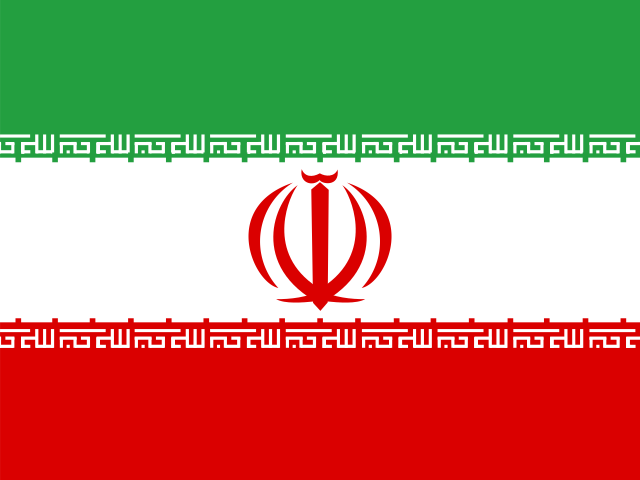
 Iran — WC 2026 Group G
Data as of: 2026-05-20





Group G Opponents (2026)
New Zealand
Minimal senior history; Iran's three Asian Cup titles and seven World Cup appearances make them clear favourites on day one.
Belgium
Limited senior history at major-tournament level; expect Iran to set up deep and Belgium to dominate possession.
Egypt
Two of the most decorated continental sides in their respective confederations; an all-or-nothing matchday three for both.
Key Players for 2026
- Mehdi Taremi · FW
Captain and Olympiacos striker — third on Iran's all-time scoring list with 56 goals and the squad's primary finisher.
- Sardar Azmoun · FW
Shabab Al-Ahli (on loan from Roma); the pace-and-movement option alongside Taremi and the squad's most-rated big-game forward.
- Alireza Jahanbakhsh · FW
Former AZ and Brighton attacker, the team's most-experienced wide creator and a regular set-piece source.
- Alireza Beiranvand · GK
Long-standing senior keeper — the defensive bedrock of Iran's pragmatic counter-attacking template.
- Saeid Ezatolahi · MF
Defensive-midfield anchor for the Ghalenoei system; the player most responsible for shutting down Belgium-Egypt midfield transitions.
Iran 🇮🇷 — Team Melli, “the national team” across the Persian-speaking world — head into a seventh FIFA World Cup as the most experienced second-tier seed in Group G. The Football Federation Islamic Republic of Iran (FFIRI), founded in 1920 and a founding AFC member in 1954, has been to every World Cup since 2014 and has never advanced beyond the group stage. The 2026 finals — under Amir Ghalenoei’s second spell in charge, with Olympiacos striker Mehdi Taremi as captain — are the federation’s best chance in years to break that ceiling, courtesy of a 48-team format and a draw that hands Iran one game they should win and two they should be able to compete in.
Tournament History at a Glance
Iran has qualified for seven FIFA World Cups — 1978 (Argentina), 1998 (France), 2006 (Germany), 2014 (Brazil), 2018 (Russia), 2022 (Qatar) and 2026 — and has never advanced beyond the group stage. The 1978 squad, anchored by Hossein Kalani, Parviz Ghelichkhani and Gholam Hossein Mazloumi, drew 1–1 with Scotland and lost to the Netherlands and Peru in Argentina. France 1998 marked the start of a sustained World Cup presence, including a 2–1 win over the United States in Lyon in a politically charged group-stage encounter.
Team Melli has won the AFC Asian Cup three times — 1968, 1972 and 1976 — making Iran, along with Saudi Arabia and Japan, one of only three nations to have lifted the trophy three or more times. The 1976 title in Tehran is Iran’s most recent continental crown. Iran also won Asian Games gold in 1974, 1990, 1998 and 2002.
The Carlos Queiroz era (2011–2019, with a brief return in 2019) brought the longest single coaching tenure in modern Team Melli history and back-to-back World Cup qualification for 2014 and 2018. Queiroz’s side took Argentina to a 0–1 finish in Brazil 2014 and held Portugal 1–1 at Russia 2018. At Qatar 2022, Iran beat Wales 2–0 before a narrow loss to the USA ended the campaign.
Current Form
Iran sealed 2026 World Cup qualification on 25 March 2025 with a 2–2 home draw against Uzbekistan in the eighth matchday of AFC third-round Group A — the result clinched a top-two finish with a match in hand. That was the highlight of a campaign Ghalenoei built on defensive structure and Taremi-Azmoun productivity up top. March 2026 friendlies against Nigeria and Costa Rica completed the senior-team tune-up window.
Iran’s recent World Cup history is the form line that matters most. At Russia 2018, Iran were seconds away from beating Portugal in their final group fixture and topping a group that also included Spain. In Qatar 2022, they beat Wales convincingly before a narrow loss to the USA ended the campaign. The pattern is competitive intensity for two of three group matches, with the third game proving the federation’s recurring ceiling. The 48-team format reframes that pattern: Iran no longer need to beat one of the big boys to advance.
The 2026 Squad: Europe-Tested Spine, Domestic Core
Captain Mehdi Taremi (Olympiacos) is the third-highest scorer in Team Melli history with 56 goals as of FourFourTwo’s March 2026 squad audit. Sardar Azmoun (Shabab Al-Ahli, on loan from Roma) is the pace-and-movement option alongside him. Alireza Jahanbakhsh — former AZ Alkmaar and Brighton attacker — is the team’s most-experienced wide creator and a regular set-piece source.
Goalkeeper Alireza Beiranvand returns as the long-standing senior No. 1; central defender Majid Hosseini and midfield anchor Saeid Ezatolahi handle the spine of the defensive block. Persepolis FC and Esteghlal FC of Tehran continue to supply the bulk of senior call-ups for domestic-league players, with Sepahan SC of Isfahan and Tractor SC of Tabriz producing regular internationals.
Ali Daei’s 108 international goals — the long-standing world record before Cristiano Ronaldo’s 2023 overtake — and Javad Nekounam’s 149 caps remain the federation’s all-time benchmarks the current generation chases.
Qualifying Path
Iran finished top-two in AFC third-round Group A and confirmed direct qualification on 25 March 2025 with the 2–2 home draw against Uzbekistan. FIFA president Gianni Infantino confirmed in early 2026 that Iran will play all 2026 World Cup matches in the United States despite ongoing political tensions, with venue allocations following the standard tournament-operations process.
Group G Fixtures
| Date (AEST) | Match | Venue |
|---|---|---|
| 16 Jun 2026 | Iran vs New Zealand | Lincoln Financial Field, Philadelphia |
| 21 Jun 2026 | Belgium vs Iran | MetLife Stadium, New York/New Jersey |
| 26 Jun 2026 | Egypt vs Iran | Lincoln Financial Field, Philadelphia |
Two of Iran’s three group fixtures sit at Lincoln Financial Field, Philadelphia — a relatively short turnaround between the opener and the matchday-three Egypt fixture that should suit a squad accustomed to AFC qualifying logistics.
Aussie Viewing
All three Group G fixtures are scheduled in Eastern Time Zone venues. Exact AEST kickoff times will be confirmed closer to kickoff — see the full WC 2026 schedule in AEST. For Australian football audiences, the matchday-three Egypt vs Iran fixture is the one most likely to deliver a decisive late-tournament result.
Australia Connection
Iran’s most-cited single fixture against Australia remains the 1997 AFC–OFC inter-confederation play-off for the 1998 FIFA World Cup. The first leg ended 1–1 at the Azadi Stadium in Tehran; the second leg on 29 November 1997 at the Melbourne Cricket Ground was drawn 2–2 in front of 85,022, with Iran qualifying on away goals through Karim Bagheri’s 75th-minute strike and Khodadad Azizi’s 79th-minute equaliser. The match is one of the most consequential in either federation’s history and remains the single most-discussed Iran-Australia football meeting on either side of the rivalry.
Since Australia’s 2006 AFC switch, the two AFC sides have not been drawn into the same World Cup qualifying group in any recent cycle.
Stadium and Federation
The Azadi Stadium (“Freedom Stadium”) in Tehran has been Iran’s principal home venue since opening as Aryamehr Stadium for the 1974 Asian Games. With a current capacity of 78,116, it is one of the largest active football stadiums in Asia and has hosted Iran’s 1976 Asian Cup final, multiple AFC Champions League finals, and the country’s high-profile World Cup qualifying fixtures. Selected friendlies and AFC Champions League fixtures rotate through other venues including Yadegar-e Emam Stadium in Tabriz and Pars Stadium in Shiraz.
The Group G Opponents
New Zealand (matchday 1, Lincoln Financial Field, 16 June). Iran’s three Asian Cup titles and seven World Cup appearances make them clear favourites. The opener is the must-win game in Iran’s group — three points here transforms the maths for the Belgium and Egypt fixtures.
Belgium (matchday 2, MetLife Stadium, 21 June). Limited senior history at major-tournament level. Iran will set up deep, defend the box and counter through Azmoun’s running. The fixture Belgium are most likely to dominate possession in — and the one Iran are most likely to need to nick a 1-0 against the run of play to keep advancement chances alive.
Egypt (matchday 3, Lincoln Financial Field, 26 June). Two of the most decorated continental sides in their respective confederations. If both teams have a point or more going into the final matchday, this is the de-facto round-of-32 play-in. Salah versus Beiranvand is the marquee duel.
Key Players to Watch
Watch Taremi in the box — the captain is Iran’s primary finisher and the player Belgium and Egypt’s centre-backs will need to track on set pieces. Watch Azmoun for the through-ball: his off-ball movement is the team’s most-likely Belgium-buster. Watch Jahanbakhsh on wide-area free kicks — Iran’s most reliable secondary goal source. Watch Beiranvand: he is the difference between Iran competing for 90 minutes and being put away early by quality. And watch Ezatolahi between the boxes — the most thankless and most important job in the squad.
What Iran Need to Advance
Realistically: 4 points, the same target as most second-tier sides in the new 48-team maths. A win against New Zealand on day one and a draw with either Belgium or Egypt gets Iran into the round of 32. A repeat of the 2022 group-game intensity — three matches of organised counter-attacking pressure — is the path Ghalenoei has built the team around.
The bigger picture: this is Iran’s seventh World Cup and the first in which a group-stage exit can still mean tournament progression. The federation’s stated objective is finally crossing that line.
Rivalries and Coaching Tree
Iran’s principal regional rivalries are Iraq (the political backdrop of the 1980–1988 Iran–Iraq War; fixtures regularly contested in qualifiers and WAFF tournaments), Saudi Arabia (a top-of-table AFC fixture across qualifying and Asian Cup competitions) and South Korea (Iran’s most-played AFC fixture). The federation’s coaching pipeline has historically drawn on European technical staff — the Portuguese Carlos Queiroz (longest-serving foreign coach), Croatian Branko Ivanković, Belgian Marc Wilmots and Croatian Dragan Skočić — alongside Iranian-born figures including Afshin Ghotbi and the current head coach, Amir Ghalenoei.
All-Time Honours and Records
- AFC Asian Cup: champions 1968, 1972, 1976 (three consecutive titles).
- Asian Games gold: 1974, 1990, 1998, 2002.
- WAFF Championship: multiple titles (2000, 2004, 2007, 2008).
- FIFA World Cup appearances: 7 (1978, 1998, 2006, 2014, 2018, 2022, 2026 — qualified).
- Most caps: Javad Nekounam (149).
- All-time top scorer: Ali Daei (108) — the world record for men’s full internationals until Cristiano Ronaldo overtook him in 2023.
- Current captain Mehdi Taremi is third on the all-time scoring list with 56 goals (FFT, March 2026).
Iconic Players Past and Present
- Pre-revolution era: Hossein Kalani, Parviz Ghelichkhani, Gholam Hossein Mazloumi (1968–1976 Asian Cup three-peat generation).
- 1990s–2000s: Ali Daei (108 goals — world record until 2023), Khodadad Azizi (1997 MCG equaliser), Karim Bagheri, Mehdi Mahdavikia, Javad Nekounam (149 caps).
- Modern era: Mehdi Taremi (Olympiacos — current captain, third on all-time scoring list), Sardar Azmoun (Shabab Al-Ahli, on loan from Roma), Alireza Jahanbakhsh (former AZ and Brighton), Alireza Beiranvand, Saeid Ezatolahi.
Supporters Culture and Wider Football
Home support concentrates on the Azadi Stadium in Tehran and on a Persian-speaking diaspora that turns out in large numbers at away fixtures — including the 1997 MCG play-off, the 1998 World Cup matches in France, and 2006 Germany. Iranian women’s stadium-access has been a recurring civil-society and FIFA-engagement issue across the past decade; FFIRI began allowing limited women’s access to selected men’s matches at the Azadi from 2019 onwards under FIFA pressure.
Persepolis FC and Esteghlal FC of Tehran continue to supply the bulk of senior call-ups for domestic-league players, with Sepahan SC of Isfahan and Tractor SC of Tabriz also producing regular internationals through the past decade. The federation’s revenue and operational structure have been periodically constrained by international sanctions affecting kit-supply contracts, training-camp logistics and friendly-match scheduling.
Recent Tournament Record
- 2014 FIFA World Cup (Brazil): Group stage exit — held Argentina to 0–0 for 90 minutes before a 91st-minute Lionel Messi winner; lost to Bosnia and drew with Nigeria 0–0.
- 2018 FIFA World Cup (Russia): Group stage exit — beat Morocco 1–0, lost 0–1 to Spain in a tight match, drew 1–1 with Portugal in a fixture where Iran were seconds away from a knockout-stage berth.
- 2019 AFC Asian Cup (UAE): Semi-final exit — lost 0–3 to Japan.
- 2022 FIFA World Cup (Qatar): Group stage exit — beat Wales 2–0 (Rouzbeh Cheshmi 98’, Ramin Rezaeian 90+11’), lost 0–1 to USA, lost 2–6 to England.
- 2023 AFC Asian Cup (played 2024 in Qatar): Semi-final exit — lost 2–3 to host Qatar.
- 2026 FIFA World Cup qualifying: Top-two finish in AFC third round Group A — qualification sealed on 25 March 2025 with a 2–2 home draw against Uzbekistan.
Looking Ahead
Iran enters the 2026 finals with the same medium-term challenge it has faced since 1998: progression beyond the group stage. The Group G draw against Belgium, Egypt and New Zealand offers a competitive but navigable path. The federation’s near-term priorities centre on Ghalenoei’s continuity through the United States / Canada / Mexico tournament, the operational logistics of playing every fixture in the United States under sanctions, and the next AFC Asian Cup cycle plus the 2030 World Cup qualifying campaign that opens immediately after the 2026 finals.
Public Image and Off-Pitch Context
The Iran national team has operated under varying levels of US, EU and UN-related sanctions affecting kit supply, friendly-match scheduling and travel. The 2018 friendly against Greece was cancelled in connection with sanctions impact on training-camp logistics. The 2022 World Cup in Qatar saw Iran’s squad publicly aligned with the “Woman, Life, Freedom” protest movement during their first group match. Stadium-access for women has been a long-running issue on which FIFA has periodically intervened, with FFIRI beginning to allow limited women’s access to selected men’s matches at the Azadi from 2019 onwards under FIFA pressure. FIFA president Gianni Infantino confirmed in early 2026 that Iran will play all 2026 World Cup matches in the United States despite ongoing political tensions and US sanctions, with venue allocations to follow the standard tournament-operations process.
Coaches and Managers — Modern Era
- 1960s–1970s: Mahmoud Bayati (Asian Cup era of the late 1960s and 1970s — three consecutive AFC titles).
- 1978 World Cup: Heshmat Mohajerani.
- 1998 qualification: Mohammad Mayeli Kohan — the head coach for the MCG play-off victory.
- 2000s: Branko Ivanković (Croatian, 2002–2006), Afshin Ghotbi (Iran-born, US-raised).
- 2010s: Carlos Queiroz (Portuguese, 2011–2019, with subsequent brief returns — Iran’s longest-serving foreign coach), Marc Wilmots (Belgian), Dragan Skočić (Croatian).
- Current: Amir Ghalenoei — Iranian-born coach with extensive Persian Gulf Pro League experience, now in his second senior-team spell, contracted through the 2026 finals.
More Iran + WC 2026 Reading
All-time history: See Iran's full World Cup history (all tournaments) →
 Best Betting Sites
 Best Online Casinos
 Blackjack Sites
 Online Pokies
 Fast Payout Casinos
 PayID Casinos
 New Casinos 2026