 Qatar at the World Cup — Full History
Key Facts
- The Qatar Football Association (QFA) was founded in 1960 and joined FIFA in 1963; the national team is nicknamed Al-Annabi (“The Maroons”) in reference to the country’s traditional kit colour.
- Qatar has appeared at two FIFA World Cups: 2022 as host nation (group-stage exit, three group losses) and 2026 via standard AFC qualifying — confirmed on 14 October 2025 with a 2–1 win over the United Arab Emirates in Doha.
- The 2022 FIFA World Cup, held in Qatar from 20 November to 18 December 2022, made Qatar the first Arab and Middle Eastern country to host a senior FIFA World Cup; the host team finished bottom of Group A with three losses (0–2 vs Ecuador, 1–3 vs Senegal, 0–2 vs Netherlands), becoming the first World Cup hosts to lose all three group games.
- Qatar won the AFC Asian Cup in 2019 (in the United Arab Emirates) and 2023 (held in Qatar in January 2024), becoming the first team since Japan to defend the title and the AFC’s first back-to-back champions of the modern era; the 2019 campaign produced a tournament-record one goal conceded.
- Almoez Ali, the Khartoum-born forward who was part of the 2019 and 2023 Asian Cup-winning squads, is Qatar’s all-time top scorer with 60+ international goals as of QNA’s October 2025 audit; he is also the all-time top scorer in a single AFC Asian Cup tournament with 9 goals at the 2019 edition.
- Hassan Al-Haydos, the long-serving captain and Al-Sadd midfielder, is Qatar’s all-time most-capped player with 184 international appearances per FFT’s 2026 squad audit.
- Spanish head coach Julen Lopetegui — the former Real Madrid, Spain national team and West Ham United manager — was appointed in mid-2025 (replacing Tintín Márquez, who had succeeded the long-serving Spanish coach Carlos Queiroz), and led Qatar through the 2026 AFC qualifying fourth-round campaign and the 2–1 win over the UAE that confirmed qualification.
- At the 5 December 2025 FIFA World Cup draw in Washington, D.C., Qatar’s group-stage placement for the 2026 finals was confirmed; the team enters the tournament under Lopetegui after the difficult 2022 host campaign.
- The Jassim bin Hamad Stadium in Doha (capacity 15,000, opened 1974) is Qatar’s principal current home venue for senior internationals; the QFA also uses several of the eight 2022 World Cup venues including Khalifa International Stadium, Education City Stadium and Stadium 974 for selected fixtures.
- Qatar’s 2022 World Cup hosting was the subject of substantial international scrutiny over migrant-worker conditions, freedom of expression and LGBTQ+ rights, with reporting led by Amnesty International, Human Rights Watch and major international media outlets including the Guardian; the Qatari authorities and the Supreme Committee for Delivery and Legacy responded with documented labour-reform legislation including the 2020 dismantling of the kafala sponsorship system and the 2021 minimum-wage law.
- Qatar’s principal regional rivalry is with the United Arab Emirates and Saudi Arabia in Gulf Cup and AFC qualifying competition; the 2017–2021 GCC blockade affected fixture scheduling against neighbours during that period.
- The QFA is led by Sheikh Hamad bin Khalifa bin Ahmed Al Thani; the federation is the lead Asian football organiser of the modern era through its 2022 World Cup hosting and 2023 Asian Cup hosting cycle.
Qatar World Cup Vital Statistics
| Metric | Value |
|---|---|
| Federation founded | 1960 (QFA, Doha) |
| FIFA / AFC membership | FIFA 1963 / AFC 1972 |
| FIFA World Cup appearances | 2 — 2022 (host), 2026 |
| Best FIFA World Cup finish | Group stage (2022 hosts: 3 losses; 2026: TBD) |
| AFC Asian Cup titles | 2 — 2019, 2023 (back-to-back) |
| Most caps (all-time) | Hassan Al-Haydos — 184 |
| Top scorer (all-time) | Almoez Ali — 60+ |
| Current head coach | Julen Lopetegui (Spanish; appointed mid-2025) |
| 2026 WC qualification | Confirmed 14 Oct 2025 vs UAE (2-1) — AFC fourth-round playoff |
| 2026 WC finals group | Allocated at 5 Dec 2025 draw — see official FIFA group |
| Home stadium | Jassim bin Hamad Stadium, Doha (capacity 15,000) |
| 2022 FIFA World Cup hosting | First Arab / Middle Eastern host; 20 Nov – 18 Dec 2022 |
Qatar at the World Cup — History And Profile
The Qatar national football team — known across the Arabic-speaking world as Al-Annabi, “The Maroons” — is the senior men’s representative side of the Qatar Football Association (QFA), a body founded in 1960 and admitted to FIFA in 1963. Qatar has built one of the most consequential football administrative profiles of the modern era despite a population that places it among the smallest FIFA member states, hosting the 2022 FIFA World Cup as the first Arab and Middle Eastern country to do so, hosting the 2023 AFC Asian Cup, and back-to-back winning the AFC Asian Cup in 2019 and 2023.
The team’s modern competitive arc began in earnest in the early 2000s. Qatar reached its first AFC Asian Cup quarter-final in 2000 and first hosted the AFC Asian Cup in 1988 and again in 2011. The country’s broader football-investment programme — anchored by the Aspire Academy in Doha (opened 2004) and the QFA’s long-running youth-development partnership with the Spanish football technical school — produced an entirely homegrown senior squad through the 2010s. The breakthrough came at the 2019 AFC Asian Cup in the United Arab Emirates, where Qatar — coached by the Spanish technician Félix Sánchez Bas, who had progressed through the Aspire Academy youth pathways — won the tournament without losing a match. Qatar conceded just one goal across seven games and beat Japan 3–1 in the final at Mohammed Bin Zayed Stadium in Abu Dhabi on 1 February 2019. Forward Almoez Ali finished the tournament as top scorer with nine goals, an AFC Asian Cup tournament record.
The 2022 FIFA World Cup, played in Qatar from 20 November to 18 December 2022, was the host country’s senior-tournament debut. Coached by Sánchez Bas, Qatar finished bottom of Group A with three losses — 0–2 to Ecuador in the opening match at Al Bayt Stadium in Al Khor, 1–3 to Senegal at Al Thumama Stadium in Doha and 0–2 to the Netherlands at Al Bayt — becoming the first World Cup hosts to lose all three group fixtures. The tournament was preceded by years of international media and human-rights scrutiny over migrant-worker conditions during stadium construction; the QFA, the Supreme Committee for Delivery and Legacy and the Qatari government documented labour-reform legislation including the 2020 dismantling of the kafala sponsorship system and the 2021 minimum-wage law in response to international reporting led by the Guardian, Amnesty International and Human Rights Watch. The Qatari authorities and FIFA presented the tournament as a successful operational delivery; the human-rights debate continued into the 2023 cycle.
The 2023 AFC Asian Cup — held in Qatar in January 2024 after the original Chinese host’s withdrawal — produced the country’s second consecutive continental title under coach Tintín Márquez (who had succeeded Sánchez Bas during the 2022 World Cup cycle). Qatar progressed from a group containing China, Tajikistan and Lebanon, eliminated Palestine, Uzbekistan and Iran in the knockout rounds, and beat Jordan 3–1 in the final at Lusail Iconic Stadium on 10 February 2024, with Akram Afif scoring a hat-trick of penalties. The result made Qatar the AFC’s first back-to-back Asian Cup champions of the modern era and one of only three nations to have defended the title.
The 2026 World Cup qualifying campaign saw Qatar finish first in second-round Group A with 16 points and an unbeaten run, then finish fourth in third-round Group A with 13 points from 10 matches (four wins, one draw and five losses). The QFA replaced Tintín Márquez with Spanish coach Luis Garcia in early 2025 and then with Julen Lopetegui — the former Real Madrid, Spain national team and West Ham United head coach — in mid-2025 ahead of the fourth-round play-off campaign. Lopetegui’s side drew 0–0 with Oman in the play-off semi-final and beat the United Arab Emirates 2–1 in Doha on 14 October 2025 to confirm 2026 World Cup qualification — the team’s first via standard AFC qualifying after the 2022 host-nation appearance.
The senior 2026 squad is led by captain Hassan Al-Haydos (Al-Sadd; 184 caps per FFT) alongside Almoez Ali (Al-Duhail; 60+ goals per QNA), playmaker Akram Afif (Al-Sadd; AFC Player of the Year multiple times), goalkeeper Saad Al-Sheeb and central defenders Bassam Al-Rawi and Boualem Khoukhi. The squad is overwhelmingly drawn from the Qatar Stars League, with Al-Sadd, Al-Duhail, Al-Rayyan and Al-Gharafa the principal pathway clubs. The Jassim bin Hamad Stadium in Doha (capacity 15,000) is Qatar’s principal current home venue for senior fixtures, with the eight 2022 World Cup venues including Lusail Iconic Stadium, Al Bayt and Education City available for higher-attendance internationals.
Detailed Profile
Crest, Colours & Kit Evolution
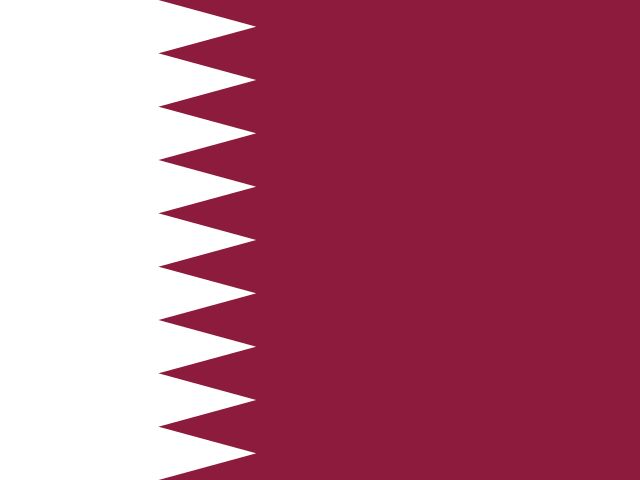
Qatar’s home kit is maroon shirts and white shorts, reversing for the away kit; the maroon colour is shared with the Qatari flag. The QFA crest carries a stylised national-flag motif and the federation monogram. Recent kit suppliers include Adidas (long-running) and currently Nike under the 2024–2026 cycle.
Stadium History
The Jassim bin Hamad Stadium in Doha (capacity 15,000, opened 1974) is Qatar’s principal current home venue for senior internationals. The Khalifa International Stadium (40,000 capacity, the country’s oldest major stadium, originally opened 1976 and refurbished for the 2022 World Cup), Education City Stadium (44,667), Lusail Iconic Stadium (88,966 — host of the 2022 World Cup final and 2023 Asian Cup final), Al Bayt Stadium, Al Janoub Stadium, Ahmad bin Ali Stadium, Stadium 974 (deconstructable, since dismantled) and Al Thumama Stadium are also available for selected senior fixtures.
Coaches & Managers Legacy
Notable head coaches: Carlos Alberto Parreira (Brazilian, brief late-1980s spell), Bruno Metsu (French, 2008–2010), Sebastião Lazaroni (Brazilian), Paulo Autuori (Brazilian), Carlos Queiroz (Portuguese, mid-2010s spell), Félix Sánchez Bas (Spanish, 2017–2022 — 2019 Asian Cup-winning coach and 2022 World Cup host coach), Tintín Márquez (Spanish, 2023 Asian Cup-winning coach), Luis Garcia (Spanish, brief 2025 spell), Julen Lopetegui (Spanish, current head coach since mid-2025).
Iconic Players
1990s–2000s: Mubarak Mustafa, Adel Khamis, Khalfan Ibrahim. 2010s: Sebastián Soria (Uruguayan-Qatari, naturalised), Yusef Ahmed. 2019 Asian Cup-winning generation: Hassan Al-Haydos, Almoez Ali, Akram Afif, Bassam Al-Rawi, Boualem Khoukhi, Saad Al-Sheeb. 2023 Asian Cup-winning generation: largely the same core, with additions including Akram Afif (final hat-trick) and Mohammed Muntari.
Trophies & Honours
- AFC Asian Cup: champions 2019, 2023 (back-to-back).
- Arabian Gulf Cup: 3 titles — 1992, 2004, 2014.
- WAFF Championship: no senior titles.
- FIFA Arab Cup: champions 2014; runners-up 2021.
- FIFA World Cup: group stage 2022 (host); group stage 2026 (qualified, finals position TBD).
Peak Eras
- 2019 Asian Cup-winning generation under Félix Sánchez Bas.
- 2022 FIFA World Cup hosting cycle — operationally successful tournament delivery despite host-nation on-pitch result.
- 2023 Asian Cup-winning generation under Tintín Márquez — back-to-back AFC titles.
- 2026 World Cup qualification under Julen Lopetegui — first via standard AFC qualifying.
Rivalries
- United Arab Emirates: a Gulf Cup and AFC qualifying fixture, intensified by the 2017–2021 GCC blockade and the October 2025 World Cup-qualifying play-off.
- Saudi Arabia: a top-of-table Gulf rivalry with multiple Asian Cup and Gulf Cup meetings; the 2017–2021 blockade affected fixture scheduling.
- Iraq: a regional fixture contested through WAFF, Gulf Cup and AFC qualifying cycles.
Supporters Culture
Qatari national-team support concentrates on the Khalifa International Stadium, the Lusail Iconic Stadium and the Jassim bin Hamad Stadium. The 2022 World Cup hosting and 2023 Asian Cup hosting produced the largest single-stadium home attendances in QFA history. The federation operates an active fan-engagement programme through Al-Annabi-branded channels.
Public Image — Bad PR / Controversies
The 2022 FIFA World Cup hosting was the subject of substantial international scrutiny over migrant-worker conditions during stadium construction (covered in detail by the Guardian’s “Qatar 2022” investigation series, Amnesty International and Human Rights Watch reports), freedom of expression for international media at the tournament, and the application of laws affecting LGBTQ+ visitors and residents. The Qatari authorities and the Supreme Committee for Delivery and Legacy documented labour-reform legislation including the 2020 dismantling of the kafala sponsorship system and the 2021 minimum-wage law in response. The 2022 host-team result (three group-stage losses) generated extensive coverage. The 2017–2021 GCC blockade by Saudi Arabia, the UAE, Bahrain and Egypt affected QFA fixture scheduling. These items are presented neutrally with FIFA, Amnesty, HRW, Guardian and federation citations rather than as editorial commentary.
Charity & Community
The QFA runs a youth-development programme through the Aspire Academy (opened 2004 in Doha) and supports a national grass-roots programme through the Qatar Stars League clubs. Qatar’s national-team players have been featured in regional refugee-support and World Cup legacy programmes including the Generation Amazing Foundation, the Supreme Committee’s social-impact arm.
Australia Connection
Qatar and Australia have been documented within the AFC competitive programme since Australia’s 2006 confederation transfer from the OFC. The two sides have met at the 2011 AFC Asian Cup quarter-finals (Australia won 1–0 in Doha), in 2015 AFC Asian Cup group stage, and across multiple FIFA World Cup qualifying cycles. The 2026 qualifying campaign placed Australia and Qatar in different third-round groups (Australia in Group C; Qatar in Group A); Qatar’s qualification followed via the fourth-round play-off route while Australia qualified directly. The two AFC sides have not been drawn into the same 2026 World Cup finals group at the 5 December 2025 draw.
Connections to Other Federations / Celebrity Figures
The QFA’s coaching pipeline has historically drawn on Brazilian, French and (most extensively) Spanish technical staff, with a continuous Spanish coaching presence since the late 2010s through Sánchez Bas, Márquez, Garcia and Lopetegui. The Aspire Academy (Doha) operates technical-cooperation programmes with Spanish, Belgian and Dutch federations, and Qatar’s broader sport-investment portfolio includes Paris Saint-Germain (Qatar Sports Investments ownership), the 2022 FIFA World Cup, the 2023 AFC Asian Cup and the upcoming 2030 Asian Games hosting.
Potential Future Trajectory
With World Cup qualification confirmed and a Lopetegui-led senior squad heading into the 2026 finals, Qatar’s medium-term outlook centres on (a) the immediate 2026 finals performance under the most-decorated head coach in QFA history, (b) the next AFC Asian Cup cycle (Saudi Arabia 2027) as defending champions, and (c) continued senior-team integration of Aspire Academy youth-pathway products. The 2030 Asian Games hosting in Doha provides a parallel sport-administrative platform.
More World Cup 2026 Reading
WC 2026 context: See Qatar's WC 2026 group-stage form, squad and opponents →
 Best Betting Sites
 Best Online Casinos
 Blackjack Sites
 Online Pokies
 Fast Payout Casinos
 PayID Casinos
 New Casinos 2026