 Argentina at the World Cup — Full History
Key Facts
- The Argentine Football Association (AFA), the governing body of the national team, was founded on 21 February 1893 in Buenos Aires by Alejandro Watson Hutton, making it the oldest football association outside the British Isles and the oldest in South America.
- Argentina has won the FIFA World Cup three times: 1978 (3–1 vs Netherlands in Buenos Aires), 1986 (3–2 vs West Germany in Mexico City under Diego Maradona) and 2022 (3–3 a.e.t., 4–2 on penalties vs France in Lusail, Qatar) under Lionel Messi and head coach Lionel Scaloni.
- Argentina has finished as World Cup runners-up three times — 1930 (2–4 vs Uruguay, the inaugural final), 1990 (0–1 vs West Germany) and 2014 (0–1 a.e.t. vs Germany).
- Argentina has won the Copa América 16 times, equal-most with Uruguay; the most recent triumph was the 2024 final 1–0 vs Colombia in Miami.
- Lionel Messi holds the team records for caps (198) and goals (116) and captained the side that won the 2021 Copa América (its first senior title since 1993), the 2022 World Cup and the 2024 Copa América.
- Argentina topped the CONMEBOL 2026 World Cup qualifiers with 38 points (12W-2D-4L, GD +21) across the 18-match round-robin and qualified for the 2026 finals as group winners.
- Head coach Lionel Scaloni — appointed on an interim basis in August 2018 and confirmed long-term thereafter — signed a contract extension on 27 February 2023 keeping him in post through the 2026 FIFA World Cup.
- Argentina’s largest test win is 12–0 vs Ecuador (22 January 1942); the heaviest defeat in the modern era is 1–6 vs Spain (27 March 2018) and 1–6 vs Bolivia and Czechoslovakia in earlier eras.
- Argentina contests the long-running Superclásico de las Américas with Brazil (CONMEBOL’s two flagship national teams) — the most-played international fixture in South America with more than 110 official meetings.
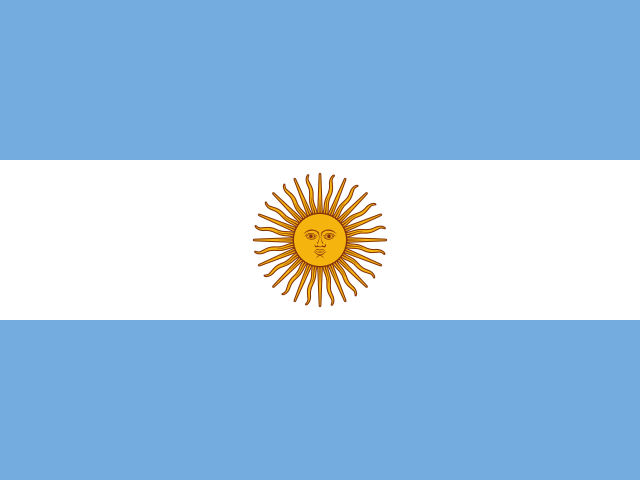
- The current strip — sky-blue and white vertical stripes — has been worn since 1908; Adidas has been kit supplier since 2002.
- Diego Maradona (1976–1994) and Lionel Messi (2005–) are the team’s two most-decorated long-serving players; Maradona scored both the “Hand of God” and “Goal of the Century” in the 1986 quarter-final 2–1 vs England.
- Argentina is ranked 3rd in the FIFA Men’s Ranking as of 2026 (most recent verified period).
Argentina World Cup Vital Statistics
| Metric | Value |
|---|---|
| AFA founded | 21 February 1893 |
| First international | 16 May 1901 vs Uruguay (3–2, Montevideo) |
| FIFA World Cups won | 3 (1978, 1986, 2022) |
| FIFA World Cup finals appearances | 6 (1930, 1978, 1986, 1990, 2014, 2022) |
| Copa América titles | 16 (most recent 2024) |
| 2026 World Cup qualifying finish | 1st in CONMEBOL, 38 points |
| Most caps | Lionel Messi (198) |
| Top scorer | Lionel Messi (116) |
| Largest win | 12–0 vs Ecuador |
| Heaviest defeat (modern) | 1–6 vs Spain |
| Current head coach | Lionel Scaloni (since 2018; extended through 2026 WC) |
| Captain | Lionel Messi |
| FIFA Men’s Ranking | 3rd |
| Confederation | CONMEBOL |
| Kit supplier | Adidas (since 2002) |
Argentina at the World Cup — History And Profile
The Argentina national football team is one of the four most-decorated nations in the history of the sport, alongside Brazil, Germany and Italy. The team is administered by the Argentine Football Association (AFA), founded on 21 February 1893 in Buenos Aires by the Scottish-born educator Alejandro Watson Hutton. The AFA is the oldest football association outside the British Isles and the founding force behind CONMEBOL, the South American confederation, which Argentina helped establish in 1916. Argentina played its first international on 16 May 1901, defeating Uruguay 3–2 in Montevideo, beginning what became football’s most-played international rivalry.
Argentina’s three FIFA World Cup titles came in 1978, 1986 and 2022. The 1978 triumph at home — under coach César Luis Menotti, captained by Daniel Passarella, and won 3–1 against the Netherlands at the Estadio Monumental in Buenos Aires — arrived during the country’s military dictatorship and remains historically scrutinised for its political backdrop. The 1986 title in Mexico is closely associated with Diego Maradona, whose performances in the quarter-final against England — the “Hand of God” handball goal and the “Goal of the Century” run — became the most-replayed sequence in World Cup history; Maradona then captained Argentina to a 3–2 final win over West Germany at the Estadio Azteca. Argentina returned to the final in 1990 (lost 0–1 to West Germany) and in 2014 (lost 0–1 a.e.t. to Germany), with Lionel Messi captaining the 2014 side.
The Lionel Scaloni era beginning in 2018 produced Argentina’s most consistent run of trophies. Scaloni — a former Argentina international with no senior managerial experience prior to his appointment — guided the team to the 2021 Copa América (1–0 vs Brazil at the Maracanã), the 2022 Finalissima (3–0 vs Italy at Wembley), the 2022 FIFA World Cup (3–3 a.e.t., 4–2 on penalties vs France in Lusail, Qatar) and the 2024 Copa América (1–0 a.e.t. vs Colombia in Miami). Lionel Messi, by then captain, scored seven goals across the 2022 World Cup, won the Golden Ball — becoming the first player to win that award twice — and led the team across all four titles. Argentina’s 16 Copa América crowns are joint-most in the competition’s history, level with Uruguay.
Argentina topped the CONMEBOL 18-match round-robin qualifying for the 2026 FIFA World Cup with 38 points (12W-2D-4L) and a goal difference of +21, well clear of second-placed Ecuador on 29. Scaloni’s contract was extended on 27 February 2023 to run through the 2026 finals, and the spine of the squad is expected to feature Messi, Lautaro Martínez, Julián Álvarez, Alexis Mac Allister, Enzo Fernández, Rodrigo De Paul, Cristian Romero, Nicolás Otamendi and goalkeeper Emiliano “Dibu” Martínez. The 2026 finals — co-hosted by Canada, Mexico and the United States — will be Messi’s record-tying sixth World Cup if he is selected.
Argentina’s principal rivalry is with Brazil — the Superclásico de las Américas — contested in more than 110 senior matches since 1914 and including the 2014, 2021 and 2024 Copa América/World Cup-era finals. Other significant fixtures are the long-running test against Uruguay (the original international rival from 1901), the World Cup encounters with England (notably the 1986 quarter-final and the politically charged 2002 group-stage match in Sapporo) and matches against the Netherlands, with whom Argentina has met five times at the World Cup including the 1978 and 2014 finals.
The team’s home is the Estadio Monumental in Buenos Aires (capacity rebuilt to circa 84,567 in the 2024 expansion), although qualifiers and friendlies rotate to other venues across Argentina. Adidas has supplied the kit since 2002, replacing Reebok; the sky-blue and white vertical-striped jersey has been the standard home kit since 1908. The AFA’s youth-development pipeline has produced multiple World Cup–winning generations and continues to feed Argentina’s professional Primera División and the global European leagues, where most senior squad members play their club football.
Outside the trophy cabinet, Argentina’s record includes a 12–0 win over Ecuador in 1942 (largest international win), heavy 1–6 defeats to Spain (2018) and Bolivia (in qualifying eras) and the highest-attended Maradona testimonial fixture (2001). The team is ranked 3rd in the FIFA Men’s Ranking as of 2026 and enters the 2026 World Cup as defending champion.
The Argentine Football Association’s official senior-team channel (afa.com.ar) confirms the squad’s current FIFA ranking position, lists Lionel Scaloni as head coach and previews Argentina’s pre-tournament friendly programme — including matches against Honduras and Iceland — staged in the build-up to the 2026 finals. The federation’s bulletins reiterate that Argentina enters the tournament as reigning World Cup, Finalissima and Copa América holder, an unprecedented concurrent triple for any CONMEBOL nation.
Detailed Profile
Crest, Colours & Kit Evolution
The current sky-blue and white vertical-striped home jersey has been worn since 1908; the AFA crest with the laurel wreath replaced earlier monograms in the 1970s. After the 2022 World Cup win, the AFA added three stars above the crest to denote the 1978, 1986 and 2022 titles. Adidas has been kit supplier since 2002, succeeding Reebok and a longer line of providers including Le Coq Sportif. The away kit historically alternates between dark navy and black; the 2024 Copa América away kit was dark purple.
Stadium & Venue History
Argentina does not maintain a single fixed national-team home ground. The Estadio Monumental — formally Estadio Mâs Monumental Antonio Vespucio Liberti — in Buenos Aires, owned by Club Atlético River Plate, is the most-used venue and hosted the 1978 World Cup final. Other major venues include the Estadio José María Minella (Mar del Plata), Estadio Madre de Ciudades (Santiago del Estero) and Estadio Único Diego Armando Maradona (La Plata). Qualifiers, friendlies and Copa América hosting have rotated across these and earlier grounds (Estadio Centenario in Córdoba, the demolished Gasómetro in Buenos Aires).
Coaches & Managers Legacy
- César Luis Menotti (1974–1983): 1978 World Cup champion; the long-haired, modernist “El Flaco” who reshaped the playing identity.
- Carlos Bilardo (1983–1990): 1986 World Cup champion and 1990 runner-up; pragmatic, defensive scheme.
- Daniel Passarella (1994–1998), Marcelo Bielsa (1998–2004), José Pekerman (2004–2006), Alfio Basile (2006–2008), Diego Maradona (2008–2010), Sergio Batista (2010–2011), Alejandro Sabella (2011–2014, 2014 World Cup runner-up), Gerardo Martino (2014–2016), Edgardo Bauza (2016–2017), Jorge Sampaoli (2017–2018), Lionel Scaloni (2018–present).
- Scaloni’s record under contract: 2021 Copa América, 2022 Finalissima, 2022 World Cup, 2024 Copa América.
Iconic Players (long-serving / influential)
- Pre-1970: Guillermo Stábile (top scorer 1930 World Cup), Antonio Sastre, Alfredo Di Stéfano (also represented Spain), Adolfo Pedernera.
- 1970s–1980s: Daniel Passarella, Mario Kempes (1978 Golden Boot), Diego Maradona (1986 captain and golden ball), Jorge Burruchaga.
- 1990s–2000s: Gabriel Batistuta (top scorer until Messi surpassed him), Diego Simeone, Juan Sebastián Verón, Hernán Crespo, Pablo Aimar, Javier Zanetti, Roberto Ayala.
- 2010s–present: Lionel Messi (198 caps, 116 goals, captain), Sergio Agüero, Javier Mascherano, Ángel Di María, Lautaro Martínez, Julián Álvarez, Emiliano Martínez, Alexis Mac Allister, Enzo Fernández, Cristian Romero, Rodrigo De Paul.
Trophies & Honours
- FIFA World Cup: champions 1978, 1986, 2022; runners-up 1930, 1990, 2014.
- Copa América: 16 titles (1921, 1925, 1927, 1929, 1937, 1941, 1945, 1946, 1947, 1955, 1957, 1959, 1991, 1993, 2021, 2024).
- Confederations Cup: runners-up 1992, 1995, 2005.
- FIFA Finalissima (CONMEBOL–UEFA Cup of Champions): 2022.
- Olympic Football Tournament (men’s): gold 2004, 2008.
- Pan American Games: multiple titles.
Peak Eras
- 1977–1986: Menotti / Bilardo era — two World Cups in eight years.
- 1990–1991: Bilardo / Basile transition — World Cup runner-up plus first Copa América of the post-Maradona era.
- 2021–2024: Scaloni–Messi era — Copa América, Finalissima, World Cup, Copa América again across four years.
Rivalries
- Brazil (Superclásico de las Américas): the most-played international rivalry in South America, contested over 110+ senior fixtures since 1914.
- Uruguay: Argentina’s first opponent (1901) and frequent Copa América final adversary.
- Germany / West Germany: three World Cup finals (1986, 1990, 2014), the only nation to face Argentina in three deciders.
- England: politically charged from the 1966 quarter-final, the 1982 Falklands/Malvinas conflict, and the 1986 quarter-final featuring the Maradona double.
- Netherlands: five World Cup meetings including the 1978 and 2014 finals and the 2022 quarter-final (penalties).
Public Image — Bad PR / Controversies
- 1978 World Cup hosting under the military junta is consistently flagged in historical retrospectives; allegations of match-fixing in the 6–0 win over Peru have never been formally proven but remain a contested chapter.
- Diego Maradona’s 1994 World Cup ephedrine positive saw him expelled mid-tournament.
- 2022 World Cup quarter-final against the Netherlands (and Maradona-era encounters) have generated repeated post-match disciplinary cases against Argentine players for on-pitch conduct.
- 2024 Copa América final saw security and overcrowding issues at Hard Rock Stadium in Miami delay kick-off; multiple investigations followed by CONMEBOL and Hard Rock Stadium operators.
Australia Connection
Argentina has played Australia (the Socceroos) on multiple occasions. The most-recent senior fixtures: a 2–1 round-of-16 win for Argentina at the 2022 FIFA World Cup in Qatar (3 December 2022, Ahmad Bin Ali Stadium), with Lionel Messi opening the scoring; and a 2–0 friendly win on 15 June 2023 at Workers’ Stadium, Beijing, in which Messi scored after roughly 80 seconds and German Pezzella added a second in the 68th minute. The two sides have also met in earlier qualifiers and friendlies, including a memorable 1993 intercontinental World Cup play-off (1–0 to Argentina in Buenos Aires after a 1–1 draw in Sydney) that sent Argentina to USA 1994 and eliminated Australia.
Connections to Other Sports / Wider Football
The AFA also runs Argentina’s women’s, U-23, U-20, U-17 and futsal national programmes. Lionel Messi’s career path links the AFA to FC Barcelona’s La Masia academy and to Paris Saint-Germain and Inter Miami; Diego Maradona’s club career linked Argentine football to Boca Juniors, Barcelona, Napoli and Boca again. The Argentine Primera División acts as the principal domestic feeder, but the modern senior squad is overwhelmingly drawn from European clubs.
Potential Future Trajectory
Argentina enters the 2026 FIFA World Cup as defending champion, having topped the CONMEBOL qualifying table by nine points. With Scaloni’s contract running to the 2026 finals and Messi indicating openness to a sixth tournament if fit, the side’s short-term outlook is “title contender”. Beyond 2026, succession planning around Messi, Di María (already retired internationally) and Otamendi will be the dominant editorial line, with younger players such as Julián Álvarez, Alexis Mac Allister, Enzo Fernández, Cristian Romero and Lautaro Martínez expected to anchor the next cycle.
More World Cup 2026 Reading
WC 2026 context: See Argentina's WC 2026 group-stage form, squad and opponents →
 Best Betting Sites
 Best Online Casinos
 Blackjack Sites
 Online Pokies
 Fast Payout Casinos
 PayID Casinos
 New Casinos 2026