 Belgium at the World Cup — Full History
Key Facts
- The Royal Belgian Football Association (Union royale belge des sociétés de football association / Koninklijke Belgische Voetbalbond, RBFA) was founded on 1 September 1895; Belgium played its first international on 1 May 1904 against France (3–3 in Uccle), the first official match between two independent European national teams.
- Best FIFA World Cup finish: third place at Russia 2018, defeating England 2–0 in the third-place play-off in Saint Petersburg on 14 July 2018; the same campaign included a 3–2 quarter-final win over Brazil in Kazan.
- Best UEFA European Championship finish: runners-up at Euro 1980 (lost 1–2 to West Germany at the Stadio Olimpico, Rome, on 22 June 1980).
- Olympic football gold: 1920 Antwerp Games (a walkover in the final after Czechoslovakia walked off the pitch in protest at the refereeing).
- “Golden Generation” 2010s: Eden Hazard, Kevin De Bruyne, Romelu Lukaku, Vincent Kompany, Thibaut Courtois, Jan Vertonghen and Dries Mertens lifted Belgium to FIFA World No. 1 across 65 months (Nov 2015–Mar 2016 and Sep 2018–Mar 2022) without winning a senior international title.
- All-time top scorer: Romelu Lukaku (89 goals). Most caps: Jan Vertonghen (157, 2007–2024).
- 2026 FIFA World Cup qualification: Belgium finished UEFA Group J unbeaten under head coach Rudi Garcia, securing direct qualification.
- Current head coach: Rudi Garcia (French, appointed 24 January 2025), with Aston Villa midfielder Youri Tielemans named permanent captain on 3 September 2025.
- Home stadium: King Baudouin Stadium (Stade Roi Baudouin / Koning Boudewijnstadion) in Brussels — capacity 50,122, opened in 1930 as the Heysel Stadium and renamed in 1995 — though Belgium has played multiple recent fixtures at the Lotto Park (RSC Anderlecht) and the Cegeka Arena (KRC Genk) during Heysel renovation.
- Principal rivalry: the Netherlands (more than 125 official fixtures since 1905, the largest senior international head-to-head data set in world football).
Belgium World Cup Vital Statistics
| Metric | Value |
|---|---|
| First international | 1 May 1904 vs France (Uccle), drew 3–3 |
| FIFA World Cup best finish | Third, 2018 |
| UEFA European Championship best | Runners-up 1980 |
| Olympic gold | 1920 Antwerp |
| 2026 WC qualification | Topped UEFA Group J unbeaten |
| Most caps | Jan Vertonghen (157) |
| All-time top scorer | Romelu Lukaku (89) |
| Current head coach | Rudi Garcia (since 24 Jan 2025) |
| Current captain | Youri Tielemans (permanent, since 3 Sep 2025) |
| Home stadium | King Baudouin Stadium, Brussels (50,122) |
| Governing body | Royal Belgian Football Association (RBFA, founded 1 Sep 1895) |
| Highest FIFA ranking | 1st (65 months across 2015–2022) |
Belgium at the World Cup — History And Profile
Belgium — the Red Devils — is the longest-running senior international rivalry in continental Europe and one of the strongest national-team brands of the 2010s, despite never having won a senior international title. The Royal Belgian Football Association (RBFA), founded on 1 September 1895, is the world’s oldest national football federation outside the United Kingdom; Belgium played its first official international on 1 May 1904, a 3–3 draw with France in Uccle, the first official match between two independent European national teams. The “Red Devils” nickname dates to a 1906 article by Pierre Walckiers that referenced the team’s all-red kit.
The early peak came at the 1920 Antwerp Olympic Games, where Belgium won the football gold medal on home soil. Czechoslovakia walked off the pitch in protest of the refereeing in the final on 2 September 1920, and the Belgian Olympic Committee was awarded the title in walkover. Belgium also finished fourth at the 1972 European Championship in their first Euros qualification, and reached the Euro 1980 final on 22 June 1980 in Rome — losing 1–2 to West Germany via a Horst Hrubesch header. The 1986 World Cup in Mexico delivered the team’s first major World Cup run, with Enzo Scifo, Jan Ceulemans and Jean-Marie Pfaff anchoring the squad to a fourth-place finish (lost to Argentina in the semi-final via Diego Maradona’s two-goal performance).
A first “Golden Generation” — Scifo, Ceulemans, Eric Gerets and Pfaff — produced sustained tournament reach through the 1980s and early 1990s, including the 1990 World Cup last 16 in Italy. The team then experienced a long decline through the 2000s, missing the 2006 and 2010 World Cups and Euro 2008. The post-2010 reset — built around the simultaneous emergence of Eden Hazard (Lille), Kevin De Bruyne (Genk, Wolfsburg, Manchester City), Romelu Lukaku (Anderlecht, Chelsea, Manchester United, Inter Milan), Thibaut Courtois (Genk, Atlético Madrid, Real Madrid), Jan Vertonghen, Toby Alderweireld, Vincent Kompany, Marouane Fellaini and Dries Mertens — became the canonical “Second Golden Generation” of European international football and lifted Belgium to FIFA World No. 1 for 65 months across 2015–2022.
The 2018 FIFA World Cup in Russia delivered the team’s defining tournament. Roberto Martínez’s Belgium reached the semi-finals, defeating Brazil 2–1 in the Kazan quarter-final on 6 July 2018 — Kevin De Bruyne’s 31st-minute strike from outside the box remains a canonical highlight — before losing the semi-final 0–1 to France in Saint Petersburg. Belgium then defeated England 2–0 in the third-place play-off on 14 July 2018, the country’s best ever World Cup finish. Subsequent tournaments returned to near-misses: Euro 2020 quarter-final (lost 1–2 to Italy in Munich), 2022 World Cup group exit (Belgium’s first since 1998), and Euro 2024 last 16 (lost 0–1 to France in Düsseldorf).
Roberto Martínez left after the 2022 World Cup. Domenico Tedesco was appointed in February 2023 and led Belgium through Euro 2024 before being dismissed in January 2025. Rudi Garcia — the French head coach previously at Lille, AS Roma, Marseille and Olympique Lyonnais — was appointed Belgium head coach on 24 January 2025 with a contract through the 2026 World Cup. Garcia’s first cycle delivered direct qualification to the 2026 FIFA World Cup as winners of UEFA Group J, with the side unbeaten across the campaign. Garcia named Aston Villa midfielder Youri Tielemans the permanent national-team captain on 3 September 2025, ending an early-2025 rotation in which Romelu Lukaku, Kevin De Bruyne, Thomas Meunier and Tielemans had each worn the armband.
The current squad combines remaining 2010s “Golden Generation” starters (Kevin De Bruyne — captain emeritus, Romelu Lukaku, Thibaut Courtois) with a younger 2020s core (Tielemans, Jérémy Doku, Charles De Ketelaere, Wout Faes, Maxim De Cuyper, Amadou Onana, Lois Openda). Captain Tielemans led the side to 6–0 wins against Liechtenstein and Kazakhstan during the September 2025 international break.
Belgium plays the bulk of senior fixtures at the King Baudouin Stadium in Brussels (Stade Roi Baudouin / Koning Boudewijnstadion, capacity 50,122) — opened in 1930 as the Heysel Stadium and renamed in 1995 in honour of King Baudouin, who died in 1993. Recent renovation works have moved selected fixtures to the Lotto Park (RSC Anderlecht’s home, Brussels) and the Cegeka Arena (KRC Genk). Training is centralised at the RBFA’s Tubize national training centre. Adidas has supplied Belgium kits since 2014. The 1985 Heysel disaster — 39 deaths at the Liverpool–Juventus European Cup final on 29 May 1985 — remains the stadium’s most heavily reported news event and indirectly framed the venue’s reputation through the rest of the decade. Belgium will co-host the 2027 UEFA European Women’s Championship and has periodically discussed a joint senior-tournament bid with the Netherlands; the senior women’s side, also administered by the RBFA, is the Red Flames, who reached the Euro 2017 quarter-finals on tournament debut.
Detailed Profile
Federation Leadership
The Royal Belgian Football Association (RBFA), founded on 1 September 1895 in Brussels, governs the senior, women’s and youth Belgian national teams. Pascale Van Damme has served as RBFA chair since June 2022; the federation has emphasised governance reform and women’s-football investment under her tenure. The RBFA is headquartered at the Tubize national football centre south-west of Brussels.
Crest, Colours & Kit Evolution
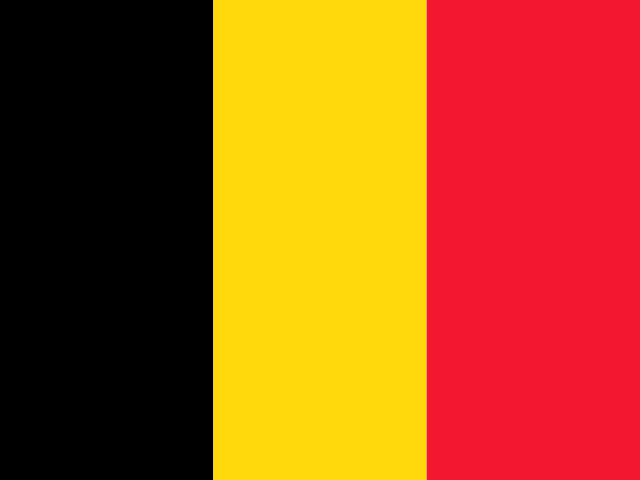
Belgium has worn red home shirts and black shorts since the 1900s, the colours referencing the national flag (red, black, yellow). The current crest features a stylised red lion (the heraldic emblem of Belgium) over the RBFA acronym. Kit suppliers in the modern era have included Adidas (1981–2010, 2014–present) and Burrda Sport / Burrda (2010–2014).
Stadium & Premises History
Belgium plays the bulk of senior fixtures at the King Baudouin Stadium (Stade Roi Baudouin / Koning Boudewijnstadion) in Brussels, capacity 50,122. The stadium was opened in 1930 as the Heysel Stadium, renamed Stade Roi Baudouin in 1995, and remained home to the senior team through the 2010s. Recent renovation works and city-of-Brussels reconstruction discussions (announced 2023) have moved selected fixtures to the Lotto Park (RSC Anderlecht, capacity 21,500) and the Cegeka Arena in Genk. The 1985 Heysel disaster — 39 deaths at the Liverpool–Juventus European Cup final on 29 May 1985 — remains the stadium’s most heavily reported public-safety incident.
Iconic Players
- Pre-1980s: Paul Van Himst (47 goals — fourth all-time), Wilfried Van Moer.
- 1980s “First Golden Generation”: Jan Ceulemans (96 caps, 23 goals), Enzo Scifo, Eric Gerets, Jean-Marie Pfaff (1986 World Cup goalkeeper), Franky Vercauteren.
- 1990s: Marc Wilmots (28 international goals), Michel Preud’homme.
- 2010s “Second Golden Generation”: Eden Hazard (126 caps, 33 goals), Kevin De Bruyne (102+ caps), Romelu Lukaku (89 goals — record), Vincent Kompany, Thibaut Courtois, Jan Vertonghen (157 caps — record), Toby Alderweireld, Marouane Fellaini, Dries Mertens.
- 2020s: Youri Tielemans (captain), Jérémy Doku, Amadou Onana, Charles De Ketelaere, Lois Openda, Wout Faes, Maxim De Cuyper.
Coaches & Managers Legacy
Notable head-coach lineage in the modern era: Guy Thys (1976–1989, Euro 1980 final and 1986 World Cup fourth place), Walter Meeuws (1989–1990), Robert Waseige (1999–2002), Marc Wilmots (2012–2016), Roberto Martínez (Spanish, 2016–2022, 2018 World Cup third place), Domenico Tedesco (Italian-German, 2023–2025) and Rudi Garcia (French, since 24 January 2025).
Trophies & Honours
- FIFA World Cup: third place 2018; fourth place 1986.
- UEFA European Championship: runners-up 1980; semi-finalists 1972.
- Olympic gold (men’s senior): 1920 Antwerp.
- FIFA Best Mover of the Year: 2007.
Peak Eras
- 1980–1986 Thys era: Euro 1980 final, 1986 World Cup fourth place.
- 2018 Russia: third at the World Cup, 2–1 quarter-final defeat of Brazil.
- 2015–2022 FIFA No. 1 ranking: 65 months at the top of the world rankings without a senior trophy.
Rivalries
- Netherlands: the longest senior international rivalry in continental Europe, with more than 125 official fixtures since 1905 (the largest data set in world football); fixtures recently include the 2024 Nations League quarter-final.
- France: 78 official fixtures, including the 2018 World Cup semi-final (France 1–0) and the Euro 2024 last 16 (France 1–0).
- England: contested at the 2018 World Cup group stage and third-place play-off (Belgium 1–0 and 2–0).
- Germany: tournament fixtures across the 1980 Euro final and 1980s World Cup cycles.
Public Image — Bad PR / Controversies
- 2022 Qatar World Cup group exit as one of the pre-tournament dark horses, the team’s first World Cup group exit since 1998; Eden Hazard retired from international football immediately after the tournament.
- 2022 Belgium FA Marc Wilmots successor and tactical-leadership succession discussion through Tedesco’s brief tenure.
- 1985 Heysel disaster: at the time the senior team’s primary home venue, the stadium hosted the Liverpool–Juventus European Cup final on 29 May 1985 in which 39 supporters died after a wall collapsed; the resulting UEFA-imposed five-year ban on English clubs in European competition framed the venue’s reputation for the rest of the decade.
Charity & Community
The RBFA operates the “Football+” community programme alongside the RBFA Foundation, focused on grassroots football development across Belgium’s three language communities (Dutch, French, German-speaking). Senior squad players have prominent personal foundations — including Vincent Kompany’s BX Brussels community-football initiative.
Australia Connection
Belgium has met Australia at senior men’s level only at friendly level. The most recent fixture sat in Australia’s 2014 World Cup-cycle preparation — Belgium 2–0 Australia, played at the King Baudouin Stadium in Brussels on 4 September 2014. No Belgium head coach has held a senior Socceroos role; the principal Belgian-Australian football crossover sits at the club level, with Belgian Pro League sides Anderlecht, Club Brugge and KAA Gent fielding Australian internationals across the 2010s and 2020s. The Belgian-Australian football diaspora is small relative to Italian-Australian, Greek-Australian or Croatian-Australian football communities. No documented coaching crossover.
Connections to Other Federations / Celebrity Figures
The Belgian coaching tree is unusually internationally distributed: Roberto Martínez (Spanish; managed Belgium 2016–2022, then Portugal from 2023), Vincent Kompany (Manchester City club captain, then Burnley, Bayern Munich head coach since 2024), Thierry Henry (French; Belgium assistant under Roberto Martínez 2016–2018), and Marc Brys (current head coach of Cameroon) all hold or have held high-profile international or top-flight club roles. Tedesco (Belgium 2023–2025) is German-Italian and previously coached Spartak Moscow and RB Leipzig.
Potential Future Trajectory
Rudi Garcia’s contract runs through the 2026 World Cup. Belgium enters the 2026 finals as a credible quarter-final pick, with the squad blending remaining “Second Golden Generation” senior starters (De Bruyne, Lukaku, Courtois) and a deep 2020s core (Tielemans, Doku, Onana, De Ketelaere, Openda, Faes, De Cuyper). The post-2026 cycle is expected to lean further on the younger generation as De Bruyne, Lukaku and Courtois reach late-career age brackets.
More World Cup 2026 Reading
WC 2026 context: See Belgium's WC 2026 group-stage form, squad and opponents →
 Best Betting Sites
 Best Online Casinos
 Blackjack Sites
 Online Pokies
 Fast Payout Casinos
 PayID Casinos
 New Casinos 2026