 Bosnia & Herzegovina at the World Cup — Full History
Key Facts
- The Football Association of Bosnia and Herzegovina (Fudbalski savez Bosne i Hercegovine, NSBiH) was founded in 1992 following the country’s independence from the Socialist Federal Republic of Yugoslavia; before 1992 Bosnian players represented Yugoslavia.
- The team is universally known as “Zmajevi” (the Dragons) — after the medieval Bosnian-king Stefan Tvrtko’s dragon emblem — with the alternative supporters’ shorthand “Zlatni Ljiljani” (Golden Lilies).
- Bosnia and Herzegovina has appeared at two FIFA World Cup tournaments — Brazil 2014 (their tournament debut) and the 2026 finals — with both campaigns reached via UEFA qualification.
- All-time records: most caps and top scorer Edin Džeko, with 148 appearances and 73 international goals — figures that place him among the most prolific national-team forwards in modern UEFA football.
- The team has yet to qualify for a UEFA European Championship, with Bosnia’s six European Championship qualifying campaigns since 2004 producing no tournament-finals appearance.
- Sergej Barbarez was appointed head coach in early 2024; the senior squad is captained by Edin Džeko (Fenerbahçe / former Manchester City and Roma) and built around Miralem Pjanić (long-time Juventus and Roma midfielder), Edin Višća, Asmir Begović, Ermedin Demirović and Adnan Janjić.
- Bosnia secured 2026 World Cup qualification via the UEFA playoffs in March 2026, defeating Italy 4–1 on penalties (1–1 after extra time) on 31 March 2026 to confirm the federation’s second-ever World Cup appearance.
- Bosnia finished UEFA 2026 World Cup qualifying Group H as runners-up to Austria — the decisive group-stage moment was the 1–1 draw with Austria in Vienna on 17–18 November 2025 that confirmed Austria’s top spot, with Bosnia entering the playoffs as the second-placed group qualifier.
- Bosnia’s 2026 World Cup final-tournament group placement is Group A, alongside Canada (host), Qatar and Switzerland; matches: Canada vs Bosnia (12 June, Toronto), Switzerland vs Bosnia (19 June, Los Angeles / Inglewood) and Qatar vs Bosnia (24 June, Seattle).
- Bosnia plays its senior men’s home internationals primarily at the 13,500-capacity Bilino Polje Stadium in Zenica; selected fixtures use the Asim Ferhatović Hase Stadium in Sarajevo.
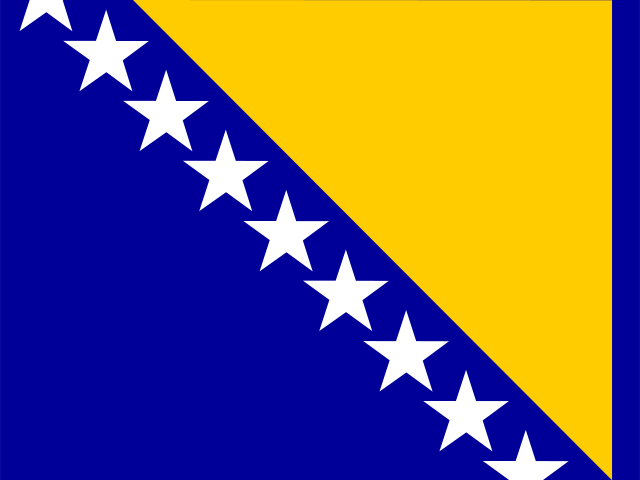
- The team plays in blue shirts with yellow trim, drawing on the national flag’s colour palette; current kit supplier is Adidas.
- Ajdin Hrustić — born 5 July 1996 in Dandenong, Victoria — has Bosnian and Romanian heritage and was approached by the NSBiH in May 2017 before electing to represent Australia at senior level (36 caps, 4 goals); the case is the most high-profile recent Australia-Bosnia dual-eligibility decision.
Bosnia & Herzegovina World Cup Vital Statistics
| Metric | Value |
|---|---|
| Federation founded | 1992 (NSBiH) |
| FIFA World Cup appearances | 2 (incl. 2026) — 2014, 2026 |
| Best FIFA World Cup finish | Group stage (2014) |
| UEFA Euro appearances | 0 |
| Most caps (all-time) | Edin Džeko — 148 |
| Top scorer (all-time) | Edin Džeko — 73 |
| FIFA Ranking | 65 |
| FIFA Ranking peak | 13 (August 2013) |
| Current head coach | Sergej Barbarez (appointed early 2024) |
| Captain | Edin Džeko |
| 2026 WC qualifying group | UEFA Group H — runners-up (behind Austria) |
| 2026 WC playoff result | Bosnia 1–1 Italy a.e.t. (4–1 on penalties), 31 March 2026 |
| 2026 WC final-tournament group | Group A — Canada (host), Qatar, Switzerland |
| Home stadium | Bilino Polje Stadium, Zenica — capacity 13,500 |
| 2016 Kirin Cup | Winners (under coach Mehmed Baždarević) |
Bosnia & Herzegovina at the World Cup — History And Profile
The Bosnia and Herzegovina national football team — universally known as “Zmajevi” (the Dragons) — is the senior men’s representative side of the Football Association of Bosnia and Herzegovina (Fudbalski savez Bosne i Hercegovine, NSBiH). The federation was established in 1992 following the country’s independence from the Socialist Federal Republic of Yugoslavia, and Bosnian players who had previously represented Yugoslavia transitioned to the new federation across the early 1990s. The federation joined FIFA in 1996 and UEFA the same year. Across the post-1996 era, Bosnian football has produced an outsized concentration of European-club-football talent — particularly forwards — relative to a domestic population of fewer than 3.5 million.
The most consequential single milestone in NSBiH history was qualification for Brazil 2014, the federation’s first World Cup tournament finals. A side coached by Safet Sušić and built around captain Emir Spahić, goalkeeper Asmir Begović, Edin Džeko (then of Manchester City), Miralem Pjanić (then of Roma), Vedad Ibišević and Zvjezdan Misimović finished as Group F runners-up to Argentina, with a 1–0 win over Iran in Salvador on 25 June 2014 producing Bosnia’s first-ever World Cup victory. The team did not qualify for any subsequent World Cup or any UEFA European Championship through the 2014–2024 cycles, although it did secure promotion to UEFA Nations League A by winning its 2022–23 Nations League B group and won the 2016 Kirin Cup in Japan under coach Mehmed Baždarević.
A long downturn followed. Bosnia finished UEFA Euro 2024 qualifying outside the automatic-qualifying place and entered an extended rebuild under successive coaches before Sergej Barbarez — the former Bayer Leverkusen and Hamburger SV forward — was appointed in early 2024. The 2026 World Cup qualifying campaign rebuilt the team’s tournament-cycle credibility. Bosnia finished UEFA Group H as runners-up to Austria; the decisive group-stage moment was the 1–1 draw with Austria in Vienna on 17–18 November 2025, which confirmed Austria’s top spot and sent Bosnia into the European playoffs.
The 31 March 2026 playoff produced the federation’s most-watched single fixture since the 2014 World Cup. Bosnia drew 1–1 with Italy after extra time and won the penalty shootout 4–1 to secure qualification for the 2026 World Cup — eliminating Italy from a senior men’s World Cup tournament finals for the third consecutive cycle. Al Jazeera described the post-match scenes as “unbridled Bosnian joy”; FIFA confirmed Bosnia and Herzegovina as the 44th country to qualify for the 2026 finals. The December 2025 finals draw placed Bosnia in Group A alongside hosts Canada, Qatar and Switzerland, with the three group fixtures: Canada vs Bosnia (12 June, BMO Field / Toronto Stadium), Switzerland vs Bosnia (19 June, SoFi Stadium / Los Angeles Stadium in Inglewood) and Qatar vs Bosnia (24 June, Lumen Field / Seattle Stadium).
The current senior squad is built around captain Edin Džeko — Bosnia’s all-time most-capped player (148) and top scorer (73 international goals) — Miralem Pjanić (long-time Juventus and Roma midfielder), Asmir Begović (the long-serving goalkeeper, now in the third decade of his international career), Ermedin Demirović (Bayer Leverkusen / VfB Stuttgart), Adnan Janjić, Edin Višća, Sead Kolašinac, Sead Hakšabanović and the rising Tahirović generation behind them. Pjanić’s full international career spans 2008 to the present.
The team plays its senior men’s home internationals primarily at the 13,500-capacity Bilino Polje Stadium in Zenica, with selected fixtures at the Asim Ferhatović Hase Stadium in Sarajevo. Bosnia plays in blue shirts with yellow trim, white shorts and blue socks, drawing on the national flag’s colour palette; the current kit supplier is Adidas. The federation is headquartered in Sarajevo, with current NSBiH president Vico Zeljković in office.
UEFA’s published 2026 qualification archive records Bosnia’s playoff route through the path-A semi-final and final, with the federation’s first World Cup return since Brazil 2014 confirmed at FIFA’s 1 April 2026 update. The Bosnia-Australia bilateral has limited prior senior men’s full international history. The most significant cross-federation thread is the case of Ajdin Hrustić — born 5 July 1996 in Dandenong, Victoria, with Bosnian and Romanian heritage — who was contacted by the NSBiH in May 2017 before electing to represent Australia at senior level (36 caps, 4 goals to date). The 2026 World Cup is the first major tournament in which Bosnia and Australia are both qualified, although the December 2025 draw placed the two federations in different groups (Bosnia in Group A, Australia in Group D). The bilateral therefore has no announced senior men’s match for the 2026 tournament window. Bosnian-Australian diaspora communities — concentrated in Melbourne and Sydney — provide a substantial supporter dimension to the federations’ commercial planning.
Detailed Profile
Crest, Colours & Kit Evolution
Bosnia and Herzegovina plays in blue shirts with yellow trim, white shorts and blue socks, drawing on the national flag’s colour palette. The crest carries the NSBiH shield with the Bosnian fleurs-de-lys (golden lilies). Current kit supplier is Adidas. Iconic shirts include the 2014 World Cup home design and the 2024–25 Nations League A home strip.
Stadium History
The federation’s primary home venue is the 13,500-capacity Bilino Polje Stadium in Zenica, with selected fixtures at the Asim Ferhatović Hase Stadium in Sarajevo. The Asim Ferhatović Hase ground was a 1984 Sarajevo Winter Olympics venue and is the historic home of FK Sarajevo. The Bilino Polje hosted the 17 November 2025 1–1 draw with Austria that confirmed Bosnia’s playoff path.
Coaches & Managers Legacy
Notable head-coach lineage includes Fuad Muzurović (1992 founding stint), Faruk Hadžibegić, Meho Kodro (multiple stints), Safet Sušić (the 2014 World Cup qualifier), Mehmed Baždarević (2016 Kirin Cup winner), Robert Prosinečki (2018–2019), Faruk Hadžibegić (second stint), Ivailo Petev, Savo Milošević and Sergej Barbarez (since early 2024).
Iconic Players
Pre-1992 (Yugoslavia era): Safet Sušić, Mirsad Fazlagić, Ivica Osim, Faruk Hadžibegić, Predrag Pašić, Vahid Halilhodžić, Meho Kodro. 1996–2014: Sergej Barbarez (now head coach), Hasan Salihamidžić, Elvir Bolić, Edin Bolić, Edin Džeko (148 caps / 73 goals), Asmir Begović. 2010s–2026: Miralem Pjanić, Vedad Ibišević, Senad Lulić, Edin Višća, Haris Medunjanin, Sead Kolašinac. Modern era: Ermedin Demirović, Adnan Janjić, Sead Hakšabanović, Tahirović generation, Asmir Begović (continuing).
Trophies & Honours
- FIFA World Cup tournament finals: 2 appearances (2014, 2026) — first appearance secured the federation’s first-ever World Cup victory (1–0 v Iran, 25 June 2014, Salvador).
- UEFA Nations League: promotion to League A in 2022–23 cycle (federation first).
- 2016 Kirin Cup: winners (under Mehmed Baždarević).
- Highest FIFA Ranking peak: 13th (August 2013).
Peak Eras
- 2010–2014 Safet Sušić cycle (qualification for the 2014 World Cup; the 1–0 win over Iran in Salvador).
- 2016 Kirin Cup win under Mehmed Baždarević.
- 2024–2026 Sergej Barbarez cycle (UEFA Nations League A consolidation; 2026 World Cup qualification via Italy playoff).
Rivalries
Bosnia’s principal rivalries are regional. The Croatia, Serbia and North Macedonia fixtures form the post-Yugoslav-split derbies; the Croatia-Bosnia matchup has produced sustained federation- and supporter-level commentary across the 2010s and 2020s. The Italy fixture is the most-cited international rivalry, given the 31 March 2026 playoff result eliminating Italy from a third consecutive World Cup tournament finals.
Supporters Culture
The Bosnia and Herzegovina supporters’ federation — concentrated around the Bosnian-language ultras pipelines (BHFanaticos and successors) — provides sell-out home support at the Bilino Polje, particularly during Edin Džeko’s senior-team era. The diaspora component is significant, with Bosnian-supporter blocs travelling in volume to UEFA fixtures across western Europe, Scandinavia and North America (in 2026).
Public Image — Bad PR / Controversies
The 2017 NSBiH-arranged friendly against Russia drew sustained criticism from Edin Džeko and Miralem Pjanić, both of whom publicly objected to the fixture’s political timing. Bosnia’s federation has historically been the subject of FIFA / UEFA conduct cases related to fan behaviour at qualifying fixtures, particularly in Sarajevo. The 2014 World Cup pre-tournament cycle was disrupted by federation-administration disputes that led to Sušić’s departure shortly after the tournament.
Charity & Community
The NSBiH operates community programmes through 10 cantonal federations, with grassroots-football pyramids feeding Bosnian top-flight academies (FK Sarajevo, Željezničar, FK Zrinjski Mostar, FK Borac Banja Luka). Edin Džeko’s personal foundation — established during his Manchester City years — funds children’s-football and earthquake-relief programmes in Mostar, Sarajevo and surrounding regions.
Australia Connection
The Bosnia-Australia senior men’s bilateral has limited prior tournament-cycle history. The most-cited cross-federation case is Ajdin Hrustić, born 5 July 1996 in Dandenong, Victoria, with Bosnian and Romanian heritage. The NSBiH contacted Hrustić in May 2017 before he opted to represent Australia at senior level — he has earned 36 caps with 4 goals as a Socceroo, including in the 2022 World Cup qualifying cycle. The 2026 World Cup is the first major tournament in which Bosnia and Australia are both qualified, although the December 2025 draw placed the two federations in different groups (Bosnia in Group A, Australia in Group D). Bosnian-Australian diaspora communities — concentrated in Melbourne and Sydney — provide a substantial commercial and supporter dimension to both federations’ commercial planning.
Connections to Other Federations / Celebrity Figures
The NSBiH maintains close technical relationships with other post-Yugoslav federations (Croatia, Serbia, North Macedonia, Slovenia, Montenegro, Kosovo) and has long-standing club-football pathways into the Bundesliga (Bayer Leverkusen, VfL Wolfsburg, RB Leipzig — a function of the substantial Bosnian-German diaspora), the Premier League (Manchester City, Chelsea, Wolverhampton Wanderers), Serie A (Roma, Juventus, Inter Milan, Lazio) and the Süper Lig (Fenerbahçe, Galatasaray). Edin Džeko’s Manchester City / Roma / Inter Milan / Fenerbahçe trajectory and Miralem Pjanić’s Roma / Juventus / Barcelona / Sharjah / Sporting CP path are the highest-profile current cross-federation connections.
Potential Future Trajectory
With qualification for the 2026 FIFA World Cup confirmed via the 31 March 2026 playoff penalty-shootout win over Italy and a Group A draw with Canada, Qatar and Switzerland, Bosnia and Herzegovina’s medium-term outlook centres on (a) Sergej Barbarez’s contract terms beyond the 2026 finals, (b) the federation’s pathway from a 12-year World Cup absence into a settled major-tournament rotation, and (c) the longer-term transition from the Edin Džeko / Miralem Pjanić era to the rising Tahirović and Demirović generation. Euro 2028 (United Kingdom and Ireland) opens immediately after the 2026 finals, and would, if reached, be Bosnia’s first-ever UEFA European Championship tournament finals.
 Best Betting Sites
 Best Online Casinos
 Blackjack Sites
 Online Pokies
 Fast Payout Casinos
 PayID Casinos
 New Casinos 2026