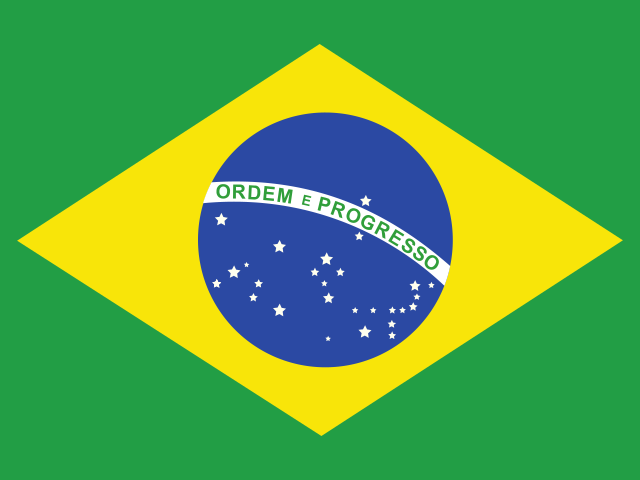
 Brazil at the World Cup — Full History
Key Facts
- Brazil is the most-decorated nation in FIFA World Cup history with five titles (1958, 1962, 1970, 1994, 2002) and is the only country to have appeared at every World Cup since the inaugural tournament in 1930.
- The team is administered by the Confederação Brasileira de Futebol (CBF), founded as the multi-sport Federação Brasileira de Sports on 8 June 1914 and re-organised as the football-only confederation on 24 September 1979.
- Brazil’s first international was a 3–0 defeat to Argentina on 20 September 1914 in Buenos Aires; the rivalry between the two nations has continued ever since.
- Brazil has won the Copa América nine times — 1919, 1922, 1949, 1989, 1997, 1999, 2004, 2007 and 2019.
- The 1970 squad coached by Mário Zagallo and built around Pelé, Tostão, Gérson, Rivellino and Jairzinho is widely cited in football historiography as among the most influential national teams ever assembled.
- Pelé scored at four World Cups (1958, 1962, 1966, 1970); his 1958 final goal at age 17 years, 239 days remains the youngest scorer in a World Cup men’s final.
- Neymar is Brazil’s all-time leading scorer with 79 international goals, having surpassed Pelé’s long-held national-team record in 2023.
- Cafu holds the men’s caps record at 142 appearances and is the only player to have featured in three consecutive World Cup finals (1994, 1998, 2002).
- Brazil’s heaviest defeat — 1–7 to Germany in the 2014 World Cup semi-final at the Mineirão in Belo Horizonte (8 July 2014) — is the most-discussed result in the team’s modern history.
- On 26 May 2025, the CBF appointed Carlo Ancelotti as head coach, the first permanent foreign manager in Brazil’s senior history; Ancelotti’s previous club roles include Real Madrid (five UEFA Champions League titles), Milan, Chelsea, PSG and Bayern Munich.
- Brazil qualified for the 2026 FIFA World Cup via the CONMEBOL round-robin, finishing 5th with 28 points (the top six qualified directly); the squad is captained by Marquinhos and includes Vinícius Júnior, Rodrygo, Raphinha, Endrick, Bruno Guimarães, Casemiro and Alisson.
- Brazil is ranked 6th in the FIFA Men’s Ranking as of April 2026.
Brazil World Cup Vital Statistics
| Metric | Value |
|---|---|
| First international | 20 September 1914, vs Argentina (lost 0–3, Buenos Aires) |
| CBF founded | 8 June 1914 (multi-sport); football-only since 24 September 1979 |
| FIFA World Cups won | 5 (1958, 1962, 1970, 1994, 2002) |
| FIFA World Cup finals appearances | 7 (1950, 1958, 1962, 1970, 1994, 1998, 2002) |
| Copa América titles | 9 (1919, 1922, 1949, 1989, 1997, 1999, 2004, 2007, 2019) |
| 2026 World Cup qualifying finish | 5th in CONMEBOL, 28 points |
| Most caps | Cafu (142) |
| Top scorer | Neymar (79) |
| Largest win | 10–1 vs Bolivia |
| Heaviest defeat | 1–7 vs Germany (World Cup semi-final, Belo Horizonte) |
| Current head coach | Carlo Ancelotti (since 26 May 2025) |
| Captain | Marquinhos |
| FIFA Men’s Ranking | 6th |
| Confederation | CONMEBOL |
Brazil at the World Cup — History And Profile
The Brazil national football team — universally known as the Seleção — is the most successful side in FIFA World Cup history, with five titles (1958, 1962, 1970, 1994, 2002) and the distinction of being the only nation to have competed at every edition since 1930. The team is administered by the Confederação Brasileira de Futebol (CBF), founded as the multi-sport Federação Brasileira de Sports on 8 June 1914 and reorganised as a football-only confederation on 24 September 1979. The Seleção’s first international was a 3–0 defeat away to Argentina on 20 September 1914, beginning what would become world football’s most-played senior rivalry.
Brazil’s first World Cup title in 1958 in Sweden — won 5–2 over the host nation in the final — introduced Pelé to the global audience as a 17-year-old; Pelé’s two goals in that final and earlier hat-trick against France made him the youngest scorer in a World Cup men’s final, a record that still stands. The 1962 retention in Chile was achieved despite an injury to Pelé in the second match, with Garrincha and Vavá leading the squad to a 3–1 final win over Czechoslovakia. The 1970 World Cup in Mexico, won 4–1 in the final against Italy, is widely regarded as the most accomplished single tournament campaign in football history; the squad — Pelé, Carlos Alberto, Gérson, Tostão, Rivellino and Jairzinho (the only player to score in every match of a World Cup) — coached by Mário Zagallo, retired the original Jules Rimet Trophy.
A 24-year title drought ended in 1994 in the United States, when Brazil — coached by Carlos Alberto Parreira and built around Romário (Golden Ball) and Bebeto — defeated Italy on penalties in the final at the Rose Bowl, Pasadena. The fifth title in 2002, won 2–0 against Germany in Yokohama, came from the “three Rs” of Ronaldo, Rivaldo and Ronaldinho, with Ronaldo finishing as tournament top scorer with eight goals. Subsequent World Cups have produced quarter-final and semi-final exits — most painfully the 1–7 defeat to Germany at home in the 2014 semi-final at the Mineirão in Belo Horizonte, often referred to in Brazilian football writing as the Mineirazo and one of the most-cited results in the team’s modern history. The 2018 (quarter-final) and 2022 (quarter-final, lost on penalties to Croatia) campaigns continued the post-2002 trophy drought.
In Copa América, Brazil has won nine titles, the most recent in 2019 on home soil with a 3–1 win over Peru. The team also won the FIFA Confederations Cup in 1997, 2005, 2009 and 2013 (all four lifted under different head coaches). Olympic football gold finally came at home in Rio 2016 — a penalty-shootout win over Germany in the final at the Maracanã — and was retained at Tokyo 2020. Brazil also won the Copa América Centenario qualification path, the Pan American Games, and a long list of underage tournaments.
The 2026 FIFA World Cup qualification produced an uneven campaign by historic Brazilian standards. Brazil finished 5th in the CONMEBOL 18-match round-robin with 28 points, qualifying directly but well behind Argentina on 38, Ecuador on 29 and level on points with Colombia, Uruguay and Paraguay. Multiple coaching changes shaped the cycle — Tite stepped down after the 2022 World Cup, with Ramon Menezes (interim), Fernando Diniz and Dorival Júnior preceding the appointment of Carlo Ancelotti on 26 May 2025. Ancelotti — the most-decorated club manager of the 21st century, with five UEFA Champions League titles and league championships in all five major European leagues — became the first permanent foreign head coach in Brazil’s senior history.
The 2026 squad is captained by Paris Saint-Germain centre-back Marquinhos and is built around forwards Vinícius Júnior, Raphinha, Rodrygo and Endrick (Real Madrid), midfielders Bruno Guimarães, Lucas Paquetá and Casemiro, and goalkeeper Alisson. Neymar, after long-running injuries and a return to Brazilian club football with Santos, was omitted from Ancelotti’s pre-tournament squads pending fitness; the official 26-man final list is to be announced at CBF headquarters in Rio in May 2026.
The team’s principal rivalry remains with Argentina (Superclásico de las Américas), with Uruguay (the 1950 Maracanazo opponent) and with European nations Italy, Germany and France in World Cup history. Brazil does not maintain a single permanent home stadium; international fixtures rotate among the Maracanã (Rio de Janeiro), Arena Corinthians (São Paulo), Estádio do Morumbi (São Paulo), the Mineirão (Belo Horizonte) and the Mané Garrincha (Brasília). The CBF training centre at Granja Comary in Teresópolis, Rio de Janeiro state, has been the squad’s pre-tournament base since 1987.
Detailed Profile
Crest, Colours & Kit Evolution
Brazil’s canary-yellow shirt with green trim, blue shorts and white socks was introduced after a 1953 Correio da Manhã newspaper design competition that followed the 1950 Maracanazo defeat, when the previous white kit was deemed “unpatriotic.” The CBF crest carries the four colours of the Brazilian flag and five stars above the badge, one for each World Cup title. Nike has been the kit supplier under a long-term commercial agreement (originally signed 1996 and renewed multiple times since).
Stadium & Venue History
Brazil does not maintain a single national-team home ground. The Maracanã in Rio de Janeiro — the venue of the 1950 World Cup final loss to Uruguay and the 2014 World Cup final between Germany and Argentina — is the most historically significant Brazilian football venue. Other regular Seleção venues include the Mineirão (Belo Horizonte), the Mané Garrincha (Brasília), Arena Corinthians and Estádio do Morumbi (both São Paulo) and the Arena de São Januário (Vasco da Gama, Rio de Janeiro). The CBF training centre at Granja Comary in Teresópolis has been the squad’s pre-tournament base since 1987.
Coaches & Managers Legacy
- Pre-1970: Vicente Feola (1958 World Cup), Aymoré Moreira (1962), João Saldanha (1969–1970 qualifying).
- 1970–2002: Mário Zagallo (1970 World Cup champion, multiple later spells); Cláudio Coutinho, Telê Santana, Sebastião Lazaroni, Carlos Alberto Parreira (1994 World Cup champion, 2006), Mário Zagallo (1998), Luiz Felipe Scolari (2002 World Cup champion, 2014).
- 2003–2022: Dunga (twice), Mano Menezes, Tite (2016–2022, longest-serving coach of the post-2014 era).
- 2023–2025 transition: Ramon Menezes (interim), Fernando Diniz (interim), Dorival Júnior (Jan 2024–March 2025).
- Carlo Ancelotti (since 26 May 2025) — first permanent foreign head coach.
Iconic Players (long-serving / influential)
- 1950s–1970s: Pelé (1,281 goals at all levels claimed; 77 international goals), Garrincha, Didi, Vavá, Tostão, Gérson, Rivellino, Jairzinho, Carlos Alberto, Zico, Sócrates, Falcão.
- 1990s: Romário (Golden Ball 1994), Bebeto, Cafu (142 caps record), Roberto Carlos, Rivaldo, Ronaldo Nazário, Dunga.
- 2000s–2010s: Ronaldinho, Kaká, Ronaldo (top scorer 2002), Robinho, Thiago Silva, Daniel Alves, Marcelo, David Luiz, Casemiro, Neymar (79 goals — all-time top scorer).
- Modern: Marquinhos (captain), Vinícius Júnior, Rodrygo, Raphinha, Endrick, Bruno Guimarães, Lucas Paquetá, Alisson, Ederson.
Trophies & Honours
- FIFA World Cup: champions 1958, 1962, 1970, 1994, 2002; runners-up 1950, 1998.
- Copa América: 9 titles (1919, 1922, 1949, 1989, 1997, 1999, 2004, 2007, 2019).
- FIFA Confederations Cup: 4 (1997, 2005, 2009, 2013).
- Olympic gold (men’s): 2016 (home), 2020.
- Pan American Games: multiple titles.
- Superclásico de las Américas (vs Argentina): multiple wins since the trophy’s modern reinstatement in 2011.
Peak Eras
- 1958–1970: Three World Cup titles in four tournaments; Pelé–Garrincha generation.
- 1994–2002: Two further World Cup titles bookending the Romário, Ronaldo and Ronaldinho generations.
- 1997–2009: Four Copa América titles in 13 years and four Confederations Cups.
Rivalries
- Argentina (Superclásico de las Américas): the most-played international rivalry in South America since 1914.
- Uruguay: the 1950 Maracanazo opponent and frequent Copa América obstacle.
- Italy: opponents in the 1970 and 1994 World Cup finals.
- Germany: opponents in the 2002 World Cup final and the 1–7 2014 semi-final.
Public Image — Bad PR / Controversies
- 1950 Maracanazo: home defeat to Uruguay in the deciding World Cup match — the most-discussed loss in Brazilian sporting history.
- 2014 Mineirão semi-final: 1–7 home defeat to Germany.
- CBF governance: multiple presidents have faced FIFA disciplinary action and Brazilian judicial investigation in the post-2010 era; Ricardo Teixeira (1989–2012) resigned amid corruption inquiries, and successor presidents have been suspended at various points by Brazilian courts and FIFA.
- Long-running selectorial debates around Neymar’s role and conduct, particularly the 2018 World Cup simulation criticism.
Australia Connection
The Seleção and the Australia Socceroos most recently met on 13 June 2017 at the Melbourne Cricket Ground in an international friendly that drew 49,874 spectators; Brazil won 4–0 with two goals from Diego Souza (one inside 12 seconds and one in stoppage time), Thiago Silva and Taison. The fixture was Brazil’s first under then-head coach Tite. Earlier meetings include the 2009 friendly in Doha and the 2013 fixture in Brasília during Australia’s pre-2014 World Cup preparation. The 2017 match also formed part of Australia’s pre-Confederations Cup preparation.
Connections to Other Sports / Wider Football
The CBF also runs Brazil’s women’s, U-23, U-20, U-17 and futsal national programmes. Brazilian futsal has historically dominated FIFA Futsal World Cups. Pathways from the Brasileirão (Série A) and from young transfers to Europe (Real Madrid, Manchester City, Barcelona, Chelsea, PSG) populate the senior squad; the 2026 squad is overwhelmingly drawn from European clubs.
Potential Future Trajectory
Brazil enters the 2026 FIFA World Cup as a credible title contender after a difficult qualifying campaign. Carlo Ancelotti’s appointment is seen as a managerial upgrade by domestic press; questions remain over an attacking line-up around Vinícius Júnior, Rodrygo, Raphinha and Endrick, the integration of Neymar (if fit) and the depth at central defence behind Marquinhos. Beyond 2026, the CBF’s medium-term priorities include extending women’s professionalisation following the 2027 Women’s World Cup hosting bid (awarded to Brazil for 2027), Olympic football continuity in 2028 Los Angeles, and ongoing CBF governance reform.
More World Cup 2026 Reading
WC 2026 context: See Brazil's WC 2026 group-stage form, squad and opponents →
 Best Betting Sites
 Best Online Casinos
 Blackjack Sites
 Online Pokies
 Fast Payout Casinos
 PayID Casinos
 New Casinos 2026