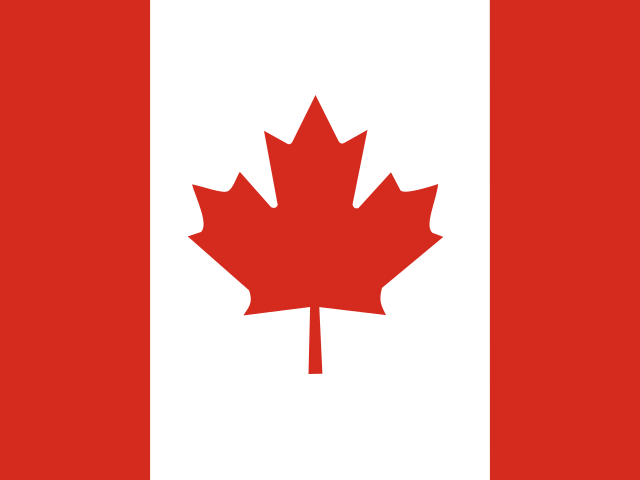
 Canada at the World Cup — Full History
Key Facts
- The Canada men’s national soccer team is governed by Canada Soccer (the Canadian Soccer Association), founded in 1912; Canada joined FIFA the same year and was a founding member of CONCACAF in 1961.
- Canada’s first official international match was a 3–2 friendly loss to Australia on 7 June 1924 in Brisbane — making Australia the team’s inaugural opponent.
- Canada will co-host the 2026 FIFA World Cup with the United States and Mexico, automatically qualifying as host in February 2023; this is Canada’s third World Cup appearance, after the 1986 group-stage debut in Mexico and the 2022 group-stage exit in Qatar.
- At the 2026 World Cup draw on 5 December 2025 in Washington, D.C., Canada was placed in Group B alongside Switzerland, Qatar and the winner of UEFA Play-Off A (Italy, Northern Ireland, Wales or Bosnia and Herzegovina). [The Globe and Mail; CBC Sports]
- Canada won the inaugural CONCACAF Championship in 1985 (qualifying the team for the 1986 World Cup) and the 2000 CONCACAF Gold Cup, defeating Colombia 2–0 in the final at the Los Angeles Memorial Coliseum.
- Jesse Marsch was appointed head coach on 13 May 2024; under his leadership Canada reached the 2024 Copa América semi-final stage, the side’s first appearance in the tournament.
- Captain Alphonso Davies (Bayern Munich) became the first Canadian to win the UEFA Champions League in 2020 and is widely regarded as the country’s most decorated active footballer.
- Atiba Hutchinson holds the appearance record (104 caps); Jonathan David (Lille) is the all-time top scorer with 39 goals.
- Canada hosts its 2026 World Cup group fixtures at BMO Field in Toronto and BC Place in Vancouver, with the tournament opener scheduled for 12 June 2026 at BMO Field.
- Canada and Bosnia and Herzegovina have met once previously, a 2002 friendly won 3–1 by Canada; Canada vs Qatar has produced a 2000 Qatari win and a 2010 1–1 draw. [The Globe and Mail]
Canada World Cup Vital Statistics
| Metric | Value |
|---|---|
| Federation founded | 1912 (Canada Soccer / Canadian Soccer Association) |
| First international | 7 June 1924, lost 2–3 to Australia in Brisbane |
| FIFA World Cup appearances | 3 (1986, 2022, 2026) |
| 2026 World Cup status | Co-host (with USA, Mexico); Group B |
| CONCACAF Gold Cup / Championship titles | 2 (1985 CONCACAF Championship; 2000 Gold Cup) |
| All-time appearances leader | Atiba Hutchinson (104) |
| All-time top scorer | Jonathan David (39 goals) |
| Head coach | Jesse Marsch (since 13 May 2024) |
| Captain | Alphonso Davies (Bayern Munich) |
| Primary home venues | BMO Field, Toronto; BC Place, Vancouver |
Canada at the World Cup — History And Profile
Canada men’s national soccer team is the senior representative side of Canadian football, governed by Canada Soccer (the Canadian Soccer Association), which was founded in 1912 and is one of the oldest national football federations in the Americas. Canada became a FIFA member the same year and was among the founding members of the Confederation of North, Central American and Caribbean Association Football (CONCACAF) in 1961. The team’s inaugural international, on 7 June 1924, was a 3–2 friendly defeat to Australia in Brisbane during a Canadian tour of Oceania — a fixture that gives Canada the unusual distinction of having played Australia as its first-ever opponent.
For most of the twentieth century Canada was a peripheral CONCACAF nation. The breakthrough came at the 1985 CONCACAF Championship, when a side coached by Tony Waiters won the regional tournament and qualified for the 1986 FIFA World Cup in Mexico — the country’s first appearance at the global finals. Canada lost all three group-stage matches in 1986 (to France, Hungary and the Soviet Union) without scoring, but the qualification itself remained the high-water mark of Canadian men’s football for more than three decades. A second continental title followed at the 2000 CONCACAF Gold Cup, where Canada beat Colombia 2–0 in the Los Angeles final.
The next World Cup qualification took 36 years. Under coach John Herdman, who had previously led the Canadian women’s team to back-to-back Olympic bronze medals, Canada topped the CONCACAF Octagonal qualifying group ahead of Mexico and the United States and qualified for the 2022 World Cup in Qatar, where it lost group-stage matches to Belgium, Croatia and Morocco. Although Canada exited without a point, Alphonso Davies’s goal against Croatia was the country’s first ever at a World Cup. Herdman departed in 2023 and was replaced on an interim basis before American manager Jesse Marsch — formerly of RB Salzburg, RB Leipzig and Leeds United — was appointed head coach on 13 May 2024.
Marsch’s first major tournament with Canada was the 2024 Copa América, hosted by the United States as part of the wider build-up to the 2026 World Cup. Canada was the first non-CONMEBOL invitee to reach the semi-finals of a Copa América since the modern guest-team era began, ultimately losing the third-place play-off. Davies, the Edmonton-born Bayern Munich left-back who in 2020 became the first Canadian to win the UEFA Champions League, captains the side; Lille striker Jonathan David is the country’s all-time top scorer with 39 goals; and former captain Atiba Hutchinson is the appearance record-holder on 104 caps.
Canada’s 2026 World Cup status is that of automatic co-host alongside the United States and Mexico, confirmed by FIFA in February 2023. At the draw on 5 December 2025 in Washington, D.C., Canada was placed in Group B with Switzerland (FIFA-ranked seventeenth at the draw), Qatar and the winner of UEFA Play-Off A — a slot due to be decided in late March 2026 between Italy, Northern Ireland, Wales and Bosnia and Herzegovina. Canada’s group-stage matches are scheduled for 12 June 2026 at BMO Field in Toronto (against the playoff winner) and 18 and 24 June 2026 at BC Place in Vancouver (against Qatar and Switzerland respectively). Marsch publicly described the draw as “middling”, expressing concern that the late playoff resolution would compress preparation for the opening fixture.
Canada plays in red and white, the colours of the national flag, and is most commonly nicknamed Les Rouges (The Reds); other nicknames include the Canucks and the Maple Leaf Team. Home matches rotate among BMO Field in Toronto (the de facto national-team home), BC Place in Vancouver, Commonwealth Stadium in Edmonton (the high-altitude venue used for cold-weather qualifiers) and Tim Hortons Field in Hamilton. The principal regional rivalries are with the United States and Mexico — the latter through several decisive World Cup qualifying fixtures during the 2022 cycle, in which Canada beat Mexico 2–1 in Edmonton in November 2021. Supporter culture coalesces around the Voyageurs, the long-standing fan group whose travel and tifo programmes have grown sharply since 2022 qualification.
The Australia connection is foundational rather than incidental: Canada’s first international, on 7 June 1924, was a 3–2 loss to Australia in Brisbane, making the Socceroos the team’s inaugural opponent. The two sides have since met in friendlies and at age-group level, with Australia (as 2015 AFC Asian Cup champions) and Canada (as 2000 Gold Cup champions) representing rare cases of CONCACAF and AFC continental title-holders. The medium-term outlook centres on the 2026 home World Cup: a generation built around Davies, David, Tajon Buchanan and Stephen Eustáquio is now in its peak years, and the federation has invested in pre-tournament friendlies and base-camp infrastructure intended to convert host status into a first ever Canadian knockout-round appearance.
Detailed Profile
Founding & Origins
The Canadian Soccer Association was founded in 1912 in Toronto, with Canada joining FIFA the same year, although the team’s first international match did not take place until 7 June 1924, a 3–2 friendly defeat to Australia in Brisbane during a Canadian tour. Canada is also a founding member of CONCACAF (1961).
Crest, Colours & Kit Evolution
Canada plays in red shirts with white shorts (and a white change strip), reflecting the colours of the Canadian flag. The crest features a stylised maple leaf and the Canada Soccer wordmark. Nike has manufactured the kit through the modern era.
Stadium & Premises History
Canada does not maintain a single permanent home venue. BMO Field in Toronto (opened 2007, expanded 2016) is the most-used home; BC Place in Vancouver hosts large-capacity fixtures; Commonwealth Stadium in Edmonton has historically hosted cold-weather qualifiers; and Tim Hortons Field in Hamilton has been used since the 2022 qualifying cycle. The 2026 World Cup matches are split between BMO Field and BC Place.
Historical Key Players
Pre-2000 era: Bruce Wilson (long-serving captain), Paul Dolan, Igor Vrablic, Dale Mitchell. 1990s–2000s: Dwayne De Rosario, Paul Stalteri, Jason de Vos, Tomasz Radzinski. 2010s: Atiba Hutchinson (104 caps record), Julian de Guzman, Will Johnson. Modern era: Alphonso Davies (current captain), Jonathan David (top scorer, 39 goals), Stephen Eustáquio, Tajon Buchanan, Cyle Larin, Junior Hoilett, Milan Borjan, Maxime Crépeau.
Coaches & Managers Legacy
Tony Waiters (1981–1986, 1985 CONCACAF Championship and 1986 World Cup); Bob Lenarduzzi (1992–1997); Holger Osieck (1999–2003, 2000 Gold Cup); Frank Yallop, Stephen Hart, Benito Floro and Octavio Zambrano through the 2010s. John Herdman led the team to 2022 World Cup qualification before departing in 2023. Jesse Marsch was appointed on 13 May 2024 and his contract runs through July 2026.
Trophies & Honours
- CONCACAF Championship: 1 (1985)
- CONCACAF Gold Cup: 1 (2000)
- CONCACAF Nations League: runners-up 2023
- FIFA World Cup: appearances 1986, 2022, 2026 (host)
Peak Eras
1985–1986: First continental title and first World Cup qualification under Tony Waiters. 2000: Gold Cup triumph in Los Angeles under Holger Osieck. 2021–2022: Topped CONCACAF Octagonal qualifying ahead of Mexico and the United States, ending a 36-year World Cup absence. 2024–2026: Copa América semi-final under Marsch and 2026 home World Cup.
Rivalries
The principal modern rivalry is with the United States, contested across CONCACAF qualifying and Gold Cup fixtures. Mexico is the second principal rival; Canada’s 2–1 home defeat of Mexico at Commonwealth Stadium in November 2021 was a defining moment of the 2022 qualification cycle.
Supporters Culture, Flags & Chants
The Voyageurs are the recognised national-team supporter group, awarding the Voyageurs Cup as the domestic Canadian championship trophy and travelling in significant numbers to recent qualifiers and Copa América matches. Matchday culture coalesces around the maple-leaf flag and the bilingual chants “Allez les Rouges / Go Canada Go”.
Public Image — Bad PR / Controversies
Canada Soccer faced sustained labour disputes with both senior teams during 2022–2024 over compensation, prize-money distribution and federation governance, with player-led actions including a brief work stoppage at a friendly in 2023. The federation also faced criticism over the 2024 Olympic women’s drone-spying incident, which led to coaching dismissals and a points deduction for the women’s side. The men’s programme was not directly implicated.
Charity & Community
Canada Soccer’s grassroots and EDI programmes operate alongside provincial associations under Canadian-context Long-Term Player Development frameworks; the federation runs national talent-identification camps and supports the BC Place and BMO Field community fixtures.
Australia Connection
Canada’s first ever international match was a 3–2 friendly defeat to Australia on 7 June 1924 in Brisbane, played as part of a Canadian tour of Oceania. Australia is therefore Canada’s inaugural opponent in international football, an unusual historical link given the geographic distance. The two federations have since met sporadically in friendlies and at age-group competitions; both sides also share the rare distinction of having held a continental confederation title (Canada — 1985 CONCACAF Championship and 2000 Gold Cup; Australia — four OFC Nations Cups and the 2015 AFC Asian Cup). Several Canadian internationals have also played in the A-League and several Australian-Canadian dual nationals have featured at age-group level.
Connections to Other Clubs / Sports / Celebrity Figures
Alphonso Davies’s career link with Bayern Munich and Jonathan David’s with Lille are the principal current European-club ties; Atiba Hutchinson spent more than a decade at Beşiktaş. Through Canada’s three Major League Soccer franchises (Toronto FC, Vancouver Whitecaps and CF Montréal) the national team draws domestic-club pathways alongside the European-based core.
Potential Future Trajectory
The 2026 home World Cup is the defining short-term objective. With Davies, David, Eustáquio, Buchanan and the Marsch coaching staff in place through July 2026, Canada Soccer’s stated medium-term aim is the team’s first knockout-round appearance at a senior FIFA tournament. Beyond 2026, succession planning around the post-Davies/David generation, the integration of younger MLS- and European-academy graduates, and the federation’s resolution of compensation disputes will define the next cycle.
More World Cup 2026 Reading
WC 2026 context: See Canada's WC 2026 group-stage form, squad and opponents →
 Best Betting Sites
 Best Online Casinos
 Blackjack Sites
 Online Pokies
 Fast Payout Casinos
 PayID Casinos
 New Casinos 2026