 Colombia at the World Cup — Full History
Key Facts
- The Federación Colombiana de Fútbol (FCF / Colfútbol) was founded on 12 October 1924, with its modern legal structure established at a general assembly on 15 June 1971; the federation was admitted to FIFA and CONMEBOL in 1936.
- Colombia has appeared at seven FIFA World Cups (1962, 1990, 1994, 1998, 2014, 2018, 2026) and reached its highest finish — the quarter-finals — at the 2014 World Cup in Brazil under head coach José Pékerman.
- Colombia’s only Copa América title came in 2001 on home soil, when Iván Ramón Mosquera Ruiz’s side defeated Mexico 1–0 in the final at El Campín, Bogotá; the team won every match in the tournament without conceding a goal.
- The 2024 Copa América saw Colombia reach its first final since 2001, losing 0–1 to Argentina after extra time at Hard Rock Stadium in Miami Gardens on 14 July 2024 (Lautaro Martínez goal in the 112th minute).
- Under head coach Néstor Lorenzo (appointed 2 June 2022), Colombia compiled a 28-match unbeaten run that ended only at the 2024 Copa América final.
- Colombia finished 3rd in the CONMEBOL 2026 World Cup qualifiers with 28 points (level on points with Uruguay, Brazil and Paraguay; ahead on goal difference and head-to-head), securing direct qualification in September 2025.
- At the 2026 finals Colombia was drawn into Group K alongside Portugal, the Democratic Republic of the Congo and Uzbekistan; its scheduled fixtures are 17 June (vs Uzbekistan, Mexico City), 23 June (vs DR Congo, Zapopan, Guadalajara) and 27 June (vs Portugal, Hard Rock Stadium, Miami Gardens).
- Goalkeeper David Ospina is the team’s caps record-holder with 129 international appearances; Radamel Falcao is the all-time leading scorer with 36 international goals.
- The Estadio Metropolitano Roberto Meléndez in Barranquilla, opened on 11 May 1986, is the FCF’s designated home venue and has hosted World Cup qualifiers ahead of every Colombian appearance from 1990 onwards.
- The “Golden Generation” of the early 1990s — Carlos Valderrama, Faustino Asprilla, Freddy Rincón, René Higuita and Andrés Escobar — was widely tipped at the 1994 World Cup; Escobar’s murder in Medellín on 2 July 1994, weeks after the team’s group-stage exit, remains the most-cited tragedy in Colombian football history.
- Adidas has supplied Colombia’s kit since 2011, succeeding Lotto, Reebok and earlier providers.
- Colombia is ranked 13th in the FIFA Men’s Ranking as of April 2026.
Colombia World Cup Vital Statistics
| Metric | Value |
|---|---|
| FCF founded | 12 October 1924; reorganised 15 June 1971 |
| First international | 17 February 1926 vs Costa Rica (won 4–1, Barranquilla) |
| FIFA World Cup appearances | 7 (1962, 1990, 1994, 1998, 2014, 2018, 2026) |
| Best World Cup finish | Quarter-finals (2014) |
| Copa América titles | 1 (2001) |
| Copa América runners-up | 2024 (vs Argentina) |
| 2026 World Cup qualifying finish | 3rd in CONMEBOL, 28 points |
| 2026 World Cup group | Group K — vs Portugal, DR Congo, Uzbekistan |
| Most caps | David Ospina (129) |
| Top scorer | Radamel Falcao (36) |
| Largest win | 6–0 vs Bahrain |
| Heaviest defeat | 0–9 vs Brazil |
| Current head coach | Néstor Lorenzo (since 2 June 2022) |
| Captain | James Rodríguez |
| FIFA Men’s Ranking | 13th |
| Confederation | CONMEBOL |
| Kit supplier | Adidas (since 2011) |
Colombia at the World Cup — History And Profile
The Colombia national football team — Los Cafeteros, La Tricolor, La Sele — is administered by the Federación Colombiana de Fútbol (FCF), founded on 12 October 1924 and reorganised in its modern form on 15 June 1971. The federation was admitted to FIFA and CONMEBOL in 1936. Colombia’s first international match was a 4–1 win over Costa Rica on 17 February 1926 in Barranquilla, the city that has remained the spiritual home of the senior team and the location of the Estadio Metropolitano Roberto Meléndez (opened 11 May 1986), which has hosted World Cup qualifying campaigns through every Colombian World Cup appearance from 1990 onwards.
Colombia first qualified for the FIFA World Cup in 1962 in Chile, drawing 4–4 with the Soviet Union in a celebrated group-stage match before exiting at that round. After a 28-year absence the team returned at Italia 1990 under Francisco Maturana, with goalkeeper-sweeper René Higuita, captain Carlos Valderrama and forwards Faustino Asprilla and Freddy Rincón producing the country’s most-recognised generation. Colombia reached the second round in 1990 (lost 1–2 a.e.t. to Cameroon) and qualified for USA 1994 with a memorable 5–0 away win against Argentina at El Monumental on 5 September 1993. The 1994 tournament was a pre-event favourite for Colombia, but a group-stage exit was followed by the murder of defender Andrés Escobar in Medellín on 2 July 1994 — ten days after his own goal in the 1–2 loss to the United States — an event that has been the subject of multiple documentaries (including the ESPN 30 for 30 film The Two Escobars) and remains the most-cited tragedy in Colombian football history.
Colombia returned to the World Cup in 2014 in Brazil under coach José Pékerman and captain Mario Yepes, reaching the quarter-finals (lost 1–2 to Brazil). James Rodríguez won the Golden Boot with six goals, including a celebrated volley against Uruguay in the round of 16. Colombia returned to the round of 16 in 2018 (lost on penalties to England) but missed both the 2002 and 2022 finals during difficult qualifying cycles. The team’s only Copa América triumph came in 2001 on home soil, when a Francisco Maturana side defeated Mexico 1–0 in the final at El Campín in Bogotá — Colombia’s tournament concluded with all matches won and no goals conceded.
Néstor Lorenzo, an Argentine coach previously assistant to José Pékerman in the 2014 World Cup cycle, was appointed Colombia head coach by the FCF on 2 June 2022 on a four-year contract. Under Lorenzo Colombia compiled a 28-match unbeaten run that ended only with the 0–1 extra-time loss to Argentina in the 2024 Copa América final at Hard Rock Stadium in Miami Gardens (14 July 2024). Colombia finished 3rd in the CONMEBOL 2026 World Cup qualifying round-robin with 28 points — level with Uruguay, Brazil and Paraguay but ahead on goal difference and head-to-head — and clinched direct qualification in September 2025.
The 2026 World Cup squad is captained by James Rodríguez (recently returned to Club León in Mexico) and built around Bayern Munich winger Luis Díaz, Atlético Nacional and Atalanta forward Luis Sinisterra, Brighton midfielder Jefferson Lerma, Real Sociedad’s Daniel Muñoz, Liverpool defender Davinson Sánchez and goalkeeper Camilo Vargas (Atlas, Mexico). Veteran goalkeeper David Ospina (Atlético Nacional) is expected to retain a back-up role. Colombia was drawn into Group K of the 2026 finals alongside Portugal (Cristiano Ronaldo’s expected final World Cup), the Democratic Republic of the Congo and Uzbekistan, with fixtures scheduled for 17 June (vs Uzbekistan, Mexico City), 23 June (vs DR Congo, Zapopan/Guadalajara) and 27 June (vs Portugal, Hard Rock Stadium, Miami Gardens).
Colombia’s most-cited rivalries are with Argentina (Pékerman / Lorenzo continuity links the two football cultures, with the 1993 5–0 and 2024 Copa América final among the defining matches), Brazil (the 2014 World Cup quarter-final and 1957 9–0 defeat — Colombia’s heaviest), Peru and Venezuela (regional CONMEBOL fixtures), and Mexico (recurring friendly and Copa América opponents).
Adidas has been kit supplier since 2011. Colombia is ranked 13th in the FIFA Men’s Ranking as of April 2026, the highest position among the South American nations behind Argentina, Brazil and Uruguay.
FIFA’s 2026 team profile records Colombia as one of the historically strongest CONMEBOL sides outside Brazil and Argentina, with seven World Cup appearances spanning 1962, 1990, 1994, 1998, 2014, 2018 and 2026. The federation’s qualifying summary highlights Lorenzo’s emphasis on possession-based football, James Rodríguez’s set-piece leadership and the squad’s depth in attacking wide areas as the primary tactical levers carried into the United States and Mexico tournament hosts.
Detailed Profile
Crest, Colours & Kit Evolution
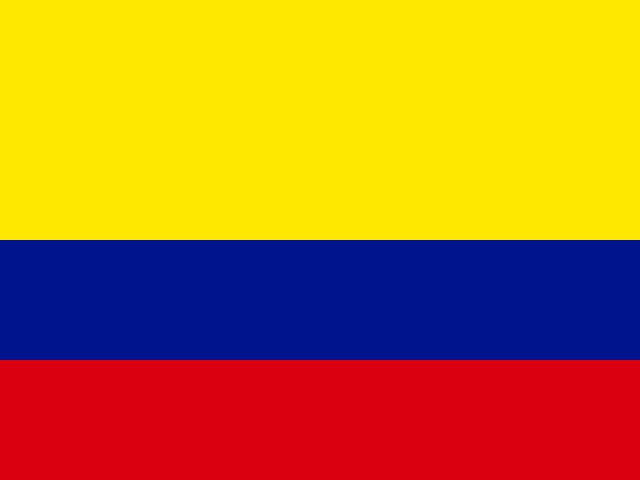
The traditional kit is yellow with navy and red trim, reflecting the Colombian flag. The home shirt has been yellow since the 1960s. The away kit alternates between red and navy. Adidas has supplied the kit since 2011, replacing Lotto and Reebok.
Stadium & Venue History
The Estadio Metropolitano Roberto Meléndez in Barranquilla, opened on 11 May 1986, is Colombia’s principal home venue and the FCF’s designated qualifying ground. The stadium has a capacity of approximately 46,692 and was the host of the 2011 FIFA U-20 World Cup. Other regular Colombia venues include Estadio El Campín (Bogotá) — site of the 2001 Copa América final — and the Estadio Pascual Guerrero (Cali). The FCF training centre is located at Sede Deportiva FCF in Bogotá.
Coaches & Managers Legacy
- Pre-1990: Pedro López, Efraín Sánchez, Carlos Salvador Bilardo (early career), Adolfo Pedernera.
- Francisco Maturana (1987–1994 in two stints, 2001 Copa América champion).
- Hernán Darío “Bolillo” Gómez (1995–1998, 2010–2014 various roles).
- José Pékerman (2012–2018, 2014 World Cup quarter-final, 2018 round of 16).
- Carlos Queiroz (2019–2020), Reinaldo Rueda (2021–2022).
- Néstor Lorenzo (since 2 June 2022) — 2024 Copa América final, 2026 World Cup qualification.
Iconic Players (long-serving / influential)
- 1960s–1980s: Marino Klinger, Willington Ortiz, Arnoldo Iguarán, Carlos Valderrama (debut 1985).
- Golden Generation (1989–1998): Carlos Valderrama (111 caps, 11 goals), Faustino Asprilla, Freddy Rincón, René Higuita, Andrés Escobar, Leonel Álvarez, Adolfo Valencia.
- 2000s–2010s: Iván Córdoba, Mario Yepes, David Ospina (129 caps record), Carlos Sánchez, Pablo Armero.
- 2010s–2020s: Radamel Falcao (36 goals top scorer), James Rodríguez (2014 Golden Boot, 1 goal in every World Cup match he played that tournament), Juan Cuadrado, Yerry Mina, Davinson Sánchez.
- Current: James Rodríguez (captain), Luis Díaz, Luis Sinisterra, Daniel Muñoz, Jefferson Lerma, Camilo Vargas, Richard Ríos.
Trophies & Honours
- FIFA World Cup: best finish quarter-finals 2014.
- Copa América: champions 2001; runners-up 1975, 2024; third place 1987, 1993, 1995, 2004, 2016, 2021, 2024 (third in modern format).
- CONCACAF Gold Cup: invited and reached semi-finals 2000, 2003, 2005.
- Copa América Centenario (2016): third place.
Peak Eras
- 1989–1994: Maturana / Valderrama “Golden Generation” — three consecutive World Cups, regional dominance.
- 2001: home Copa América title, all matches won, no goals conceded.
- 2014: World Cup quarter-final under Pékerman; James Rodríguez Golden Boot.
- 2022–2024: Lorenzo era 28-match unbeaten run, 2024 Copa América final.
Rivalries
- Argentina: 1993 5–0 World Cup qualifier, 2024 Copa América final, frequent World Cup-qualifying meetings.
- Brazil: long-running CONMEBOL fixtures including 1957 0–9 (Colombia’s heaviest defeat) and 2014 World Cup quarter-final.
- Venezuela: regional rivalry contested in qualifiers and Copa América.
- Peru: closely contested CONMEBOL fixtures.
- Ecuador: Andean derby with several controversial qualifiers.
Public Image — Bad PR / Controversies
- 1994 World Cup: pre-tournament death threats against squad players by drug-cartel-linked actors; defender Andrés Escobar’s murder in Medellín on 2 July 1994.
- 1989 Copa Libertadores: Atlético Nacional referee scandal led to a brief national-football suspension.
- FCF governance: multiple presidents (notably Luis Bedoya, banned by FIFA for life in 2016 in the FIFA corruption probe) have faced FIFA and Colombian judicial action.
- 2024 Copa América final: post-match crowd disturbances at Hard Rock Stadium delayed kick-off; investigations followed.
Australia Connection
The Socceroos and Colombia have met four times in senior international football. Colombia leads the head-to-head with two wins and two draws — Australia has never beaten Colombia. The most-recent fixture was a 3–0 Colombia win in an international friendly at MetLife Stadium in East Rutherford / New York City on 18 November 2025, with goals from James Rodríguez (76th-minute penalty), Luis Díaz (89th) and Jefferson Lerma (90+3); the match was Australia’s heaviest defeat under coach Tony Popovic. Earlier fixtures were a 0–0 draw at the 2014 FIFA World Cup warm-up cycle and a 2–0 Colombia win in 2018, plus a 2017 friendly draw in London.
Connections to Other Sports / Wider Football
The FCF also runs Colombia’s women’s, U-23, U-20, U-17 and futsal national programmes. Colombia’s club football is led historically by Atlético Nacional (Copa Libertadores 1989, 2016) and Once Caldas (Copa Libertadores 2004); both have supplied successive generations of senior internationals. Most senior squad members play their club football in Europe (Premier League, La Liga, Bundesliga) and Mexico’s Liga MX.
Potential Future Trajectory
Colombia enters the 2026 FIFA World Cup as a strong group-stage and round-of-32 contender. Lorenzo’s contract runs through the 2026 cycle, and the squad’s mix of established names (James Rodríguez, Luis Díaz, Davinson Sánchez) and emerging players (Richard Ríos, Daniel Muñoz, Luis Sinisterra) provides one of the deeper attacking pools in CONMEBOL. Beyond 2026, the FCF’s hosting bid for the 2027 Women’s World Cup (joint with Brazil bid) and continuity at U-20 / U-17 level will be the medium-term focus.
More World Cup 2026 Reading
WC 2026 context: See Colombia's WC 2026 group-stage form, squad and opponents →
 Best Betting Sites
 Best Online Casinos
 Blackjack Sites
 Online Pokies
 Fast Payout Casinos
 PayID Casinos
 New Casinos 2026