 Czechia at the World Cup — Full History
Key Facts
- The Football Association of the Czech Republic (Fotbalová asociace České republiky, FAČR) is the governing body; the senior team inherits the football-history record of Czechoslovakia, which was split following the country’s January 1993 dissolution.
- As Czechoslovakia, the team finished as FIFA World Cup runners-up twice — losing the 1934 final 1–2 to Italy in Rome (after extra time) and the 1962 final 1–3 to Brazil in Santiago de Chile — and won the 1976 UEFA European Championship in Yugoslavia, defeating West Germany on penalties (Antonín Panenka’s chipped winning kick).
- Czechoslovakia also won the 1980 Moscow Olympic Games men’s football tournament; the federation’s full senior honours list combines the 1934/1962 World Cup finals, the 1976 Euro title and 1980 Olympic gold.
- As the Czech Republic since 1993, the team’s best result was the runners-up finish at UEFA Euro 1996 in England, losing the final 1–2 to Germany on a Bierhoff golden-goal extra-time strike at Wembley.
- The Czech Republic also reached the semi-finals of UEFA Euro 2004, with a Karel Brückner-coached side built around Pavel Nedvěd, Tomáš Rosický, Petr Čech, Milan Baroš, Jan Koller and Vladimír Šmicer eliminated by Greece.
- All-time records: most caps Petr Čech with 124 appearances; top scorer Jan Koller with 55 goals.
- The Czech Republic qualified for the 2026 FIFA World Cup via the UEFA playoffs in March 2026, ending a 20-year men’s World Cup absence since Germany 2006; head coach Miroslav Koubek replaced Ivan Hašek after the failure to qualify automatically.
- 2026 WC playoff path: Czechia 2–2 Ireland (4–3 on penalties) in the semi-final on 26 March 2026; Czechia 2–2 Denmark (3–1 on penalties) in the final at Prague’s Fortuna Arena on 31 March 2026, with goalkeeper Matěj Kovář saving Anders Dreyer’s spot-kick.
- Czech Republic’s 2026 final-tournament group placement is Group A, alongside hosts Mexico, South Africa and Korea Republic, per the December 2025 draw.
- The senior captain is Ladislav Krejčí (confirmed March 2026); the squad’s most prominent attacker is Bayer Leverkusen striker Patrik Schick.
- Australia’s senior men’s record against the Czech Republic / Czechoslovakia: Czechoslovakia won six and drew two of eight friendlies between 1980 and 1991; Australia defeated the Czech Republic 4–0 in Sankt Pölten, Austria, on 1 June 2018 (the Czech Republic’s heaviest defeat to that point).
- The team’s primary home venue is the 19,370-capacity Fortuna Arena (Stadion Eden) in Prague, the long-standing home ground of SK Slavia Praha.
Czechia World Cup Vital Statistics
| Metric | Value |
|---|---|
| Federation founded | 1901 (predecessor); FAČR established 1993 (Czech Republic) |
| FIFA World Cup appearances (combined) | 10 — Czechoslovakia 8 (1934, 1938, 1954, 1958, 1962, 1970, 1982, 1990) + Czech Republic 2 (2006, 2026) |
| Best FIFA World Cup finish (combined) | Runners-up 1934, 1962 (both as Czechoslovakia) |
| UEFA Euro best finish | Winners 1976 (Czechoslovakia); runners-up 1996 (Czech Republic) |
| 1980 Olympic Games | Gold medal (Czechoslovakia) |
| Most caps (Czech Republic era) | Petr Čech — 124 |
| Top scorer (Czech Republic era) | Jan Koller — 55 |
| Current head coach | Miroslav Koubek (replaced Ivan Hašek) |
| Captain | Ladislav Krejčí |
| 2026 WC qualifying path | UEFA playoffs (Path D) |
| 2026 WC playoff results | SF Czechia 2-2 Ireland (4-3 pens, 26 March 2026); F Czechia 2-2 Denmark (3-1 pens, Prague, 31 March 2026) |
| 2026 WC final-tournament group | Group A — Mexico, Korea Republic, South Africa, Czechia |
| Home stadium | Fortuna Arena (Stadion Eden), Prague — capacity 19,370 |
Czechia at the World Cup — History And Profile
The Czech Republic national football team is the senior men’s representative side of the Football Association of the Czech Republic (Fotbalová asociace České republiky, FAČR). The federation was established in its current form in 1993 following the dissolution of Czechoslovakia, and the team inherits the FIFA-recognised competition record of the Czechoslovakia national team alongside its post-1993 results. The combined honours list places the Czech / Czechoslovak football tradition among the strongest in central Europe.
As Czechoslovakia, the team finished as FIFA World Cup runners-up at Italy 1934 — losing the Rome final 1–2 to Italy after extra time — and again at Chile 1962, with a Josef Masopust-led side eliminated 1–3 by Brazil in the final at Santiago de Chile. Czechoslovakia won the 1976 UEFA European Championship in Yugoslavia, defeating West Germany 5–3 on penalties in the final at Belgrade, with Antonín Panenka’s chipped final spot-kick — now widely cited as the original “Panenka penalty” — securing the trophy. The same federation also won the 1980 Moscow Olympic Games men’s football tournament. Through the 1980s and 1990s, players including Pavel Nedvěd (later 2003 Ballon d’Or winner with Juventus), Karel Poborský and Ivan Hašek bridged the federation’s late-Czechoslovak and early-Czech Republic eras.
The Czech Republic’s first major-tournament campaign as an independent nation came at UEFA Euro 1996 in England, where Dušan Uhrin’s side reached the final at Wembley before losing 1–2 to Germany on Oliver Bierhoff’s extra-time golden-goal strike. The Karel Brückner generation produced a second peak: Euro 2000 group-stage exit; quarter-final at Euro 2004 (eliminated by Greece in the semi-final, with the squad built around Nedvěd, Tomáš Rosický, Petr Čech, Milan Baroš — Euro 2004 Golden Boot — Jan Koller and Vladimír Šmicer); the round of 16 at the 2006 World Cup in Germany. The team did not return to a men’s World Cup until the 2026 cycle, a 20-year absence punctuated by Euro qualification cycles in 2008, 2012, 2016, 2020 and 2024.
The 2026 World Cup qualifying campaign was difficult. The Czech Republic finished outside the automatic qualifying place in its UEFA group under Ivan Hašek; Hašek’s tenure ended after the failure to qualify automatically, and Miroslav Koubek was appointed as his successor. The Czech Republic entered the UEFA playoffs as the Path D second-round qualifier. In the semi-final on 26 March 2026, Czechia drew 2–2 with the Republic of Ireland and won 4–3 on penalties; Patrik Schick scored a Czech penalty in the 27th minute. In the final on 31 March 2026 at the Fortuna Arena in Prague, Czechia drew 2–2 with Denmark and won the penalty shootout 3–1, with goalkeeper Matěj Kovář saving Anders Dreyer’s spot-kick and both Rasmus Højlund and Mathias Jensen missing for Denmark. The result confirmed the Czech Republic’s first World Cup appearance since 2006, and the December 2025 finals draw placed Czechia in Group A alongside hosts Mexico, South Africa and Korea Republic.
The current senior squad is built around captain Ladislav Krejčí (Sparta Praha / Girona), Bayer Leverkusen striker Patrik Schick (24 goals in 50 caps as a 30-year-old going into the playoffs), goalkeeper Matěj Kovář (Bayer Leverkusen, the playoff hero), and a midfield-engine cohort that includes Tomáš Souček (West Ham), Tomáš Cvancara, Adam Hložek, Lukáš Provod and Antonín Barák. Petr Čech (124 caps) and Jan Koller (55 goals) remain the federation’s all-time most-capped player and top scorer respectively as of the 2026 cycle.
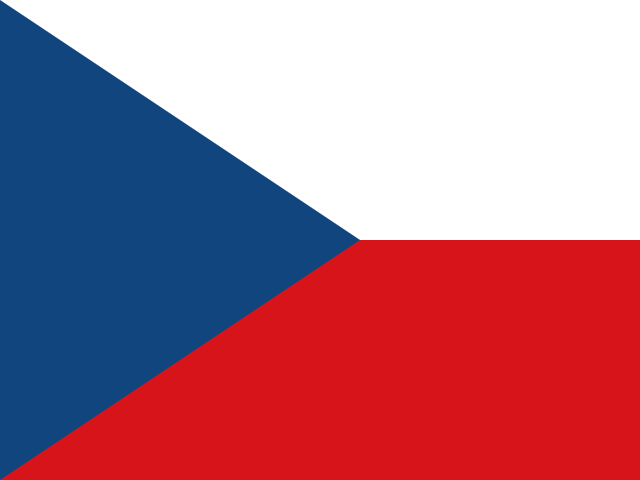
The team’s primary home venue is the 19,370-capacity Fortuna Arena (formerly Stadion Eden) in Prague, the long-standing home ground of Czech First League club SK Slavia Praha; selected qualifiers are also played at Generali Česká pojišťovna Aréna in Pilsen and Stadion u Nisy in Liberec. Czech Republic plays in red shirts, white shorts and blue socks, drawing on the national flag’s tricolour. Federation headquarters are in Prague.
FIFA’s December 2025 draw documentation lists the three Group A fixtures for Czechia as openers against Mexico, South Africa and Korea Republic, with all three matches scheduled across the host federation’s principal stadia between 11 June and 24 June 2026. The Czech Republic / Czechoslovakia–Australia bilateral has produced a long-running but unbalanced record. As Czechoslovakia, the team won six and drew two of eight friendlies against Australia between 1980 and 1991, with no Czechoslovak defeat. The Czech Republic and Australia have met once in the post-1993 era — a 1 June 2018 friendly in Sankt Pölten, Austria, won 4–0 by Australia and constituting the Czech Republic’s heaviest senior defeat to that point. The bilateral remains a friendly-only fixture; no senior Czech Republic-Australia match has been announced for the 2026 World Cup tournament window.
Detailed Profile
Crest, Colours & Kit Evolution
The Czech Republic plays in red shirts, white shorts and blue socks, drawing on the Czech tricolour. The crest carries the Bohemian Lion within the FAČR shield. Current kit supplier is Puma. Notable shirts include the 1996 Euro final retro design and the 2025 qualifying-cycle home strip.
Stadium History
The team’s primary home is the 19,370-capacity Fortuna Arena (formerly Stadion Eden) in Prague, the home ground of Czech First League club SK Slavia Praha. The 31 March 2026 World Cup qualifying playoff final win over Denmark was played at the Fortuna Arena. Selected qualifiers and friendlies are also played at Generali Česká pojišťovna Aréna in Pilsen and other regional venues. Strahov Stadium and Stadion Letná hosted earlier-era national-team fixtures.
Coaches & Managers Legacy
Czechoslovakia: Karel Petrů (1934 World Cup final), Rudolf Vytlačil (1962 World Cup final), Václav Ježek (1976 European Championship). Czech Republic: Dušan Uhrin (Euro 1996 final), Karel Brückner (Euro 2004 semi-finals; 2006 World Cup), Karel Jarolím, Vladimír Šmicer (interim), Pavel Vrba (multiple stints), Ivan Hašek (2024–2025), Miroslav Koubek (since late 2025).
Iconic Players
Czechoslovakia era: Antonín Puč, Oldřich Nejedlý (Golden Boot at the 1934 World Cup), Josef Masopust (1962 Ballon d’Or), Antonín Panenka (1976 Euro winning penalty), Pavel Nedvěd, Karel Poborský, Pavel Kuka. Czech Republic era: Petr Čech (124 caps), Jan Koller (55 goals), Pavel Nedvěd (Ballon d’Or 2003), Tomáš Rosický, Milan Baroš (Euro 2004 Golden Boot), Vladimír Šmicer, Patrik Berger. Modern era: Ladislav Krejčí (captain), Patrik Schick, Tomáš Souček, Matěj Kovář, Adam Hložek, Lukáš Provod.
Trophies & Honours
- FIFA World Cup runners-up: 1934, 1962 (both as Czechoslovakia).
- UEFA European Championship winners: 1976 (Czechoslovakia).
- UEFA European Championship runners-up: 1996 (Czech Republic).
- UEFA European Championship semi-finals: 1980 (Czechoslovakia), 2004 (Czech Republic).
- 1980 Moscow Olympic Games: gold medal (Czechoslovakia).
Peak Eras
- 1934–1938 inter-war Czechoslovakia (1934 World Cup final; 1938 quarter-final).
- 1962 Czechoslovakia World Cup final under Rudolf Vytlačil with Masopust and Lala Schroif.
- 1976 European Championship under Václav Ježek (Panenka final).
- 1996 Czech Republic Euro final under Dušan Uhrin (Nedvěd, Poborský, Šmicer).
- 2004 Czech Republic Euro semi-finals under Karel Brückner (Nedvěd, Rosický, Čech, Baroš, Koller).
Rivalries
The Czech Republic’s principal rivalries are regional. The Slovakia fixture (post-1993 split) is the closest equivalent to a derby. The Germany / West Germany fixture is the most consequential historical rivalry — defining moments include the 1976 Euro final win and the 1996 Euro final loss. Russia, Hungary, Croatia and Romania are the other long-running central / eastern European fixtures.
Supporters Culture
Czech home support is concentrated at the Fortuna Arena, with the supporters’ federation Fanklub Česká reprezentace travelling in volume to qualifiers. Sell-out home fixtures returned during the November 2025 / March 2026 playoff cycle.
Public Image — Bad PR / Controversies
The early-2024 Hašek tenure produced sustained domestic criticism after a series of qualifying-campaign losses, leading to Hašek’s departure and Miroslav Koubek’s appointment ahead of the March 2026 playoffs. The Czech Republic / Czechoslovakia federation has periodically been the subject of UEFA disciplinary action over crowd conduct in qualifying fixtures.
Charity & Community
The FAČR runs grassroots and community programmes through 14 regional federations; senior players have repeatedly featured in matchday community-visit programmes and federation-sponsored youth tournaments.
Australia Connection
The Czech Republic / Czechoslovakia–Australia bilateral has produced one of the more imbalanced records on Australia’s all-time fixture list. As Czechoslovakia, the team won six and drew two of eight friendlies against Australia between 1980 and 1991, with no Czechoslovak defeat across that span. The Czech Republic has met Australia once in the post-1993 era — a 1 June 2018 friendly in Sankt Pölten, Austria, won 4–0 by Australia and constituting the Czech Republic’s heaviest senior defeat to that point. The bilateral remains a friendly-only fixture; no senior Czech Republic–Australia match has been announced for the 2026 World Cup tournament window.
Connections to Other Federations / Celebrity Figures
The FAČR maintains close technical relationships with neighbouring central-European federations (Slovakia, Hungary, Austria, Germany, Poland) and has long-standing club-football pathways into the Bundesliga (Bayer Leverkusen, Borussia Dortmund), the Premier League (Chelsea, West Ham, Manchester United, Arsenal) and Serie A (Juventus, Lazio). Pavel Nedvěd’s Juventus career — captain through the 2003 Champions League final and 2003 Ballon d’Or — and Petr Čech’s Chelsea / Arsenal career are the highest-profile long-form club connections.
Potential Future Trajectory
With qualification for the 2026 FIFA World Cup confirmed via the Prague playoff final shootout win over Denmark on 31 March 2026 and a Group A draw with hosts Mexico, South Africa and Korea Republic, Czech Republic’s medium-term outlook centres on (a) Miroslav Koubek’s contract terms beyond the 2026 finals, (b) the integration of Schick and Krejčí alongside the Souček-Hložek midfield core, and (c) the federation’s pathway from a 20-year World Cup absence into a settled major-tournament rotation. Euro 2028 (United Kingdom and Ireland) opens immediately after the 2026 finals.
More World Cup 2026 Reading
WC 2026 context: See Czechia's WC 2026 group-stage form, squad and opponents →
 Best Betting Sites
 Best Online Casinos
 Blackjack Sites
 Online Pokies
 Fast Payout Casinos
 PayID Casinos
 New Casinos 2026