 DR Congo at the World Cup — Full History
Key Facts
- The team is administered by the Fédération Congolaise de Football Association (FECOFA), founded in 1919, making it one of the oldest football federations in Africa.
- Nicknamed Les Léopards (the Leopards), the team has played under three national identities — Belgian Congo (pre-1960), Congo-Kinshasa, and Zaire (1971–1997) — before reverting to the current DR Congo name.
- DR Congo are two-time Africa Cup of Nations champions (1968 in Ethiopia and 1974 in Egypt), making them one of only seven African countries to have won AFCON multiple times.
- As Zaire, the team became the first sub-Saharan African team to qualify for a FIFA World Cup, appearing at the 1974 finals in West Germany.
- The 2026 World Cup will be DR Congo’s second appearance, ending a 52-year absence from the tournament — qualification was sealed via the inter-confederation playoff with a 1–0 extra-time win over Jamaica in Zapopan, Mexico, on 31 March 2026 (Axel Tuanzebe goal).
- Sébastien Desabre, the French coach, has been head coach since August 2022 and rebuilt the squad with a heavy reliance on dual-eligible Europe-based players (Wan-Bissaka, Bakambu, Sadiki, Tuanzebe).
- Captain Chancel Mbemba is also the most-capped player in DR Congo history with 107 appearances.
- Striker Dieumerci Mbokani is the all-time top scorer with 22 goals.
- The team also won the African Nations Championship (CHAN, the home-based version of AFCON) in 2009 and 2016.
- Home internationals are played at the Stade des Martyrs in Lingwala, Kinshasa, opened on 14 September 1994 with a capacity of approximately 80,000 — the largest stadium in DR Congo.
- Sky Sports’ qualification feature framed the Desabre rebuild as having functioned “amid reports of months without pay and substandard training conditions”, contextualising the difficulty of the qualification environment.
- The team is colloquially also referred to as Congo-Kinshasa to distinguish it from Congo-Brazzaville (Republic of the Congo).
DR Congo World Cup Vital Statistics
| Metric | Value |
|---|---|
| Federation founded | 1919 (FECOFA) |
| FIFA World Cup appearances | 2 (1974 as Zaire, 2026) |
| Africa Cup of Nations titles | 2 (1968, 1974) |
| African Nations Championship titles | 2 (2009, 2016) |
| Most caps | Chancel Mbemba (107) |
| All-time top scorer | Dieumerci Mbokani (22) |
| FIFA ranking | 46 |
| Head coach | Sébastien Desabre |
| Captain | Chancel Mbemba |
| Home stadium | Stade des Martyrs, Kinshasa (capacity ~80,000, opened 1994) |
| 2026 WC qualification | Inter-confederation playoff vs Jamaica (1–0 a.e.t., Tuanzebe), 31 March 2026 |
DR Congo at the World Cup — History And Profile
DR Congo’s national football team — Les Léopards — has a deep but interrupted World Cup history. As Zaire under Mobutu Sese Seko’s 1971 country-renaming, the team became the first sub-Saharan African nation to qualify for a FIFA World Cup, appearing at West Germany 1974. After 52 years of absence, the team has now returned to football’s marquee tournament, qualifying for the 2026 World Cup via the inter-confederation playoff in Zapopan, Mexico, on 31 March 2026 with a 1–0 extra-time win over Jamaica, Axel Tuanzebe scoring the decisive goal.
The Fédération Congolaise de Football Association (FECOFA) was founded in 1919, making it among the oldest football federations on the continent. The team has competed under three names: Belgian Congo until independence in 1960, Congo-Kinshasa from independence to 1971, and Zaire from 1971 to 1997 under Mobutu’s national rebranding. Following the 1996–1997 First Congo War and the country’s renaming to the Democratic Republic of the Congo, the team has played as DR Congo since.
The country’s two greatest pre-2026 achievements both came under the Zaire name. The first was the 1968 Africa Cup of Nations, won in Ethiopia after a 1–0 final victory over Ghana — at that point only the second African country to claim a continental title. The second was the 1974 AFCON in Egypt, with a 2–2 draw in the final replayed and won 2–0 against Zambia, in a side coached by Yugoslav-born Blagoje Vidinić. The 1974 Zaire team progressed directly to the FIFA World Cup later that year, becoming the continent’s first sub-Saharan finalists. The campaign in West Germany was difficult — the side conceded heavily, including a 9–0 defeat by Yugoslavia, in conditions of organisational neglect and reported political interference from Mobutu’s apparatus.
After 1974, DR Congo went 52 years without a World Cup appearance — the longest such gap of any 2026 qualifier. AFCON appearances continued throughout, with quarter-final and semi-final runs in subsequent decades, but the World Cup proved out of reach until the Desabre era. The African Nations Championship (CHAN), the locally-based variant of AFCON, was won by DR Congo in 2009 and 2016, providing continuity for domestically-based talent.
The transformative shift began in August 2022, when French coach Sébastien Desabre — previously of Uganda, Espérance Tunis, USM Alger and Pyramids — took the head-coach role. Desabre’s tenure has been built on a dual-eligibility recruitment programme that brought in defenders Aaron Wan-Bissaka (capped by England), centre-backs and midfielders Axel Tuanzebe (capped by England U-21s) and Noah Sadiki (eligible for Belgium), alongside continuity figures captain Chancel Mbemba (Newcastle United, since transferred), striker Cédric Bakambu and forward Dieumerci Mbokani. Sky Sports’ qualification feature noted that Desabre’s rebuild was conducted “amid reports of months without pay and substandard training conditions”, framing the operating environment.
The 2026 World Cup qualifying campaign in CAF Group B saw DR Congo finish second behind Senegal, claiming the highest-placed runners-up slot to advance to the CAF playoff phase. Three subsequent decisive matches — against Cameroon and Nigeria in the CAF playoff bracket, and against Jamaica in the inter-confederation final — produced the most dramatic qualification path of any 2026 finalist. In the Nigeria semi-final, Desabre famously substituted goalkeeper Lionel Mpasi for Timothy Fayulu before the penalty shootout, the kind of high-leverage tactical decision that defined the campaign. The 1–0 final win over Jamaica in Zapopan on 31 March 2026 — Tuanzebe scoring in extra time — completed the qualification.
DR Congo’s home matches are played at the Stade des Martyrs in Lingwala, Kinshasa, opened on 14 September 1994 (originally as Stade Kamanyola, renamed in 1997 to honour four ministers executed by the Mobutu regime in June 1966). The stadium has an approximate capacity of 80,000 and is the largest sports venue in the country. Maintenance challenges, including crowd-crush incidents during 2022 and 2024 concerts, have been documented in public records.
The country’s principal football rivalries are with regional neighbours: Republic of Congo (the cross-river derby with Brazzaville), Cameroon (continued AFCON and World Cup playoff fixtures), Nigeria (the 2026 CAF playoff in Morocco), Zambia (1974 AFCON final) and Ghana (1968 AFCON final). The Mbemba era has produced a generation of Europe-based talent that is most likely to define the post-2026 outlook.
Looking forward, DR Congo’s outlook centres on consolidating the Desabre rebuild and using the 2026 World Cup to anchor a generation. Generational succession from Mbemba and Mbokani to younger players such as Sadiki, Tuanzebe, Wan-Bissaka and Theo Bongonda is the strategic axis. The 2027 AFCON cycle will be the next test of whether the 2026 World Cup berth becomes the start of a sustained era.
Detailed Profile
Crest, Colours & Kit Evolution
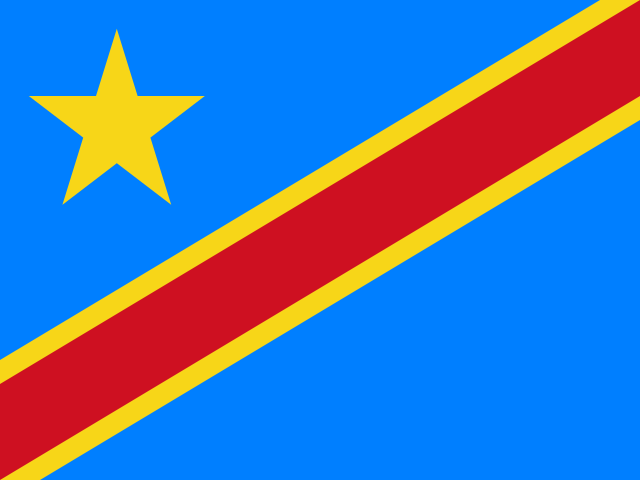
DR Congo plays primarily in blue shirts with yellow trim, drawn from the national flag’s blue-and-yellow palette. The Leopard motif on the crest dates from the Zaire era and has been retained through naming changes. Modern kit suppliers have rotated through O’Neills and other smaller-market suppliers; the 2026 cycle features a new kit deal which Dawan Africa has covered.
Stadium & Premises History
The Stade des Martyrs in Kinshasa, opened 14 September 1994 by a Chinese-built consortium for approximately $38 million, replaced the older Stade Tata Raphaël as the principal national venue. Capacity sits at approximately 80,000 — the largest in DR Congo. It hosted the 2023 Jeux de la Francophonie. The stadium was renamed in 1997 from Stade Kamanyola to honour the four ministers executed by Mobutu’s regime in June 1966.
Iconic Players
- Zaire era (1968–1997): Pierre Ndaye Mulamba (1974 AFCON top scorer with 9 goals — a tournament record that stood for decades), Mwepu Ilunga (memorably booked at 1974 World Cup for the famous “free-kick rush”), Mukombo Mwamba.
- 2000s–2010s: Lomana LuaLua (Newcastle, Portsmouth), Trésor Mputu, Dieumerci Mbokani (record goalscorer).
- 2020s and 2026 cycle: Chancel Mbemba (captain, record caps), Cédric Bakambu, Yoane Wissa, Aaron Wan-Bissaka, Axel Tuanzebe, Noah Sadiki, Theo Bongonda, Timothy Fayulu.
Coaches & Managers Legacy
Modern coaching lineage includes Blagoje Vidinić (1974 AFCON and World Cup), Otto Pfister, Henri Depireux, Hector Cuper, Florent Ibengé (CHAN 2016), Christian Nsengi-Biembe, Hector Cuper (second spell) and Sébastien Desabre (since August 2022). Desabre’s predecessor was the focus of a long-running federation funding dispute described in Sky Sports’ qualification report.
Trophies & Honours
- AFCON: champions 1968, 1974; runners-up never; multiple semi-finals.
- African Nations Championship (CHAN): champions 2009 and 2016.
- 2026 FIFA World Cup qualification — first since 1974.
Peak Eras
- 1968–1974: AFCON double, World Cup debut as Zaire — the country’s golden era.
- 2009–2016: CHAN double under Florent Ibengé.
- 2022–present: Desabre rebuild ending 52-year World Cup gap.
Rivalries
- Republic of Congo (Brazzaville derby).
- Cameroon: AFCON and World Cup playoff history.
- Nigeria: 2026 CAF playoff.
- Zambia: 1974 AFCON final.
- Ghana: 1968 AFCON final.
Public Image — Bad PR / Controversies
The 1974 World Cup squad faced documented neglect by the Mobutu regime, including the famous Zaire team rumour around the dollar-incentive shortfall ahead of the Yugoslavia game. public records team’s defeats — particularly the 9–0 to Yugoslavia — must be read against political and organisational pressures. More recently, Sky Sports has reported “months without pay” episodes during qualification preparations. The team’s 2009 AFCON Group D exit produced significant criticism of FECOFA governance.
Australia Connection
No documented Australia connection. Australia’s senior men’s team has not played DR Congo (or its predecessor Zaire) in any FIFA-listed match’s Socceroos head-to-head archive.
Potential Future Trajectory
The post-2026 outlook centres on consolidating the Desabre rebuild. Generational succession from Mbemba and Bakambu to Sadiki, Tuanzebe and Bongonda is the strategic axis. AFCON 2027 will be the test of whether the 2026 World Cup berth marks a single peak or the start of a sustained era.
More World Cup 2026 Reading
WC 2026 context: See DR Congo's WC 2026 group-stage form, squad and opponents →
 Best Betting Sites
 Best Online Casinos
 Blackjack Sites
 Online Pokies
 Fast Payout Casinos
 PayID Casinos
 New Casinos 2026