 France at the World Cup — Full History
Key Facts
- The France national football team played its first international match on 1 May 1904, a 3–3 draw with Belgium in Brussels; the side has been administered by the Fédération Française de Football (FFF) since the federation’s establishment in 1919.
- France has won the FIFA World Cup twice — in 1998 (3–0 over Brazil at the Stade de France) and in 2018 (4–2 over Croatia in Moscow).
- France reached the World Cup final on two further occasions, losing the 2006 final to Italy on penalties (1–1 a.e.t.) and the 2022 final to Argentina on penalties (3–3 a.e.t.).
- The team has won the UEFA European Championship twice (1984 and 2000) and the inaugural UEFA Nations League in 2021.
- Hugo Lloris holds the all-time appearance record (145 caps); Olivier Giroud is the all-time top scorer (57 goals).
- Didier Deschamps has confirmed he will leave the head coach role when his contract expires after the 2026 FIFA World Cup, ending a tenure that began in July 2012.
- Kylian Mbappé serves as captain; FIFA’s April 2026 ranking placed France 1st in the world.
- France topped UEFA qualification Group D for the 2026 World Cup with a +12 goal difference, finishing first ahead of Ukraine across an eight-match programme between September and November 2025.
- The 2010 South Africa World Cup is remembered for the “Knysna mutiny”, in which the squad refused to train after Nicolas Anelka’s expulsion; France exited at the group stage and the FFF imposed bans on several players.
- The team’s primary home is the Stade de France in Saint-Denis (capacity 80,698); training is centralised at the FFF’s INF Clairefontaine academy south-west of Paris.
France World Cup Vital Statistics
| Metric | Value |
|---|---|
| First international | 1 May 1904, drew 3–3 vs Belgium (Brussels) |
| FIFA World Cups won | 2 (1998, 2018) |
| World Cup final appearances | 4 (1998, 2006, 2018, 2022) |
| UEFA European Championship titles | 2 (1984, 2000) |
| UEFA Nations League titles | 1 (2021) |
| FIFA ranking | 1st |
| Most caps | Hugo Lloris (145) |
| All-time top scorer | Olivier Giroud (57 goals) |
| Current head coach | Didier Deschamps (since 8 July 2012; departing post-2026 WC) |
| Current captain | Kylian Mbappé |
| 2026 WC qualification | Topped UEFA Group D over Ukraine, Iceland, Azerbaijan |
| Governing body | Fédération Française de Football (FFF, founded 1919) |
France at the World Cup — History And Profile
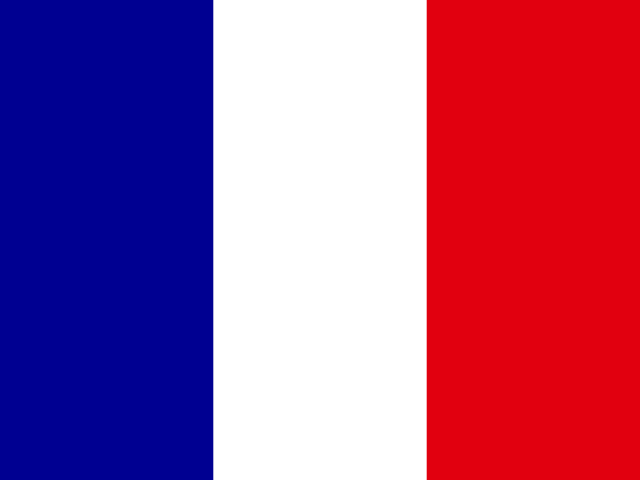
The France national football team, known as Les Bleus, is one of European football’s defining sides of the modern era and the only national team to hold both the FIFA World Cup and the UEFA European Championship simultaneously across two distinct cycles, in 1998–2000 and again — with the World Cup and Nations League — in 2018–2021. The team played its first international match on 1 May 1904, drawing 3–3 with Belgium in Brussels. Administration passed to the Fédération Française de Football (FFF) on the federation’s formation in 1919, and the side has worn the blue, white and red of the French tricolour throughout its history.
France’s competitive identity emerged through several distinct generations. The 1958 World Cup squad, built around Reims forward Just Fontaine — whose 13 goals at that single tournament remain a World Cup record — finished third in Sweden, France’s first global podium. The Michel Platini era of the early 1980s delivered the country’s first major trophy: a 2–0 win over Spain in Paris on 27 June 1984 secured the European Championship at the Parc des Princes. Platini captained the team and was the tournament’s top scorer with nine goals across five matches, a record that has never been matched at a single Euros.
The defining cycle, however, opened on 12 July 1998 in Saint-Denis, when a France side coached by Aimé Jacquet and captained by Didier Deschamps defeated Brazil 3–0 to win the FIFA World Cup on home soil. Zinedine Zidane, the playmaker shaped at Cannes, Bordeaux and Juventus, scored two first-half headers; Emmanuel Petit added a third in stoppage time. Two years later, on 2 July 2000 in Rotterdam, Roger Lemerre’s France beat Italy 2–1 after extra time to claim the European Championship and complete a back-to-back global-and-continental double. That side, anchored by Marcel Desailly, Lilian Thuram, Patrick Vieira and Thierry Henry — France’s leading scorer until Giroud overtook him — defined the country’s “Black-Blanc-Beur” identity and remains the benchmark for subsequent generations.
The post-2000 cycle dipped sharply: France exited the 2002 World Cup at the group stage as defending champions, and the 2006 final in Berlin ended in defeat to Italy on penalties after Zidane’s headbutt on Marco Materazzi led to his red-card dismissal in extra time. The 2010 South Africa World Cup was the squad’s worst public moment: a player revolt at the team’s Knysna training base — the so-called “Knysna mutiny” — followed Nicolas Anelka’s expulsion for a dressing-room incident, and France exited at the group stage. The FFF disciplinary commission later imposed match bans on Anelka, Patrice Evra, Franck Ribéry and Jérémy Toulalan.
Didier Deschamps was appointed head coach on 8 July 2012. His side reached the Euro 2016 final on home soil, losing 0–1 to Portugal in extra time, then won the 2018 FIFA World Cup with a 4–2 final defeat of Croatia in Moscow on 15 July 2018; Mbappé, then 19, became the first teenager to score in a World Cup final since Pelé in 1958. France added the inaugural UEFA Nations League in 2021 — beating Spain 2–1 in Milan — and reached a fourth World Cup final in 2022, losing to Argentina on penalties after a 3–3 draw in Lusail.
The team’s contemporary core is built around Mbappé as captain, with William Saliba and Dayot Upamecano in central defence, Aurélien Tchouaméni and Eduardo Camavinga in midfield, and Ousmane Dembélé and Michael Olise in support of Mbappé. France topped UEFA 2026 World Cup qualification Group D over Ukraine, Iceland and Azerbaijan with a +12 goal difference across eight matches between September and November 2025, and was ranked 1st in the FIFA April 2026 standings. Deschamps has confirmed publicly that the 2026 World Cup will be his final tournament, with the FFF expected to appoint a successor in the second half of 2026.
The team plays primarily at the Stade de France in Saint-Denis (capacity 80,698, opened in 1998 for that year’s World Cup) and trains at the FFF’s INF Clairefontaine academy south-west of Paris, where the entire 1998 World Cup-winning squad had been assembled in residence in the weeks before the tournament. Principal rivalries are with Belgium, England, Germany, Italy, Portugal, Spain and — since the 2022 final — Argentina. The kit supplier is Nike (since 2011); two stars sit above the FFF crest in recognition of the 1998 and 2018 World Cup titles. France’s senior women’s side, also administered by the FFF, is Les Bleues; both senior teams use the same crest and colour palette, and the federation’s commercial portfolio is among the most highly valued in European football. The 2026 World Cup will be Deschamps’s seventh successive senior tournament as head coach, the longest continuous senior France men’s coaching tenure on record.
Detailed Profile
Federation Leadership
The Fédération Française de Football (FFF), founded in 1919, administers all France senior, youth and women’s national teams. Philippe Diallo serves as FFF president (elected June 2023, succeeding Noël Le Graët). The FFF is headquartered in Paris and operates the INF Clairefontaine training academy.
Crest, Colours & Kit Evolution
France has worn variations of blue (home), white (away) and red since 1904. The current crest features a stylised cockerel — a long-running national symbol — over the FFF acronym. Kit suppliers in the modern era have included Adidas (1972–2010) and Nike (since 2011). Two stars sit above the crest in recognition of the 1998 and 2018 World Cup titles.
Stadium & Premises History
France does not maintain a single national stadium dedicated solely to the men’s senior team, but the Stade de France in Saint-Denis (opened 28 January 1998, capacity 80,698) has hosted the majority of major home fixtures since the 1998 World Cup. The Parc des Princes — used for the Euro 1984 final — and provincial venues including Marseille (Stade Vélodrome), Lyon (Groupama Stadium) and Lille (Stade Pierre-Mauroy) also host friendlies and qualifiers. Training is centralised at INF Clairefontaine.
Iconic Players
- Pre-1980s: Just Fontaine (13 goals, 1958 World Cup), Raymond Kopa.
- 1980s: Michel Platini (Euro 1984 top scorer with 9 goals), Jean Tigana, Alain Giresse, Luis Fernández.
- 1998–2006 generation: Zinedine Zidane, Marcel Desailly, Lilian Thuram, Patrick Vieira, Thierry Henry, Fabien Barthez, Emmanuel Petit, Didier Deschamps, Laurent Blanc.
- 2018–present: Hugo Lloris (145 caps), Olivier Giroud (57 goals — record), Antoine Griezmann, Paul Pogba, Raphaël Varane, N’Golo Kanté, Kylian Mbappé.
Coaches & Managers Legacy
Notable head-coach lineage in the modern era: Michel Hidalgo (1976–1984, Euro 1984), Henri Michel (1984–1988), Aimé Jacquet (1994–1998, 1998 World Cup), Roger Lemerre (1998–2002, Euro 2000), Jacques Santini (2002–2004), Raymond Domenech (2004–2010, 2006 final, 2010 group exit), Laurent Blanc (2010–2012), and Didier Deschamps (since 8 July 2012; 2018 World Cup, 2021 Nations League, 2016 and 2022 finalists; departing post-2026 World Cup).
Trophies & Honours
- FIFA World Cup: champions 1998, 2018; runners-up 2006, 2022; third place 1958, 1986.
- UEFA European Championship: champions 1984, 2000; runners-up 2016.
- UEFA Nations League: champions 2021.
- FIFA Confederations Cup: champions 2001, 2003.
- Olympic gold: 1984 Los Angeles (men’s tournament).
Peak Eras
- 1982–1986 Platini era: Euro 1984 champion and World Cup semi-finalists in both 1982 and 1986.
- 1998–2000 Jacquet–Lemerre era: World Cup champions, Euro champions and FIFA Confederations Cup winners.
- 2018–2022 Deschamps era: World Cup champions 2018, finalists 2022, Nations League champions 2021.
Rivalries
- Germany: a long-running European rivalry with the 1982 and 1986 World Cup semi-finals (both won by West Germany), the 2014 World Cup quarter-final (1–0 to Germany) and the 2016 Euro semi-final (2–0 to France).
- Italy: 2000 European Championship final (won 2–1 by France) and 2006 World Cup final (won by Italy on penalties).
- England: a frequent friendly and tournament fixture, including a 3–1 France quarter-final win at the 2022 World Cup.
- Argentina: rekindled by the 2022 World Cup final loss in Lusail.
Public Image — Bad PR / Controversies
- 2010 Knysna mutiny: the squad refused to train at its World Cup base after Nicolas Anelka’s expulsion; France exited at the group stage and the FFF imposed bans on Anelka, Patrice Evra, Franck Ribéry and Jérémy Toulalan.
- 2006 World Cup final: Zinedine Zidane’s red card for headbutting Marco Materazzi in extra time of his last competitive appearance.
- 2010s “sex-tape” / Valbuena affair: Karim Benzema was excluded from the senior squad between 2015 and 2021 amid a blackmail investigation tied to teammate Mathieu Valbuena; Benzema was convicted in November 2021 (suspended sentence) and recalled briefly thereafter.
Charity & Community
The FFF runs the “Programme Éducatif Fédéral” community curriculum across French amateur football, and France internationals regularly participate in the federation’s Téléthon and Restos du Cœur events. The 1998 squad’s “Black-Blanc-Beur” identity remains a frequent reference point in French public discourse on integration.
Australia Connection
Limited but notable: Didier Deschamps coached Olympique de Marseille from 2009 to 2012 in a period when the club hosted multiple friendlies against Australian opposition; no France senior coach has held a Socceroos role. France and Australia met at the 2018 World Cup group stage in Kazan on 16 June 2018, France winning 2–1 with the help of the tournament’s first VAR-awarded penalty (converted by Antoine Griezmann); the sides also met in the 2022 World Cup group stage in Al Wakrah on 22 November 2022, France winning 4–1. No documented coaching crossover.
Connections to Other Federations / Celebrity Figures
French football’s coaching tree is unusually globally distributed: Arsène Wenger (Arsenal, AS Monaco), Gérard Houllier (Liverpool), Zinedine Zidane (Real Madrid; three Champions League titles 2016–2018), Didier Deschamps (national team) and Thierry Henry (Belgium assistant; Monaco; Montreal Impact) all built careers spanning France and the wider European or North American game. The FFF maintains close working relationships with UEFA in Nyon and FIFA in Zürich.
Potential Future Trajectory
With Deschamps confirmed to depart after the 2026 World Cup, the FFF is expected to appoint a new head coach in the second half of 2026. Under-25 internationals William Saliba, Dayot Upamecano, Aurélien Tchouaméni, Eduardo Camavinga, Michael Olise and Mbappé form the core of a squad expected to compete deep at the 2026 World Cup and the Euro 2028 cycle. The team carries top-of-table FIFA ranking and a deep player pool through Ligue 1 and the Premier League into the tournament.
More World Cup 2026 Reading
WC 2026 context: See France's WC 2026 group-stage form, squad and opponents →
 Best Betting Sites
 Best Online Casinos
 Blackjack Sites
 Online Pokies
 Fast Payout Casinos
 PayID Casinos
 New Casinos 2026