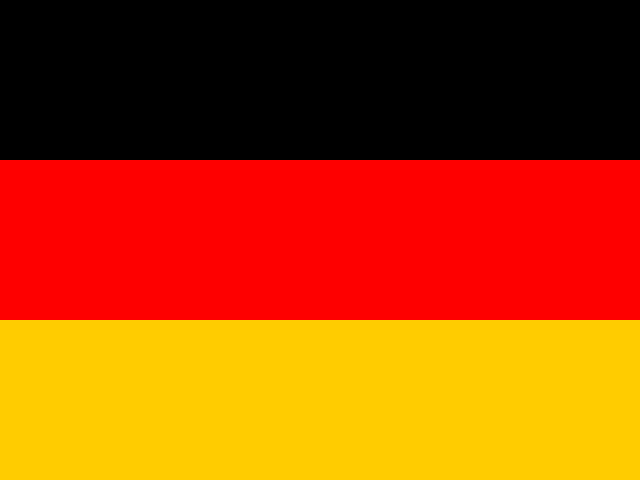
 Germany at the World Cup — Full History
Key Facts
- 4 FIFA World Cup titles — 1954, 1974, 1990, 2014 — second only to Brazil’s five at the senior men’s level.
- 3 UEFA European Championship titles — 1972, 1980, 1996 — joint with Spain at the time of writing.
- First international: 5 April 1908, lost 3–5 to Switzerland in Basel; the Deutscher Fußball-Bund (DFB) had been founded eight years earlier on 28 January 1900.
- 1954 World Cup final (“Miracle of Bern”): West Germany defeated Hungary 3–2 in Bern, ending the Magyars’ 32-match unbeaten run.
- 2014 World Cup: Germany became the first European team to win a World Cup staged in the Americas, defeating Argentina 1–0 in Rio de Janeiro on 13 July 2014; the same campaign included a 7–1 semi-final defeat of host Brazil in Belo Horizonte.
- Euro 2024 on home soil: Germany reached the quarter-final and lost 1–2 to Spain after extra time; the tournament was Julian Nagelsmann’s first major competition in charge.
- 2026 World Cup qualification: Germany topped UEFA Group A with 15 points from 6 matches (5 wins, 1 loss), securing direct qualification.
- Head coach Julian Nagelsmann (appointed 22 September 2023) had his contract extended by the DFB through Euro 2028; Joshua Kimmich is captain.
- All-time top scorers: Miroslav Klose (71 goals — also the all-time World Cup top scorer with 16 goals across 4 tournaments) and Gerd Müller (68 goals in 62 matches).
- Most-capped: Lothar Matthäus (150 caps), the only player to have appeared at five FIFA World Cups (1982–1998).
Germany World Cup Vital Statistics
| Metric | Value |
|---|---|
| First international | 5 April 1908, lost 3–5 vs Switzerland (Basel) |
| FIFA World Cups won | 4 (1954, 1974, 1990, 2014) |
| World Cup final appearances | 8 (1954, 1966, 1974, 1982, 1986, 1990, 2002, 2014) |
| UEFA European Championship titles | 3 (1972, 1980, 1996) |
| Euro 2024 result | Quarter-final, lost 1–2 to Spain (a.e.t.) |
| 2026 WC qualification | Topped UEFA Group A, 15 pts (5W-1L) |
| Most caps | Lothar Matthäus (150) |
| All-time top scorer | Miroslav Klose (71) |
| Current head coach | Julian Nagelsmann (since 22 Sept 2023, contract through Euro 2028) |
| Current captain | Joshua Kimmich |
| Governing body | Deutscher Fußball-Bund (DFB, founded 28 Jan 1900) |
Germany at the World Cup — History And Profile
Germany sit at four FIFA World Cup titles (1954, 1974, 1990, 2014), three UEFA European Championships (1972, 1980, 1996) and eight World Cup final appearances — production levels matched in modern men’s international football only by Brazil. The Deutscher Fußball-Bund (DFB) was founded on 28 January 1900 in Leipzig, and the team played its first international on 5 April 1908, a 3–5 loss to Switzerland in Basel. Between the 1949 partition and the 1990 reunification, two German teams competed internationally: the Federal Republic side (West Germany), which the DFB and FIFA recognise as the legal predecessor of the current national team, and East Germany’s Deutscher Fußball-Verband side (1952–1990).
The defining early data point is the 1954 final in Bern. West Germany — debutants among the post-war giants and rank outsiders against a Hungary side unbeaten in 32 matches — won 3–2 in heavy rain on 4 July 1954 at the Wankdorf Stadium, the result canonised in German memory as the “Miracle of Bern” and credited as a foundation event for post-war federal-republic identity. The 1972 squad coached by Helmut Schön — Beckenbauer, Müller, Netzer, Maier — won the European Championship in Belgium with a 3–0 final defeat of the Soviet Union, a result Schön and Beckenbauer would replicate by winning the 1974 World Cup at home (2–1 over the Netherlands in Munich).
The 1980 European Championship in Italy delivered a third senior trophy under Jupp Derwall (2–1 over Belgium), and the 1990 World Cup in Italy a third world title under Franz Beckenbauer’s coaching — 1–0 over Argentina in Rome on a late Andreas Brehme penalty. Reunification followed in October 1990; the DFB absorbed East German football and ran a single combined senior side from then forward. Berti Vogts succeeded Beckenbauer and led Germany to Euro 1996 in England (2–1 over the Czech Republic in the final at Wembley, won by an Oliver Bierhoff golden goal).
The 2000s opened with a low — group exit at Euro 2000 — before the Rudi Völler 2002 World Cup runner-up finish (lost 0–2 to Brazil). Jürgen Klinsmann’s 2006 home World Cup ended in a third-place finish but is widely credited with the modernisation of the DFB youth and tactical programme that produced the 2014 generation. Joachim Löw, Klinsmann’s assistant, took over in 2006 and ran the senior team for 15 years (2006–2021). Löw’s defining tournament was the 2014 World Cup in Brazil: a 1–0 final win over Argentina in Rio de Janeiro on 13 July 2014, with Mario Götze’s 113th-minute extra-time goal, a result that made Germany the first European team to win the trophy on the South American continent. The same campaign included the 7–1 semi-final defeat of host Brazil in Belo Horizonte on 8 July 2014 — Germany’s seventh-most-watched goal sequence in DFB television history at the time.
Three group-stage exits in successive major tournaments followed: the 2018 World Cup in Russia (group exit as defending champions), Euro 2020 (last 16 to England), and the 2022 World Cup in Qatar (group exit). Hansi Flick — World Cup-winning assistant in 2014, then Bayern Munich treble-winning head coach — took over in August 2021 but was dismissed in September 2023 after a 1–4 home defeat to Japan. Julian Nagelsmann was appointed on 22 September 2023 on an initial deal to Euro 2024. Nagelsmann led the host nation to a Euro 2024 quarter-final, where Germany lost 1–2 after extra time to eventual champions Spain in Stuttgart on 5 July 2024. The DFB extended his contract on the back of that performance through the 2028 European Championship.
The current squad core combines Bayer Leverkusen’s title-winning generation (Florian Wirtz, Jonathan Tah) with Bayern Munich’s spine (Joshua Kimmich, Jamal Musiala, Leroy Sané) and Manchester City forward Kai Havertz. Germany topped UEFA 2026 World Cup qualification Group A with 15 points from six matches (five wins, one loss), securing direct qualification under streamlined European group rules. Captain Joshua Kimmich anchors the midfield; Manuel Neuer’s senior international career ended after Euro 2024, with Marc-André ter Stegen (FC Barcelona) as senior goalkeeper.
Germany has no permanent national stadium. Senior internationals rotate among the Allianz Arena (Munich), Olympiastadion (Berlin), Signal Iduna Park (Dortmund), Volksparkstadion (Hamburg) and provincial venues including the Veltins-Arena in Gelsenkirchen and the Mercedes-Benz Arena in Stuttgart. Kit supplier Adidas — Germany’s commercial partner since 1954 — confirmed in 2024 that its DFB contract will end after 2026, with Nike named as kit supplier from 2027, ending what was the longest-running active kit partnership in international football. The team is colloquially known as Die Mannschaft, Die Nationalelf or simply the DFB-Team. Principal rivalries are with the Netherlands, England, Italy and France; the women’s senior side, also administered by the DFB, is the two-time World Cup-winning DFB-Frauen.
Detailed Profile
Federation Leadership
The Deutscher Fußball-Bund (DFB), founded 28 January 1900 in Leipzig, governs the national team. Bernd Neuendorf has served as DFB president since 11 March 2022, having succeeded Fritz Keller. The DFB is headquartered in Frankfurt am Main and operates the DFB-Akademie (national football centre) on the same campus.
Crest, Colours & Kit Evolution
Germany has played in white shirts and black shorts since 1908; the choice references the colours of Prussia rather than the modern federal flag. The current crest features the federal eagle (Bundesadler) over the DFB acronym, and four stars sit above the crest in recognition of the 1954, 1974, 1990 and 2014 World Cup titles. Kit supplier Adidas has produced DFB jerseys continuously since 1954; the DFB announced in March 2024 that Nike will succeed Adidas from 2027, ending the longest-running active kit partnership in international football.
Stadium & Premises History
Germany does not maintain a permanent national stadium. Major fixtures rotate among the Allianz Arena (Munich, capacity 75,024), Olympiastadion (Berlin, 74,475), Signal Iduna Park (Dortmund, 81,365), Volksparkstadion (Hamburg, 57,000), Veltins-Arena (Gelsenkirchen) and Mercedes-Benz Arena (Stuttgart). The 2014 World Cup’s preparation training base was the Campo Bahia in northeastern Brazil; permanent administrative and training operations are at the DFB-Akademie in Frankfurt am Main, opened in 2022.
Iconic Players
- Pre-1970s: Fritz Walter (1954 World Cup-winning captain), Helmut Rahn (1954 final scorer), Uwe Seeler.
- 1970s: Franz Beckenbauer (1974 World Cup-winning captain), Gerd Müller (68 goals in 62 matches), Sepp Maier, Paul Breitner.
- 1980s–1990s: Karl-Heinz Rummenigge, Lothar Matthäus (150 caps, 1990 World Cup-winning captain), Jürgen Klinsmann, Andreas Brehme.
- 2000s: Oliver Kahn, Michael Ballack, Miroslav Klose (71 goals — record).
- 2014 generation: Manuel Neuer, Philipp Lahm, Bastian Schweinsteiger, Toni Kroos, Thomas Müller, Mario Götze (2014 final extra-time winner).
- Modern: Joshua Kimmich (captain), Kai Havertz, Jamal Musiala, Florian Wirtz, Leroy Sané, Antonio Rüdiger.
Coaches & Managers Legacy
Notable head-coach lineage in the modern era: Sepp Herberger (1936–1964, 1954 World Cup), Helmut Schön (1964–1978, 1972 Euro and 1974 World Cup), Jupp Derwall (1978–1984, 1980 Euro), Franz Beckenbauer (1984–1990, 1990 World Cup), Berti Vogts (1990–1998, 1996 Euro), Erich Ribbeck (1998–2000), Rudi Völler (2000–2004, 2002 World Cup runner-up), Jürgen Klinsmann (2004–2006), Joachim Löw (2006–2021, 2014 World Cup), Hansi Flick (2021–2023, dismissed) and Julian Nagelsmann (since 22 September 2023, contract extended through Euro 2028).
Trophies & Honours
- FIFA World Cup: champions 1954, 1974, 1990, 2014; runners-up 1966, 1982, 1986, 2002.
- UEFA European Championship: champions 1972, 1980, 1996; runners-up 1976, 1992, 2008.
- FIFA Confederations Cup: champions 2017.
- Olympic gold (East Germany only): 1976 Montreal.
Peak Eras
- 1972–1974 Beckenbauer–Müller cycle: Euro 1972 and World Cup 1974, both at maximum strength.
- 1990–1996 Vogts era: 1990 World Cup, Euro 1992 final, Euro 1996 title.
- 2014 Löw era: World Cup champions, with the 7–1 semi-final defeat of Brazil and a 1–0 extra-time final win over Argentina.
Rivalries
- Netherlands: the post-1974 World Cup-final rivalry, including the 1988 Euro semi-final (won 2–1 by the Netherlands) and the 1990 World Cup last-16 fixture (won 2–1 by West Germany).
- England: Anglo–German fixtures including the 1966 World Cup final (4–2 to England), 1990 World Cup semi-final (West Germany on penalties), and Euro 1996 semi-final (Germany on penalties); a frequent dataset reference for tournament football.
- Italy: Italy lead the head-to-head record at the World Cup; the 4–3 1970 semi-final (“Game of the Century”) and Euro 2012 semi-final (2–1 to Italy) are the headline encounters.
- France: see Euro 2016 semi-final (won 2–0 by France) and the 2014 World Cup quarter-final (1–0 to Germany).
Public Image — Bad PR / Controversies
- 2018 World Cup group exit as defending champions (defeats to Mexico and South Korea), the team’s first group-stage exit at a World Cup since 1938.
- 2022 World Cup pre-match “mouth-covered” protest in Doha against FIFA’s restrictions on the OneLove armband; team again exited at the group stage.
- 2024 Adidas / Nike transition: DFB’s announcement that Nike would replace Adidas from 2027 attracted political comment from then-economy minister Robert Habeck.
Charity & Community
The DFB operates the “DFB-Stiftung Egidius Braun” (named after the former DFB president) supporting amateur football and refugee-integration projects, and the “Sepp Herberger Stiftung” supporting prison-football and disability-football programmes. Senior squad players regularly visit DFB youth-academy partner clubs during international weeks.
Australia Connection
Limited but recurring: Jürgen Klinsmann (Germany head coach 2004–2006) was an early high-profile global advocate of the German youth-academy reform that Football Australia and the FFA cited in their 2008 “National Football Curriculum” rewrite. Germany met Australia at the 2010 World Cup group stage in Durban on 13 June 2010, a 4–0 Germany win, and at the 2017 FIFA Confederations Cup group stage in Sochi on 19 June 2017, a 3–2 Germany win. No Australia coaching role is held by a German national-team head coach. Australia-born German internationals are infrequent; the principal historical link is Mark Schwarzer’s selection by Australia despite German-language football schooling and German club interest in the 1990s.
Connections to Other Federations / Celebrity Figures
The DFB coaching tree is unusually concentrated in elite club football: Jürgen Klopp (Borussia Dortmund, Liverpool — Bundesliga and Premier League titles, 2019 Champions League), Joachim Löw (West Germany / DFB), Thomas Tuchel (Paris Saint-Germain, Chelsea, Bayern Munich, England senior team from 2025), Hansi Flick (Bayern Munich Champions League 2020, FC Barcelona from 2024), Julian Nagelsmann (Bayern Munich, RB Leipzig, DFB) and Ralf Rangnick (Schalke, RB Leipzig, Manchester United interim, Austria national team) all hold DFB coaching qualifications.
Potential Future Trajectory
Nagelsmann’s contract extension through Euro 2028 gives Germany rare continuity at head-coach level relative to the post-2018 cycle. The squad combines Bayer Leverkusen’s young Bundesliga title-winning core with Bayern Munich and Real Madrid (Antonio Rüdiger) regulars, and is expected to compete deep at the 2026 World Cup. The 2027 kit transition to Nike — ending Adidas’s continuous 1954–2026 supply contract — represents the most material commercial change of the cycle.
More World Cup 2026 Reading
WC 2026 context: See Germany's WC 2026 group-stage form, squad and opponents →
 Best Betting Sites
 Best Online Casinos
 Blackjack Sites
 Online Pokies
 Fast Payout Casinos
 PayID Casinos
 New Casinos 2026