 Ghana at the World Cup — Full History
Key Facts
- The team is administered by the Ghana Football Association (GFA), with the senior side’s first international played on 28 May 1950 against Nigeria.
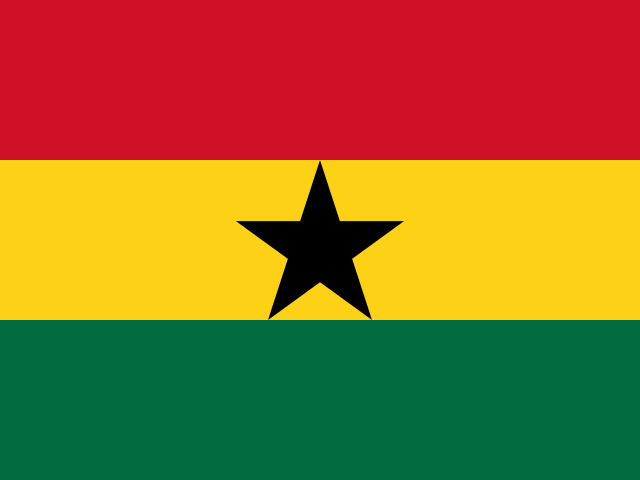
- Nicknamed the Black Stars after the symbol of pan-African independence on the Ghanaian flag, the team plays in white home shirts and yellow change kits.
- Ghana have won the Africa Cup of Nations four times — 1963 (hosts), 1965, 1978 and 1982 — making them one of the most successful CAF nations historically.
- Ghana have finished AFCON runners-up five times: 1968, 1970, 1992, 2010 and 2015.
- The 2026 World Cup will be Ghana’s fifth tournament appearance (2006, 2010, 2014, 2022, 2026); the team’s best result is the quarter-finals at South Africa 2010, where Asamoah Gyan’s penalty miss in extra time against Uruguay defined the country’s most painful World Cup memory.
- Otto Addo became the first coach to guide Ghana to two World Cup qualifications (2022 and 2026),and Ghana media reporting.
- After friendly defeats by Austria and Germany in March 2026, the GFA dismissed Addo and appointed Portuguese veteran Carlos Queiroz as head coach on 14 April 2026, just over two months before the World Cup.
- Ghana topped CAF Group I in qualification with 25 points and went unbeaten through the campaign per multiple Ghana-media outlets.
- The 2026 World Cup draw placed Ghana in Group L alongside Croatia, England and Panama; the schedule starts vs Panama on 17 June, England on 23 June and Croatia on 27 June.
- Forward André Ayew is the most-capped Ghana international with 120 appearances; striker Asamoah Gyan is the all-time top scorer with 51 goals.
- The principal Ghana–Nigeria rivalry — known as the “Jollof derby” — is one of the most-followed fixtures in African football.
- Ghana became the first African nation to win the FIFA U-20 World Cup, defeating Brazil in the 2009 final.
Ghana World Cup Vital Statistics
| Metric | Value |
|---|---|
| First international | 28 May 1950 vs Nigeria |
| Federation founded | 1957 (GFA) |
| FIFA World Cup appearances | 5 (2006, 2010, 2014, 2022, 2026) |
| Best FIFA World Cup result | Quarter-finals (2010) |
| Africa Cup of Nations titles | 4 (1963, 1965, 1978, 1982) |
| AFCON runners-up | 5 (1968, 1970, 1992, 2010, 2015) |
| Most caps | André Ayew (120) |
| All-time top scorer | Asamoah Gyan (51) |
| FIFA ranking | 74 |
| Head coach | Carlos Queiroz |
| Captain | Jordan Ayew |
| 2026 WC qualification (CAF) | Group I winners — 25 pts (unbeaten) |
| 2026 WC finals group | Group L vs Croatia, England, Panama |
Ghana at the World Cup — History And Profile
Ghana’s Black Stars are among the most decorated and most-followed national teams in African football, with four Africa Cup of Nations titles, five further AFCON final appearances, and a fifth FIFA World Cup berth in 2026. Administered by the Ghana Football Association (GFA, founded in the late 1950s), the team takes its nickname from the black star on the country’s flag — itself a Pan-African symbol of independence and continental unity, designed by Theodosia Okoh to mark Ghana’s 1957 independence from Britain.
The Black Stars played their first international against Nigeria on 28 May 1950 — the start of what is now the longest-running senior fixture in West African football and the foundation of the modern Ghana–Nigeria “Jollof derby” rivalry. Through the 1960s, Ghana established itself as the continent’s first football superpower under coaches including the Englishman C. K. Gyamfi (1963 AFCON winner) and Charles Kumi Gyamfi’s three AFCON victories (1963, 1965 and 1982). The 1978 AFCON title under Fred Osam-Duodu cemented Ghana’s status. The four-title haul stood as the African record until Egypt overtook in the 2000s.
Across the 1980s and 1990s, the team produced a generation of European-based stars — Abedi Pele, Anthony Yeboah, Kwame Ayew, Sammy Kuffour — but failed to qualify for a World Cup until Germany 2006. The team’s first World Cup appearance ended in a round-of-16 loss to Brazil. The defining World Cup peak came at South Africa 2010, when Ghana — led by Asamoah Gyan and Sulley Muntari, coached by Milovan Rajevac — became the first African nation to host the tournament’s region (sub-Saharan continental host). They reached the quarter-finals before losing to Uruguay on penalties after Luis Suárez’s deliberate handball denied Dominic Adiyiah a winning header in the final minute of extra time, and Gyan missed the resulting penalty before the shootout. The 2014 (Brazil) and 2022 (Qatar) appearances both ended in group-stage exits.
Otto Addo, formerly of Borussia Dortmund’s coaching staff, became Ghana’s first head coach to lead the team to two consecutive World Cup qualifications — 2022 and 2026 —. The 2026 qualifying campaign in CAF Group I produced 25 points and an unbeaten run, with Ghana finishing ahead of Comoros, Madagascar, Mali, Central African Republic and Chad. After friendly defeats to Austria and Germany in March 2026, however, the GFA dismissed Addo. Portuguese veteran Carlos Queiroz — formerly of Real Madrid, Manchester United (assistant), South Africa, Portugal, Iran and Egypt — was appointed on 14 April 2026 from a reported field of more than 600 applicants. Queiroz becomes one of a handful of coaches to lead five different national teams to FIFA World Cups, with prior tournament experience at South Africa 2002, World Cup 2010, 2014 and 2018.
The 2026 World Cup draw placed Ghana into Group L alongside Croatia, England and Panama. Ghana’s tournament begins against Panama on 17 June 2026, followed by England on 23 June and Croatia on 27 June. Group L is widely regarded as one of the most demanding groups in the 2026 finals; GFA president Kurt Okraku has framed Queiroz’s mandate as a “Black Stars revival” project, with target outputs that include a knockout-stage berth.
The squad blends established Premier League and Championship-based experience — captain Jordan Ayew, defender Mohammed Salisu (Monaco), midfielders Thomas Partey and Mohammed Kudus (West Ham), strikers Inaki Williams (Athletic Bilbao) and Antoine Semenyo (Bournemouth) — with the next-generation pipeline including forwards from across European leagues. Most-capped player André Ayew (120 caps) and record goalscorer Asamoah Gyan (51 goals) anchor the historical record.
Ghana plays its principal home internationals at the Accra Sports Stadium and the Baba Yara Stadium in Kumasi, with the GFA rotating venues for marquee fixtures. The Accra Sports Stadium is also the venue of the most painful event in Ghanaian football history — the 9 May 2001 stadium disaster, in which 127 fans died in a stampede during a domestic Hearts of Oak vs Asante Kotoko fixture. The disaster reshaped Ghana football’s safety regulation framework.
Ghana’s principal rivalries are with Nigeria (the Jollof derby), Egypt, Cameroon, Ivory Coast and Senegal, with the Nigeria fixture functioning as the most culturally significant in West African football. Diplomatic and cultural exchanges across both countries reflect the cross-border football identity.
Looking forward, Ghana’s outlook is rebuild-and-revive. Queiroz’s brief — reportedly running through the AFCON 2027 cycle — is to convert raw talent into a knockout-capable World Cup unit. Generational succession from Ayew and Gyan to Kudus, Williams, Semenyo and Salisu is the central strategic axis through 2027.
Detailed Profile
Crest, Colours & Kit Evolution
Ghana plays in white home shirts and yellow away shirts. The Black Stars crest features a black five-pointed star on white, drawn directly from the national flag. Pan-African colours of red, gold and green appear in trim and on the GFA badge. Modern kit suppliers have included Puma since the 2000s with a renewed multi-cycle agreement.
Stadium & Premises History
Home internationals are split between the Accra Sports Stadium (rebuilt and reopened ahead of the 2008 AFCON, capacity ~40,000) and the Baba Yara Stadium in Kumasi (capacity ~40,000). The 9 May 2001 Accra stadium disaster — in which 127 supporters died in a domestic-league stampede — remains the most significant safety incident in Ghanaian football and shaped the modern stadium operating regime.
Iconic Players
- 1960s–1980s: Osei Kofi, Robert Mensah, Ibrahim Sunday (1971 African Footballer of the Year), Karim Abdul Razak, Abdul Razak (1978 African Footballer of the Year).
- 1990s: Abedi Pele (three-time African Footballer of the Year), Anthony Yeboah, Sammy Kuffour, Kwame Ayew.
- 2000s: Stephen Appiah, Michael Essien, Sulley Muntari, John Paintsil.
- 2010s: Asamoah Gyan (record goalscorer), Kevin-Prince Boateng, Andre Ayew (record caps).
- 2020s and 2026 cycle: Jordan Ayew (captain), Mohammed Salisu, Thomas Partey, Mohammed Kudus, Inaki Williams, Antoine Semenyo.
Coaches & Managers Legacy
Modern coaching lineage includes C. K. Gyamfi (multiple AFCON titles), Fred Osam-Duodu (1978 AFCON), Sven-Göran Eriksson briefly, Milovan Rajevac (2010 World Cup quarter-finals), Goran Stevanović, Akwasi Appiah (two spells), Avram Grant (2014 World Cup, AFCON 2015 final), Otto Addo (2022 and 2026 World Cup qualifications) and Carlos Queiroz (since April 2026). Adomonline reported that GFA officials have publicly tasked Queiroz with a 2026 World Cup semi-final target.
Trophies & Honours
- AFCON: champions 1963, 1965, 1978, 1982; runners-up 1968, 1970, 1992, 2010, 2015.
- FIFA U-20 World Cup champions 2009 (first African nation to win at U-20 level).
- FIFA U-17 World Cup champions 1991 and 1995.
- All-Africa Games champions 1978, 2003.
Peak Eras
- 1963–1982: four AFCON titles, the era of C. K. Gyamfi.
- 2009: FIFA U-20 World Cup title.
- 2010: World Cup quarter-finals — sub-Saharan Africa’s deepest run.
- 2015: AFCON final loss to Ivory Coast.
Rivalries
- Nigeria (Jollof derby): the defining West African fixture.
- Ivory Coast: 2015 AFCON final.
- Egypt: AFCON title-deciders.
- Cameroon: AFCON and World Cup play-off history.
- Senegal: AFCON quarter-final and qualifying battles.
Public Image — Bad PR / Controversies
The 9 May 2001 Accra stadium disaster, in which 127 supporters died in a stampede during the Hearts of Oak vs Asante Kotoko derby, remains the most consequential incident in Ghanaian football history. The 2014 World Cup mid-tournament squad-bonus dispute — in which a chartered jet flew $3 million in cash to the squad in Brazil after a player threat to refuse training — produced lasting reputational damage and led to a Presidential Commission of Inquiry. The 2026 cycle’s mid-cycle coaching change has been a public-debate item across Ghana media.
Australia Connection
Australia and Ghana have met at least once in international football: a 2006 friendly. Beyond that fixture, no further documented Australia–Ghana FIFA-recognised matches are recorded in public records-to-head archive.
Potential Future Trajectory
Queiroz’s brief is short-cycle: deliver World Cup performance through 2027 AFCON. Generational succession from the Ayew–Partey–Gyan generation to Kudus, Williams, Semenyo and Salisu defines the strategic axis. The GFA’s restated public target is a knockout-stage finish in North America.
More World Cup 2026 Reading
WC 2026 context: See Ghana's WC 2026 group-stage form, squad and opponents →
 Best Betting Sites
 Best Online Casinos
 Blackjack Sites
 Online Pokies
 Fast Payout Casinos
 PayID Casinos
 New Casinos 2026