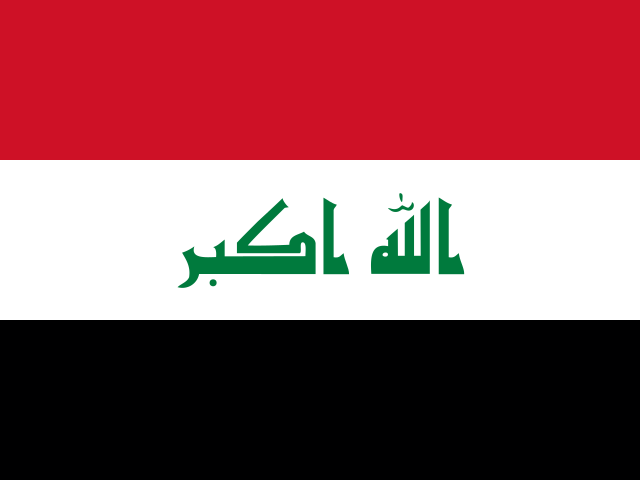
 Iraq at the World Cup — Full History
Key Facts
- The Iraq Football Association (IFA) was founded on 8 October 1948; Iraq joined FIFA in 1950 and the AFC at the confederation’s establishment in 1954.
- Iraq has appeared at two FIFA World Cups: 1986 in Mexico (Iraq’s debut, scoring once against Belgium) and 2026 in the United States, Canada and Mexico, the latter ending a 40-year absence from the tournament.
- Iraq’s signature continental achievement was the 2007 AFC Asian Cup, won on 29 July 2007 in Jakarta with a 1–0 victory over Saudi Arabia courtesy of a Younis Mahmoud header from a Hawar Mulla Mohammed corner; Mahmoud was named tournament MVP and shared the Golden Boot.
- The 2007 squad — drawn from Sunni, Shia and Kurdish backgrounds and prepared in difficult security conditions during the Iraq War — defeated Australia, South Korea and Saudi Arabia en route to the title, an outcome widely cited as among the most-celebrated continental results in AFC history.
- Iraq qualified for the 2026 FIFA World Cup as the final team to confirm a place, defeating Bolivia 2–1 in the FIFA inter-confederation play-off at Estadio BBVA in Monterrey, Mexico, on 18 March 2026.
- Australian head coach Graham Arnold — formerly Socceroos head coach from 2018 through the 2022 Qatar World Cup — was appointed Iraq head coach in 2025 and led the team through the third-round qualifying campaign and the inter-confederation play-off, becoming the first Australian to coach two different nations at men’s FIFA World Cups.
- At the 5 December 2025 FIFA World Cup draw in Washington, D.C., and following the play-off-stage allocations, Iraq was placed in Group I alongside France, Senegal and Norway for the 2026 finals.
- Iraq is one of eight current AFC members to have lifted the AFC Asian Cup, alongside Japan (4 — record), Iran (3), Saudi Arabia (3), Qatar (2), South Korea (2), Australia (1) and Kuwait (1).
- Iraq won the Arabian Gulf Cup in 1979, 1984, 1988 and most recently in January 2023 (as hosts in Basra) under Spanish coach Jesús Casas, prior to Casas’s mid-cycle dismissal during the 2026 qualifying campaign.
- The Basra International Stadium (capacity 65,227, opened in 2013) is Iraq’s primary home venue for senior internationals; selected fixtures are also played at the Karbala International Stadium and the Al-Madina International Stadium in Baghdad following an extended period when Iraq was prevented from hosting full home internationals on Iraqi soil under FIFA security restrictions.
- The Iraq–Iran rivalry is the team’s most-cited regional fixture, contested across qualifying and Asian Cup cycles and carrying the political backdrop of the 1980–1988 Iran–Iraq War; Iraq’s rivalry with Saudi Arabia is increasingly significant in the modern era after the 2007 Asian Cup final and recent qualification meetings.
- Younis Mahmoud (148 caps, 57 international goals at retirement per IFA records) is Iraq’s most-decorated player of the modern era and the captain of the 2007 Asian Cup-winning side.
Iraq World Cup Vital Statistics
| Metric | Value |
|---|---|
| Federation founded | 8 October 1948 (Baghdad) |
| FIFA / AFC membership | FIFA 1950 / AFC 1954 (founding) |
| FIFA World Cup appearances | 2 — 1986, 2026 |
| Best FIFA World Cup finish | Group stage (1986, 2026) |
| AFC Asian Cup titles | 1 — 2007 |
| Arabian Gulf Cup titles | 4 — 1979, 1984, 1988, 2023 |
| Most-decorated modern player | Younis Mahmoud (2007 Asian Cup MVP / Golden Boot) |
| Current head coach | Graham Arnold (Australian; appointed 2025) |
| 2026 WC qualification | Inter-confederation play-off — beat Bolivia 2-1, Monterrey, 18 Mar 2026 |
| 2026 WC finals group | Group I — France, Senegal, Norway |
| Home stadium | Basra International Stadium (capacity 65,227) |
| Federation HQ | Baghdad, Iraq |
Iraq at the World Cup — History And Profile
The Iraq national football team, known across the Arabic-speaking world as Usood al-Rafidayn — the Lions of Mesopotamia — is the senior men’s representative side of the Iraq Football Association (IFA), a body founded in Baghdad on 8 October 1948 and admitted to FIFA in 1950 and to the Asian Football Confederation at its 1954 establishment. Iraq has been a competitive presence in West Asian football across the post-war era, won the AFC Asian Cup once in 2007, and in March 2026 qualified for only its second FIFA World Cup, ending a forty-year absence since the team’s debut in Mexico in 1986.
Iraq’s first FIFA World Cup appearance came at Mexico 1986, where the side was drawn into a group with Paraguay, Belgium and Mexico. Iraq lost all three matches but scored its only World Cup goal of that tournament against Belgium through Ahmed Radhi, the captain whose name remains synonymous with the 1986 generation. Domestic political and security upheaval — the Iran–Iraq War of 1980–1988, the 1990–1991 Gulf War and the 2003 invasion and subsequent insurgency — disrupted the federation’s competitive operations across the next two decades. Iraq spent extended periods unable to host full home internationals on Iraqi soil, with FIFA and the AFC routing fixtures through neutral venues in Doha, Tehran, Amman, Dubai and Tashkent.
The 2007 AFC Asian Cup, jointly hosted by Indonesia, Malaysia, Thailand and Vietnam, produced the team’s defining achievement. Coached by the Brazilian Jorvan Vieira, who had been appointed only weeks before the tournament, Iraq overcame Australia in the quarter-finals, South Korea in the semi-finals (4–3 on penalties after a goalless draw) and Saudi Arabia in the final at the Gelora Bung Karno Stadium in Jakarta on 29 July 2007. Captain Younis Mahmoud’s 73rd-minute header from a Hawar Mulla Mohammed corner secured the 1–0 win that lifted Iraq to its first continental title. Mahmoud was named MVP and shared the Golden Boot with Saudi Arabia’s Yasser Al-Qahtani and Japan’s Naohiro Takahara. The 2007 squad — composed of Sunni Arab, Shia Arab and Kurdish players in roughly equal proportions — became one of the most-cited symbols of post-2003 Iraqi national unity in the world football literature.
Subsequent campaigns produced semi-final finishes at the 2015 Asian Cup in Australia and the 2025 AFC Asian Cup in Saudi Arabia, alongside qualifying-cycle near-misses for the 2014, 2018 and 2022 FIFA World Cups. The federation cycled through a succession of head coaches across the 2010s and early 2020s, including Brazilian, Slovenian, Romanian and Spanish technicians. Spanish coach Jesús Casas, appointed in 2022, won the 2023 Arabian Gulf Cup as hosts in Basra, beating Oman 3–2 in the final, but was dismissed during the third round of 2026 World Cup qualifying after a defeat to Palestine.
The 2026 World Cup qualification campaign concluded in dramatic fashion. Following Casas’s mid-cycle exit, the IFA appointed the Australian Graham Arnold — head coach of the Socceroos at the 2018 and 2022 World Cups, with a deep AFC-cycle CV — to oversee the closing fixtures and the inter-confederation play-off. Iraq finished the AFC fourth round in a position requiring play-off advancement; on 18 March 2026 at the Estadio BBVA in Monterrey, Mexico, Iraq defeated Bolivia 2–1 to claim the final available 2026 World Cup berth. The result triggered nationwide celebrations across Iraq and a “hero’s welcome” for Arnold during a public reception in Sydney, where the Australian coach maintains his primary residence (per Al Jazeera, 6 April 2026). The 5 December 2025 World Cup draw, supplemented by the post-play-off allocation, placed Iraq in Group I for the 2026 finals alongside France, Senegal and Norway.
The Basra International Stadium, opened in 2013 with a capacity of 65,227, is Iraq’s principal home venue. The Karbala International Stadium and Al-Madina International Stadium in Baghdad have hosted senior-team fixtures during the past decade as security conditions have allowed. Iraq’s senior squad in 2026 includes captain and full-back Aymen Hussein, midfielder Amir Al-Ammari, central defender Manaf Younis and Europe-based striker Mohanad Ali, alongside a Persian Gulf Pro League and Saudi Pro League contingent. The federation, headquartered in Baghdad and led by IFA president Adnan Dirjal (a former Iraq international), is responsible for the senior team, the women’s national side and the youth pathway through Iraqi Premier League clubs. Iraqi Premier League pathway clubs Al-Quwa Al-Jawiya, Al-Zawraa SC, Al-Shorta SC and Al-Talaba have supplied the bulk of senior call-ups across the modern era, with a growing Saudi Pro League contingent including senior squad members at Al-Nassr, Al-Ittihad and Al-Wehda. The 2026 World Cup qualification is widely expected to drive an additional wave of investment in the federation’s youth pathway and the Iraqi Premier League’s broadcast and sponsorship operations through the next four-year cycle.
Detailed Profile
Crest, Colours & Kit Evolution
Iraq’s traditional home kit is green with white trim, with the away kit reversing the combination. The crest carries a stylised eagle with the Iraqi flag. Recent kit suppliers include Adidas, Givova and currently Capelli Sport per the IFA’s 2024 cycle.
Stadium History
The Basra International Stadium, opened in 2013, is Iraq’s primary home venue with a capacity of 65,227. The Al-Shaab Stadium in Baghdad served as the historical national stadium across the 1960s–1980s but was reduced in role after the 2003 invasion; current senior-team fixtures rotate among Basra, the Karbala International Stadium and the Al-Madina International Stadium in Baghdad. Iraq spent extended periods between 2003 and 2018 unable to host competitive home internationals on Iraqi soil under FIFA security restrictions; FIFA fully lifted that restriction in 2018.
Coaches & Managers Legacy
Notable head coaches: Ammo Baba (multiple spells across the 1970s–1990s, the most-cited Iraqi coaching figure), Adnan Hamad (early 2000s), Jorvan Vieira (Brazilian, 2007 Asian Cup-winning coach), Bora Milutinović (Serbian, 2009), Wolfgang Sidka, Hakeem Shaker, Bernd Stange (German), Radhi Shenaishil, Srečko Katanec (Slovenian), Jesús Casas (Spanish, 2022 Gulf Cup winner), Graham Arnold (Australian, current coach for the 2026 World Cup).
Iconic Players
Pre-2003: Ahmed Radhi (1986 World Cup goalscorer vs Belgium), Hussein Saeed, Karim Saddam. 2007 Asian Cup generation: Younis Mahmoud (148 caps, 57 goals at retirement), Hawar Mulla Mohammed, Nashat Akram, Noor Sabri (goalkeeper). Modern era: Ali Adnan, Justin Meram, Ahmed Yasin, Mohanad Ali, Amir Al-Ammari, Aymen Hussein.
Trophies & Honours
- AFC Asian Cup: champions 2007 (Jakarta).
- Arabian Gulf Cup: 4 titles — 1979, 1984, 1988, 2023.
- WAFF Championship: multiple titles in the 2000s and 2010s.
- Asian Games gold: 1982 (men’s tournament).
- FIFA World Cup: group stage 1986; group stage 2026 (qualified).
Peak Eras
- Late 1970s through 1980s “Ammo Baba” generation — Gulf Cup three-peat, 1986 World Cup qualification.
- 2007 Asian Cup-winning generation under Jorvan Vieira and Younis Mahmoud.
- 2015 Asian Cup semi-final run in Australia.
- 2023 Arabian Gulf Cup hosts and champions (Basra) under Jesús Casas.
- 2026 World Cup qualification under Graham Arnold (final available berth via Bolivia play-off).
Rivalries
- Iran: the principal regional rivalry, with the political backdrop of the 1980–1988 Iran–Iraq War and a long history of tightly contested AFC fixtures.
- Saudi Arabia: a top-of-table fixture across qualifying and Gulf Cup cycles, intensified by the 2007 Asian Cup final.
- Kuwait: historically Iraq’s principal regional rivalry through the 1970s and 1980s; reduced significance in the modern era as Kuwait’s AFC competitiveness has diminished.
Supporters Culture
Iraqi national-team support concentrates on the Basra International Stadium and Al-Madina in Baghdad, with extensive overseas-diaspora attendance at qualifiers in Tehran, Doha, Amman and Dubai during the periods when Iraq could not host on home soil. The 2007 Asian Cup final saw nationwide celebrations across Baghdad despite the security situation, and was widely covered by international media.
Public Image — Bad PR / Controversies
The IFA was the subject of a 2008 dissolution and reinstatement cycle linked to government interference, leading to brief FIFA suspension of Iraq from international football and resolution by 2009. The federation has navigated FIFA security restrictions on home fixtures across multiple periods (most recently from 2003 through 2018), with neutral venues in Tehran, Amman, Doha and Dubai used for qualifiers. These items are presented neutrally with FIFA, AFC and federation citations rather than as editorial commentary.
Charity & Community
The IFA runs a youth-development programme through the Iraqi Premier League clubs and supports a number of recovery-football and trauma-rehabilitation projects connected to communities affected by the 2003 invasion and post-2014 ISIS displacement. National-team players including Younis Mahmoud have been featured in Iraqi humanitarian-aid and refugee-resettlement campaigns.
Australia Connection
Iraq and Australia have an extensively documented competitive history within the AFC since Australia’s 2006 confederation transfer from the OFC. The two sides met at the 2007 AFC Asian Cup quarter-final, with Iraq winning 2–0 in Bangkok en route to the title. Subsequent AFC qualifying cycles have produced multiple meetings, including 2026 third-round fixtures and earlier campaigns. The most defining single connection in the current cycle is the appointment of Graham Arnold, the long-serving Australian coach (former Socceroos head coach 2018–2022, including the 2022 Qatar World Cup round-of-16 elimination by Argentina), as Iraq head coach in 2025; Arnold became the first Australian to coach two different nations at men’s FIFA World Cups, leading Iraq through the inter-confederation play-off victory over Bolivia and the 2026 qualification.
Connections to Other Federations / Celebrity Figures
The Iraq coaching pipeline has historically drawn on Brazilian (Jorvan Vieira), Slovenian (Srečko Katanec), Spanish (Jesús Casas) and now Australian (Graham Arnold) technical staff. The Iraqi Premier League serves as the principal pathway for senior internationals; a growing number of squad members play in the Saudi Pro League, the Persian Gulf Pro League, the Iranian top flight, and selected European leagues including Sweden’s Allsvenskan and Italy’s lower-divisions network.
Potential Future Trajectory
With Graham Arnold under contract through the 2026 World Cup, the IFA’s medium-term priorities centre on (a) the team’s 2026 finals performance in Group I against France, Senegal and Norway, (b) the next AFC Asian Cup cycle following Saudi Arabia 2027, and (c) consolidation of Basra and Baghdad as full-fledged hosting venues following the federation’s return to home-soil fixtures. The 2026 qualification — sealed via the inter-confederation play-off rather than direct AFC route — has refreshed national interest and is likely to influence federation funding and youth-pathway investment through the next four-year cycle.
More World Cup 2026 Reading
WC 2026 context: See Iraq's WC 2026 group-stage form, squad and opponents →
 Best Betting Sites
 Best Online Casinos
 Blackjack Sites
 Online Pokies
 Fast Payout Casinos
 PayID Casinos
 New Casinos 2026