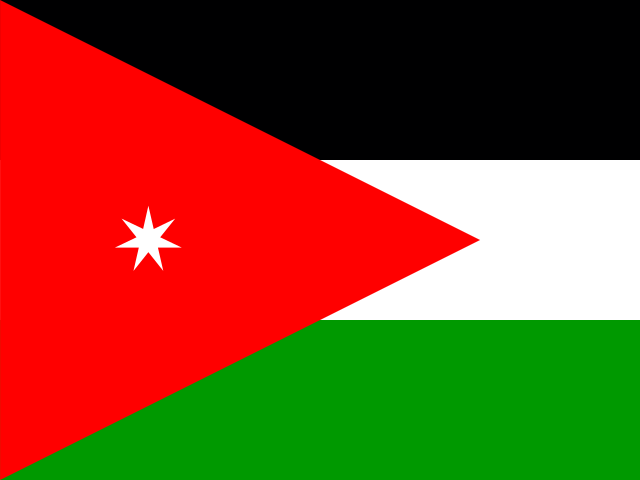
 Jordan at the World Cup — Full History
Key Facts
- The Jordan Football Association (JFA) governs the senior men’s national team; Jordan’s first international fixture was contested against Syria in Egypt in 1953, and the federation joined FIFA in 1958 and the AFC at the same period.
- Jordan qualified for its first ever FIFA World Cup on 5 June 2025 with a 3–0 away victory over Oman in Muscat, securing AFC third-round Group B’s automatic qualification spot in the team’s 76-year senior-international history.
- At the 5 December 2025 FIFA World Cup draw in Washington, D.C., debutants Jordan were placed in Group J alongside reigning champions Argentina, Algeria and Austria.
- Jordan’s most-cited continental result is the run to the 2023 AFC Asian Cup final (held in Qatar in January 2024), the team’s first appearance in an Asian Cup final after defeating South Korea 2–0 in the semi-final and Tajikistan 1–0 in the quarter-final; Jordan lost the final 1–3 to host Qatar.
- The 2023 Asian Cup run was overseen by Moroccan head coach Hussein Ammouta, who was appointed in June 2023; Ammouta requested release from his contract in mid-2024 and was succeeded in August 2024 by fellow Moroccan Jamal Sellami on a three-year contract.
- Captain Mousa Al-Tamari (Montpellier, then OGC Nice in the 2025–26 season per FFT) is Jordan’s most-capped active outfield player with 90+ caps and 24+ international goals as of FFT’s March 2026 squad audit, and is widely regarded as the federation’s most prominent modern player.
- Jordan plays its competitive home internationals primarily at the 17,619-capacity Amman International Stadium in Amman, with selected fixtures at the King Abdullah II Stadium (also Amman) and the Petra Stadium.
- Jordan’s nickname Al-Nashama translates as “the Chivalrous Ones”; the team plays in white shirts and white shorts at home, and red away.
- Jordan’s previous best Asian Cup finishes prior to the 2024 final were quarter-final appearances at the 2004 (China) and 2011 (Qatar) editions; the team also reached the 2014 FIFA World Cup AFC–CONMEBOL inter-confederation play-off, losing to Uruguay over two legs.
- The JFA is led by HRH Prince Ali bin Hussein, a long-serving FIFA-engaged football administrator who contested the 2015 and 2016 FIFA presidential elections and is one of the most prominent Asian football leaders of the modern era.
- Jordan’s principal regional fixtures include qualifiers against Iraq, Saudi Arabia and Palestine within WAFF and AFC competition cycles; the team is one of eleven WAFF members and a regular participant in the WAFF Championship.
- No documented men’s senior full international between Jordan and Australia has been recorded prior to the 2026 World Cup cycle in publicly available match registers; per FFT and ESPN qualifying coverage, the two AFC sides did not meet in third- or fourth-round 2026 qualifying.
Jordan World Cup Vital Statistics
| Metric | Value |
|---|---|
| Federation founded | 1949 (JFA, Amman) |
| FIFA / AFC membership | FIFA 1958 / AFC 1970s |
| FIFA World Cup appearances | 1 — 2026 (debut) |
| Best AFC Asian Cup finish | Runners-up 2023 (held Jan 2024) — lost 1-3 to Qatar |
| AFC Asian Cup appearances | 5 — 2004, 2011, 2015, 2019, 2023 |
| Captain | Mousa Al-Tamari (OGC Nice) — 90+ caps, 24+ goals |
| Current head coach | Jamal Sellami (Moroccan, appointed Aug 2024) |
| 2026 WC qualification | AFC third-round Group B — sealed 5 June 2025 vs Oman (3-0) |
| 2026 WC finals group | Group J — Argentina, Algeria, Austria |
| Home stadium | Amman International Stadium (capacity 17,619) |
| Federation president | HRH Prince Ali bin Hussein |
| Confederation | AFC (West Zone, WAFF) |
Jordan at the World Cup — History And Profile
The Jordan national football team — known across the Arabic-speaking world as Al-Nashama, “the Chivalrous Ones” — is the senior men’s representative side of the Jordan Football Association (JFA), a body founded in 1949 in Amman. Jordan’s first documented international match took place in 1953 against Syria in Egypt; the federation joined FIFA in 1958 and is one of the foundational members of the AFC’s West Asian zone, currently administered through the West Asian Football Federation (WAFF). For most of its 76-year senior-international history Jordan operated as a mid-tier AFC programme, and for that reason the team’s 2026 FIFA World Cup qualification — the country’s first ever appearance at the senior tournament — is the most consequential single result in the federation’s history.
The team’s historical competitive presence centred on Asian Cup and WAFF Championship cycles. Jordan made its AFC Asian Cup debut at the 2004 edition in China, reaching the quarter-finals on debut. The 2011 Asian Cup in Qatar produced a second quarter-final under the Iraqi-Jordanian coach Adnan Hamad, with Jordan progressing from a group containing Japan, Saudi Arabia and Syria. The 2015 Asian Cup in Australia and 2019 Asian Cup in the United Arab Emirates produced earlier exits, and the 2014 World Cup qualifying cycle delivered Jordan’s first AFC–CONMEBOL inter-confederation play-off appearance, with Uruguay winning the home-and-away tie comfortably under coach Óscar Tabárez.
The defining competitive phase opened in mid-2023. JFA appointed the Moroccan head coach Hussein Ammouta in June 2023 with a brief to lead the team through the 2023 AFC Asian Cup (which was held in January 2024 in Qatar following the original Chinese host’s withdrawal). Jordan progressed from a group containing Malaysia, Bahrain and South Korea, then defeated Iraq 3–2 after scoring two goals in stoppage time in the round of 16, beat Tajikistan 1–0 in the quarter-final, and beat South Korea 2–0 in the semi-final to reach the country’s first ever Asian Cup final. The 1–3 defeat to host Qatar in the final on 10 February 2024 ended a tournament run that, alongside the subsequent World Cup qualification, transformed the team’s status within Asian football. Ammouta requested release from his contract in mid-2024 for family reasons; the JFA appointed fellow Moroccan Jamal Sellami in August 2024 on a three-year contract.
The 2026 World Cup qualification campaign opened with Jordan in AFC third-round Group B alongside South Korea, Iraq, Oman, Palestine and Kuwait. A 3–0 away win over Oman at the Sultan Qaboos Sports Complex in Muscat on 5 June 2025 confirmed second place in the group and Jordan’s first ever automatic FIFA World Cup qualification. Captain Mousa Al-Tamari, the Montpellier and subsequently OGC Nice winger who is the federation’s most-capped active outfield player, scored Jordan’s opener; goals from forwards Yazan Al-Naimat and Mahmoud Al-Mardi sealed the result. Jordan and fellow AFC debutants Uzbekistan qualified on the same matchday, with FIFA’s matchday-nine summary describing the joint achievement as “the most consequential matchday in modern AFC qualifying history”.
The 5 December 2025 World Cup draw in Washington, D.C., placed Jordan in Group J alongside reigning champions Argentina, Algeria and Austria — a competitive but not impossible group given the team’s 2024 Asian Cup form. The senior 2026 squad is built around Al-Tamari (current OGC Nice), goalkeeper Yazeed Abulaila (Al-Wehdat), central defender Ihsan Haddad (Al-Hussein), midfielder Noor Al-Rawabdeh (Al-Faisaly) and forward Yazan Al-Naimat (Al-Ahli, on loan to selected European-pathway clubs in 2025). The squad is overwhelmingly drawn from the Jordanian Pro League with a small but growing Europe-pathway contingent.
The Amman International Stadium (capacity 17,619, opened 1968) is Jordan’s principal home venue for senior fixtures, with selected matches also at the King Abdullah II Stadium and the Petra Stadium. The JFA is led by HRH Prince Ali bin Hussein, a long-serving FIFA-engaged football administrator who has been involved in multiple FIFA presidential elections (2015 and 2016) and is one of the most-cited Asian football leaders of the modern era. The 2024 Asian Cup final and 2026 World Cup qualification have driven significant federation-level investment in youth pathways through the Jordanian Pro League and the JFA’s national academy in Amman. The Jordanian Pro League’s principal pathway clubs — Al-Wehdat (the country’s most-decorated club), Al-Faisaly and Al-Hussein — supply the bulk of senior call-ups for domestic-league players, alongside the Al-Salt and Al-Ramtha programmes. Jordan’s broader national-team identity has historically drawn on the country’s role as a regional host of refugee populations from Iraq, Syria and Palestine, with several senior internationals across the modern era of mixed Jordanian-Palestinian descent; the JFA’s fixture list and federation governance treat Jordan as the senior team’s exclusive representative side under the standard FIFA eligibility framework, with no documented dual-eligibility selection disputes of significance in the recent cycle.
Detailed Profile
Crest, Colours & Kit Evolution
Jordan’s traditional home kit is white shirts and white shorts, with the away kit in red — colours drawn from the Jordanian flag. The crest carries a stylised Hashemite seven-pointed star and the JFA monogram. Recent kit suppliers include Adidas, Macron and currently Macron under the 2024–2026 cycle.
Stadium History
The Amman International Stadium (capacity 17,619, opened 1968 and refurbished 2007) is Jordan’s principal home venue. The King Abdullah II Stadium (15,000-capacity, opened 1999) is also located in Amman and hosts selected senior fixtures alongside Jordanian Pro League matches. The Petra Stadium and Prince Mohammed Stadium in Zarqa serve as secondary venues for friendlies.
Coaches & Managers Legacy
Notable head coaches: Adnan Hamad (multiple spells across the 2000s and 2010s), Mahmoud El-Gohary (Egyptian, mid-2000s), Adnan Hamad (2011 Asian Cup quarter-final), Harry Redknapp (English, brief 2016 spell linked but not formalised), Vital Borkelmans (Belgian), Adnan Hamad (returns), Hussein Ammouta (Moroccan, 2023 Asian Cup-final coach), Jamal Sellami (Moroccan, current head coach since August 2024).
Iconic Players
1990s–2000s: Hassouneh Al-Sheikh, Bashar Bani Yaseen, Faisal Ibrahim. 2000s–2010s: Hatem Aqel, Amer Deeb, Mahmoud Shelbaieh, Hassan Abdel-Fattah, Ahmad Hayel. 2010s–2020s: Amer Shafi (record-cap goalkeeper, retired 2024), Anas Bani Yaseen, Saeed Al-Murjan, Musa Suleiman. Modern era (2024–2026): Mousa Al-Tamari (captain), Yazan Al-Naimat, Mahmoud Al-Mardi, Yazeed Abulaila, Ihsan Haddad, Noor Al-Rawabdeh.
Trophies & Honours
- AFC Asian Cup: runners-up 2023 (held January 2024 in Qatar); quarter-finals 2004, 2011.
- WAFF Championship: multiple runner-up finishes (no senior title) across 2000–2024 cycles.
- Pan Arab Games football: bronze 2011.
- FIFA World Cup: group stage 2026 (debut, qualified).
Peak Eras
- Mid-2000s under Adnan Hamad with Asian Cup quarter-finals on debut (2004).
- 2014 World Cup qualifying inter-confederation play-off (Uruguay tie).
- 2023 Asian Cup runners-up generation under Hussein Ammouta with Al-Tamari, Al-Naimat and Abulaila.
- 2026 World Cup qualification under Jamal Sellami — the federation’s most consequential single achievement.
Rivalries
- Iraq: a long-running WAFF and Asian Cup fixture, including the 2023 Asian Cup round-of-16 (Jordan won 3–2 after extra time).
- Palestine: a regional fixture contested through WAFF and qualifying cycles.
- Saudi Arabia: an AFC West Zone fixture, also intensified by the 2023 Asian Cup era.
- Egypt: contested through WAFF, Pan Arab Games and selected friendly cycles.
Supporters Culture
Jordan’s national-team support concentrates on the Amman International Stadium and the King Abdullah II Stadium, with the JFA running an active fan-engagement programme through Al-Nashama-branded channels. The 2024 Asian Cup final saw the largest single Jordanian away support of the modern era at the Lusail Iconic Stadium in Doha.
Public Image — Bad PR / Controversies
The JFA has been periodically the subject of media discussion regarding match-scheduling and refereeing decisions in regional competition; no FIFA disciplinary cases of significance against the JFA have been recorded in the modern era. The 2024 Asian Cup final loss generated extensive Arabic-language and English-language media coverage of the team’s tactical approach in the second half against Qatar; this is presented neutrally as documented match analysis rather than editorial commentary.
Charity & Community
The JFA runs a youth-development programme through the Jordanian Pro League clubs and supports a national grass-roots programme through the federation’s Amman-based academy. National-team players have been featured in regional refugee-support campaigns including those connected to the Syrian crisis, with Jordan as a major host country.
Australia Connection
No documented men’s senior full international between Jordan and Australia has been recorded prior to the 2026 World Cup cycle in publicly available match registers (per RSSSF, FFT and ESPN qualifying coverage). The two AFC sides have been drawn into different qualifying groups across recent cycles, including the 2026 third-round draw, where Jordan was in Group B and Australia was in Group C. A friendly fixture has not been arranged at the time of this research cut. The 2026 World Cup finals also place Jordan and Australia into different groups — Jordan in Group J, Australia in a separate AFC-allocated group.
Connections to Other Federations / Celebrity Figures
The JFA’s modern coaching pipeline has drawn extensively on Moroccan technical staff (Hussein Ammouta and current head coach Jamal Sellami), with earlier spells under Egyptian (Mahmoud El-Gohary) and Belgian (Vital Borkelmans) head coaches. JFA president HRH Prince Ali bin Hussein contested the 2015 and 2016 FIFA presidential elections and is the highest-profile Asian football administrator of the modern era. The Jordanian Pro League supplies the bulk of senior squad players, with Al-Wehdat, Al-Faisaly and Al-Hussein the principal pathway clubs.
Potential Future Trajectory
With World Cup qualification confirmed and a Group J final-tournament draw against Argentina, Algeria and Austria, Jordan’s medium-term outlook centres on (a) Sellami’s continuity through the United States / Canada / Mexico tournament, (b) a deeper run at the next AFC Asian Cup cycle (Saudi Arabia 2027), and (c) continued investment in the youth pathway following the 2024 Asian Cup runners-up generation. The federation’s near-term competitive ceiling will be tested at the 2026 finals, where any group-stage win would be the senior team’s first ever World Cup point.
More World Cup 2026 Reading
WC 2026 context: See Jordan's WC 2026 group-stage form, squad and opponents →
 Best Betting Sites
 Best Online Casinos
 Blackjack Sites
 Online Pokies
 Fast Payout Casinos
 PayID Casinos
 New Casinos 2026