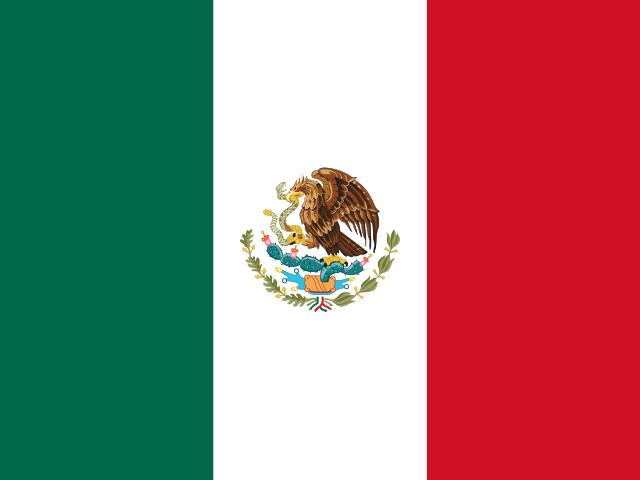
 Mexico at the World Cup — Full History
Key Facts
- The Mexico national football team is governed by the Federación Mexicana de Fútbol (FMF), founded in 1927; Mexico became a FIFA member in 1929 and a founding CONCACAF member in 1961.
- Mexico will co-host the 2026 FIFA World Cup with the United States and Canada, becoming the first nation in history to host three different editions of the men’s World Cup (1970, 1986, 2026).
- Mexico has appeared at the FIFA World Cup 17 times (a CONCACAF record), reaching the quarter-finals on the two occasions on which the country has hosted (1970 and 1986).
- Mexico is the most successful CONCACAF nation in continental competition, with 9 CONCACAF Gold Cup titles (most by any nation), 3 CONCACAF Championships and the 2019–20 CONCACAF Nations League — the basis of FMF’s claim to a record 15 senior CONCACAF titles.
- Mexico won the 1999 FIFA Confederations Cup on home soil, beating Brazil 4–3 in the final at the Estadio Azteca — to date the only senior FIFA men’s tournament won by a CONCACAF nation.
- Javier Aguirre was appointed head coach in August 2024 — his third spell in charge — and led Mexico to the 2025 CONCACAF Gold Cup title, his second Gold Cup as Mexico head coach; he is contracted through the end of the 2026 World Cup.
- Captain and defensive midfielder Edson Álvarez (West Ham United) leads the side; goalkeeper Guillermo “Memo” Ochoa remains the most-capped player and the only Mexican to play at five FIFA World Cups (2006, 2010, 2014, 2018, 2022).
- The all-time leading scorer is Javier “Chicharito” Hernández with 52 international goals; Andrés Guardado (181 caps) holds the appearance record.
- Hugo Sánchez (29 goals in 58 caps) is the team’s most decorated forward of the pre-Hernández era and was voted CONCACAF Player of the Century by the IFFHS in 1999.
- Mexico hosts its 2026 World Cup group fixtures across Estadio Azteca (renamed Estadio Banorte for the tournament) in Mexico City, Estadio BBVA in Monterrey and Estadio Akron in Guadalajara, with the tournament’s opening match scheduled at the Azteca on 11 June 2026.
- Mexico and Australia have met multiple times, including a 3–1 Australian win at the 1997 FIFA Confederations Cup in Saudi Arabia and a 2–2 friendly in Dallas on 9 September 2023.
Mexico World Cup Vital Statistics
| Metric | Value |
|---|---|
| Federation founded | 1927 (Federación Mexicana de Fútbol, FMF) |
| FIFA World Cup appearances | 17 |
| World Cup quarter-final appearances | 2 (1970, 1986 — both as host) |
| 2026 World Cup status | Co-host (with USA, Canada); third Mexico-hosted World Cup |
| CONCACAF Gold Cup titles | 9 (record) |
| FIFA Confederations Cup titles | 1 (1999) |
| All-time top scorer | Javier “Chicharito” Hernández (52 goals) |
| All-time appearances leader | Andrés Guardado (181) |
| Head coach | Javier Aguirre (third stint, since August 2024) |
| Captain | Edson Álvarez (West Ham United) |
| Primary home venue | Estadio Azteca, Mexico City (capacity 87,523) |
Mexico at the World Cup — History And Profile
The Mexico national football team, universally known as El Tri or El Tricolor, is the senior men’s representative side of Mexican football and the most successful national team in CONCACAF history. The Federación Mexicana de Fútbol (FMF), founded on 23 August 1927, governs the side; Mexico joined FIFA in 1929 and was a founding member of CONCACAF in 1961. The team plays in the green-white-red colours of the Mexican flag and is based at the Estadio Azteca in Mexico City, the 87,523-capacity stadium opened in 1966 that has hosted both World Cup finals to date staged in Mexico.
Mexico’s World Cup record is the deepest in CONCACAF: 17 finals appearances since 1930, including every tournament since 1994. The team’s two best results both came as host — quarter-finals at the 1970 World Cup, where the Estadio Azteca staged the final, and again at the 1986 World Cup, which Mexico took on at short notice after Colombia withdrew. Quarter-final exits in 1970 (to Italy) and 1986 (to West Germany on penalties) remain the high-water marks. In post-1994 World Cups, Mexico has reached the round of 16 seven times in a row through 2018 before being eliminated in the group stage of Qatar 2022 — a result that prompted federation reform and an extended search for a coach for the 2026 cycle.
Continental success has been steadier. Mexico has won the CONCACAF Gold Cup nine times (1993, 1996, 1998, 2003, 2009, 2011, 2015, 2019 and 2025), more than any other nation, plus three earlier CONCACAF Championship titles (1965, 1971, 1977). The team also won the 2019–20 CONCACAF Nations League. The crowning international achievement remains the 1999 FIFA Confederations Cup, won at the Estadio Azteca with a 4–3 victory over Brazil — to date the only senior men’s FIFA tournament won by a CONCACAF nation, sustained as a regional point of pride.
Modern Mexico has been built around a generation of European-based internationals: Hugo Sánchez (Real Madrid, La Liga top scorer five times) was named the IFFHS CONCACAF Player of the Century in 1999 and finished his international career with 29 goals in 58 caps. Rafael Márquez captained the side at four World Cups (2002, 2006, 2010, 2014) and is one of only three players to captain at four World Cups. Javier “Chicharito” Hernández is the all-time leading scorer with 52 international goals, set during a career that took him from Manchester United through Real Madrid, Bayer Leverkusen and Sevilla. Goalkeeper Guillermo “Memo” Ochoa, who played his fifth World Cup at Qatar 2022, is the most-capped player. Andrés Guardado, on 181 caps, holds the senior appearance record.
The 2026 World Cup is the defining current cycle. Mexico will co-host with the United States and Canada, becoming the first nation to stage three different World Cups (1970, 1986 and 2026). Javier Aguirre was appointed head coach in August 2024 for his third spell in charge — having previously led Mexico at the 2002 and 2010 World Cups, both ending in round-of-16 exits — with Rafael Márquez confirmed as his designated successor from 2026 onward. Aguirre’s first tournament was the 2025 CONCACAF Gold Cup, which Mexico won on home soil, making him the first manager to win two Gold Cups in charge of Mexico. The 2026 squad is being built around West Ham captain Edson Álvarez, AC Milan striker Santiago Giménez, Fulham forward Raúl Jiménez, and a Liga MX core; Aguirre’s controversial early-2026 directive that Liga MX clubs must release players for World Cup preparation drew sustained domestic backlash.
Stadium-wise, Mexico’s three host venues for 2026 are the Estadio Azteca in Mexico City (rebranded Estadio Banorte for the tournament), the Estadio BBVA in Monterrey and the Estadio Akron in Guadalajara. The opening match of the 2026 World Cup is scheduled for the Azteca on 11 June 2026, making it the first stadium ever to host opening matches at three different World Cups. Supporter culture coalesces around the chant of “Cielito Lindo”, the Mexican wave (which Mexico claims as a 1986 World Cup invention), and the controversial “puto” goal-kick chant that FIFA has repeatedly fined the FMF over. Domestic rivalries are sharp: the United States rivalry has been the principal CONCACAF axis since the 1990s, while a separate Concacafan rivalry with Costa Rica has produced multiple decisive qualifying fixtures.
The Australia connection runs through Confederations Cup and friendly meetings — Australia beat Mexico 3–1 at the 1997 Confederations Cup in Saudi Arabia and 2–0 at the 2001 edition in South Korea, and the two sides drew 2–2 in a Dallas friendly on 9 September 2023. The medium-term outlook centres on the home World Cup, with Aguirre’s contract running through the tournament and Márquez’s appointment defining the post-2026 generation.
Detailed Profile
Founding & Origins
The Federación Mexicana de Fútbol Asociación was founded on 23 August 1927. Mexico joined FIFA in 1929 and played at the inaugural FIFA World Cup in Uruguay 1930. CONCACAF, of which Mexico is a founding member, was constituted in 1961 from the merger of the older NAFC and CCCF confederations.
Crest, Colours & Kit Evolution
Mexico plays in green shirts (the host colour of the Mexican flag), white shorts and red socks; the away kit is most often white with green-and-red trim. The crest features the federation logo with the eagle-and-snake motif of the national emblem. Adidas has been the long-term kit manufacturer through the modern era.
Stadium & Premises History
The Estadio Azteca in Mexico City, opened on 29 May 1966, has been the team’s principal home for nearly six decades and hosted the 1970 and 1986 World Cup finals. The Estadio BBVA in Monterrey (opened 2015) and the Estadio Akron in Guadalajara (opened 2010) are the other 2026 host venues. The FMF training base is the Centro de Alto Rendimiento outside Mexico City.
Historical Key Players
Pre-1970s: Antonio Carbajal (the first player to appear at five World Cups, 1950–1966). 1980s–1990s: Hugo Sánchez, Luis García, Jorge Campos, Luis Hernández. 2000s: Cuauhtémoc Blanco, Rafael Márquez (four-time WC captain), Carlos Salcido, Pavel Pardo, Gerardo Torrado. 2010s–2020s: Javier “Chicharito” Hernández (52 goals), Andrés Guardado (181 caps), Guillermo “Memo” Ochoa, Hirving “Chucky” Lozano, Carlos Vela, Raúl Jiménez, Edson Álvarez (current captain), Santiago Giménez.
Coaches & Managers Legacy
Notable head-coach lineage: César Luis Menotti (Argentine, 1991–1992), Bora Milutinović (1995–1997, 1995 Copa América third place), Manuel Lapuente (1997–2000, 1999 Confederations Cup), Javier Aguirre (first stint 2001–2002, 2002 World Cup R16; second stint 2009–2010, 2010 World Cup R16; third stint from August 2024), Ricardo La Volpe (2002–2006, 2006 World Cup R16), Sven-Göran Eriksson (2008–2009), Miguel Herrera (2014, 2015 Gold Cup), Juan Carlos Osorio, Tata Martino (2018–2022, 2022 group exit) and Diego Cocca (2023, brief). Rafael Márquez is the FMF-confirmed successor from 2026.
Trophies & Honours
- FIFA Confederations Cup: 1 (1999)
- CONCACAF Gold Cup: 9 (1993, 1996, 1998, 2003, 2009, 2011, 2015, 2019, 2025)
- CONCACAF Championship: 3 (1965, 1971, 1977)
- CONCACAF Nations League: 1 (2019–20)
- Pan American Games gold: multiple
- Olympic gold: 2012 men’s tournament (London)
Peak Eras
1965–1971: Inaugural CONCACAF dominance under Ignacio Trelles. 1986: Quarter-final at the home World Cup with Hugo Sánchez and Manuel Negrete (whose volley vs Bulgaria was named the official Goal of the Tournament). 1999: Confederations Cup victory at the Azteca. 2009–2015: Three Gold Cups in seven years; 2012 Olympic gold under Luis Fernando Tena.
Rivalries
The principal rivalry is with the United States, contested across the CONCACAF Gold Cup, World Cup qualifiers and Nations League finals. Costa Rica is the second principal rival; Argentina has produced the most-watched friendly fixtures internationally.
Supporters Culture, Flags & Chants
“Cielito Lindo” is the de facto national anthem of El Tri matches; the Mexican wave (la ola) was popularised at the 1986 World Cup. The “puto” goal-kick chant has produced multiple FIFA disciplinary fines for the FMF since 2014, and federation-led “no puto” campaigns continue.
Public Image — Bad PR / Controversies
- 2022 Qatar World Cup: Group-stage exit triggered the dismissal of Tata Martino and a public reckoning over Liga MX talent depth.
- “Puto” chant: Multiple FIFA fines since 2014; FMF-led campaigns to reduce its use.
- Aguirre 2026 Liga MX directive: His ultimatum that domestic clubs release players for pre-World Cup camps drew sustained criticism in early 2026.
- 2024 Dallas-shooting incident: A friendly vs Australia drew scrutiny in 2023 over crowd-control.
Charity & Community
The FMF runs grassroots programmes in conjunction with Liga MX clubs and the federation-affiliated state associations; specific national-team charity initiatives sit under the FMF Foundation umbrella.
Australia Connection
Mexico and Australia have met multiple times in international competition. Highlights include the 1997 FIFA Confederations Cup quarter-final in Saudi Arabia, where Australia won 3–1 (with goals from Mark Viduka and John Aloisi); the 2001 Confederations Cup in South Korea, an Australian 2–0 win; and the 2–2 friendly in Dallas on 9 September 2023, in which Cesar Huerta equalised against an Australia side led by Harry Souttar. Several Mexican-Australian dual nationals and exchange-coach programmes link the two federations.
Connections to Other Clubs / Sports / Celebrity Figures
The strongest current European-club ties are Edson Álvarez (West Ham), Santiago Giménez (AC Milan), Raúl Jiménez (Fulham), Johan Vásquez (Genoa) and Cesar Montes (Lokomotiv Moscow). Long-standing sporting cross-overs include the FMF’s relationship with the Liga MX clubs América and Chivas Guadalajara, the principal domestic rivalry.
Potential Future Trajectory
The defining medium-term objective is the 2026 home World Cup. Aguirre’s mandate runs through the tournament; Rafael Márquez has been confirmed as successor from 2026. Beyond the home tournament, succession around Memo Ochoa and Andrés Guardado (now retired from the senior side), the integration of European-based forwards (Giménez, Jiménez) and the Liga MX-federation rapprochement around release windows will define the next cycle.
More World Cup 2026 Reading
WC 2026 context: See Mexico's WC 2026 group-stage form, squad and opponents →
 Best Betting Sites
 Best Online Casinos
 Blackjack Sites
 Online Pokies
 Fast Payout Casinos
 PayID Casinos
 New Casinos 2026