 Norway at the World Cup — Full History
Key Facts
- The Football Association of Norway (Norges Fotballforbund, NFF) was founded in 1902 and is the governing body for football in Norway; the senior men’s national team plays in red shirts, white shorts and blue socks.
- Norway has appeared at three FIFA World Cup tournaments — 1938, 1994 and 1998 — and qualified for the 2026 World Cup, ending a 28-year absence since France 1998.
- Norway’s best World Cup finishes are round-of-16 exits in 1938 (to Italy) and 1998 (to Italy again), the latter coming after a famous 2–1 group-stage win over reigning champions Brazil.
- Norway won the bronze medal at the 1936 Berlin Olympic Games men’s football tournament, defeating host nation Germany 2–0 in the quarter-finals; the match was attended by Adolf Hitler.
- Norway is the only national team never to have lost to Brazil in senior men’s full international football, with two wins and two draws in four meetings.
- Erling Haaland is Norway’s all-time top scorer with 55 international goals in 49 appearances at the time of qualification, a goals-per-game ratio of 1.12.
- Haaland scored 16 goals in eight matches during the UEFA 2026 World Cup qualifying campaign, tying Robert Lewandowski’s 2018 record for most goals in a single European qualifying cycle, and scored in all eight of Norway’s group fixtures.
- Norway’s 2026 qualifying campaign was a perfect 8W-0D-0L group-stage run with a +31 goal difference, including a 4–1 home win over Italy in Oslo on 16 November 2025 that confirmed top-of-group qualification.
- Captain Martin Ødegaard (Arsenal) and head coach Ståle Solbakken (appointed December 2020 in his second NFF stint) anchor the senior squad.
- Norway plays its senior men’s home internationals at the 27,200-capacity Ullevaal Stadion in Oslo, the federation’s primary venue since 1926.
- Norway and Australia have met multiple times in men’s senior international football — most recently a 1–4 Norway win in Oslo on 23 March 2018 (Bert van Marwijk’s first match as Australia head coach, with Ola Kamara hat-trick), preceded by a 2–2 draw at Craven Cottage in 2004 (Tim Cahill, Josip Skoko goals) and a 1–0 Australia win in Sydney in 1997 (Robbie Hooker).
- Norway’s 2026 World Cup tournament group draw placed it in a high-profile pool, with Fox Sports describing the team as “dictating” the 2026 group of death narrative.
Norway World Cup Vital Statistics
| Metric | Value |
|---|---|
| Federation founded | 1902 (NFF) |
| FIFA World Cup appearances | 4 (incl. 2026) — 1938, 1994, 1998, 2026 |
| Best FIFA World Cup finish | Round of 16 (1938, 1998) |
| 1936 Olympic Games | Bronze medal — football |
| Top scorer (all-time) | Erling Haaland — 55 goals in 49 caps (1.12 ratio) |
| Current head coach | Ståle Solbakken (appointed December 2020, second stint) |
| Captain | Martin Ødegaard |
| Home stadium | Ullevaal Stadion, Oslo — capacity 27,200 |
| 2026 WC qualifying group | UEFA — first place, 8W-0D-0L (+31 GD) |
| Haaland 2026 qualifying goals | 16 goals (tied Lewandowski 2018 record) |
| 2026 WC final-tournament group | High-profile draw — described by Fox Sports as “Group of Death” |
| Australia head-to-head (men’s senior) | 1997 (Aus 1–0), 2004 (2–2 draw, Craven Cottage), 2018 (Norway 4–1, Oslo) |
Norway at the World Cup — History And Profile
The Norway national football team — known by the supporters’ nickname “Drillos” (after long-serving 1990s head coach Egil Olsen, “Drillo”) and by the patriotic shorthand “Røde, Hvite, Blå” (Red, White and Blue) — is the senior men’s representative side of the Football Association of Norway (Norges Fotballforbund, NFF). The federation was founded in 1902 and is the principal national governing body for football in Norway. Despite the country’s small population — fewer than 5.5 million at the most recent census — Norwegian football has produced two distinct peaks at major tournaments and, in the 2020s, a generational golden cohort built around captain Martin Ødegaard (Arsenal) and forward Erling Haaland (Manchester City).
The earliest peak arrived in the late 1930s. Norway won the bronze medal at the 1936 Berlin Olympic Games men’s football tournament, defeating host nation Germany 2–0 in the quarter-finals — a fixture attended by Adolf Hitler — before losing the bronze-medal match. Norway then reached the round of 16 at its first FIFA World Cup at France 1938, losing 1–2 after extra time to Italy, the eventual world champions. The team did not return to a World Cup until almost six decades later.
The second peak — under coach Egil “Drillo” Olsen — produced consecutive World Cup qualifications in 1994 (USA) and 1998 (France). The 1994 squad reached the second round before exiting in a tightly contested group; the 1998 squad authored Norway’s most-replayed result by defeating reigning world champions Brazil 2–1 in the group stage at Stade Vélodrome, Marseille, before losing 0–1 to Italy in the round of 16. Norway is the only national team never to have lost to Brazil in senior men’s full international football, with two wins and two draws across four meetings,. Notable players from that era included Tore André Flo, Henning Berg, Ole Gunnar Solskjær, Ronny Johnsen, John Carew and goalkeeper Frode Grodås. Solskjær — later head coach of Manchester United (2018–2021) — is among the most-cited Norwegian footballing figures abroad.
A long absence followed. Norway did not qualify for any World Cup or European Championship between 2000 and 2024 — a 24-year drought that produced steady mid-table qualification campaigns but no major-tournament returns. The current era began with the December 2020 reappointment of Ståle Solbakken (his second NFF stint after a 2007 spell), running parallel to the rapid international emergence of Erling Haaland, who debuted for the senior team in September 2019 at age 19, and Martin Ødegaard, who had become Norway’s youngest senior international at age 15 in 2014. Both players reached established Premier League peaks in the early 2020s — Haaland with Manchester City (2022–) and Ødegaard at Arsenal (2021–).
The 2026 World Cup qualifying campaign was historic. Norway finished UEFA group stage with a perfect record of eight wins from eight, with no draws or defeats and a +31 goal difference. Haaland scored 16 goals in those eight matches — equalling Robert Lewandowski’s 2018 record for most goals in a single European qualifying cycle — and scored in every fixture. The decisive match was a 4–1 home win over Italy at Ullevaal Stadion on 16 November 2025, Norway’s first competitive win over Italy in 25 years, which confirmed top-of-group qualification and the country’s return to World Cup football for the first time since France 1998. The team is captained by Ødegaard and managed by Solbakken; key contributors include Alexander Sørloth, Antonio Nusa, Sander Berge, Patrick Berg, Kristoffer Ajer and goalkeeper Ørjan Nyland.
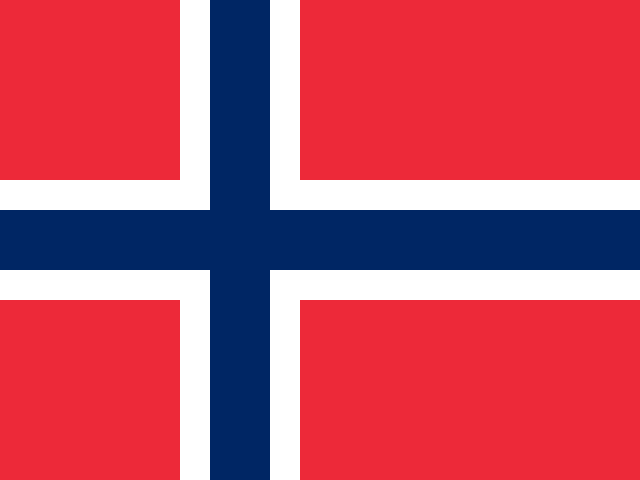
Norway plays its senior men’s home internationals at the 27,200-capacity Ullevaal Stadion in Oslo, the federation’s primary venue since 1926. The team kit pairs red shirts with white shorts and blue socks, drawing on the Norwegian flag’s colour palette. The federation is headquartered in Oslo, with current NFF president Lise Klaveness in office.
The Norway–Australia bilateral has produced three notable senior men’s full internationals in the modern era. Australia won 1–0 in Sydney in 1997 (Robbie Hooker scoring the only goal in Terry Venables’ early Socceroos tenure), drew 2–2 at Craven Cottage in London in 2004 (Tim Cahill and Josip Skoko scoring), and lost 4–1 in Oslo on 23 March 2018 in Bert van Marwijk’s first match as Australia head coach (Ola Kamara scoring a hat-trick). Per Fox Sports’ December 2025 draw analysis, Norway’s 2026 World Cup tournament group placement was characterised as one of the harder draws of the cycle. Subsequent ESPN and beIN Sports previews highlighted Haaland’s qualifying-cycle scoring rate (16 goals in 8 matches, equalling Robert Lewandowski’s 2018 European-qualifier record) as the principal commercial and editorial storyline running into the finals.
Detailed Profile
Crest, Colours & Kit Evolution
Norway plays in red shirts, white shorts and blue socks, drawing on the Norwegian flag’s colour palette. The crest carries the NFF logo with a stylised lion. Current kit supplier is Nike. Iconic shirts include the 1998 France World Cup design and the 2025 qualifying-cycle home strip.
Stadium History
Ullevaal Stadion in Oslo has been the federation’s primary national-team venue since 1926. The 27,200-capacity ground hosted the 16 November 2025 World Cup qualifying win over Italy that confirmed Norway’s 2026 qualification. Selected qualifiers and friendlies are also played at smaller venues including the Lerkendal Stadion in Trondheim and Brann Stadion in Bergen.
Coaches & Managers Legacy
The most decorated NFF coach is Egil “Drillo” Olsen, whose long-form-direct-style 1990s side qualified Norway for the 1994 and 1998 World Cups. Olsen’s later stints (2009–2013) and the intervening tenures of Nils Johan Semb (1998–2003), Åge Hareide (2003–2008) and Per-Mathias Høgmo (2013–2016) bridged the long absence. Lars Lagerbäck — Sweden’s longest-serving coach — coached Norway from 2017 to 2020. Ståle Solbakken returned for a second stint in December 2020 and remains in post.
Iconic Players
Pre-1990s: Jørgen Juve (the all-time leading scorer until eclipsed by Haaland in the 2020s, with 33 goals in his career). 1990s: Tore André Flo, Henning Berg, Ronny Johnsen, John Carew, Ole Gunnar Solskjær (later Manchester United head coach), Frode Grodås. 2000s–2010s: John Arne Riise, Joshua King, Stefan Strandberg. Modern era: Erling Haaland, Martin Ødegaard (captain), Alexander Sørloth, Antonio Nusa, Sander Berge, Kristoffer Ajer, Patrick Berg.
Trophies & Honours
- 1936 Berlin Olympic Games: bronze medal (football).
- FIFA World Cup: round of 16 in 1938 and 1998; group-stage 1994.
- Cited Norway-only record: never lost to Brazil in senior men’s full internationals (2W-2D-0L).
- 2026 FIFA World Cup qualification: perfect 8W-0D-0L group-stage campaign with +31 GD and Haaland’s 16-goal qualifying record.
Peak Eras
- 1936–1938 cycle (Olympic bronze; first World Cup round of 16).
- 1990s “Drillos” era under Egil Olsen (1990–1998 World Cups; Brazil 2–1 group win in 1998).
- 2024–2026 Solbakken-Haaland-Ødegaard cycle (perfect qualifying campaign; return to World Cup after 28 years).
Rivalries
Norway’s principal rivalries are regional. The “Scandinavian derby” against Sweden is the longest-running fixture. The Denmark fixture is similarly long-standing. Outside Scandinavia, Norway’s most consequential modern rivalries are with Italy (the 1938 and 1998 World Cup losses, the 2025 qualifying win) and with Brazil (Norway’s unbeaten record in head-to-head play).
Supporters Culture
Norway’s home support is concentrated at Ullevaal Stadion, with the supporters’ group Heia Norge travelling in volume to qualifiers. Norway home matches sell out routinely in the Haaland–Ødegaard era, with November 2025 fixture demand reaching peaks not seen since the late 1990s.
Public Image — Bad PR / Controversies
Norway’s relative under-investment in coaching pathways during the 2000s and early 2010s was a frequent target of domestic football-media commentary, with several coaches departing under sustained pressure. The federation’s most-cited modern reputational issue was the 2007 Solbakken first-stint resignation; he returned 13 years later for a second stint that has produced the 2026 qualification.
Charity & Community
The NFF runs grassroots programmes through 18 district associations, including the long-running Norway Cup youth tournament — historically one of the world’s largest age-grade football events. National-team players have repeatedly featured in matchday community-visit programmes; the federation has also been at the forefront of UEFA-led anti-discrimination signalling, including a 2021 protest against Qatar 2022 host conditions.
Australia Connection
Norway has played Australia in three senior men’s full internationals in the modern era. Australia won 1–0 in Sydney in 1997 (Robbie Hooker scoring in early Terry Venables tenure as part of the four-nation Optus World Series). Norway and Australia drew 2–2 at Craven Cottage in London in 2004, with Tim Cahill and Josip Skoko scoring for Australia. Norway then defeated Australia 4–1 in Oslo on 23 March 2018, with Ola Kamara scoring a hat-trick in Bert van Marwijk’s first match as Socceroos head coach. The bilateral has been concentrated around friendlies rather than competitive ties; no senior Norway-Australia fixture has been announced for the 2026 World Cup tournament window.
Connections to Other Federations / Celebrity Figures
The NFF maintains close technical relationships with neighbouring Nordic federations (Sweden, Denmark, Finland, Iceland) and has long-standing club-football pathways into the Premier League (Manchester United, Manchester City, Arsenal, Newcastle), the Bundesliga (RB Leipzig, Borussia Dortmund) and the Eredivisie. Ole Gunnar Solskjær’s career trajectory — Manchester United player 1996–2007 and head coach 2018–2021 — links Norway to the highest tier of English club football. Erling Haaland’s father Alf-Inge Håland was a Premier League midfielder for Nottingham Forest, Leeds and Manchester City in the 1990s and 2000s.
Potential Future Trajectory
With qualification for the 2026 FIFA World Cup confirmed via a perfect group-stage campaign and the Haaland-Ødegaard generation at competitive peak, Norway’s medium-term outlook centres on (a) Solbakken’s contract terms beyond the 2026 finals, (b) the ability of the senior squad to convert qualifying form into knock-out-stage progression for the first time since 1998, and (c) the federation’s pathway from a 28-year absence into a settled major-tournament rotation. Euro 2028 (United Kingdom and Ireland) opens immediately after the 2026 finals.
More World Cup 2026 Reading
WC 2026 context: See Norway's WC 2026 group-stage form, squad and opponents →
 Best Betting Sites
 Best Online Casinos
 Blackjack Sites
 Online Pokies
 Fast Payout Casinos
 PayID Casinos
 New Casinos 2026