 Panama at the World Cup — Full History
Key Facts
- The Panama national football team is governed by the Federación Panameña de Fútbol (FEPAFUT), founded in 1937; Panama joined FIFA in 1938 and is a founding member of CONCACAF (1961).
- Panama qualified for the 2026 FIFA World Cup with an unbeaten record across the second and third rounds of CONCACAF qualifying under head coach Thomas Christiansen — 4 wins from 4 in the first group stage and an unbeaten run thereafter.
- The 2026 finals will be Panama’s second senior FIFA World Cup, after the 2018 World Cup debut in Russia, where the team lost all three group-stage matches (to Belgium, England and Tunisia).
- At the 2026 World Cup draw on 5 December 2025, Panama was placed in Group L alongside England, Croatia and Ghana — described by Fox Sports and FourFourTwo as the team’s most challenging-yet-winnable group at this level.
- Panama’s group-stage matches are scheduled for 17 June (vs Ghana, Toronto), 23 June (vs Croatia, Toronto) and 27 June 2026 (vs England, MetLife Stadium, New York/New Jersey). [Fox Sports]
- Felipe Baloy’s late goal in the 2018 World Cup match vs England (a 1–6 defeat at the Nizhny Novgorod Stadium) was Panama’s first ever goal at a senior FIFA World Cup.
- Thomas Christiansen, the Danish-born coach with Spain caps and a Bundesliga top-scorer title (2002–03 with Bochum), has led Panama since 2020 and is the longest-serving coach in the team’s history.
- Panama has reached three CONCACAF Gold Cup finals — 2005, 2013 and 2023 — finishing as runners-up each time, and was runner-up at the 2024–25 CONCACAF Nations League finals.
- Captain Aníbal Godoy (Sporting CP) leads the side; key squad members include Adalberto “Coco” Carrasquilla (2023 Gold Cup Best Player), Amir Murillo (Marseille), Ismael Díaz, Cecilio Waterman and José Fajardo.
- Roman Torres remains an iconic figure, the centre-back whose 88th-minute goal vs Costa Rica on 10 October 2017 sealed Panama’s first World Cup qualification (2018 Russia) and produced a national holiday declared by then-President Juan Carlos Varela.
- Panama plays in red shirts with white shorts at the Estadio Rommel Fernández Gutiérrez in Panama City (capacity ~32,000), the team’s nominal home venue and FIFA-rated CONCACAF qualifying stadium.
Panama World Cup Vital Statistics
| Metric | Value |
|---|---|
| Federation founded | 1937 (FEPAFUT) |
| FIFA membership | 1938 |
| FIFA World Cup appearances | 2 (2018, 2026) |
| 2026 World Cup group | Group L (England, Croatia, Ghana) |
| CONCACAF Gold Cup finals | 3 (2005, 2013, 2023 — runners-up each) |
| CONCACAF Nations League | Runners-up (2024–25) |
| Copa Centroamericana titles | 1 (2009) |
| Head coach | Thomas Christiansen (since 2020) |
| Captain | Aníbal Godoy (Sporting CP) |
| Iconic figure | Roman Torres (winning goal vs Costa Rica, 10 Oct 2017) |
| First-ever World Cup goal | Felipe Baloy vs England, 24 June 2018 |
| Home venue | Estadio Rommel Fernández Gutiérrez, Panama City |
Panama at the World Cup — History And Profile
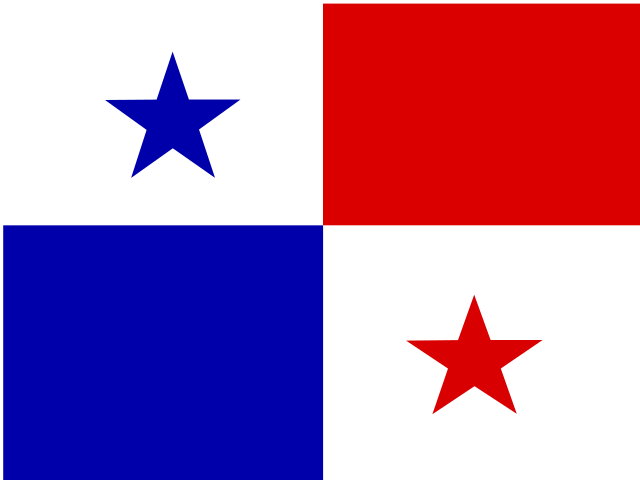
The Panama national football team — known popularly as La Marea Roja (The Red Tide) and Los Canaleros (The Canal Men, in reference to the Panama Canal) — is the senior representative side of Panamanian football. The Federación Panameña de Fútbol (FEPAFUT) was founded in 1937, with Panama joining FIFA in 1938 and becoming a founding member of CONCACAF in 1961. The team plays in red shirts with white shorts and blue socks (the colours of the national flag) and is based at the Estadio Rommel Fernández Gutiérrez in Panama City, the 32,000-capacity national stadium opened in 1970 and named after the late Panamanian footballer Rommel Fernández, who died in a car accident in Spain in 1993.
For most of the twentieth century Panama was a peripheral CONCACAF football nation. The country’s senior representative team won the CCCF Championship as host in 1951 — predecessor competition to the modern CONCACAF Championship — and produced sporadic Caribbean and Central American results, but did not contest a senior FIFA World Cup until the 2018 cycle. The breakthrough came at the 2005 CONCACAF Gold Cup, where Panama reached its first regional final, losing on penalties to the United States. A second Gold Cup final followed in 2013, again lost to the United States, in a tournament defined by Blas Pérez’s prolific scoring. The 2009 Copa Centroamericana — won as host with a final-round victory over Costa Rica — was the team’s first major regional title.
The defining football moment came on 10 October 2017. In a CONCACAF qualifier at the Estadio Rommel Fernández, Panama needed to beat Costa Rica to qualify for the 2018 World Cup; Roman Torres scored an 88th-minute winner to seal a 2–1 victory and confirm Panama’s first ever senior World Cup qualification. President Juan Carlos Varela declared the following day a national holiday, and the goal remains the most-replayed moment in the country’s football history. At the 2018 World Cup in Russia, however, Panama lost all three group-stage matches — 0–3 to Belgium, 1–6 to England and 1–2 to Tunisia. Felipe Baloy’s late goal against England, on 24 June 2018 in Nizhny Novgorod, was Panama’s first ever goal at a senior FIFA World Cup.
The post-2018 cycle then saw the appointment in 2020 of Danish-born coach Thomas Christiansen, who has since become Panama’s longest-serving head coach. Christiansen’s playing career, principally as a striker for Espanyol, Hannover and VfL Bochum (where he was the 2002–03 Bundesliga top scorer), included two appearances for Spain in 1993; his managerial pathway ran through Cyprus, Leeds United (briefly), AEL Limassol and APOEL Nicosia before the Panama appointment. Under Christiansen, Panama reached its third CONCACAF Gold Cup final in 2023 — losing 0–1 to Mexico in the Inglewood final — and the 2024–25 CONCACAF Nations League finals as runners-up.
The 2026 World Cup qualifying campaign was the most successful in the team’s history. Panama won all four matches in the second round of CONCACAF qualifying with a +12 goal difference, then completed an unbeaten third-round group to confirm qualification with matches to spare. At the 2026 World Cup draw on 5 December 2025, Panama was placed in Group L alongside England, Croatia and Ghana. The group-stage matches are scheduled for 17 June 2026 (vs Ghana at Toronto Stadium / BMO Field), 23 June (vs Croatia at Toronto) and 27 June (vs England at MetLife Stadium in New York/New Jersey).
The 2026 squad is built around captain Aníbal Godoy (Sporting CP, formerly San Jose Earthquakes), midfielder Adalberto “Coco” Carrasquilla (named 2023 CONCACAF Gold Cup Best Player), right-back Amir Murillo (Marseille), and an attack led by Ismael Díaz, Cecilio Waterman and José Fajardo. Christiansen has implemented a possession-focused approach. Roman Torres remains an iconic figure as the qualification-goal scorer; José Luis Garcés, Felipe Baloy and Blas Pérez are the principal pre-2020 generation reference points.
Supporter culture in Panama is intense and centred on La Marea Roja, the FEPAFUT-recognised supporter group whose travel programmes have grown sharply since 2017 qualification. Match-day chants combine Spanish-language football culture with Panamanian Carnival rhythms, and the FEPAFUT runs annual Día de la Marea Roja celebrations at Panama City fixtures. The principal regional rivalries are with Costa Rica (the trans-Central American axis since the 1990s) and the United States (the CONCACAF qualifying and Gold Cup pairing).
The Australia connection is essentially nonexistent. There is no documented senior international fixture between Panama and Australia, no AFC dual-national in the 2026 World Cup qualifying squad and no current Australian-registered staff member at FEPAFUT. The medium-term outlook is dominated by performance at the 2026 World Cup, with Christiansen’s Danish-Spanish coaching staff in place through the tournament and a strong Sporting CP- and MLS-anchored core.
Detailed Profile
Founding & Origins
The Federación Panameña de Fútbol (FEPAFUT) was founded in 1937. Panama joined FIFA in 1938 and was a founding member of CONCACAF in 1961. The country’s earliest international fixtures were Caribbean and Central American competitions in the 1930s and 1940s, predating CONCACAF’s modern qualifying programme.
Crest, Colours & Kit Evolution
Panama plays in red shirts with white shorts and blue socks; the change strip is white. The crest features the FEPAFUT logo with a red-white-blue motif corresponding to the national flag. New Balance has been the long-term modern kit manufacturer.
Stadium & Premises History
The Estadio Rommel Fernández Gutiérrez in Panama City, opened in 1970 and named after the Panamanian footballer Rommel Fernández (who died in a car accident in Spain in 1993), is the team’s principal home venue and the FEPAFUT-rated CONCACAF qualifying stadium. The 32,000-capacity ground hosts most senior international fixtures.
Historical Key Players
1990s–2000s: Julio César Dely Valdés (long the all-time top scorer), Jorge Dely Valdés, Felipe Baloy, Jaime Penedo. 2010s: Blas Pérez (long the top scorer record-holder), Luis Tejada, Gabriel Gómez, Román Torres (qualification-goal hero in 2017). Modern era: Aníbal Godoy (current captain), Adalberto “Coco” Carrasquilla (2023 Gold Cup Best Player), Amir Murillo, Ismael Díaz, Cecilio Waterman, José Fajardo, Eduardo Guerrero.
Coaches & Managers Legacy
Notable head-coach lineage: José Hernández (1990s); Hernán Darío Gómez (2014–2018, 2018 World Cup qualification — first in country history); Julio Dely Valdés (interim, 2018–2019); Bolillo Gómez returned briefly; Thomas Christiansen (since 2020 — longest-serving Panama head coach, 2023 Gold Cup final, 2024–25 Nations League final, 2026 World Cup qualification).
Trophies & Honours
- FIFA World Cup: appearances 2018, 2026
- CONCACAF Gold Cup: runners-up 2005, 2013, 2023
- CONCACAF Nations League: runners-up 2024–25
- Copa Centroamericana: 1 title (2009, as host)
- CCCF Championship: 1 (1951, as host)
Peak Eras
2005–2013: First CONCACAF Gold Cup finals appearances under Alexandre Guimarães and Hernán Darío Gómez. 2017–2018: First World Cup qualification under Bolillo Gómez and the Russia 2018 finals. 2020–present: Christiansen-led Gold Cup final (2023), Nations League final (2024–25) and 2026 World Cup qualification.
Rivalries
The principal regional rivalry is with Costa Rica, contested across CONCACAF qualifiers and Copa Centroamericana fixtures. The Panama-United States pairing has produced multiple decisive Gold Cup and Nations League encounters. The Panama-Honduras rivalry is the third principal Central American axis.
Supporters Culture, Flags & Chants
La Marea Roja (The Red Tide) is the FEPAFUT-recognised supporter group; matchday culture combines Spanish-language football traditions with Panamanian Carnival rhythms. The 2017 qualification triggered street celebrations across Panama City and a national-holiday declaration.
Public Image — Bad PR / Controversies
- 2018 World Cup heavy defeats: 1–6 loss to England produced sustained domestic introspection.
- 2024–25 Nations League final controversy: Officiating disputes during the final defeat to Mexico drew CONCACAF complaints.
- Pre-2014 institutional instability: FEPAFUT governance disputes through the 2010s; resolved under the modern federation leadership.
Charity & Community
FEPAFUT runs grassroots programmes across Panama’s provinces, with a particular focus on the Panama City and Colón metropolitan areas. The federation’s youth-development pipeline is integrated with Liga Panameña de Fútbol clubs.
Australia Connection
No documented senior international fixture between Panama and Australia. No AFC dual-national featured in the 2026 World Cup qualifying squad. The Australian and Panamanian football communities have no documented institutional ties beyond participation in shared FIFA tournaments.
Connections to Other Clubs / Sports / Celebrity Figures
The strongest current European-club ties are through Aníbal Godoy (Sporting CP), Amir Murillo (Marseille, formerly Anderlecht), and the MLS-based core (with multiple Panamanian internationals at Houston Dynamo, San Jose Earthquakes and Inter Miami over the past cycle). Coach Thomas Christiansen’s playing career at Espanyol, VfL Bochum and Hannover and his managerial stops at Leeds United and APOEL connect Panama to the wider European-football network.
Potential Future Trajectory
The defining short-term objective is performance at the 2026 World Cup under Thomas Christiansen — Panama’s second finals appearance in eight years. Beyond 2026, FEPAFUT’s stated priorities are sustained CONCACAF top-tier status, succession around the Godoy-Carrasquilla-Murillo generation, and continued integration of Liga Panameña and MLS-Sporting-CP-based players into a possession-orientated system.
More World Cup 2026 Reading
WC 2026 context: See Panama's WC 2026 group-stage form, squad and opponents →
 Best Betting Sites
 Best Online Casinos
 Blackjack Sites
 Online Pokies
 Fast Payout Casinos
 PayID Casinos
 New Casinos 2026