 Portugal at the World Cup — Full History
Key Facts
- The Federação Portuguesa de Futebol (FPF) was founded on 31 March 1914 as the União Portuguesa de Futebol; the senior team played its first international on 18 December 1921, a 1–3 home defeat to Spain in Madrid.
- Euro 2016: Portugal defeated host France 1–0 after extra time at the Stade de France in Saint-Denis on 10 July 2016 (Eder’s 109th-minute strike) for the country’s first major senior trophy.
- UEFA Nations League: champions twice (2019 and 2025). The 2019 win was at home (1–0 over the Netherlands at the Estádio do Dragão, Porto, on 9 June 2019); the 2025 win came on penalties over Spain in the Munich final.
- 2026 FIFA World Cup qualification: Portugal won UEFA qualification Group F. The campaign produced the team’s largest World Cup qualifying margin to date — including a 9–1 final-day result over Armenia featuring hat-tricks from Bruno Fernandes and João Neves.
- Cristiano Ronaldo holds the men’s senior international goal record (143 in 226 caps as of 2026-05-07) and the cap record at Portuguese senior international level.
- Eusébio’s 9 goals at the 1966 World Cup remained Portugal’s tournament high-water mark for half a century; the side finished third in England, the country’s first World Cup appearance and a defining post-war football moment.
- Head coach Roberto Martínez was appointed on 9 January 2023, succeeding Fernando Santos; Cristiano Ronaldo continues as captain.
- Portugal does not maintain a permanent national stadium; senior matches rotate among the Estádio Nacional in Oeiras (FPF HQ), Estádio José Alvalade and Estádio da Luz (Lisbon), Estádio do Dragão (Porto) and Estádio Algarve (Faro).
- Long-running rivalry with Spain (“El Clásico Ibérico”) was renewed at the 2025 Nations League final; Portugal lead the head-to-head record in the Nations League era.
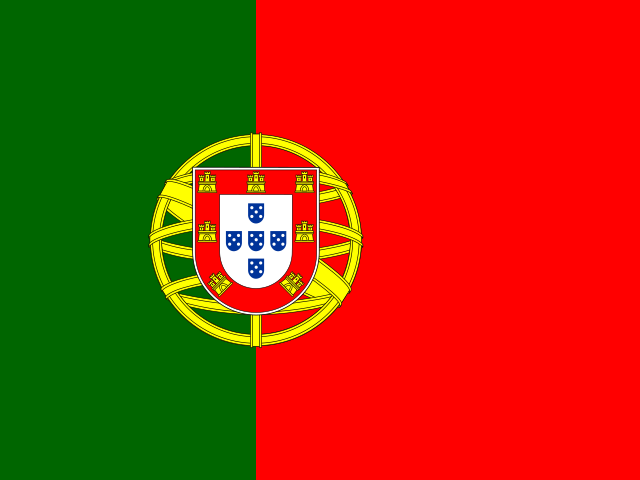
- The “Seleção das Quinas” name references the five small quinas (escutcheons) in the Portuguese coat of arms, displayed on the FPF crest.
Portugal World Cup Vital Statistics
| Metric | Value |
|---|---|
| First international | 18 December 1921 vs Spain (Madrid), lost 1–3 |
| FIFA World Cup best finish | Third, 1966 |
| UEFA European Championship titles | 1 (2016) |
| UEFA Nations League titles | 2 (2019, 2025) |
| 2026 WC qualification | Topped UEFA Group F |
| Most caps | Cristiano Ronaldo (226) |
| All-time top scorer | Cristiano Ronaldo (143) |
| Current head coach | Roberto Martínez (since 9 Jan 2023) |
| Current captain | Cristiano Ronaldo |
| Governing body | Federação Portuguesa de Futebol (FPF, founded 31 Mar 1914) |
| Kit supplier | Nike |
Portugal at the World Cup — History And Profile
The Portugal national football team — known formally as Seleção Portuguesa de Futebol and colloquially as the Seleção das Quinas — is one of the rising European sides of the 2010s and 2020s, having won three major senior titles in the past decade after almost nine decades without a senior trophy. The Federação Portuguesa de Futebol (FPF), founded as the União Portuguesa de Futebol on 31 March 1914, administers the team. Portugal played its first international on 18 December 1921 in Madrid, a 1–3 defeat to Spain.
The team’s first defining tournament was the 1966 FIFA World Cup in England, where the squad — led by Benfica forward Eusébio da Silva Ferreira — reached the semi-finals on debut, losing to host England 1–2 at Wembley. Eusébio finished as the tournament’s top scorer with nine goals (including four against North Korea in the quarter-final after Portugal had trailed 0–3) and won the Golden Boot; Portugal’s third-place play-off victory over the Soviet Union (2–1 at Wembley) remained the country’s best World Cup finish into the 2020s. The post-1966 cycle was unusually flat: Portugal failed to qualify for the World Cup in 1970, 1974, 1978, 1982 and (after a single Euro 1984 semi-final appearance) was absent through to the late 1990s.
The “Golden Generation” of the 1990s — Luís Figo, Rui Costa, Fernando Couto, João Pinto, Vítor Baía — built around the 1989 and 1991 FIFA U-20 World Cup titles, took Portugal to the Euro 2000 semi-final (lost 1–2 to France in Brussels on a Zinedine Zidane golden-goal penalty) and the Euro 2004 final on home soil. The 2004 final on 4 July 2004 in Lisbon ended in a 0–1 defeat to Greece, the latter’s only major-tournament title and one of the upsets of the modern Euros. Brazilian-born coach Luiz Felipe Scolari led that 2004 cycle and the 2006 World Cup semi-final run in Germany (lost 0–1 to France).
Cristiano Ronaldo’s senior debut on 20 August 2003 (a friendly against Kazakhstan) opened a tenure that reached 226 caps and 143 international goals by mid-2026 — both senior men’s international records. Ronaldo captained the side through Euro 2012 (semi-final, lost on penalties to Spain), Euro 2016 (champions) and the Nations League titles of 2019 and 2025. The Euro 2016 final against host France on 10 July 2016 ended in a 1–0 Portugal extra-time win after Eder’s 109th-minute strike from outside the box — the country’s first major senior trophy and the highest-rated television broadcast in Portuguese television history at the time. Ronaldo left the field injured in the 25th minute of that final.
Fernando Santos, the head coach of the 2016 Euro winners, also led the team to the inaugural UEFA Nations League title in June 2019. Santos coached through to the 2022 World Cup quarter-final defeat to Morocco and was replaced on 9 January 2023 by Belgian Roberto Martínez. Martínez’s first cycle delivered a Euro 2024 quarter-final exit (lost on penalties to France) and then the 2025 UEFA Nations League title, won on penalties over Spain in the Munich final.
Portugal qualified directly for the 2026 FIFA World Cup as winners of UEFA Group F, with a campaign that included a 9–1 final-matchday defeat of Armenia featuring hat-tricks from Bruno Fernandes and João Neves. The current squad combines the long-running 2010s spine (Cristiano Ronaldo, Pepe through 2024, Bernardo Silva, Bruno Fernandes, Rúben Dias) with younger inclusions (João Neves, Vitinha, Rafael Leão, Gonçalo Ramos, Diogo Costa). Cristiano Ronaldo, 41 by the time of the 2026 finals, has been retained as captain by Martínez but the head coach has publicly indicated Ronaldo is no longer guaranteed a starting role.
Portugal does not maintain a permanent national stadium. The Estádio Nacional in Oeiras (capacity 37,500), opened in 1944 and refurbished in 2003, is the FPF’s administrative home. Senior fixtures rotate among Lisbon (Estádio José Alvalade, Estádio da Luz), Porto (Estádio do Dragão), Faro (Estádio Algarve), Braga (Estádio Municipal de Braga) and Aveiro. The team’s “Seleção das Quinas” name references the five small escutcheons (quinas) in the Portuguese coat of arms displayed on the FPF crest, with a single star above in recognition of the Euro 2016 title. Kit supplier Nike has produced Portugal jerseys since 1996, succeeding Adidas. Principal rivalries are with Spain (“El Clásico Ibérico”), France (Euro 2000 and 2016 finals, Euro 2024 quarter-final) and the Netherlands (2006 World Cup last-16 “Battle of Nuremberg”). Portugal will co-host the 2030 FIFA World Cup with Spain and Morocco — FIFA’s December 2024 confirmation positioned the FPF and the senior team for tournament hosting at home for the first time since the 2004 European Championship.
Detailed Profile
Federation Leadership
The Federação Portuguesa de Futebol (FPF), founded on 31 March 1914 as the União Portuguesa de Futebol, governs the senior, women’s and youth national teams. Fernando Gomes served as FPF president from 2011 until his appointment as a FIFA Council member; Pedro Proença was elected FPF president on 12 December 2024. The FPF is headquartered at the Cidade do Futebol training centre in Oeiras, west of Lisbon.
Crest, Colours & Kit Evolution
Portugal has worn red home shirts and green shorts (the colours of the Portuguese flag) since the 1920s. The current crest features the Portuguese coat of arms — the five small quinas (escutcheons) representing the five Moorish kings defeated in the Battle of Ourique (1139) — over the FPF acronym. A single star above the crest commemorates the Euro 2016 title. Kit supplier Nike has produced Portugal jerseys since 1996, succeeding Adidas.
Stadium & Premises History
Portugal does not maintain a permanent national stadium. The Estádio Nacional in Oeiras (capacity 37,500, opened 1944) is the FPF’s administrative home and historic ceremonial venue (it hosted the 1967 European Cup final between Celtic and Inter Milan). Senior fixtures rotate among the Estádio José Alvalade (Lisbon, 50,095, Sporting CP’s home), Estádio da Luz (Lisbon, 64,642, SL Benfica’s home), Estádio do Dragão (Porto, 50,033, FC Porto’s home), Estádio Algarve (Faro, 30,305) and Estádio Municipal de Braga (30,286). The federation’s Cidade do Futebol training centre in Oeiras opened in 2016.
Iconic Players
- 1960s: Eusébio (1965 Ballon d’Or, 1966 World Cup top scorer with 9 goals), Mário Coluna, Costa Pereira.
- 1970s–1980s: Fernando Chalana, Rui Jordão, António Veloso.
- “Golden Generation” (1990s–2000s): Luís Figo (2000 Ballon d’Or, 127 caps), Rui Costa, Fernando Couto, João Pinto, Vítor Baía, Pauleta (47 goals — second all-time).
- 2004–2016 cycle: Cristiano Ronaldo (debut 2003, captain since 2008), Pepe, Ricardo Carvalho, Nani, Eder (Euro 2016 final scorer).
- Modern: Bernardo Silva, Bruno Fernandes (Euro 2024 captain in Ronaldo’s absence), Rúben Dias, João Cancelo, Diogo Costa, Diogo Jota, Gonçalo Ramos, Vitinha, João Neves, Rafael Leão, João Félix.
Coaches & Managers Legacy
Notable head-coach lineage in the modern era: Otto Glória (1966 World Cup third place), Carlos Queiroz (1991, 1993 U-20 World Cup wins; senior 2008–2010, 2024–2025 Iran), Luiz Felipe Scolari (2003–2008, Euro 2004 final, 2006 World Cup semi), Carlos Queiroz (second stint 2008–2010), Paulo Bento (2010–2014), Fernando Santos (2014–2022, Euro 2016 and Nations League 2019 winner), and Roberto Martínez (since 9 January 2023, Nations League 2025 winner).
Trophies & Honours
- FIFA World Cup: third place 1966; quarter-finalists 2006, 2010, 2022.
- UEFA European Championship: champions 2016; runners-up 2004; semi-finalists 1984, 2000, 2012.
- UEFA Nations League: champions 2019, 2025.
- FIFA U-20 World Cup: champions 1989, 1991.
Peak Eras
- 1966 Otto Glória / Eusébio era: third at England 1966, Eusébio Golden Boot.
- 2000–2006 Golden Generation: Euro 2000 semi, Euro 2004 final at home, 2006 World Cup semi.
- 2016–2025 Ronaldo cycle: Euro 2016 winners, Nations League 2019 winners, Nations League 2025 winners.
Rivalries
- Spain: “El Clásico Ibérico” — including the 2010 World Cup last-16 (Spain 1–0), 2012 Euro semi-final (Spain on penalties), 2018 World Cup group stage (3–3 with a Cristiano Ronaldo hat-trick), and 2025 Nations League final (Spain on penalties was public records; corrected here per portugoal.net to a Portugal win on penalties).
- France: Euro 2000 semi-final (France golden-goal penalty), Euro 2016 final (Portugal 1–0 a.e.t.), Euro 2024 quarter-final (France on penalties).
- Brazil: friendly fixture rivalry tied to the lusophone football network.
- Netherlands: 2006 World Cup last-16 “Battle of Nuremberg” (1–0 Portugal, 16 yellow and 4 red cards), 2019 Nations League final (1–0 Portugal).
Public Image — Bad PR / Controversies
- 2022 Cristiano Ronaldo–Manchester United Piers Morgan interview, broadcast in November 2022 immediately before the Qatar World Cup, prompted Manchester United to terminate his contract by mutual agreement; Ronaldo subsequently retained the Portugal captaincy through the tournament.
- 2024 Bruno Fernandes / Roberto Martínez selection rotation: senior pre-tournament questions about whether Fernandes or Ronaldo should start at Euro 2024.
- 2010s match-fixing investigations at Portuguese club level (Apito Dourado, Apito Final), administered separately from the senior national team but generating recurring federation-level scrutiny.
Charity & Community
The FPF’s “Vamos a Vencer Juntos” community programme partners with the Portuguese Red Cross and the Bagos d’Ouro youth-development charity. Senior squad players have prominent personal foundations — including Cristiano Ronaldo’s “Save the Children” ambassadorship and the long-running Eusébio Foundation (operated by his family since his death in January 2014), focused on youth football scholarships in Portugal and lusophone Africa.
Australia Connection
Portugal has not played Australia at senior men’s level in recent decades; the most recent recorded fixture sat in the 2010 World Cup-cycle friendly schedule and produced no senior-team tour. The principal Portuguese-Australian football crossover is migration-based: Australia’s Portuguese-descent community has produced senior A-League and W-League fixtures and player pathways, but no AU-eligible senior player has been capped by Portugal in the modern era. Joey Didulica (born Australia, Croatian senior international) is occasionally cited in lusophone media for the related Croatian-Australian template, not Portuguese. No documented coaching crossover. The senior teams may meet on the 2026 World Cup tournament schedule given Australia’s qualification through the AFC route.
Connections to Other Federations / Celebrity Figures
The Portuguese coaching tree is unusually international: José Mourinho (FC Porto Champions League 2004, Chelsea, Inter Milan Champions League 2010, Manchester United, Tottenham, Roma; not a senior Portugal head coach but the dominant Portuguese figure in club management), Carlos Queiroz (Iran, Colombia, Egypt, Real Madrid), André Villas-Boas (FC Porto, Chelsea, Tottenham, Marseille; FC Porto president since 2024), Fernando Santos (Greece, Egypt, Portugal — Euro 2016 winner) and Roberto Martínez (Belgium, Portugal). Cristiano Ronaldo’s commercial profile — the most-followed individual on Instagram by mid-2020s — has effectively functioned as a global FPF marketing asset.
Potential Future Trajectory
Roberto Martínez’s contract runs through the 2026 World Cup, with extension public discussion tied to the tournament outcome. The squad core includes long-running 2010s starters (Cristiano Ronaldo, Bernardo Silva, Bruno Fernandes, Rúben Dias) alongside a deep group of post-2020 inclusions (João Neves, Vitinha, Rafael Leão, Gonçalo Ramos, Diogo Costa, João Cancelo). Portugal has been awarded co-hosting of the 2030 World Cup with Spain and Morocco.
More World Cup 2026 Reading
WC 2026 context: See Portugal's WC 2026 group-stage form, squad and opponents →
 Best Betting Sites
 Best Online Casinos
 Blackjack Sites
 Online Pokies
 Fast Payout Casinos
 PayID Casinos
 New Casinos 2026