 Senegal at the World Cup — Full History
Key Facts
- The team is administered by the Fédération Sénégalaise de Football (FSF), founded in 1960; the FSF affiliated with FIFA in 1962.
- Nicknamed Les Lions de la Téranga (the Lions of Teranga, after the Wolof concept of hospitality), the team plays in white home shirts and green change kits.
- Senegal won their first Africa Cup of Nations in 2022 (Cameroon), defeating Egypt on penalties in the final after a 0–0 draw — the long-awaited continental title under coach Aliou Cissé.
- Senegal have finished AFCON runners-up four times: 2002, 2019, 2025 (held in 2026), and previously third in 2006.
- The 2026 FIFA World Cup will be Senegal’s fourth tournament appearance (2002, 2018, 2022, 2026); their best result remains the quarter-finals on debut at 2002 in South Korea/Japan, including the famous opening 1–0 upset of defending champions France.
- Senegal topped CAF Group B in 2026 qualification with 24 points (7W-3D-0L, GD +19), going unbeaten throughout.
- The qualification was sealed on 14 October 2025 with a 4–0 home win over Mauritania at the Diamniadio Olympic Stadium (Mané double, Iliman Ndiaye and Habib Diallo).
- Pape Thiaw, formerly assistant coach, took over as head coach in 2024 after Aliou Cissé’s exit and led the qualifying campaign.
- Captain Kalidou Koulibaly (Al Hilal, formerly Napoli and Chelsea) leads a squad anchored by Sadio Mané (record goalscorer, 53 goals) and most-capped player Idrissa Gana Gueye (131 caps).
- Senegal were drawn into Group I of the 2026 World Cup alongside France, Norway and a playoff winner — a high-profile group given the 2002 Senegal-vs-France history.
- Puma has been the kit supplier since 2005; the modern home jersey reflects the green-yellow-red Pan-African colour palette of the national flag.
- The home venue is the Diamniadio Olympic Stadium (also known as Stade Me Abdoulaye Wade), opened in 2022 with a capacity of approximately 50,000.
Senegal World Cup Vital Statistics
| Metric | Value |
|---|---|
| First international | 31 December 1961 vs Dahomey (lost 2–3) |
| Federation founded | 1960 (FSF) |
| FIFA member | 1962 |
| FIFA World Cup appearances | 4 (2002, 2018, 2022, 2026) |
| Best FIFA World Cup result | Quarter-finals (2002) |
| Africa Cup of Nations titles | 1 (2022) |
| AFCON runners-up | 4 (2002, 2019, 2025) |
| Most caps | Idrissa Gueye (131) |
| All-time top scorer | Sadio Mané (53) |
| FIFA ranking | 14 |
| Head coach | Pape Thiaw |
| Captain | Kalidou Koulibaly |
| Home stadium | Diamniadio Olympic Stadium (Stade Me Abdoulaye Wade) |
| 2026 WC qualification (CAF) | Group B winners — 24 pts (7W-3D-0L, GD +19) |
| 2026 WC finals group | Group I vs France, Norway + playoff winner |
Senegal at the World Cup — History And Profile
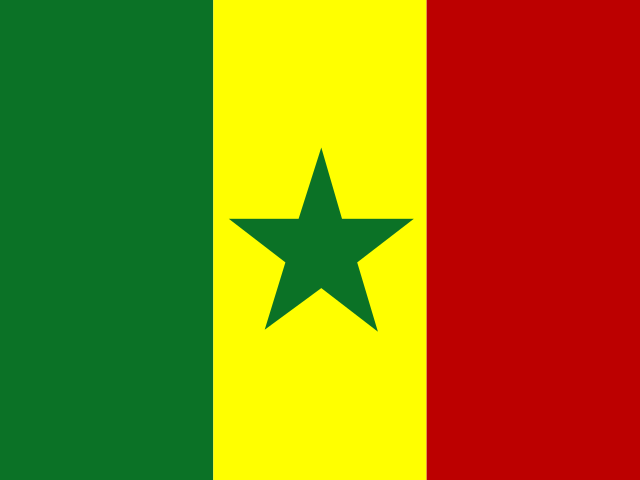
Senegal’s Lions of Teranga have established themselves as the most consistently strong national team in Africa over the past decade. Administered by the Fédération Sénégalaise de Football (FSF, founded in 1960 in the year of independence from France), the team takes its nickname from the Wolof concept of “Téranga” — hospitality, warmth, the welcoming of visitors. Senegal play in white shirts with green trim at home and green change kits, with the green-yellow-red Pan-African colour palette of the national flag carried through the FSF crest.
Senegal’s first FIFA-recognised international came on 31 December 1961, a 2–3 defeat by Dahomey. The team operated through the 1960s, 1970s and 1980s as a peripheral CAF side, with a single AFCON appearance in 1965 and 1968 before becoming a regular continental finalist from the 1990s onwards. The breakthrough generation came at the 2002 Africa Cup of Nations in Mali, where Senegal reached the final under French coach Bruno Metsu, losing 0–0 (3–2 on penalties) to Cameroon. The team — featuring Aliou Cissé, El Hadji Diouf, Henri Camara, Khalilou Fadiga, Bouba Diop and Salif Diao — followed the AFCON run with a debut FIFA World Cup appearance later in 2002. The opening 1–0 upset of defending world champions France in Seoul on 31 May 2002 (Bouba Diop goal) remains one of the most famous moments in African football history, and Senegal advanced to the quarter-finals before losing to Turkey in extra time.
After 2002, the team experienced a 16-year World Cup absence before returning at Russia 2018 (group-stage exit on fair-play disciplinary tiebreaker), Qatar 2022 (round of 16, knocked out by England), and now the 2026 finals — a third consecutive cycle, the longest streak in Senegalese football history.
The most consequential modern era came under former 2002 captain Aliou Cissé, who became head coach in 2015 and held the role through 2024. Cissé’s tenure produced two AFCON finals (2019 loss to Algeria, 2022 victory over Egypt — the country’s first continental title) and the 2018 and 2022 World Cup berths. Cissé departed in 2024; assistant Pape Thiaw was promoted to head coach. The 2026 qualification campaign in CAF Group B was unbeaten through 10 matches: 24 points (7W-3D-0L, GD +19), with the team conceding only three goals — the fewest in the group. The campaign was sealed on 14 October 2025 with a 4–0 home win over Mauritania at the Diamniadio Olympic Stadium, with Sadio Mané scoring twice (45’+1, 48’), Iliman Ndiaye on target in the 64th minute, and Habib Diallo in the 85th. The 2025 AFCON (held early 2026) ended in another final loss, this time to Morocco — a fourth AFCON runners-up finish.
The 2026 World Cup draw placed Senegal into Group I alongside France, Norway and a playoff winner. The France fixture revives the 2002 World Cup opening match, when Senegal upset Les Bleus on debut. The squad combines a veteran spine — Sadio Mané (Al-Nassr, two-time African Footballer of the Year, 53 goals), Kalidou Koulibaly (captain, Al Hilal), Édouard Mendy (Al-Ahli, formerly Chelsea), Idrissa Gueye (record caps, 131) — with a younger generation including Iliman Ndiaye (Everton), Nicolas Jackson (Chelsea), Ismaïla Sarr (Crystal Palace) and Habib Diallo. Pape Thiaw’s brief is to convert the AFCON 2022-winning generation into a sustained World Cup knockout unit.
The team plays its home matches at the Diamniadio Olympic Stadium — also known as Stade Me Abdoulaye Wade — opened in February 2022 with a capacity of approximately 50,000. The stadium is part of the new Diamniadio urban development outside Dakar. Older home internationals were played at the Stade Léopold Sédar Senghor in Dakar, which has been temporarily out of FIFA-rotation eligibility for capacity and refurbishment reasons.
Senegal’s principal football rivalries are with The Gambia (cross-border derby on the geographical basis of Senegal’s enclosure of the smaller country), Mauritania (regional fixture), Egypt (2022 AFCON final and 2022 World Cup qualifying play-off), Algeria (2019 AFCON final), Morocco (2025 AFCON final) and Ivory Coast (2024 AFCON round of 16). The Senegal–France relationship is unique: the colonial-era history is reflected in heavy French-based player participation in the squad, but the football fixture is one of the most charged in modern international football.
Looking forward, Senegal’s outlook is firmly knockout-round-capable. Pape Thiaw’s contract extends through the 2027 AFCON cycle. Generational succession from Mané and Koulibaly to Iliman Ndiaye, Sarr and Jackson is the strategic axis through 2030, and the FSF has publicly framed the 2026 World Cup as the chance to convert the AFCON 2022-winning core into a first knockout-round World Cup appearance since the 2002 quarter-final run, the country’s longest-running unfinished sporting target across two and a half decades.
Detailed Profile
Crest, Colours & Kit Evolution
Senegal plays in white home shirts with green trim and green away shirts. The Pan-African green-yellow-red palette of the national flag features in trim and on the FSF badge, which is anchored around a stylised lion (the Lion of Teranga). Puma has been the principal kit supplier since 2005 — one of the longest national-team manufacturer relationships in CAF.
Stadium & Premises History
The Diamniadio Olympic Stadium (Stade Me Abdoulaye Wade) in Diamniadio, opened in February 2022 with a capacity of approximately 50,000, is the principal venue for World Cup qualifiers and AFCON home fixtures. Earlier home internationals were played at the Stade Léopold Sédar Senghor in Dakar.
Iconic Players
- 2002 generation: El Hadji Diouf (two-time African Footballer of the Year), Henri Camara, Khalilou Fadiga, Bouba Diop, Aliou Cissé (later head coach), Ferdinand Coly, Lamine Diatta.
- 2010s: Demba Ba, Papiss Cissé, Issiar Dia.
- 2018–present: Sadio Mané (record goalscorer, two-time African Footballer of the Year), Kalidou Koulibaly (captain), Édouard Mendy, Idrissa Gueye (record caps), Cheikhou Kouyaté.
- 2022 AFCON-winning core: above plus Krepin Diatta, Pape Gueye, Bamba Dieng, Ismaïla Sarr.
- 2026 cycle: Mané, Koulibaly, Mendy, Gueye, Iliman Ndiaye, Nicolas Jackson, Ismaïla Sarr, Habib Diallo, Boulaye Dia.
Coaches & Managers Legacy
Modern lineage includes Bruno Metsu (2002 World Cup quarter-finals), Henryk Kasperczak, Amara Traoré, Joseph Koto, Alain Giresse, Aliou Cissé (2015–2024, AFCON 2022 winner) and Pape Thiaw (since 2024). Cissé’s nine-year tenure was one of the longest in CAF and produced the country’s first AFCON title.
Trophies & Honours
- AFCON: champions 2022; runners-up 2002, 2019, 2025; third 2006.
- CHAN: champions 2022.
- 2026 FIFA World Cup qualification — Group B winners.
Peak Eras
- 2002: AFCON final and World Cup quarter-finals — debut tournament breakthrough.
- 2018–2024 Cissé era: two World Cups, AFCON 2019 final, AFCON 2022 title, AFCON 2025 final.
- 2026 World Cup qualification: unbeaten campaign and third consecutive World Cup.
Rivalries
- The Gambia: cross-border derby.
- Mauritania: regional fixture.
- Egypt: 2022 AFCON final and 2022 WC qualifying play-off (both decided on penalties).
- Algeria: 2019 AFCON final.
- Morocco: 2025 AFCON final.
- France: 2002 World Cup opening 1–0 upset.
Public Image — Bad PR / Controversies
The 2018 World Cup elimination on the fair-play disciplinary tiebreaker (the first such elimination in tournament history) drew significant international criticism of the FIFA tiebreaker formula. The Aliou Cissé exit in 2024 was contested in Senegalese media. The colonial-era Senegal–France relationship continues to surface in pre-fixture commentary; the 2002 upset is regularly framed in broader post-colonial terms but the FSF has maintained a strict football-only public posture.
Australia Connection
No documented Australia connection. Australia’s senior men’s team has not played Senegal in any FIFA-listed match’s Socceroos head-to-head archive.
Potential Future Trajectory
Pape Thiaw’s contract extends through the 2027 AFCON cycle. The 2026 World Cup is the principal sporting target. Generational succession from Mané and Koulibaly to Iliman Ndiaye, Sarr and Jackson is well advanced.
More World Cup 2026 Reading
WC 2026 context: See Senegal's WC 2026 group-stage form, squad and opponents →
 Best Betting Sites
 Best Online Casinos
 Blackjack Sites
 Online Pokies
 Fast Payout Casinos
 PayID Casinos
 New Casinos 2026