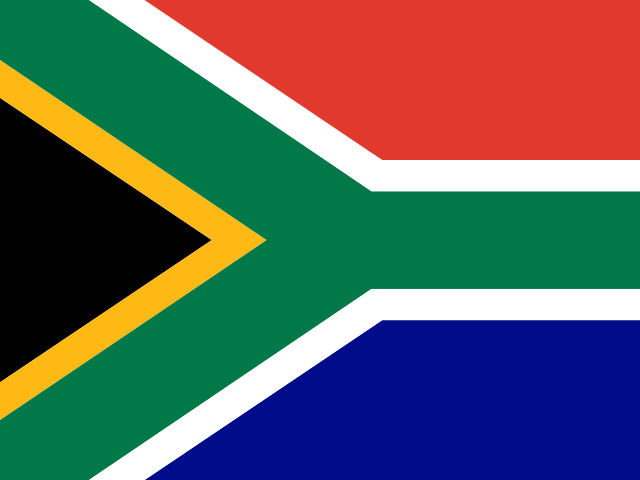
 South Africa at the World Cup — Full History
Key Facts
- The team is administered by the South African Football Association (SAFA), readmitted to FIFA in 1992 after a 16-year suspension during the apartheid era; the modern senior side dates from a re-formation in 1991.
- Nicknamed Bafana Bafana (“the boys” in the Nguni language family), the team plays in yellow home shirts and green change kits.
- South Africa won the Africa Cup of Nations in 1996 as hosts, defeating Tunisia 2–0 in the Johannesburg final under coach Clive Barker — the country’s only major continental trophy to date.
- South Africa finished AFCON runners-up in 1998 (lost 0–2 to Egypt) and third in 2000.
- The 2026 FIFA World Cup will be South Africa’s fourth tournament appearance (1998, 2002, 2010, 2026); the country also hosted the 2010 World Cup, becoming the first African nation to do so.
- The 2010 hosts campaign produced a unique milestone: South Africa became the first host nation in World Cup history to be eliminated in the group stage, despite a 2–1 final-match win over France.
- South Africa topped CAF Group C in 2026 qualification with 18 points (5W-3D-2L, GD +6), sealing the berth with a 3–0 win over Rwanda on the final matchday.
- During qualification, FIFA docked South Africa three points after their March match vs Lesotho was overturned to a 3–0 loss for fielding suspended midfielder Teboho Mokoena — a self-inflicted setback resolved on the final matchday.
- Hugo Broos, the Belgian coach who won AFCON 2017 with Cameroon, has been head coach since 2021 and has rebuilt the squad around younger players including Thalente Mbatha, Oswin Appollis and Evidence Makgopa.
- The 2026 World Cup draw placed South Africa into Group A alongside Mexico, South Korea and Czech Republic; the team opens the entire tournament against Mexico on 11 June 2026.
- Most-capped player Aaron Mokoena (107 caps) anchors the historical record; striker Benni McCarthy is the all-time top scorer with 31 goals.
- The home venue is FNB Stadium (Soccer City) in Johannesburg, capacity approximately 94,000 — the largest stadium in Africa.
South Africa World Cup Vital Statistics
| Metric | Value |
|---|---|
| Federation founded | 1991 (modern SAFA, post-apartheid) |
| Re-admission to FIFA | 1992 (after 16-year suspension) |
| FIFA World Cup appearances | 4 (1998, 2002, 2010 [hosts], 2026) |
| Best FIFA World Cup result | Group stage |
| Africa Cup of Nations titles | 1 (1996) |
| AFCON runners-up | 1 (1998) |
| Most caps | Aaron Mokoena (107) |
| All-time top scorer | Benni McCarthy (31) |
| FIFA ranking | 60 |
| Head coach | Hugo Broos |
| Captain | Ronwen Williams |
| Home stadium | FNB Stadium / Soccer City, Johannesburg (94,000) |
| 2026 WC qualification (CAF) | Group C winners — 18 pts (5W-3D-2L) |
| 2026 WC finals group | Group A vs Mexico, South Korea, Czech Republic |
South Africa at the World Cup — History And Profile
South Africa’s national football team — Bafana Bafana — has the most politically complex history of any 2026 World Cup finalist. Administered by the South African Football Association (SAFA), the team operated under multiple racially-segregated and excluded structures during the apartheid era. South Africa was suspended from FIFA in 1976 — a ban that lasted 16 years and excluded the country from international football until readmission in July 1992, the year South Africa held its first racially-integrated multilateral national-team programme. The modern unified Bafana Bafana side dates from this 1991–1992 reformation, with the first multiracial international played against Cameroon on 7 July 1992 (a 1–0 win in Durban).
The team’s defining moment came at the 1996 Africa Cup of Nations, hosted by South Africa. Coached by Englishman Clive Barker and captained by Neil Tovey, Bafana Bafana defeated Tunisia 2–0 in the Johannesburg final (Mark Williams scoring twice late) to win the country’s only major continental trophy. The tournament — opened by President Nelson Mandela — was a sporting and political milestone for the post-apartheid country, and Mandela’s later appearance in the No. 6 South Africa shirt at the 1995 Rugby World Cup final and the 1996 AFCON final remains an enduring symbol of South African nation-building.
After 1996, the team established a brief period of continental competitiveness — AFCON runner-up in 1998 (lost 0–2 to Egypt), third in 2000 — and qualified for two FIFA World Cups in succession: France 1998 (debut) and South Korea/Japan 2002. Both campaigns ended in group-stage exits. The third World Cup berth came as hosts in 2010, when South Africa became the first African nation to host the FIFA World Cup. The hosts opened the tournament with a 1–1 draw against Mexico and won the final group game 2–1 against France, but a 0–3 defeat to Uruguay in between left them eliminated on goal difference — the first time in tournament history that hosts had failed to advance from the group stage.
The 16-year stretch from 2010 to 2026 produced no further World Cup appearances and several missed AFCON cycles. The reset began in May 2021 when SAFA appointed Hugo Broos, the Belgian coach who had won the 2017 AFCON with Cameroon. ESPN’s qualification feature described Broos’s tenure as a “culture shift” centred on selecting younger players and rebuilding the South African football identity around domestic Premiership League stars. The 2026 qualification campaign in CAF Group C produced 18 points (5W-3D-2L, GD +6), with a 3–0 win over Rwanda on the final matchday sealing the berth. A self-inflicted three-point deduction earlier in the campaign — for fielding suspended midfielder Teboho Mokoena in a March 3–0 win over Lesotho, which was retroactively overturned — created a near-miss tension that resolved positively on the final matchday after Nigeria’s 4–0 win over Benin.
The 2026 World Cup draw placed South Africa into Group A alongside Mexico, South Korea and Czech Republic. The team opens the entire tournament against Mexico on 11 June 2026 in Mexico City — a fixture that mirrors the 2010 Soccer City opener vs Mexico. The squad is centred on captain Ronwen Williams (Mamelodi Sundowns goalkeeper), with younger forward talent including Thalente Mbatha (Orlando Pirates), Oswin Appollis (Orlando Pirates), Evidence Makgopa (Orlando Pirates) and Lyle Foster (Burnley). Aaron Mokoena (107 caps) and Benni McCarthy (31 goals — record goalscorer) anchor the historical record.
The home venue is FNB Stadium (Soccer City) in Johannesburg — capacity approximately 94,000, the largest stadium in Africa, and the venue of the 2010 World Cup final. The Cape Town Stadium, Mbombela Stadium and Moses Mabhida Stadium in Durban are secondary venues. SAFA has historically rotated home internationals across the country to maintain a national-engagement footprint.
South Africa’s principal football rivalries are with Nigeria (West vs South African continental fixture), Egypt (1998 AFCON final), Tunisia (1996 AFCON final), Ghana (early 2010s qualifying battles) and Zimbabwe (regional derby). The Bafana Bafana–Nigeria fixture has been the most-followed in modern South African football.
Looking forward, South Africa’s outlook is “ambitious-rebuild”. Broos’s contract has been extended through the 2027 AFCON cycle, with a stated public target of a first World Cup knockout-round appearance. Generational succession from the McCarthy and Mokoena era to Williams, Mokoena (Teboho), Mbatha, Appollis and Foster is now complete. AFCON 2025 (held early 2026) ended in a deep run, and Briefly.co.za reported the federation’s view that the 2026 World Cup is the chance to convert that momentum into an unprecedented knockout-round result and to anchor the post-2010-hosts narrative around a sporting landmark on equal footing with the 1996 AFCON title.
Detailed Profile
Crest, Colours & Kit Evolution
South Africa plays in yellow home shirts with green trim and green away shirts — the colours of the African National Congress and post-apartheid national identity. The SAFA crest features a stylised protea (the national flower) over a football. Modern kit suppliers have included Kappa, Adidas and the current cycle’s manufacturer per SAFA reporting.
Stadium & Premises History
FNB Stadium (Soccer City) in Soweto, Johannesburg, opened in 1989, expanded for the 2010 World Cup to a capacity of approximately 94,000 — the largest stadium in Africa and the venue of the 2010 World Cup final. The Cape Town Stadium, Moses Mabhida Stadium in Durban, Loftus Versfeld in Pretoria and Mbombela Stadium in Mbombela are secondary venues. The Soccer City venue’s gold-and-orange “calabash” exterior is one of the most distinctive sports venues globally.
Iconic Players
- 1996 AFCON-winning generation: Lucas Radebe (Leeds United, captain post-1996), Neil Tovey (1996 captain), Mark Williams (1996 final scorer), Doctor Khumalo, Phil Masinga, John Moshoeu, Eric Tinkler, Sizwe Motaung.
- 2000s: Quinton Fortune (Manchester United), Steven Pienaar (Everton), Aaron Mokoena (record caps), Benni McCarthy (record goalscorer), Bafana Bafana 2002 World Cup squad.
- 2010 World Cup hosts era: Itumeleng Khune, Tsepo Masilela, Reneilwe Letsholonyane, Steven Pienaar (still active), Siphiwe Tshabalala (scorer of the famous opening goal vs Mexico).
- 2026 cycle: Ronwen Williams (captain), Teboho Mokoena, Lyle Foster, Thalente Mbatha, Oswin Appollis, Evidence Makgopa, Mamelodi Sundowns and Orlando Pirates pipeline players.
Coaches & Managers Legacy
Modern lineage includes Clive Barker (1996 AFCON), Trott Moloto, Carlos Queiroz (briefly, 2002 World Cup qualifying — later coach of Ghana 2026), Stuart Baxter (multiple spells), Pitso Mosimane, Molefi Ntseki, Hugo Broos (since 2021).
Trophies & Honours
- AFCON: champions 1996; runners-up 1998; third 2000.
- COSAFA Cup multiple regional titles.
- 2010 FIFA World Cup hosts.
- 2026 FIFA World Cup qualification — Group C winners.
Peak Eras
- 1996: AFCON title under Clive Barker — the country’s first major continental trophy and a defining moment of post-apartheid sporting identity.
- 1998–2002: two consecutive World Cup appearances.
- 2010: World Cup hosts — first African nation to host the tournament.
- 2024–2026: Broos’s culture shift and 2026 World Cup qualification.
Rivalries
- Nigeria: AFCON and World Cup qualifying battles.
- Egypt: 1998 AFCON final, recurring AFCON opposition.
- Tunisia: 1996 AFCON final.
- Ghana: regional WAFCON-era fixtures.
- Zimbabwe: regional derby.
Public Image — Bad PR / Controversies
The pre-1992 apartheid-era FIFA suspension is the most consequential context for Bafana Bafana’s history; public records notes the ban factually as a 16-year exclusion. The 2026 qualifying-campaign three-point deduction for fielding the suspended Teboho Mokoena vs Lesotho was a self-inflicted technical infringement and produced significant public criticism of SAFA administration before being resolved on the final matchday. The 2010 group-stage exit as hosts produced national disappointment but was framed neutrally in subsequent SAFA reviews.
Australia Connection
Australia and South Africa played friendly matches in 2004 and 2008’s Socceroos head-to-head archive and Football Australia records. The two countries have not met in a competitive FIFA fixture.
Potential Future Trajectory
Broos’s contract extends through the 2027 AFCON cycle. The 2026 World Cup is the principal sporting target. Generational succession to Williams, Foster, Mbatha and Appollis is complete; the federation’s stated target is a first World Cup knockout-round appearance.
More World Cup 2026 Reading
WC 2026 context: See South Africa's WC 2026 group-stage form, squad and opponents →
 Best Betting Sites
 Best Online Casinos
 Blackjack Sites
 Online Pokies
 Fast Payout Casinos
 PayID Casinos
 New Casinos 2026