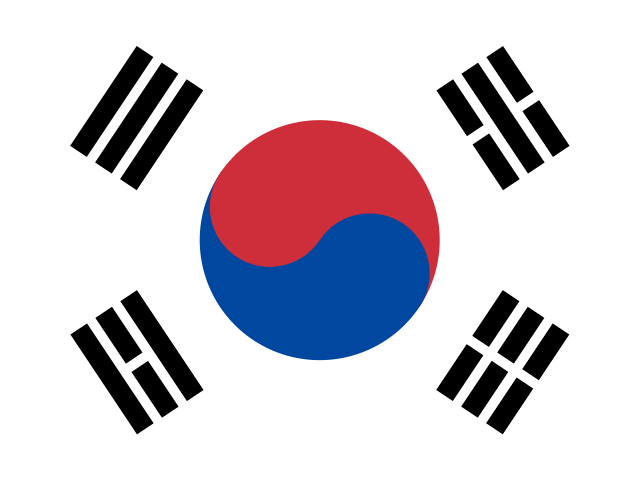
 South Korea at the World Cup — Full History
Key Facts
- The South Korea national football team — known internationally to FIFA as Korea Republic — is the senior representative side of South Korean football, governed by the Korea Football Association (KFA), founded in 1928 (with the modern federation re-established in 1948 after Korean independence).
- South Korea has appeared at 11 FIFA World Cups (1954, 1986, 1990, 1994, 1998, 2002 host, 2006, 2010, 2014, 2018, 2022) — the most by any AFC nation — and has qualified for the 2026 World Cup, which will be the team’s 12th finals appearance.
- The 2002 FIFA World Cup, co-hosted with Japan under Dutch head coach Guus Hiddink, produced the team’s defining performance: South Korea reached the semi-finals as the first Asian team in the modern era to do so, beating Italy in the round of 16 and Spain in the quarter-final on penalties before losing 0–1 to Germany.
- South Korea has won the AFC Asian Cup twice (1956 and 1960, both hosted) — making the country the inaugural Asian Cup champion. The team has not won the trophy since, finishing as runners-up four times (1972, 1980, 1988, 2015).
- Hong Myung-bo — captain of the 2002 World Cup semi-final squad and a defender with 136 international caps — was reappointed as head coach in 2024 and leads the team into the 2026 World Cup.
- Captain Son Heung-min (Tottenham Hotspur, formerly Bayer Leverkusen and Hamburger SV) is the most-capped player in team history and is four goals short of becoming the all-time top scorer; the 2026 World Cup is widely expected to be his final senior international tournament at age 33.
- South Korea qualified for the 2026 World Cup unbeaten in the AFC third round — six wins, four draws — securing automatic qualification with matches to spare. [SofaScore; Yahoo]
- At the 2026 World Cup draw on 5 December 2025, South Korea was placed in Group A alongside hosts Mexico, the Czech Republic and South Africa. Group-stage matches: 11 June (vs Mexico), 17 June (vs Czech Republic) and 23 June 2026 (vs South Africa). [12WorldCup; Yahoo]
- Cha Bum-kun (Eintracht Frankfurt, Bayer Leverkusen — UEFA Cup winner 1988) and Park Ji-sung (PSV Eindhoven, Manchester United — UEFA Champions League winner 2008) are the principal pre-Son generation reference figures, the first Asian players to win major European trophies.
- The 2015 AFC Asian Cup final, lost 1–2 to Australia after extra time at Stadium Australia in Sydney, remains the team’s most recent Asian Cup final and a defining Korea-Australia fixture.
- The KFA’s national-team supporter group, the Red Devils (founded 1995), produced the iconic 2002 World Cup street-and-stadium scenes with millions of red-clad supporters — the largest organised national-team supporter network in Asian football.
South Korea World Cup Vital Statistics
| Metric | Value |
|---|---|
| Federation founded | 1928 (Korea Football Association, KFA); modern reset 1948 |
| FIFA World Cup appearances | 11 (1954, 1986, 1990, 1994, 1998, 2002 host, 2006, 2010, 2014, 2018, 2022); 2026 will be the 12th |
| 2026 World Cup group | Group A (Mexico host, Czech Republic, South Africa) |
| Best World Cup result | Semi-finals 2002 (host) |
| AFC Asian Cup titles | 2 (1956, 1960 — both as host) |
| Asian Cup runners-up | 4 (1972, 1980, 1988, 2015) |
| Most-capped player | Son Heung-min (Tottenham, surpassing Cha Bum-kun’s earlier mark) |
| All-time top scorer | Cha Bum-kun (58 goals) — Son Heung-min within four goals |
| Head coach | Hong Myung-bo (since 2024) |
| Captain | Son Heung-min (Tottenham Hotspur) |
| FIFA ranking (April 2026) | 25 |
South Korea at the World Cup — History And Profile
The South Korea national football team — known to FIFA as Korea Republic and to global supporters as the Taegeuk Warriors, after the red-and-blue Taegeuk symbol on the national flag — is the senior representative side of South Korean football and the most successful AFC nation in FIFA World Cup competition by appearance count. The Korea Football Association (KFA), founded in 1928 and re-established in 1948 after Korean independence, governs the team. South Korea was a founding member of the Asian Football Confederation in 1954 and joined FIFA the same year.
South Korea’s World Cup record is the deepest in Asia: 11 appearances since 1954, including every tournament since 1986 — the longest active streak by any AFC nation. The 2026 World Cup will be the team’s twelfth senior finals. Of the 11 prior tournaments, the defining performance came at the 2002 FIFA World Cup, co-hosted with Japan. Under Dutch head coach Guus Hiddink, South Korea topped its group ahead of Portugal, beat Italy 2–1 in the round of 16 (Ahn Jung-hwan’s golden-goal winner) and Spain on penalties in the quarter-final, before losing 0–1 to Germany in the semi-final. Park Ji-sung’s 70th-minute winner against Portugal in Incheon, the goal that confirmed group qualification, remains the most-replayed Korean football moment. The semi-final run made South Korea the first Asian team in the modern World Cup era to reach the last four.
The team’s earliest international honours pre-date the 2002 emergence: South Korea won the inaugural AFC Asian Cup in 1956 (as host) and successfully defended the title in 1960 (also as host), making the country the only AFC nation to win the first two editions of the continental championship. The team has not won the trophy since but reached the final on four occasions (1972, 1980, 1988 and 2015 — the last lost 1–2 to Australia after extra time at Stadium Australia in Sydney, with James Troisi’s extra-time winner). South Korea has appeared at every Asian Cup since 1956.
Modern South Korea has been built around generations of European-based stars. Cha Bum-kun, who played for Eintracht Frankfurt and Bayer Leverkusen, won the UEFA Cup in 1988 and is the all-time top scorer with 58 international goals. Park Ji-sung, who joined Manchester United in 2005 from PSV Eindhoven, became the first Asian player to win the UEFA Champions League (2008) and won four Premier League titles between 2007 and 2011. Son Heung-min (Tottenham Hotspur, formerly Bayer Leverkusen and Hamburger SV) is the dominant figure of the post-2010 generation: the most-capped player in Korean history, four goals short of Cha’s all-time scoring record at the 2026 cycle’s opening, and Premier League Golden Boot winner in 2021–22. Son captains the side, and the 2026 World Cup is widely expected to be his final senior international tournament at age 33.
The 2026 World Cup qualifying campaign was the most efficient by Asian standards. South Korea went unbeaten in the AFC third-round group stage with six wins and four draws, securing automatic qualification with matches to spare. At the 2026 World Cup draw on 5 December 2025, South Korea was placed in Group A alongside hosts Mexico, the Czech Republic and South Africa — a draw described in Korean media as “playable but unforgiving”. Group-stage matches are scheduled for 11 June 2026 (vs Mexico, the tournament opener at the Estadio Azteca, Mexico City), 17 June (vs Czech Republic) and 23 June (vs South Africa). The June 11 fixture is the World Cup opener and Mexico’s home match at the Azteca, making it among the most-watched group-stage games of the tournament.
Hong Myung-bo, the captain of the 2002 semi-final squad and a 136-cap defender, was reappointed as head coach in 2024 and leads the team into the 2026 finals — his second senior stint after a previous tenure in 2013–2014. The 2026 squad is built around captain Son Heung-min, defensive midfielder Hwang In-beom (Feyenoord), forward Lee Kang-in (Paris Saint-Germain), Wolverhampton Wanderers forward Hwang Hee-chan, Brentford striker Kim Ji-soo, defenders Kim Min-jae (Bayern Munich) and Lee Jae-sung. The KFA’s recruitment of dual-national and European-academy players has been a defining cycle.
The Australia connection is significant. The 2015 AFC Asian Cup final, hosted by and won by Australia, is the most consequential Korea-Australia fixture: Tim Cahill’s two quarter-final goals against China and James Troisi’s extra-time final winner came at the expense of Hong’s then-Korean side. The two federations meet regularly in AFC qualifying and Asian Cup fixtures; both have AFC Asian Cup runner-up positions on their respective records. Several Korean internationals have played in Australian football, with cross-A-League / K League player movement increasing through the 2020s. The Korea-Australia rivalry is now the second-most consequential AFC fixture for both teams, after Korea-Japan and Australia-Japan respectively. The medium-term outlook centres on Son’s farewell tournament and post-2026 succession around Lee Kang-in, Kim Min-jae and Hwang Hee-chan.
Detailed Profile
Founding & Origins
The Korea Football Association was founded in 1928 during the Japanese colonial era, with the modern federation re-established in 1948 after Korean independence. South Korea was a founding member of the Asian Football Confederation in 1954 and joined FIFA the same year. The team’s first FIFA World Cup appearance was at Switzerland 1954, where Korea lost 0–9 to Hungary in the team’s debut match.
Crest, Colours & Kit Evolution
South Korea plays in red shirts (the colour of the Taegeuk symbol on the national flag), black shorts and red socks; the change strip is white. The crest features a stylised tiger — the symbol of the KFA since the federation’s modernisation in the 1980s. Nike has been the long-term modern kit manufacturer.
Stadium & Premises History
South Korea does not maintain a single national football venue. Senior fixtures rotate among the Seoul World Cup Stadium (the 2002 World Cup semi-final venue), Suwon World Cup Stadium, Daegu Stadium, Jeju World Cup Stadium and Goyang Stadium. The KFA training base is the National Football Centre in Paju, north of Seoul.
Historical Key Players
Pre-2000s: Cha Bum-kun (Eintracht Frankfurt, Bayer Leverkusen — 58 international goals, UEFA Cup 1988); Hong Myung-bo (current head coach, 136 caps); Hwang Sun-hong; Hong Sung-jung. 2002 generation: Park Ji-sung (PSV, Manchester United — UEFA Champions League 2008); Lee Young-pyo (PSV, Tottenham); Ahn Jung-hwan (golden-goal hero vs Italy); Seol Ki-hyeon. Modern era: Son Heung-min (current captain, Tottenham — Premier League Golden Boot 2021–22); Lee Kang-in (Paris Saint-Germain); Kim Min-jae (Bayern Munich); Hwang Hee-chan (Wolverhampton); Hwang In-beom (Feyenoord); Lee Jae-sung; Cho Gue-sung.
Coaches & Managers Legacy
Notable head-coach lineage: Park Jong-hwan (1971); Cha Bum-kun (player-coach in the 1990s); Guus Hiddink (Dutch, 2001–2002, 2002 World Cup semi-final); Jo Bonfrère (Dutch, 2004–2005); Pim Verbeek (Dutch, 2005–2006); Huh Jung-moo (2007–2010); Cho Kwang-rae (2010–2011); Choi Kang-hee (2011–2013); Hong Myung-bo (first stint 2013–2014, 2014 World Cup); Uli Stielike (German, 2014–2017, 2015 Asian Cup final); Shin Tae-yong (2017–2018, 2018 World Cup including 2–0 win over Germany); Paulo Bento (Portuguese, 2018–2022, 2022 World Cup R16); Jürgen Klinsmann (German, 2023–2024, brief tenure ended after 2024 Asian Cup semi-final exit); Hong Myung-bo (second stint, since 2024).
Trophies & Honours
- AFC Asian Cup: 2 titles (1956, 1960 — both as host); runners-up 1972, 1980, 1988, 2015
- FIFA World Cup: appearances 1954, 1986, 1990, 1994, 1998, 2002 host (semi-finals), 2006, 2010, 2014, 2018, 2022, 2026 (best result: semi-finals 2002)
- East Asian Football Championship: 5 titles (2003, 2008, 2015, 2017, 2019)
Peak Eras
1956–1960: Inaugural and second Asian Cup victories under host conditions. 1986–1990s: Cha Bum-kun’s European-based generation; sustained World Cup qualification streak from 1986 onward. 2002: Hiddink-led semi-final at the home World Cup — the country’s defining football era. 2010s–2020s: Son Heung-min’s Premier League Golden Boot (2021–22) and continued World Cup qualification, plus the 2018 World Cup 2–0 win over defending champions Germany in Kazan.
Rivalries
The principal AFC rivalry is with Japan — the Korea-Japan derby, contested since the 1950s and the second-most-played international fixture in football history (more than 80 senior internationals to date). Secondary AFC rivalries: Iran (the post-1980 Asian Cup axis); Australia (the 2015 Asian Cup final and subsequent qualifying meetings); Saudi Arabia. The 2002 Korea–Italy and Korea–Spain knockout fixtures produced lasting fan-press hostilities.
Supporters Culture, Flags & Chants
The Red Devils, founded 1995, are the official KFA-recognised national-team supporter group; the 2002 World Cup street-and-stadium scenes saw millions of red-clad supporters across Seoul and other major cities. Match-day singing centres on the Korean national anthem, the “Daehan Minguk” four-beat chant (with hand-clap rhythm), and the “Pilseung Korea” (필승 코리아) victory chant. The Red Devils’ 2002 mobilisation remains the largest organised national-team supporter event in Asian football.
Public Image — Bad PR / Controversies
- 2002 World Cup officiating: Italy and Spain referee decisions remain disputed in European football discourse but celebrated in Korea.
- 2018 Russia World Cup: Group-stage exit despite the historic 2–0 win over Germany; subsequent post-tournament debate over Shin Tae-yong’s tactics.
- 2024 AFC Asian Cup: Semi-final exit and reports of locker-room dispute between Son Heung-min and Lee Kang-in led to Klinsmann’s dismissal and Hong Myung-bo’s reappointment.
- KFA governance: The federation has faced multiple inspection-related and presidential-election controversies through the 2020s.
Charity & Community
The KFA runs extensive grassroots, women’s-football and Asian-pathway programmes; Son Heung-min’s family-run Son Football Academy operates in Chuncheon as a private youth-development pipeline. The KFA’s national-team players regularly participate in disaster-relief and education-pathway programmes.
Australia Connection
The Korea-Australia rivalry is one of the principal AFC fixtures of the post-2006 era. The defining encounter is the 2015 AFC Asian Cup final at Stadium Australia in Sydney, in which Australia beat South Korea 2–1 after extra time, with Tim Cahill’s quarter-final goals and James Troisi’s extra-time final winner ending Korea’s run. South Korea had also reached the 1972, 1980 and 1988 Asian Cup finals. The two sides meet regularly in AFC qualifying and Asian Cup fixtures; both federations have built strong K League–A-League player movement through the 2020s. Several Korean internationals have featured in the A-League Men, and Australian managers have held KFA consultancy roles in technical-development frameworks.
Connections to Other Clubs / Sports / Celebrity Figures
The strongest current European-club ties are through Son Heung-min (Tottenham Hotspur), Lee Kang-in (Paris Saint-Germain), Kim Min-jae (Bayern Munich), Hwang Hee-chan (Wolverhampton Wanderers), Hwang In-beom (Feyenoord) and the Bundesliga-Serie A pipeline. Park Ji-sung (Manchester United, four Premier League titles, 2008 UEFA Champions League) and Cha Bum-kun (Eintracht Frankfurt, Bayer Leverkusen, 1988 UEFA Cup) anchor the pre-Son generation reference.
Potential Future Trajectory
The defining short-term objective is performance at the 2026 World Cup under Hong Myung-bo, with the tournament widely framed as Son Heung-min’s last senior dance. Beyond 2026, the KFA’s stated priorities are succession around the Lee Kang-in / Kim Min-jae / Hwang Hee-chan / Hwang In-beom European-based generation, the 2027 AFC Asian Cup, and continued investment in K League and academy infrastructure. The post-Son captaincy and the post-Hong head-coach succession are the two principal next-cycle questions.
More World Cup 2026 Reading
WC 2026 context: See South Korea's WC 2026 group-stage form, squad and opponents →
 Best Betting Sites
 Best Online Casinos
 Blackjack Sites
 Online Pokies
 Fast Payout Casinos
 PayID Casinos
 New Casinos 2026