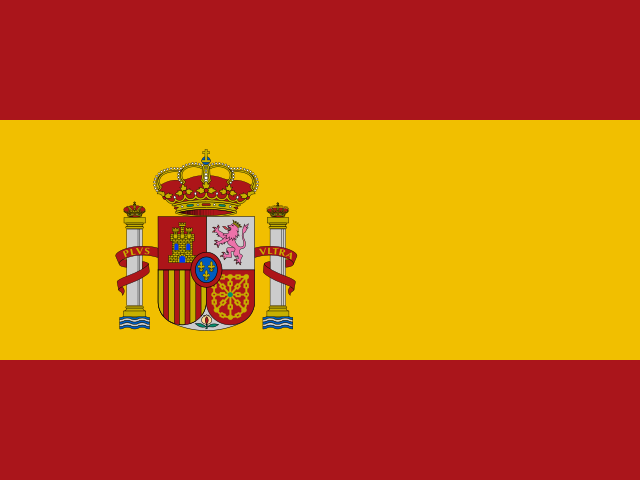
 Spain at the World Cup — Full History
Key Facts
- The Real Federación Española de Fútbol (RFEF) was founded in 1909 and admitted to FIFA in 1904 (the federation’s predecessor body); the senior men’s team played its first international on 28 August 1920 at the Antwerp Olympics.
- 1 FIFA World Cup title (2010, South Africa) — Andrés Iniesta’s 116th-minute extra-time goal defeated the Netherlands 1–0 in the Johannesburg final on 11 July 2010, making Spain the first European team to win a World Cup outside Europe.
- 4 UEFA European Championship titles — 1964, 2008, 2012 and 2024 — a record number, exceeding Germany’s three.
- 2008–2012 cycle: Spain became the only national team to win three consecutive major-tournament titles in men’s senior football (Euro 2008, World Cup 2010, Euro 2012), built on the “tiki-taka” possession-based system associated with manager Vicente del Bosque, Xavi, Iniesta and Sergio Busquets.
- Euro 2024 victory: Spain defeated England 2–1 in the final at Berlin’s Olympiastadion on 14 July 2024 under head coach Luis de la Fuente; the 2024 squad won all seven tournament fixtures, the first side to do so at a Euros under the 24-team format.
- 2023 UEFA Nations League: Spain defeated Croatia on penalties in the Rotterdam final (0–0 a.e.t., 5–4 pens) on 18 June 2023.
- 2026 World Cup qualification: Spain topped UEFA Group E with 21 goals scored against just two conceded, sealing qualification with a 2–2 draw against Turkey in their final group fixture.
- All-time top scorer: David Villa (59 goals). Most caps: Sergio Ramos (180 caps, 2005–2021) — also Spain’s most-capped male outfield player and a 2010 World Cup-winning starter.
- Current head coach: Luis de la Fuente (appointed 8 December 2022); he previously won the 2019 UEFA U21 European Championship and the 2021 Tokyo Olympic silver medal with Spain youth sides.
- Spain has no permanent national stadium and rotates senior fixtures among Madrid (Bernabéu, Metropolitano), Seville (La Cartuja), Valencia (Mestalla), Villarreal (Cerámica) and La Coruña (Riazor).
Spain World Cup Vital Statistics
| Metric | Value |
|---|---|
| First international | 28 August 1920 vs Denmark (Antwerp Olympics), won 1–0 |
| FIFA World Cup titles | 1 (2010) |
| UEFA European Championship titles | 4 (1964, 2008, 2012, 2024) — record |
| UEFA Nations League titles | 1 (2023) |
| FIFA ranking | 2nd |
| Most caps | Sergio Ramos (180) |
| All-time top scorer | David Villa (59) |
| Current head coach | Luis de la Fuente (since 8 Dec 2022) |
| Current captain | Álvaro Morata |
| 2026 WC qualification | Topped UEFA Group E (21 GF, 2 GA) |
| Governing body | Real Federación Española de Fútbol (RFEF, founded 1909) |
| Kit supplier | Adidas (since 1991, contract through 2030) |
Spain at the World Cup — History And Profile
The Spain national football team, known as La Roja, is the only side in men’s international football to have won three successive major-tournament titles (Euro 2008, FIFA World Cup 2010 and Euro 2012) and the joint-record holder of UEFA European Championships with four titles (1964, 2008, 2012 and 2024). The Real Federación Española de Fútbol (RFEF) was founded in 1909, and the senior men’s team played its first international on 28 August 1920 at the Antwerp Olympic Games, defeating Denmark 1–0. Spain wears red home shirts and dark-blue shorts, the latter referencing the colours of Castile.
The team’s pre-2008 record was characterised by recurring quarter-final exits at major tournaments, with the 1964 European Nations’ Cup — won 2–1 over the Soviet Union at the Bernabéu in Madrid on 21 June 1964 — the only senior trophy across more than four decades. The breakthrough came with the appointment of Luis Aragonés as head coach (2004–2008) and the introduction of a possession-based passing model later canonised as “tiki-taka”. Aragonés’s side won Euro 2008 in Vienna with a 1–0 final over Germany on 29 June 2008, Spain’s first major trophy in 44 years.
Vicente del Bosque succeeded Aragonés in 2008 and led Spain through what is widely regarded as the dominant cycle of modern men’s international football. At the 2010 World Cup in South Africa, Spain lost their opening group fixture 0–1 to Switzerland and then won six consecutive knock-out fixtures, sealing the title with Andrés Iniesta’s 116th-minute extra-time strike against the Netherlands at Soccer City, Johannesburg, on 11 July 2010. Two years later in Kyiv, Spain defeated Italy 4–0 in the Euro 2012 final on 1 July 2012 — the largest victory margin in a European Championship final and the only successful defence of the title at the time of writing. The squad’s spine — goalkeeper Iker Casillas, defender Sergio Ramos, midfielders Xavi, Iniesta, Sergio Busquets and Xabi Alonso, and forward David Villa (59 international goals — record) — won the Euro 2008–World Cup 2010–Euro 2012 treble together.
The post-2012 cycle dipped sharply: a group-stage exit at the 2014 World Cup as defending champions, last-16 elimination at Euro 2016, and another last-16 exit at the 2018 World Cup in Russia. Julen Lopetegui was dismissed by the RFEF on 13 June 2018 — two days before the World Cup opener — after Real Madrid announced him as their incoming manager; Fernando Hierro coached the interim. Luis Enrique took over after the 2018 tournament, reaching the Euro 2020 semi-final (lost on penalties to Italy) and the 2022 World Cup last 16 (lost on penalties to Morocco). Luis Enrique left after Qatar.
Luis de la Fuente — previously head coach of Spain’s U21s (2019 European Championship winner) and the Tokyo 2020 Olympic men’s side (silver medal) — was appointed senior head coach on 8 December 2022. His first cycle delivered the 2023 UEFA Nations League, with a 0–0 draw and penalty shoot-out victory over Croatia in Rotterdam on 18 June 2023, and Euro 2024 — Spain winning all seven tournament fixtures (including a 2–1 quarter-final defeat of host Germany after extra time and a 2–1 final win over England in Berlin on 14 July 2024) for the country’s record-extending fourth European Championship.
Spain qualified directly for the 2026 FIFA World Cup as winners of UEFA Group E. The campaign produced 21 goals scored against just two conceded across eight matches; the side finished a record 30-match unbeaten run dating to a 0–2 Euro 2024 qualifying defeat by Scotland in March 2023. The current squad core combines 2024 Euro winners (Rodri Hernández, Aymeric Laporte, Dani Carvajal, Mikel Merino, Fabián Ruiz, Nico Williams, Lamine Yamal, Álvaro Morata) with younger inclusions (Pedri, Pau Cubarsí, Marc Cucurella). Lamine Yamal — who turned 17 the day before the Euro 2024 final — became the youngest player to score and assist at a European Championship.
Spain has no permanent national stadium and rotates senior fixtures among Madrid (Estadio Santiago Bernabéu, Estadio Wanda Metropolitano), Seville (La Cartuja), Valencia (Mestalla), Villarreal (Cerámica) and La Coruña (Riazor). The training base is the RFEF’s Ciudad del Fútbol facility in Las Rozas, Madrid, north-west of the city. Adidas has been the federation’s kit supplier since 1991, with the current contract running through 2030 — among the longest active national-team kit partnerships in international football. Principal rivalries are with Portugal (Iberian neighbour), Italy, France, England, Germany and the Netherlands; the women’s senior side, also administered by the RFEF, is the 2023 World Cup champion La Selección Femenina, whose 1–0 final defeat of England in Sydney on 20 August 2023 made Spain the first nation to hold both senior World Cups simultaneously. Spain’s 2030 co-hosting of the FIFA World Cup with Portugal and Morocco was confirmed by FIFA in December 2024.
Detailed Profile
Federation Leadership
The Real Federación Española de Fútbol (RFEF), founded in 1909, governs the senior men’s, women’s and youth national teams. Rafael Louzán has served as RFEF president since 16 December 2024, having succeeded Pedro Rocha (interim 2023–2024) and Luis Rubiales — Rubiales resigned on 10 September 2023 amid the post-Women’s-World-Cup “kiss” controversy and was subsequently convicted of sexual assault in February 2025 (suspended sentence). The RFEF is headquartered in Las Rozas, Madrid, and operates the Ciudad del Fútbol national training facility on the same campus.
Crest, Colours & Kit Evolution
Spain has worn red home shirts since the 1920 Antwerp Olympics, with dark-blue shorts (referencing the colours of Castile) and yellow trim added in subsequent decades. The current crest features the RFEF coat of arms — combining the Spanish royal crown with the federation acronym — and a single star above the crest in recognition of the 2010 World Cup. Adidas has produced Spain jerseys since 1991, with the contract publicly extended through 2030 (announced March 2023).
Stadium & Premises History
Spain does not maintain a permanent national stadium. Senior fixtures rotate among Estadio Santiago Bernabéu (Madrid, capacity 81,044 post-renovation), Estadio Wanda Metropolitano (Madrid, 70,460), Estadio de La Cartuja (Seville, 57,619), Estadio de Mestalla (Valencia, 49,500), Estadio de la Cerámica (Villarreal, 23,500) and Estadio Riazor (La Coruña, 32,490). The Euro 2008 final celebrations and the 2010 World Cup victory parade returned to Madrid’s Plaza de Cibeles. The Ciudad del Fútbol in Las Rozas, north-west of Madrid, is the senior squad’s training base.
Iconic Players
- Pre-1980s: Telmo Zarra (20 goals in 20 caps), Luis Suárez Miramontes (1960 Ballon d’Or winner), Amancio Amaro.
- 1980s–1990s: Emilio Butragueño, Míchel, Andoni Zubizarreta, Fernando Hierro.
- 2008–2012 generation: Iker Casillas (167 caps), Sergio Ramos (180 caps — record), Xavi (133 caps), Andrés Iniesta (131 caps, 2010 final scorer), Sergio Busquets, Xabi Alonso, Carles Puyol, David Villa (59 goals — record), Fernando Torres.
- 2024 Euro generation: Rodri Hernández, Aymeric Laporte, Dani Carvajal, Pedri González, Mikel Merino, Fabián Ruiz, Lamine Yamal, Nico Williams, Álvaro Morata.
Coaches & Managers Legacy
Notable head-coach lineage in the modern era: José Villalonga (1962–1966, Euro 1964 winner), Ladislao Kubala (1969–1980), Miguel Muñoz (1982–1988), Luis Suárez Miramontes (1988–1991), Javier Clemente (1992–1998), Luis Aragonés (2004–2008, Euro 2008 winner), Vicente del Bosque (2008–2016, World Cup 2010 and Euro 2012 winner), Julen Lopetegui (2016–2018, dismissed before the 2018 World Cup opener), Fernando Hierro (interim 2018), Luis Enrique (2018–2022) and Luis de la Fuente (since 8 December 2022, Nations League 2023 and Euro 2024 winner).
Trophies & Honours
- FIFA World Cup: champions 2010; fourth place 1950.
- UEFA European Championship: champions 1964, 2008, 2012, 2024; runners-up 1984.
- UEFA Nations League: champions 2023; runners-up 2021.
- Olympic gold (men’s senior): 1992 Barcelona; silver: 1920 Antwerp, 2000 Sydney, 2020 Tokyo.
- FIFA Confederations Cup: runners-up 2013.
Peak Eras
- 2008–2012 Aragonés–del Bosque cycle: Euro 2008, World Cup 2010 and Euro 2012 — the only successive major-tournament treble in men’s international football.
- 2023–2024 de la Fuente cycle: Nations League 2023 and Euro 2024.
- 1964 Villalonga era: Euro 1964 win at the Bernabéu, the federation’s first major trophy.
Rivalries
- Portugal: the “El Clásico Ibérico”, with the most recent decisive fixture being the 2025 Nations League final (Portugal won 5–3 on penalties after a 2–2 draw in Munich).
- Italy: the 2008 quarter-final (Spain on penalties), 2012 final (4–0 to Spain), 2016 last-16 (2–0 to Italy) and Euro 2020 semi-final (Italy on penalties).
- France: the 2024 Euro semi-final (2–1 to Spain in Munich).
- Germany: Euro 2008 final (1–0 to Spain), Euro 2024 quarter-final (2–1 to Spain a.e.t.).
- Netherlands: 2010 World Cup final (1–0 to Spain) and 2014 World Cup group-stage rematch (5–1 to Netherlands).
Public Image — Bad PR / Controversies
- 2018 Lopetegui dismissal: the RFEF dismissed head coach Julen Lopetegui on 13 June 2018, two days before Spain’s World Cup opener, after Real Madrid announced him as incoming manager.
- 2023 RFEF “kiss” controversy: at the FIFA Women’s World Cup final on 20 August 2023, RFEF president Luis Rubiales kissed forward Jennifer Hermoso without consent during the medal ceremony in Sydney; he resigned on 10 September 2023 and was convicted of sexual assault by a Spanish court in February 2025 (suspended sentence). The case prompted a player revolt at La Selección Femenina and an overhaul of RFEF governance.
- Recurring tactical-discipline criticism through the 2014–2022 cycle, capped by group-stage exits at the 2014 and 2022 World Cups.
Charity & Community
The RFEF operates the “Pisamos Charco” grassroots programme and partners with UNICEF Spain on La Roja-branded fundraising fixtures. Senior squad players have prominent personal foundations — including Iker Casillas’s eponymous foundation focused on community football and education.
Australia Connection
Spain has met Australia at senior men’s level only at friendly level, with the most recent fixture a March 2023 friendly arranged around Australia’s 2022 World Cup squad reset. The principal Spanish-Australian football crossover sits at club level — La Liga clubs Sevilla, Valencia and Espanyol have run pre-season friendlies in Australia in the 2010s and 2020s — and at the player level, with Mark Bosnich’s mid-1990s Aston Villa career running parallel to interest from FC Barcelona before he signed for Manchester United. No Spain head coach has held a Socceroos role at senior level. Australia-born Spain internationals are not on record.
Connections to Other Federations / Celebrity Figures
The 2008–2012 generation produced an unusually wide post-playing managerial network: Xavi (head coach FC Barcelona 2021–2024), Iniesta (Vissel Kobe playing-coach role), Xabi Alonso (Bayer Leverkusen 2024 Bundesliga title, Real Madrid head coach from 2025), Mikel Arteta (Arsenal head coach since 2019), and Pep Guardiola (Manchester City; not a senior Spain international but the architect of the Barcelona club system that produced the tiki-taka generation). Luis Enrique held the Paris Saint-Germain head-coach role between 2023 and 2025 alongside the senior Spain national-team consultancy briefing.
Potential Future Trajectory
Spain enters the 2026 World Cup as joint pre-tournament favourites alongside France and Argentina, on a 30-match unbeaten run, ranked 2nd in the FIFA April 2026 standings, and with a young squad core (Lamine Yamal, Pedri, Pau Cubarsí, Nico Williams) likely to remain in place through the 2030 World Cup, which Spain will co-host with Portugal and Morocco. Luis de la Fuente’s contract runs through the 2026 cycle, with extension speculation tied to the World Cup result.
More World Cup 2026 Reading
WC 2026 context: See Spain's WC 2026 group-stage form, squad and opponents →
 Best Betting Sites
 Best Online Casinos
 Blackjack Sites
 Online Pokies
 Fast Payout Casinos
 PayID Casinos
 New Casinos 2026