 Türkiye at the World Cup — Full History
Key Facts
- The Turkish Football Federation (Türkiye Futbol Federasyonu, TFF) was founded in 1923, the same year as the founding of the Turkish Republic; the team’s first international match — a 2–2 draw with Romania — was played on 26 October 1923.
- Türkiye joined FIFA in 1923 and UEFA in 1962 (after a 1923–1962 affiliation realignment).
- Türkiye has appeared at four FIFA World Cup tournaments — 1950, 1954, 2002 and 2026 — with the team’s best finish a third-place result at Korea/Japan 2002 under Şenol Güneş.
- Hakan Şükür’s 11th-second goal for Türkiye against South Korea in the 2002 third-place play-off remains the fastest goal in FIFA World Cup history (officially recorded at approximately 10.8–11 seconds).
- All-time records: most caps Rüştü Reçber with 120 appearances; top scorer Hakan Şükür with 51 goals.
- Türkiye qualified for the 2026 FIFA World Cup via the UEFA playoffs in March 2026, ending a 24-year absence since 2002, with Vincenzo Montella’s side winning Path C with back-to-back 1–0 wins over Romania (semi-final) and Kosovo (final, in Pristina, 31 March 2026, Kerem Aktürkoğlu scoring in the 54th minute).
- Captain Hakan Çalhanoğlu (Inter Milan) leads a senior squad built around Real Madrid’s 21-year-old playmaker Arda Güler, Juventus forward Kenan Yıldız, Galatasaray’s Mauro Icardi support cast, and Inter Milan’s Çalhanoğlu midfield axis.
- Türkiye’s 2026 final-tournament group is Group D, alongside the United States, Paraguay and Australia; the Crescent-Stars open the tournament against the Socceroos at BC Place, Vancouver, Canada, on 13 June 2026 (5:00am AEST 14 June).
- Türkiye won UEFA Nations League promotion to League A for the first time in the 2024–25 cycle, completing the federation’s most successful sustained period since 2002–2008.
- Vincenzo Montella, the former Italy striker and Sevilla, Fiorentina and Adana Demirspor head coach, was appointed in September 2023 and has overseen back-to-back qualification for Euro 2024 (round of 16) and the 2026 World Cup.
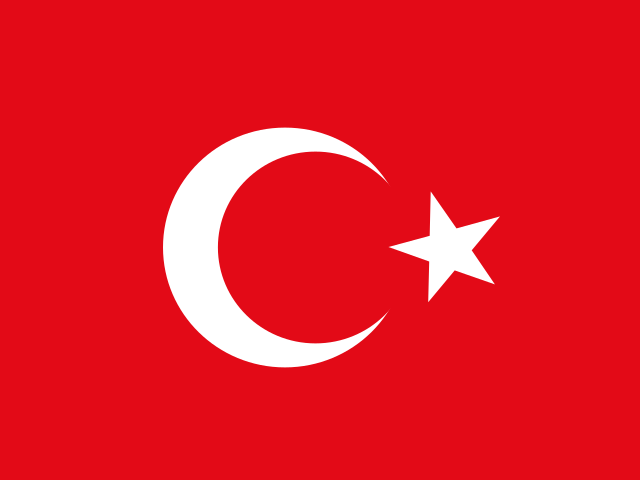
- Türkiye plays in red shirts with the white star-and-crescent crest of the national flag; the team is universally known by the supporters’ shorthand “Ay-Yıldızlılar” (Crescent-Stars).
- The federation does not maintain a single national stadium; senior internationals rotate principally through the Atatürk Olympic Stadium (Istanbul), Vodafone Park (Istanbul), the new Konya Stadium and the Bursa Atatürk Stadium.
Türkiye World Cup Vital Statistics
| Metric | Value |
|---|---|
| Federation founded | 1923 (TFF) |
| First international match | 26 October 1923 vs Romania (2–2) |
| FIFA World Cup appearances | 4 (incl. 2026) — 1950, 1954, 2002, 2026 |
| Best FIFA World Cup finish | Third place — 2002 (Korea/Japan) |
| Fastest goal in WC history | Hakan Şükür vs South Korea, 11 seconds (2002 third-place play-off) |
| Most caps (all-time) | Rüştü Reçber — 120 |
| Top scorer (all-time) | Hakan Şükür — 51 |
| Current head coach | Vincenzo Montella (appointed September 2023) |
| Captain | Hakan Çalhanoğlu |
| 2026 WC qualifying path | UEFA Path C playoffs |
| 2026 WC playoff results | SF Türkiye 1–0 Romania; F Türkiye 1–0 Kosovo (Pristina, 31 March 2026, Aktürkoğlu) |
| 2026 WC final-tournament group | Group D — USA, Paraguay, Australia, Türkiye |
| Opening 2026 WC match | Türkiye vs Australia, BC Place, Vancouver, 13 June 2026 |
| FIFA Ranking | Mid-30s (estimated as of qualifying confirmation) |
Türkiye at the World Cup — History And Profile
The Türkiye national football team — universally known by the supporters’ shorthand “Ay-Yıldızlılar” (Crescent-Stars) — is the senior men’s representative side of the Turkish Football Federation (Türkiye Futbol Federasyonu, TFF). The federation was founded in 1923, the same year as the founding of the Turkish Republic, and Türkiye’s first international fixture was a 2–2 draw with Romania played on 26 October 1923. The TFF joined FIFA in 1923 and UEFA in 1962. Across the post-war era, Turkish football has produced a small number of distinct tournament peaks alongside long stretches of qualifying-cycle near-misses, with the federation’s standing rebuilt in the 2020s by a generational cohort built around Inter Milan midfielder Hakan Çalhanoğlu and Real Madrid playmaker Arda Güler.
The most consequential single tournament campaign in TFF history was the 2002 FIFA World Cup in South Korea and Japan. A side coached by Şenol Güneş and built around captain Rüştü Reçber, Hakan Şükür, İlhan Mansız, Bülent Korkmaz and Emre Belözoğlu defeated the host Senegal — corrected: South Korea — and others to finish third — Türkiye’s best World Cup result. Hakan Şükür’s strike against South Korea in the third-place play-off, scored after approximately 11 seconds, remains the fastest goal in FIFA World Cup history. The 2002 cycle also produced the federation’s strongest UEFA European Championship of the same era (Euro 2008 semi-final) and a generation of players who pushed Galatasaray (2000 UEFA Cup winners), Fenerbahçe and Beşiktaş into sustained UEFA-club-football contention.
A long downturn followed Euro 2008. Türkiye missed every World Cup tournament between 2006 and 2022, and qualified for only Euro 2016, Euro 2020 (held 2021) and Euro 2024 across that span, with first-round group exits at all three. The current era began with Vincenzo Montella’s September 2023 appointment as head coach. The former Italy striker — who has previously coached Sevilla, Fiorentina, AC Milan, Adana Demirspor and other Italian and European sides — produced a Euro 2024 round-of-16 run (a 2–1 win over Austria in the round of 16, a 1–2 quarter-final exit to the Netherlands), promotion to UEFA Nations League A in the 2024–25 cycle (a federation first), and the 2026 World Cup qualification campaign.
The 2026 cycle was eventful. Türkiye finished the qualifying group stage outside the automatic-qualifying place after a 6–0 home defeat to Spain in Konya — described by Daily Sabah as the team’s heaviest competitive defeat in six decades — but recovered to draw with Spain in Seville and entered the UEFA playoffs as a Path C qualifier. In the March 2026 playoffs, Türkiye defeated Romania 1–0 in the semi-final and Kosovo 1–0 in the final at Pristina on 31 March 2026, with Kerem Aktürkoğlu scoring the decisive goal in the 54th minute. The result confirmed Türkiye’s first World Cup appearance since 2002 and made the federation the 44th country to qualify for the 2026 finals.
The current senior squad is built around captain Hakan Çalhanoğlu (Inter Milan, the team’s most prominent midfielder), 21-year-old Real Madrid playmaker Arda Güler, Juventus forward Kenan Yıldız, goalkeeper Mert Günok, defenders Merih Demiral and Çağlar Söyüncü, midfielders Orkun Kökçü and İsmail Yüksek, and forwards Kerem Aktürkoğlu and Mauro Icardi (the Galatasaray-based Argentine, ineligible for Türkiye but emblematic of the league’s recent profile, with Cenk Tosun and Halil Dervişoğlu among the recognised TFF-eligible attacking options). Türkiye’s 2026 finals draw placed the team in Group D alongside Australia, Paraguay and the United States, with the tournament-opening Türkiye-Australia fixture scheduled for BC Place in Vancouver on 13 June 2026 (5:00am AEST 14 June).
The federation does not maintain a single national stadium. Senior internationals rotate principally through the 76,761-capacity Atatürk Olympic Stadium in Istanbul (the 2005 and 2023 UEFA Champions League final venue), the 41,903-capacity Vodafone Park / Tüpraş Stadyumu in Istanbul (Beşiktaş’s home), the Konya Stadium and the Bursa Atatürk Stadium. Türkiye plays in red shirts with the star-and-crescent of the national flag and white shorts; current kit supplier is Nike. The TFF is headquartered in Istanbul.
The Türkiye-Australia bilateral has limited prior history outside the 2026 World Cup window. The two federations are matched in Group D of the 2026 finals, with Türkiye’s tournament opener against Australia at BC Place, Vancouver, on 13 June 2026 — the Socceroos’ first World Cup fixture under head coach Tony Popovic. The bilateral has therefore become one of the highest-profile cross-confederation fixtures of the 2026 cycle, with Australian-Turkish diaspora communities providing a substantial commercial and supporter dimension to both federations’ commercial planning. UEFA’s playoff archive logs Türkiye’s 1–0 victory over Kosovo in Pristina as the federation’s first World Cup-clinching playoff result of the 48-team-format era.
Detailed Profile
Crest, Colours & Kit Evolution
Türkiye plays in red shirts with the white star-and-crescent of the Turkish flag, white shorts and red socks. The crest carries the TFF logo. Current kit supplier is Nike. The 2002 World Cup retro-style kit, the 2008 Euro semi-final design, and the 2024 Euro round-of-16 design are widely cited.
Stadium History
The federation does not operate a single national stadium. The most-used venues are the 76,761-capacity Atatürk Olympic Stadium in Istanbul (the 2005 and 2023 UEFA Champions League final venue), the 41,903-capacity Vodafone Park / Tüpraş Stadyumu in Istanbul (Beşiktaş’s home), the new Konya Stadium and the Bursa Atatürk Stadium. The 2002 World Cup third-place run was supported by sell-out home qualifying fixtures at the now-demolished Inönü Stadium in Istanbul.
Coaches & Managers Legacy
The most decorated TFF coach is Şenol Güneş, who led the 2002 World Cup third-place run. Other modern-era coaches include Mustafa Denizli (Euro 2008 semi-finals), Fatih Terim (multiple stints, including the post-2002 cycle), Abdullah Avcı, Stefan Kuntz (former Euro U-21-winning coach) and Vincenzo Montella (since September 2023).
Iconic Players
Pre-2002: Lefter Küçükandonyadis, Metin Oktay, Cemil Turan, Tanju Çolak. 2000s: Rüştü Reçber (120 caps), Hakan Şükür (51 goals), Bülent Korkmaz, Alpay Özalan, Tugay Kerimoğlu, Hasan Şaş, Ümit Davala, Emre Belözoğlu, İlhan Mansız, Hamit Altıntop. 2010s: Burak Yılmaz, Arda Turan, Selçuk İnan, Cenk Tosun. Modern era: Hakan Çalhanoğlu (captain), Arda Güler, Kenan Yıldız, Merih Demiral, Çağlar Söyüncü, Mert Günok, Kerem Aktürkoğlu, Orkun Kökçü.
Trophies & Honours
- FIFA World Cup: third place 2002 (Korea/Japan) — best ever finish.
- 2003 FIFA Confederations Cup: third place.
- UEFA European Championship semi-finals: 2008 (Switzerland/Austria).
- UEFA European Championship round of 16: 2024 (Germany).
- UEFA Nations League promotion to League A: 2024–25 cycle (federation first).
- Hakan Şükür’s 11-second goal in the 2002 World Cup third-place play-off (fastest in tournament history).
Peak Eras
- 1950–1954 first World Cup era under Sandro Puppo.
- 2000–2008 Şenol Güneş / Mustafa Denizli golden generation (2002 World Cup third place; 2008 Euro semi-finals).
- 2024–2026 Vincenzo Montella cycle (Euro 2024 round of 16; Nations League A promotion; 2026 World Cup qualification).
Rivalries
Türkiye’s principal rivalries are regional. The Greece fixture is the most-cited bilateral. The Romania, Bulgaria and Russia fixtures are the long-standing eastern European matchups; the Spain and Italy fixtures are the principal southern-European tournament-cycle rivalries. The 2026 World Cup playoff final win over Kosovo in Pristina is the most consequential recent fixture against a fellow Balkan federation.
Supporters Culture
The Crescent-Stars supporter base — concentrated around the Galatasaray, Fenerbahçe and Beşiktaş ultras pipelines — produces some of the highest-decibel home atmospheres in UEFA international football. Sell-out home qualifiers at Vodafone Park and the Konya Stadium have been the norm during the Montella cycle. The Türkiye supporters’ federation has a substantial diaspora component, particularly in Germany, the Netherlands and the United Kingdom.
Public Image — Bad PR / Controversies
Türkiye’s October 2025 6–0 home defeat to Spain in Konya — described by Daily Sabah as the team’s heaviest competitive defeat in six decades — was the most-cited domestic-criticism moment of the qualifying cycle. The 2019 Euro qualifying cycle produced a UEFA disciplinary case after Turkish-army-style goal celebrations during a fixture against France. The federation has periodically been the subject of anti-discrimination signalling around fan-conduct and player-conduct cases in the modern era.
Charity & Community
The TFF runs grassroots and community programmes through 81 provincial federations, including the long-running youth-development pyramid that has fed academy systems at Galatasaray, Fenerbahçe and Beşiktaş. Senior players have repeatedly featured in matchday community-visit programmes and federation-led earthquake-relief fundraising activity (notably after the February 2023 Türkiye–Syria earthquake).
Australia Connection
Türkiye and Australia are matched in Group D of the 2026 FIFA World Cup, with Türkiye’s tournament-opening fixture against Australia at BC Place, Vancouver, scheduled for 13 June 2026 (5:00am AEST 14 June). The match is the Socceroos’ first World Cup fixture under head coach Tony Popovic. The bilateral has limited prior senior men’s full international history outside the 2026 cycle. Australian-Turkish diaspora communities — concentrated in Melbourne, Sydney and surrounds — provide a substantial commercial and supporter dimension to the fixture; the Türkiye-Australia 2026 group-stage opener is widely cited as one of the more high-profile cross-confederation fixtures of the tournament’s opening round.
Connections to Other Federations / Celebrity Figures
The TFF maintains close technical relationships with neighbouring federations (Greece, Bulgaria, Romania, Georgia, Azerbaijan) and has long-standing club-football pathways into the Bundesliga (Bayer Leverkusen, Borussia Dortmund — a function of the substantial Turkish-German diaspora), the Premier League (Leicester, West Ham), Serie A (Inter Milan, Juventus, Roma) and La Liga (Real Madrid, Atletico Madrid). Hakan Çalhanoğlu’s Bayer Leverkusen / AC Milan / Inter Milan trajectory and Arda Güler’s 2023 transfer from Fenerbahçe to Real Madrid are the highest-profile current cross-federation connections.
Potential Future Trajectory
With qualification for the 2026 FIFA World Cup confirmed via the Pristina playoff final win over Kosovo on 31 March 2026 and a Group D draw with the United States, Paraguay and Australia, Türkiye’s medium-term outlook centres on (a) Vincenzo Montella’s contract terms beyond the 2026 finals, (b) the integration of Arda Güler and Kenan Yıldız alongside the experienced Çalhanoğlu-Demiral-Günok core, and (c) the federation’s pathway from a 24-year World Cup absence into a settled major-tournament rotation. The Türkiye-Australia tournament opener at BC Place on 13 June 2026 is the federation’s most-watched single fixture since the 2002 World Cup semi-final.
More World Cup 2026 Reading
WC 2026 context: See Türkiye's WC 2026 group-stage form, squad and opponents →
 Best Betting Sites
 Best Online Casinos
 Blackjack Sites
 Online Pokies
 Fast Payout Casinos
 PayID Casinos
 New Casinos 2026