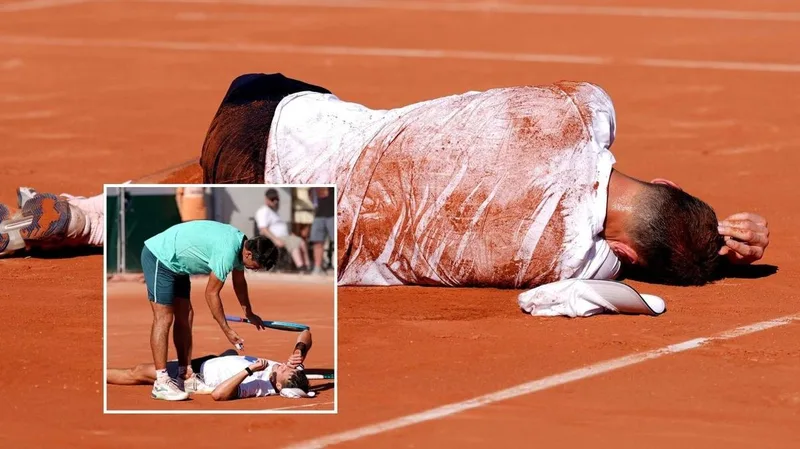
The unforgiving clay courts of Roland-Garros have claimed another victim, with Czech rising star Jakub Mensik’s tournament ending in dramatic fashion after a heat-induced collapse that could reshape Alex de Minaur’s path through the draw.
When Paris Burns
Look, we’ve seen some scorching French Open conditions over the years, but this one’s hitting different. Mensik’s medical emergency — where his body simply “turned off” according to the 18-year-old — comes as Paris swelters through what officials are calling extreme heat conditions. The courts are becoming furnaces, and players are dropping like flies.
For De Minaur, who’s been building momentum in his tennis campaign, this development opens up a completely different trajectory through the men’s draw. The Aussie was preparing for what many considered a dangerous early-round encounter with the talented Czech teenager, but now finds himself with a clearer path and perhaps more energy preserved for the business end of the tournament.
The timing couldn’t be more crucial. De Minaur’s clay court game has evolved significantly over recent seasons, and Roland-Garros 2026 represents perhaps his best opportunity yet to make a serious statement at the French major.
The Demon’s Clay Court Evolution
What makes this situation particularly intriguing is how De Minaur has adapted his game for the red dirt. Gone are the days when the Aussie was merely surviving on clay — he’s genuinely thriving. His movement has become more patient, his shot selection more calculated, and his physical conditioning allows him to outlast opponents in these brutal Parisian conditions where others are wilting.
The heat that felled Mensik might actually play into De Minaur’s hands. The Aussie has always been a grinder, someone who relishes the physical battle, and his preparation for extreme conditions has been meticulous. While other players struggle with the furnace-like atmosphere at Roland-Garros, De Minaur’s proven ability to maintain his intensity through marathon matches becomes a significant advantage.
The draw reshuffle also means potential energy conservation for later rounds. Every top player knows that surviving the early stages with minimal wear is crucial for deep tournament runs, especially when the courts are this punishing.
Looking Ahead at Roland-Garros
The broader picture here extends beyond just one match result. We’re seeing conditions at this year’s French Open that are testing players’ physical limits in ways we haven’t witnessed before. The medical timeouts are mounting, withdrawal lists are growing, and the tournament is becoming as much about survival as skill.
For Australian tennis fans tracking De Minaur’s progress, this development represents both opportunity and responsibility. The door has swung open, but capitalising requires the kind of clinical execution that separates good players from great ones on the biggest stages.
The heat wave gripping Paris isn’t showing signs of breaking, which means every remaining match becomes a test of endurance as much as tennis ability. De Minaur’s preparation for these exact conditions could prove the difference between an early exit and a genuine deep run at Roland-Garros.
With each passing round, the stakes escalate and the physical demands intensify. The Australian’s moment at the French Open might just be arriving under the most challenging circumstances imaginable.
NC — Staff sports writer, australiafootball.com
 Best Betting Sites
 Best Online Casinos
 Blackjack Sites
 Online Pokies
 Fast Payout Casinos
 PayID Casinos
 New Casinos 2026