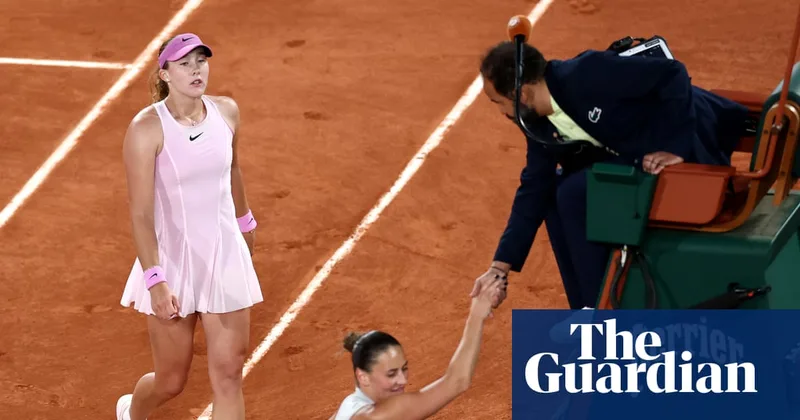
Mirra Andreeva’s clinical 6-1, 6-3 demolition of Marta Kostyuk in the French Open semi-final delivered more than just another teenage breakthrough — it crystallised tennis’s unresolved struggle with the ongoing Russia-Ukraine conflict that continues to fracture the sport’s competitive landscape.
Pre-Match Protocol Breakdown
The tension manifested before a ball was struck, with Kostyuk swerving the traditional pre-match photo opportunity alongside her Russian opponent. This calculated snub, while symbolic, underscored how geopolitical realities have infiltrated tennis’s supposedly neutral competitive framework. The WTA’s continued allowance of Russian players competing under neutral flags — a compromise that satisfies neither side completely — creates these awkward ceremonial moments where sporting protocol collides with personal conviction.
Kostyuk’s strategic positioning throughout this French Open campaign has consistently emphasised her role as Ukraine’s sporting ambassador, using media opportunities to maintain international awareness of her country’s ongoing conflict. Her semi-final platform, reaching a career-high Grand Slam stage, amplified this message to its largest audience yet.
Tactical Dominance Amid Political Undercurrents
Andreeva’s on-court performance rendered the political subplot secondary through sheer technical superiority. The 17-year-old Russian’s aggressive baseline positioning and precise shot selection dismantled Kostyuk’s defensive structure systematically. Where Kostyuk typically thrives on extended rallies and opponent errors, Andreeva shortened points through winner placement and forcing weak returns.
The statistical disparity — Andreeva reaching the French Open final with minimal resistance — reflected months of contrasting preparation approaches. Kostyuk’s season has been punctuated by media commitments and advocacy responsibilities that, while admirable, potentially compromise pure competitive focus. Andreeva, competing under neutral status, maintains singular tournament concentration without external messaging obligations.
This performance differential mirrors broader patterns across the tennis circuit, where Russian players operating under neutral flags have consistently outperformed expectations. The absence of national pressure, paradoxically, may provide competitive advantages that traditional national representation structures cannot match.
Systemic Sport-Politics Integration
Tennis governing bodies continue navigating unprecedented territory in managing athlete political expression within competitive frameworks. The International Tennis Federation’s current protocols allow individual player statements while maintaining official tournament neutrality — a position that pleases nobody completely but prevents total competitive breakdown.
Kostyuk’s campaign strategy — using tournament success to amplify political messaging — represents one evolutionary response to sport’s intersection with geopolitical conflict. Her approach contrasts sharply with players who separate competitive performance from political advocacy entirely.
The broader implications extend beyond individual matches. Rankings points, prize money distribution, and tournament seeding all remain affected by these ongoing diplomatic tensions. Tournament directors must balance competitive integrity with sponsor expectations and broadcast considerations, creating complex operational matrices that traditional sporting governance never anticipated.
Championship Implications
Andreeva’s final appearance establishes her among tennis’s emerging elite while highlighting the sport’s continued fragmentation along geopolitical lines. Her technical development under neutral flag competition suggests Russian tennis infrastructure remains robust despite international sporting restrictions.
For Kostyuk, this semi-final represents both career breakthrough and successful advocacy platform utilisation. Her post-match comments confirming the campaign’s messaging success indicate strategic objectives achieved despite competitive disappointment.
The French Open final will feature Andreeva against either Elena Rybakina or Iga Swiatek, with Kazakhstan’s Rybakina presenting another complex nationality narrative given her Russian birth and training background.
This championship race exemplifies tennis’s current reality — elite competition proceeding amid unresolved political tensions that influence everything from pre-match protocols to post-tournament analysis frameworks.
AK — Senior tactical analyst, australiafootball.com
 Best Betting Sites
 Best Online Casinos
 Blackjack Sites
 Online Pokies
 Fast Payout Casinos
 PayID Casinos
 New Casinos 2026