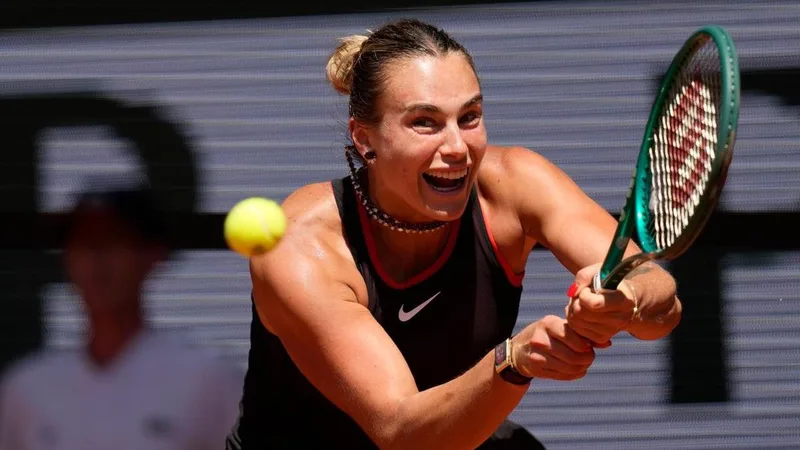
Aryna Sabalenka’s straight-sets dismissal of Jessica Bouzas Maneiro demonstrated the tactical refinement that has transformed her clay-court prospects, as Roland-Garros 2026 opens with familiar efficiency from the world’s elite.
Clay-Court Evolution Under Pressure
The Belarusian’s systematic dismantling of Spain’s Bouzas Maneiro reflects a broader shift in how power players approach clay-court tennis. Where Sabalenka once relied on overwhelming pace that frequently misfired on the slower surface, her recent Roland-Garros campaigns have showcased measured aggression — maintaining her natural intensity whilst respecting the surface’s tactical demands.
This evolution mirrors the pathway carved by previous hard-court specialists who conquered clay through tactical discipline rather than stylistic overhaul. Sabalenka’s 2023 Roland-Garros semi-final appearance marked the culmination of this process — her ability to construct points rather than simply end them proving crucial against clay-court specialists who had previously exposed her tactical limitations.
The efficiency displayed against Bouzas Maneiro suggests this development has reached maturity. Quick progression through early rounds becomes essential for players targeting deep Roland-Garros runs, particularly when facing the physical demands that separate clay-court tennis from other surfaces.
Australian Contingent Context
Sabalenka’s smooth progression contrasts with the challenges facing Australia’s tennis representatives, where clay-court preparation remains a perennial concern. Destanee Aiava and Priscilla Hon face the familiar challenge of translating hard-court success to European clay — a transition that has historically proven problematic for Australian players despite recent improvements in preparation protocols.
The tactical template Sabalenka has established — combining natural power with enhanced court positioning and shot selection — offers insight into how Australian players might approach similar surface transitions. Her journey from clay-court liability to genuine Roland-Garros threat required fundamental adjustments to movement patterns and defensive positioning, changes that Australian players have increasingly incorporated into their development programs.
Roland-Garros Tactical Landscape
Sabalenka’s clinical first-round performance establishes early momentum in a tournament where rhythm often determines ultimate success. Her positioning as a genuine title contender reflects not just individual improvement but the broader tactical evolution within women’s tennis — power players no longer accepting clay-court limitations as immutable constraints.
The Spanish challenge represented by Bouzas Maneiro, whilst ultimately unsuccessful, highlighted the depth of clay-court expertise that remains embedded within European tennis culture. Sabalenka’s ability to neutralise this home-surface advantage demonstrates the tactical sophistication required for Roland-Garros success in 2026.
As the tournament progresses, Sabalenka’s early efficiency positions her advantageously for the physical demands ahead, where tactical discipline and energy conservation often prove decisive in determining championship outcomes.
AK — Senior tactical analyst, australiafootball.com
 Best Betting Sites
 Best Online Casinos
 Blackjack Sites
 Online Pokies
 Fast Payout Casinos
 PayID Casinos
 New Casinos 2026