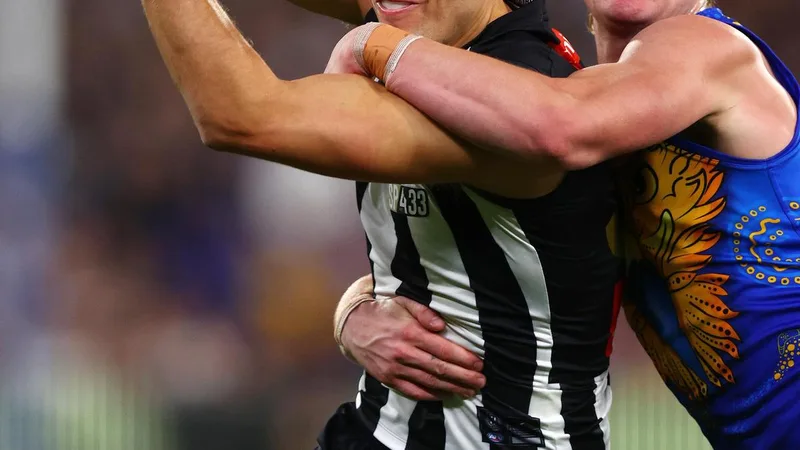
When Collingwood admits they need to try “something different” with Darcy Moore’s rehabilitation, it’s not just an admission of failure—it’s a damning indictment of how modern football is breaking its best players. The Pies captain’s endless cycle of soft-tissue injuries has become the poster child for a sport that’s pushing human physiology beyond reasonable limits.
The Hamstring Merry-Go-Round
Moore’s injury history reads like a medical textbook. Multiple hamstring strains, calf problems, and recurring soft-tissue issues have turned one of the competition’s premier key defenders into a part-time player at best. The fact that Collingwood is now openly acknowledging their traditional methods have failed speaks volumes about the desperation at Olympic Park.
This isn’t about individual weakness or poor conditioning. Moore represents a generation of athletes caught between the old-school “run through walls” mentality and the new reality of elite sport where margins are measured in milliseconds and GPS data drives everything. The modern game demands explosive power, endurance, and agility that previous generations never faced, yet we’re still largely using rehabilitation methods developed when players kicked the footy in their spare time.
The irony cuts deep. We have more sports science, better nutrition, and advanced recovery methods than ever before, yet soft-tissue injuries are epidemic across the AFL. Moore’s predicament mirrors what we’re seeing with other elite players—bodies that can’t cope with the relentless intensity that television contracts and fan expectations demand.
Beyond the Individual Crisis
What makes Moore’s situation particularly galling is its timing. As captain of one of the competition’s powerhouse clubs, his availability directly impacts Collingwood’s premiership window. The Pies have built their defensive structure around his intercept marking and leadership, making his absence catastrophic rather than merely inconvenient.
But zoom out, and Moore’s struggles represent a broader crisis in player welfare that the AFL continues to dance around. The competition has expanded seasons, increased intensity, and loaded more games into compressed timeframes while expecting players’ bodies to simply adapt. When elite athletes like Moore—who should be in his prime—are constantly battling soft-tissue breakdowns, something fundamental is broken.
The league’s response has been predictably bureaucratic: more rules about training loads, GPS monitoring, and wellness checks. Yet these administrative solutions ignore the elephant in the room—that we’re asking human bodies to perform beyond their evolutionary design, then acting surprised when they break down.
The Uncomfortable Truth
Collingwood’s new approach with Moore might work, but it’s treating symptoms rather than causes. Until the AFL acknowledges that its current model is unsustainable—that longer seasons, more games, and increased intensity have consequences—we’ll keep seeing talented players like Moore become part-time contributors to the sport they should be dominating.
The real question isn’t whether Moore can overcome his injury demons. It’s whether Australian football is prepared to admit that its pursuit of entertainment value has created a physical toll that’s destroying careers and diminishing the very spectacle it’s trying to enhance. Moore’s broken body is just the most visible symptom of a much larger problem.
VS — Chief sports columnist, australiafootball.com
 Best Betting Sites
 Best Online Casinos
 Blackjack Sites
 Online Pokies
 Fast Payout Casinos
 PayID Casinos
 New Casinos 2026