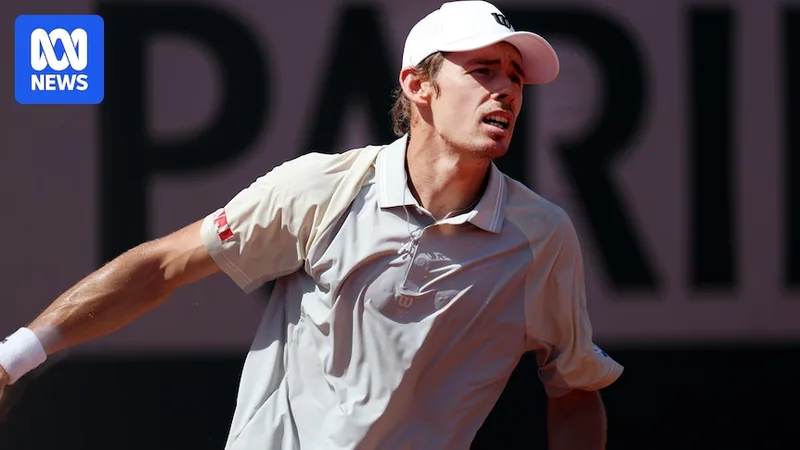
The red clay of Roland-Garros has claimed two more scalps, with Australia’s Alex de Minaur and seven-time champion Novak Djokovic both crashing out in the third round, sending shockwaves through a tournament already reeling from major upsets.
Australia’s Clay Court Dreams Dashed
For de Minaur, this represented another painful reminder of clay’s unforgiving nature. The 25-year-old had arrived at Roland-Garros with cautious optimism, his game showing signs of adaptation to the surface that has historically been his kryptonite. But the Parisian clay, slick from recent rain and demanding patience above all else, proved once again why it remains tennis’s greatest equaliser.
The loss stings particularly because de Minaur had been building momentum through the early rounds, looking more comfortable on the slower surface than ever before. His serve-and-volley forays, so effective on hard courts, became laboured affairs on clay. Where his speed usually compensates for positioning, the heavy conditions neutralised his greatest weapon.
This exit continues a broader Australian struggle at Roland-Garros, with Thanasi Kokkinakis already departed and the nation’s hopes now resting on the doubles draws. The clay swing has historically been Australia’s weakest link in the tennis calendar, and 2026 appears no different despite the encouraging signs from de Minaur’s recent European preparation.
Djokovic’s Shocking Vulnerability
Perhaps more stunning was Djokovic’s elimination, the Serbian appearing every bit his 39 years against an opponent ranked outside the top 20. The man who has owned this tournament for much of the past decade looked out of sorts, his usually metronomic groundstrokes lacking their customary precision.
This marks the earliest Djokovic has exited Roland-Garros since 2009, a statistic that speaks to both his previous dominance and current decline. The Serbian’s movement, so fluid in his prime, appeared laboured in the heavy conditions. His famous mental fortitude, built through countless five-set battles on this very court, seemed to abandon him when he needed it most.
For a player who has redefined longevity in men’s tennis, this defeat raises uncomfortable questions about Father Time’s inevitability. Djokovic’s serve percentage dropped significantly in the deciding sets, and his return position — traditionally his greatest strength — looked tentative against aggressive hitting.
Championship Picture Transforms
With Djokovic gone and several other seeds already eliminated, the men’s draw has opened dramatically. Daniil Medvedev and Stefanos Tsitsipas suddenly find themselves as the tournament favourites, though both carry their own clay court question marks.
The unseeded players who caused these upsets now face the burden of expectation. Beating a legend is one thing; backing it up against fresh opponents who’ve studied every weakness exposed is another entirely. Roland-Garros has a habit of creating overnight heroes only to humble them days later.
What makes this year’s carnage particularly striking is its timing. Third-round exits for players of this calibre usually happen when they’re nursing injuries or arriving underprepared. Neither applied here — both de Minaur and Djokovic had shown strong form leading into Paris.
This tournament’s wide-open nature should excite neutrals, but for Australian tennis fans watching their highest seed fall short once again, the focus shifts to learning from another clay court lesson. The TENNIS Hub will be crucial for following how the remaining Australians fare in doubles competition.
The red dirt has spoken with brutal clarity — reputation means nothing when the points begin, and Roland-Garros 2026 belongs to whoever can handle the pressure of unexpected opportunity.
RK — Features writer, australiafootball.com
 Best Betting Sites
 Best Online Casinos
 Blackjack Sites
 Online Pokies
 Fast Payout Casinos
 PayID Casinos
 New Casinos 2026