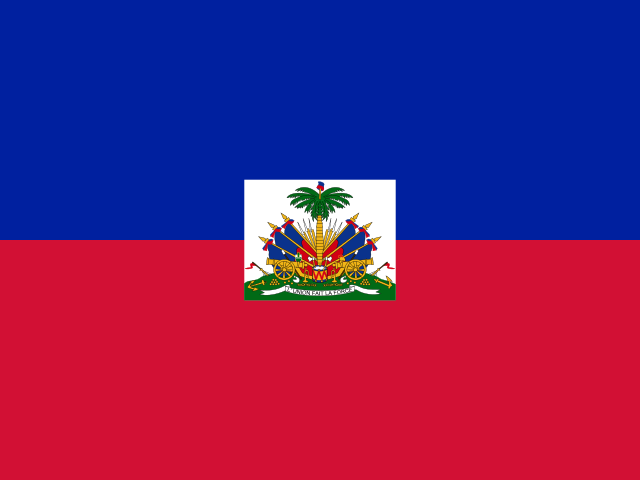
 Haiti — WC 2026 Group C
Data as of: 2026-05-20





Recent Form
| Date | Opponent | Score | Result | Competition |
|---|---|---|---|---|
| 2025-11-19 | Nicaragua | 2-0 | W | CONCACAF WC 2026 Qualifier — Round 3 (neutral venue, Curaçao) |
Group C Opponents (2026)
Scotland
No documented prior senior meeting. Haiti's tournament-opener is also a first-ever competitive fixture between the two federations — and Boston's Haitian-American diaspora means the venue will be charged with travelling support.
Brazil
Brazil's only documented prior meeting with Haiti was a 1959 charity friendly in Port-au-Prince. The 2026 fixture is the first competitive meeting between Les Grenadiers and the Seleção.
Morocco
No documented prior senior meeting. A first-ever competitive fixture between Haiti and Morocco.
Key Players for 2026
- Jean-Ricner Bellegarde · MF
Wolverhampton Wanderers attacking midfielder, formerly of RC Strasbourg. The highest-profile European-based Haitian player and the creative outlet on which the 2026 attack depends.
- Frantzdy Pierrot · FW
AEK Athens striker; aerial presence, holds the ball up, the focal point of every Migné counter-attacking blueprint.
- Duckens Nazon · FW
Haiti's all-time top scorer with 44 international goals — now at Esteghlal in Iran. The squad's most experienced match-winning forward.
- Johny Placide · GK
Captain and SC Bastia goalkeeper at 37; the most-experienced member of the squad and the leader of every Haitian defensive set-up.
Haiti arrive at the 2026 World Cup as one of the most romantic stories in CONCACAF history — a 52-year World Cup absence ended, a defining qualifying run produced against the backdrop of a security crisis that has prevented every “home” qualifier from being played in Port-au-Prince since 2022, and a Group C draw that pits Les Grenadiers against the most decorated nation in World Cup history (Brazil), the African side that reached the 2022 semi-finals (Morocco), and the European programme returning from its own 27-year absence (Scotland). For Haiti, simply arriving is the achievement. What happens at Gillette Stadium, Lincoln Financial Field and Mercedes-Benz Stadium across June 2026 is bonus territory.
Qualifying Path — Curaçao, 19 November 2025
The defining match was the 19 November 2025 third-round Group C decider against Nicaragua. Played at the neutral venue of Curaçao — the security situation in Haiti has forced every “home” qualifier in the cycle to relocate abroad — Haiti won 2-0 to top the CONCACAF third-round group ahead of Honduras, Costa Rica and Nicaragua and secured qualification for the 2026 finals. The result triggered street celebrations across Port-au-Prince and the major US Haitian-American diaspora cities — Miami, New York and Boston — with one journalist quoted in the Haitian Times saying “people took to the streets and started dancing”.
The campaign was led by Sébastien Migné, the French head coach previously of Equatorial Guinea, Kenya and the Republic of Congo. Migné had taken Equatorial Guinea to the 2015 Africa Cup of Nations and was appointed by the FHF on the strength of that tournament-management track record. The qualifying group itself was completed without any home fixture in Haiti — the Fédération Haïtienne de Football has institutionally relocated to neutral hubs since 2022.
The 2026 Squad — Diaspora-Led, European-Based
Captain and goalkeeper Johny Placide at SC Bastia — 37 years old at the qualification window — is the most-experienced member of the squad and the on-field leader. The outfield core is overwhelmingly European-based:
- Jean-Ricner Bellegarde at Wolverhampton Wanderers (formerly RC Strasbourg) is the highest-profile European-based Haitian and the creative outlet around which the 2026 attack is built.
- Frantzdy Pierrot at AEK Athens provides the aerial-presence striker profile and is Migné’s reference point for counter-attacking transitions.
- Duckens Nazon at Esteghlal — Haiti’s all-time top scorer with 44 international goals, formerly of Wolverhampton Wanderers and Coventry City — is the experienced match-winner up front.
- The wider defensive and midfield rotation is drawn from the French and Belgian leagues, supplemented by MLS-based players particularly at Inter Miami and Philadelphia Union.
Pierre-Richard Bruny remains the team’s all-time appearance leader with 95 caps. The recruitment of dual-national diaspora players via the FHF’s outreach programme has been the defining feature of the modern Haiti side, and the 2026 squad is the most European-experienced in the federation’s history.
How Group C Plays Out
Haiti’s three group fixtures will be staged at venues in Boston (Gillette Stadium), Philadelphia (Lincoln Financial Field) and Atlanta (Mercedes-Benz Stadium) — venue selection partly designed to leverage the major US Haitian-American diaspora populations. Many fans publicly expressed disappointment that no Haiti fixture was scheduled at Hard Rock Stadium in Miami, the metropolitan area with the largest US Haitian diaspora.
The fixtures:
- Sun 14 Jun — vs Scotland, Gillette Stadium Boston. A first-ever competitive meeting between the two federations and a fixture that Boston’s Haitian-American community will turn into a near-home atmosphere. Scotland are favourites but the emotional weight of a 52-year World Cup return for Les Grenadiers should produce a tightly contested opener.
- vs Brazil. Brazil’s only documented prior meeting with Haiti was a 1959 charity friendly in Port-au-Prince; the modern senior sides have not played. Brazil are heavy favourites — but Haiti’s defensive shape, Migné’s tournament-management instincts and the magnitude of the occasion mean Les Grenadiers will sit in a deep low block and look for one moment of magic on the counter.
- vs Morocco. A first-ever competitive fixture between Haiti and Morocco. The Atlas Lions are the more talented side and arrive on a 19-match winning streak, but Haiti’s defensive resilience could keep this tight.
Realistically, Haiti’s best chance for a point or three is the Scotland opener. Brazil and Morocco are the two highest-quality opponents the Haitian senior side has ever faced in a competitive match.
Aussie Viewing Notes
Eastern-time U.S. venues — Boston, Philadelphia, Atlanta — translate to AEST early-morning kickoffs for Australian audiences; FIFA’s final venue-by-venue scheduling was not confirmed in this form at the time of writing. There is no documented senior international fixture between Haiti and Australia, and the Australian and Haitian football communities have no documented institutional ties beyond participation in shared FIFA tournaments. For Australian viewers, Haiti is the neutrals’ romantic pick — exactly the kind of underdog story the World Cup has always celebrated. Check the full WC 2026 schedule in AEST closer to the tournament.
Key Players to Watch
Watch Bellegarde in the No.10 role — Wolverhampton’s attacking midfielder is the only Haitian creative force genuinely comparable to the Scottish and Moroccan midfielders he will face. Watch Pierrot’s hold-up play — the AEK Athens striker is the platform for every counter-attacking Migné transition. Watch Nazon for late-game impact — Haiti’s all-time leading scorer is the squad’s most-experienced match-winner. Watch Placide’s command of his area — at 37, the captain’s organisational voice is what holds the Haitian defensive shape together.
The Bigger Picture
Manno Sanon’s goal against Italy at the 1974 World Cup in Munich — Haiti’s first ever World Cup goal, and the goal that ended Dino Zoff’s then-world-record run of 1,143 minutes without conceding — remains the high-water mark of Haitian football. The 2026 cycle gives a new generation the opportunity to write its own equivalent moment. Even a single goal, a single draw, a single moment of defiance against the odds would be celebrated across Haiti and the Caribbean diaspora as an achievement of profound significance.
For the federation, the bigger picture is institutional: restoration of home-venue football in Port-au-Prince once the security situation permits, sustained CONCACAF top-tier status, continued recruitment of European-based diaspora players, and federation governance reform. The 2026 World Cup is both the destination of the current cycle and the foundation of whatever the next one looks like.
What Haiti Need to Advance
Realistically: three points and a goal difference miracle. Under the 48-team format, a single win and two narrow losses can — in unusual goal-difference circumstances — produce best-thirds progression. The Scotland opener at Gillette Stadium is the realistic target match. Anything beyond that is the kind of World Cup story that gets told for the next 52 years.
More Haiti + WC 2026 Reading
All-time history: See Haiti's full World Cup history (all tournaments) →
 Best Betting Sites
 Best Online Casinos
 Blackjack Sites
 Online Pokies
 Fast Payout Casinos
 PayID Casinos
 New Casinos 2026