 Haiti at the World Cup — Full History
Key Facts
- The Haiti national football team is governed by the Fédération Haïtienne de Football (FHF), founded in 1904 — making the FHF one of the oldest national football federations in the Americas; Haiti has been a FIFA affiliate since 1934 and was a founding member of CONCACAF in 1961.
- Haiti qualified for the 2026 FIFA World Cup on 19 November 2025 with a 2–0 win over Nicaragua (played at the neutral venue of Curaçao due to the Haitian security situation), topping CONCACAF third-round Group C.
- The 2026 finals will be Haiti’s second appearance at a senior FIFA World Cup, ending a 52-year absence since the country’s debut at West Germany 1974.
- At the 2026 World Cup draw on 5 December 2025, Haiti was placed in Group C with Brazil, Morocco and Scotland — described by the Philadelphia Union and Haitian Times as “a dream draw for visibility, but a daunting group” for advancement. [Haitian Times; Philadelphia Union]
- Haiti’s group fixtures will be played at venues in Boston, Philadelphia and Atlanta, all chosen to leverage major US Haitian-diaspora populations. [Haitian Times]
- Haiti won the 1973 CONCACAF Championship as host (the qualifying tournament for the 1974 World Cup) and the 2007 Caribbean Cup; the team has reached the Gold Cup semi-finals once, in 2019.
- Sébastien Migné, the French coach previously of Equatorial Guinea, Kenya and Republic of Congo, is the senior head coach during the 2026 World Cup cycle; goalkeeper Johny Placide (SC Bastia) serves as captain.
- All-time top scorer is Duckens Nazon with 44 international goals; appearance leader is Pierre-Richard Bruny with 95 caps.
- Iconic 1970s figures include Manno Sanon, scorer of Haiti’s first ever World Cup goal — and Italy’s first conceded goal in 1,143 minutes — at the 1974 World Cup against Italy in Munich on 15 June 1974.
- The 2026 squad’s most prominent European-based players include Jean-Ricner Bellegarde (Wolverhampton Wanderers), Frantzdy Pierrot (AEK Athens) and Duckens Nazon (Esteghlal). [Haitian Times]
- Haiti’s largest senior international victory was a 13–0 win over Sint Maarten in 2018; Stade Sylvio Cator in Port-au-Prince is the team’s nominal home venue, although ongoing security conditions have forced “home” qualifiers to be played abroad through the 2026 cycle.
Haiti World Cup Vital Statistics
| Metric | Value |
|---|---|
| Federation founded | 1904 (Fédération Haïtienne de Football) |
| FIFA membership | 1934 (affiliate) |
| FIFA World Cup appearances | 2 (1974, 2026) |
| 2026 World Cup qualification date | 19 November 2025, 2–0 vs Nicaragua (in Curaçao) |
| 2026 World Cup group | Group C (Brazil, Morocco, Scotland) |
| CONCACAF Championship titles | 1 (1973, as host) |
| Caribbean Cup titles | 1 (2007) |
| All-time top scorer | Duckens Nazon (44 goals) |
| All-time appearances leader | Pierre-Richard Bruny (95) |
| Head coach | Sébastien Migné |
| Captain | Johny Placide (SC Bastia) |
| Largest international win | 13–0 vs Sint Maarten (2018) |
| Home venue | Stade Sylvio Cator, Port-au-Prince (qualifiers staged abroad) |
Haiti at the World Cup — History And Profile
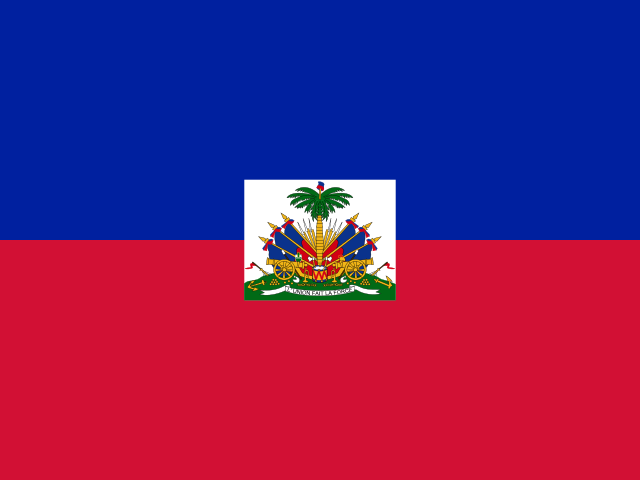
The Haiti national football team, known throughout the Caribbean as Les Grenadiers (The Grenadiers), is the senior representative side of Haitian football. The Fédération Haïtienne de Football (FHF), founded in 1904, is one of the oldest national football federations in the Americas. Haiti became a FIFA affiliate in 1934 and was a founding member of CONCACAF in 1961. The team plays in the blue-and-red colours of the national flag and is nominally based at the Stade Sylvio Cator in Port-au-Prince — though the ongoing political and security crisis in Haiti has forced “home” qualifiers throughout the 2026 cycle to be played at neutral venues, principally in the Caribbean and the United States.
Haiti’s defining football moment until November 2025 was the 1974 FIFA World Cup in West Germany. Having won the 1973 CONCACAF Championship as host (the qualifying tournament for the World Cup) under coach Antoine Tassy, Haiti reached the 1974 finals as one of three CONCACAF representatives. In the opening group match in Munich on 15 June 1974, striker Manno Sanon scored Haiti’s first ever World Cup goal — and ended Italy goalkeeper Dino Zoff’s then-world-record run of 1,143 minutes without conceding. Haiti ultimately lost the match 1–3 and was eliminated at the group stage, with subsequent matches against Poland and Argentina also ending in defeat, but the Sanon goal remains the high-water mark of pre-2025 Haitian football.
The 52 years that followed produced sporadic regional success but no further World Cup qualification. Haiti reached the CONCACAF Championship final in 1977 and won the 2007 Caribbean Cup, defeating Trinidad and Tobago in the final. The team’s first major modern result was the run to the 2019 CONCACAF Gold Cup semi-finals, in which Haiti beat Canada 3–2 in a memorable quarter-final at the BBVA Compass Stadium in Houston before losing 1–3 to Mexico. The 2019 result confirmed the maturation of a generation built around forwards Duckens Nazon (now the all-time top scorer with 44 goals) and Frantzdy Pierrot, and signalled the FHF’s increasing reliance on diaspora-recruited players from the French and Belgian leagues.
The breakthrough then came in November 2025. Under head coach Sébastien Migné — the French manager who had previously taken Equatorial Guinea to the 2015 Africa Cup of Nations — Haiti topped CONCACAF third-round Group C ahead of Honduras, Costa Rica and Nicaragua. On 19 November 2025, in a third-round decider relocated to the neutral venue of Curaçao because of the security situation in Port-au-Prince, Haiti beat Nicaragua 2–0 to confirm qualification. The result triggered street celebrations across Port-au-Prince and major US Haitian diaspora cities — Miami, New York and Boston — with one journalist quoted in the Haitian Times saying “people took to the streets and started dancing”.
At the 2026 World Cup draw at the Kennedy Center in Washington, D.C. on 5 December 2025, Haiti was placed in Group C alongside Brazil, Morocco and Scotland — a draw widely framed as “a dream for visibility, daunting for advancement”. Haiti’s three group-stage matches will be played at venues in Boston (Gillette Stadium), Philadelphia (Lincoln Financial Field) and Atlanta (Mercedes-Benz Stadium), all chosen partly to draw on Haitian-American support. Many fans publicly expressed disappointment that no Haiti fixture was scheduled at Hard Rock Stadium in Miami, the metropolitan area with the largest US Haitian diaspora.
The 2026 squad is built around captain and goalkeeper Johny Placide (SC Bastia, 37 years old at the qualification window), Wolverhampton Wanderers attacking midfielder Jean-Ricner Bellegarde, AEK Athens striker Frantzdy Pierrot, Esteghlal striker Duckens Nazon and a French- and Belgian-league core. The recruitment of dual-national diaspora players via the FHF’s outreach programme has been a defining feature of the modern Haiti side. Pierre-Richard Bruny remains the all-time appearance record-holder with 95 caps. The team’s largest senior international win was 13–0 over Sint Maarten in 2018.
Supporter culture is intense and diaspora-led: the Grenadiers’ followings in Miami, New York, Boston and Montreal have driven much of the team’s modern travel infrastructure. The pre- and post-match céleste-and-rouge banner displays at Stade Sylvio Cator are matched at neutral-venue qualifiers by an extensive Haitian-American supporter network. Bad PR around the cycle has centred on the security situation, which has prevented home matches in Port-au-Prince since 2022 and led to the FHF’s institutional relocation to neutral hubs.
The Australia connection is essentially nonexistent. There is no documented senior international fixture between Haiti and Australia, no AFC dual-national in the 2026 World Cup qualifying squad and no current Australian-registered staff member at the FHF. The medium-term outlook centres on performance at the 2026 World Cup itself — Haiti’s first finals appearance in 52 years — and on whether the FHF can convert the qualification’s symbolic and diaspora-fundraising momentum into renewed federation infrastructure once the Haitian political and security situation stabilises.
Detailed Profile
Founding & Origins
The Fédération Haïtienne de Football was founded in 1904, predating most other Caribbean federations and ranking among the oldest national football associations in the Americas. Haiti became a FIFA affiliate in 1934 and was a founding member of CONCACAF in 1961.
Crest, Colours & Kit Evolution
Haiti plays in royal blue shirts with red trim, blue shorts and red socks (replicating the colours of the national flag); the change strip is white. The crest features the FHF logo with the national palm-and-cannon emblem.
Stadium & Premises History
The team’s nominal home venue is the Stade Sylvio Cator in Port-au-Prince (capacity around 10,500), opened in 1953 and named after the 1928 Olympic long-jump silver medallist Sylvio Cator. The 2010 Haiti earthquake damaged the stadium and adjacent infrastructure; subsequent reconstructions have been partial. The ongoing security situation in Haiti has forced all “home” 2026 qualifiers to be played at neutral venues, principally in Curaçao and the United States.
Historical Key Players
1970s era: Manno Sanon (scorer of Haiti’s first World Cup goal vs Italy in 1974), Henry Francillon, Philippe Vorbe. Modern era: Pierre-Richard Bruny (95 caps), Duckens Nazon (44 goals, all-time top scorer), Frantzdy Pierrot, Johny Placide (current captain), Jean-Ricner Bellegarde (Wolverhampton), Carlens Arcus, Steeven Saba.
Coaches & Managers Legacy
Notable head-coach lineage: Antoine Tassy (1973 CONCACAF Championship and 1974 World Cup); Marc Collat (mid-2010s, modern professionalisation); Patrice Neveu (2017–2019, including the 2019 Gold Cup semi-final run); Marc Collat returned 2021–2023; Sébastien Migné (current, leading the 2026 World Cup cycle).
Trophies & Honours
- FIFA World Cup: appearances 1974, 2026
- CONCACAF Championship: 1 (1973, as host)
- Caribbean Cup: 1 (2007)
- CONCACAF Gold Cup: semi-finals 2019 (best result)
Peak Eras
1973–1974: CONCACAF Championship victory and 1974 World Cup appearance under Antoine Tassy. 2007: Caribbean Cup title under Wagneau Eloi. 2019: Gold Cup semi-final run. 2024–2025: Migné-led qualification for the 2026 World Cup, ending a 52-year absence.
Rivalries
The principal Caribbean rivalries are with Jamaica, Trinidad and Tobago and Cuba, contested across Caribbean Cup and CONCACAF qualifying fixtures. The Mexico-Haiti and USA-Haiti pairings have been the most significant continental encounters in modern Gold Cup competition.
Supporters Culture, Flags & Chants
Supporter culture is heavily diaspora-led. The Haitian-American communities in Miami, New York, Boston, Philadelphia and Montreal drive much of the team’s modern travel infrastructure; FHF-affiliated supporter clubs operate in each. Match-day singing centres on Kreyòl-language chants and the national anthem “La Dessalinienne”. The 2025 qualification produced street celebrations across Port-au-Prince, Brooklyn and Miami. [Haitian Times]
Public Image — Bad PR / Controversies
- Security situation: Since 2022 the political and gang-violence crisis in Haiti has prevented all home qualifiers in Port-au-Prince and has forced the FHF to relocate “home” matches to neutral venues, principally in Curaçao and Florida.
- 2010 earthquake: Damaged Stade Sylvio Cator and FHF infrastructure; reconstruction partial.
- Past institutional issues: The FHF has faced criticism over governance and player-welfare matters across multiple cycles.
Charity & Community
The 2025 qualification has been widely framed in Haitian and diaspora media as a moment of national pride amid the security crisis; FHF and diaspora-led fundraising and youth-development initiatives intensified through the qualifying campaign. [Haitian Times]
Australia Connection
No documented senior international fixture between Haiti and Australia. No AFC dual-national featured in the 2026 World Cup qualifying squad. The Australian and Haitian football communities have no documented institutional ties beyond participation in shared FIFA tournaments.
Connections to Other Clubs / Sports / Celebrity Figures
The strongest current European-club ties are through Jean-Ricner Bellegarde (Wolverhampton Wanderers, formerly RC Strasbourg), Frantzdy Pierrot (AEK Athens) and Duckens Nazon (Esteghlal, formerly Wolverhampton Wanderers and Coventry City). Several Haitian internationals have played in MLS, particularly with Inter Miami and Philadelphia Union. [Haitian Times; Foxsports]
Potential Future Trajectory
The defining short-term objective is performance at the 2026 World Cup under Sébastien Migné — Haiti’s first finals appearance in 52 years. Beyond 2026, the FHF’s stated priorities are sustained CONCACAF top-tier status, continued recruitment of European-based diaspora players, restoration of home-venue football in Port-au-Prince once the security situation permits, and federation governance reform.
More World Cup 2026 Reading
WC 2026 context: See Haiti's WC 2026 group-stage form, squad and opponents →
 Best Betting Sites
 Best Online Casinos
 Blackjack Sites
 Online Pokies
 Fast Payout Casinos
 PayID Casinos
 New Casinos 2026