 Algeria at the World Cup — Full History
Key Facts
- Algeria are administered by the Fédération Algérienne de Football (FAF), founded in 1962 in the year of independence from France; the FAF affiliated with FIFA on 1 January 1964.
- Nicknamed “Les Fennecs” (the desert foxes), “Les Verts” (the greens) and “the Desert Warriors”, the team plays in white-with-green-trim home shirts and all-green change kits.
- Algeria have won the Africa Cup of Nations twice — at home in 1990 (1–0 vs Nigeria) and in Egypt in 2019 (1–0 vs Senegal) — and finished runners-up in 1980 and 2004.
- The 2026 FIFA World Cup will be Algeria’s fifth tournament appearance (1982, 1986, 2010, 2014, 2026); their best result is the round of 16 in 2014.
- Algeria topped CAF Group G in qualification with 25 points (8W-1D-1L, GD +16)‘s CAF first-round summary.
- Vladimir Petković, the Bosnian-Swiss former Switzerland and Lazio coach, has been Algeria head coach since February 2024 after Djamel Belmadi’s exit following back-to-back AFCON group-stage exits.
- Algeria were drawn into Group J of the 2026 World Cup alongside Argentina, Austria and Jordan, with the team focused on second place per Petković’s pre-tournament comments to CAF Online.
- Captain Riyad Mahrez (Al-Ahli, formerly Manchester City) leads a squad anchored by Wolves left-back Rayan Aït-Nouri, Marseille forward Amine Gouiri and goalkeeper Luca Zidane (son of Zinedine).
- Centre-back Aïssa Mandi holds the all-time appearance record with 116 caps; striker Islam Slimani is the all-time top scorer with 45 goals.
- Algeria’s home matches are split between the new Nelson Mandela Stadium in Algiers (opened 2024) and the Miloud Hadefi Stadium in Oran.
- The kit-supplier deal with Adidas has run since 2015; the 1990 AFCON-winning side wore Adidas, anchoring the modern brand association.
Algeria World Cup Vital Statistics
| Metric | Value |
|---|---|
| First international (FIFA-recognised) | 1963 vs Bulgaria |
| Federation founded | 1962 |
| FIFA member | 1 January 1964 |
| FIFA World Cup appearances | 5 (1982, 1986, 2010, 2014, 2026) |
| Best FIFA World Cup result | Round of 16 (2014) |
| Africa Cup of Nations titles | 2 (1990, 2019) |
| AFCON runners-up | 2 (1980, 2004) |
| Most caps | Aïssa Mandi (116) |
| All-time top scorer | Islam Slimani (45) |
| FIFA ranking | 28 |
| Head coach | Vladimir Petković |
| Captain | Riyad Mahrez |
| 2026 WC qualification (CAF) | Group G winners — 25 pts (8W-1D-1L) |
| 2026 WC finals group | Group J vs Argentina, Austria, Jordan |
Algeria at the World Cup — History And Profile
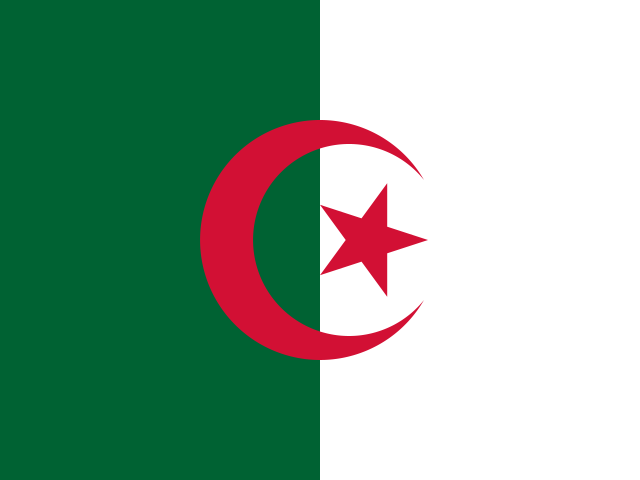
Algeria’s national football team are one of the most decorated sides on the African continent and one of the few to retain a permanent place in the modern World Cup conversation. Administered by the Fédération Algérienne de Football, founded in 1962 immediately after independence from France, the team has carried the dual identity of post-colonial sporting symbol and contemporary North African powerhouse. Nicknamed Les Fennecs after the desert fox of the Sahara — and also Les Verts and the Desert Warriors — Algeria play in white shirts with green trim that align with the national flag.
Algeria’s first FIFA-recognised international came in 1963, with FIFA membership formalised on 1 January 1964. The team’s modern reputation rests heavily on three peaks. The first was the 1982 World Cup in Spain, when Algeria became the first African team to defeat European world champions in a finals match, beating West Germany 2–1; controversy over the result of the subsequent West Germany vs Austria game (the so-called “Disgrace of Gijón”) ultimately led FIFA to schedule final group games simultaneously. The second peak was the 1990 Africa Cup of Nations, won as hosts after a 1–0 final win over Nigeria. The third — and the most recent definitive title — was the 2019 AFCON in Egypt, with a 1–0 final victory over Senegal under Djamel Belmadi.
The 2026 World Cup will be Algeria’s fifth appearance at the tournament, after 1982, 1986, 2010 and 2014. Their best result remains the 2014 round of 16, when a side anchored by Vahid Halilhodžić’s possession structure pushed eventual finalists Germany to extra time before losing 1–2. Algeria sealed 2026 qualification by topping CAF Group G with 25 points from a 10-game programme: eight wins, one draw and one defeat, with a goal difference of +16 and matches against Guinea, Uganda, Mozambique, Botswana and Somalia. CAF Online has noted the campaign as decisive after the disappointment of failing to qualify for 2018 and 2022.
Vladimir Petković — the Bosnian-Swiss coach who guided Switzerland to the 2018 World Cup and the Euro 2020 quarter-finals — has held the head-coach role since February 2024, replacing Belmadi after consecutive AFCON group-stage exits. Petković’s brief Lazio spell preceded the Switzerland appointment, and he assumed the Algeria role with explicit instructions to rebuild the side around Manchester City and Al-Ahli forward Riyad Mahrez, who continues as captain through the 2026 cycle. The squad combines Mahrez with Wolves left-back Rayan Aït-Nouri, Marseille forward Amine Gouiri, midfielders Houssem Aouar (formerly Lyon and Roma) and Ismaël Bennacer (AC Milan), and goalkeeper Luca Zidane.
The 2026 World Cup finals draw placed Algeria into Group J alongside Argentina, Austria and Jordan. Petković, speaking to CAF Online, confirmed the realistic target as second place behind Argentina, alongside an “ambition rather than mere participation” mentality against the holders. Algeria’s path will involve their tournament opener against Argentina, a fixture that revives memories of the 1986 Mexico campaign in which they finished bottom of a group containing Brazil, Spain and Northern Ireland.
Domestically, the team’s primary modern home is the Nelson Mandela Stadium in Algiers (opened 2024), supplemented by the Miloud Hadefi Stadium in Oran. The kit deal with Adidas, dating to 2015, anchors the contemporary commercial profile. Aïssa Mandi (116 caps) is the most-capped player in Algerian history; Islam Slimani is the country’s record goalscorer with 45 goals.
Algeria’s principal football rivalries are with Egypt (the bitter 2009 World Cup play-off in Khartoum, which spilled into a diplomatic incident), Morocco (a Maghreb derby with deep regional weight), Tunisia (the most-played fixture on the North African calendar), Nigeria (continental heavyweights met in five AFCON knockouts since 1980) and Senegal (the 2019 AFCON final). Mali and Cameroon round out the regular CAF knockout opposition.
Algeria’s principal supporters’ culture is built around the away-end ultras of national-team fixtures, particularly the Algiers and Oran travelling support that shaped the atmosphere of the 2014 World Cup in Brazil and the 2019 AFCON in Egypt. Tifo displays referencing the 1954–1962 War of Independence and the FLN football team — the all-Algerian XI that toured during the war — remain a recurring motif. The national team’s symbolic role, both within Algeria and across the diaspora in France, has been a continuous thread for more than six decades.
Looking forward to 2026 and beyond, Algeria’s outlook is contender-level rather than favourite. The Petković reset is built on the dual-national pipeline (Aït-Nouri, Gouiri, Zidane, Bennacer) plus established core veterans (Mahrez, Mandi, Belaïli) and a structured rebuild aimed at a deep run in North America before the 2027 AFCON. The federation has publicly framed the cycle as a chance to mirror — or surpass — the 2014 round-of-16 milestone, after a 12-year gap between World Cup appearances.
Detailed Profile
Crest, Colours & Kit Evolution
Algeria’s home shirt is white with green trim — green for Islam, white for purity — matching the national flag, with the FAF badge and a stylised fennec-fox motif in modern editions. The away shirt is all green with white trim. Adidas has been the principal kit-maker since 2015. Earlier suppliers included Le Coq Sportif and Puma.
Stadium & Premises History
Algeria played home internationals at the Stade du 5 Juillet 1962 in Algiers throughout much of the post-1962 era, and at the Stade Mustapha Tchaker in Blida during the 2010s. The Nelson Mandela Stadium in Baraki, Algiers, opened in 2024 with a capacity of approximately 40,000 and is now the principal venue. The Miloud Hadefi Stadium in Oran is the secondary venue.
Iconic Players
- 1980s: Rabah Madjer (1982 WC team, AFCON 1990), Lakhdar Belloumi (African Footballer of the Year 1981), Salah Assad.
- 2000s: Rafik Saïfi, Rafik Halliche.
- 2010s: Sofiane Feghouli, Madjid Bougherra, Yacine Brahimi (2014 hat-trick vs South Korea).
- 2014–present: Riyad Mahrez (captain, 2015 PFA Player of the Year), Aïssa Mandi (most caps), Islam Slimani (record goalscorer), Yassine Brahimi, Baghdad Bounedjah, Ismaël Bennacer, Riyad Boudebouz.
- 2024–present generation: Rayan Aït-Nouri, Amine Gouiri, Luca Zidane, Houssem Aouar.
Coaches & Managers Legacy
Modern lineage includes Rabah Saâdane (multiple spells, 2010 World Cup), Vahid Halilhodžić (2014 World Cup, round of 16), Christian Gourcuff (2014–2016), Lucas Alcaraz, Rabah Madjer (2017–2018), Djamel Belmadi (2018–2024, AFCON 2019 winner) and Vladimir Petković (February 2024 – present).
Trophies & Honours
- Africa Cup of Nations: champions 1990, 2019; runners-up 1980, 2004; third place 1984, 1988.
- AFC President’s Cup, Mediterranean Games and Pan Arab Games titles in earlier decades.
- All-Africa Games winners 1978.
Peak Eras
- 1982–1986: Algeria’s first two World Cup appearances; the 2–1 win over West Germany in 1982 remains a totemic continental moment.
- 1990: AFCON title at home — the first major continental trophy.
- 2014: Vahid Halilhodžić-led round of 16 — the country’s deepest World Cup run.
- 2019: Djamel Belmadi’s AFCON victory and a 35-match unbeaten run that ended in 2022.
Rivalries
- Egypt: defining North African rivalry, sharpened by the 2009 World Cup play-off in Khartoum.
- Morocco: Maghreb derby with strong political weight.
- Tunisia: most-frequent fixture on the calendar.
- Nigeria: AFCON knockout opposition since 1980, including the 1990 final.
- Senegal: 2019 AFCON final.
Public Image — Bad PR / Controversies
The 2009 Egypt–Algeria World Cup qualification play-off in Khartoum produced fan violence and diplomatic recriminations, with Egypt and Algeria each recalling ambassadors. Failed AFCON campaigns in 2021 and 2023 produced significant public criticism of the FAF and led directly to Belmadi’s exit. Algeria’s 2026 World Cup qualification campaign was later cited as a corrective.
Australia Connection
No documented Australia connection. Australia’s senior men’s team has not played Algeria in any FIFA-listed match’s Socceroos head-to-head and Football Australia archives.
Potential Future Trajectory
With Petković under contract through the 2026 World Cup and the AFCON 2025 cycle in parallel, Algeria’s outlook is “contender” rather than “favourite”. The dual-national pipeline (Aït-Nouri, Gouiri, Zidane, Bennacer) plus a Mahrez-led core sets the strategic axis through 2027.
More World Cup 2026 Reading
WC 2026 context: See Algeria's WC 2026 group-stage form, squad and opponents →
 Best Betting Sites
 Best Online Casinos
 Blackjack Sites
 Online Pokies
 Fast Payout Casinos
 PayID Casinos
 New Casinos 2026