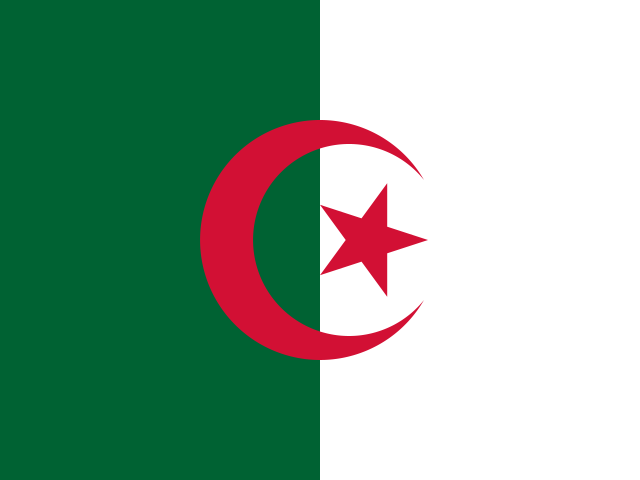
 Algeria — WC 2026 Group J
Data as of: 2026-05-20





Group J Opponents (2026)
Key Players for 2026
- Riyad Mahrez · FW
Al-Ahli captain and the squad's creative reference point; set-piece delivery and right-foot whip from the left half-space remain the most reliable Algerian goal source.
- Rayan Aït-Nouri · DF
Wolves left-back, the most-improved Algerian since 2023 and the player Petković's structure runs through on the overlap.
- Amine Gouiri · FW
Marseille forward who replaced Slimani as the No. 9 of the new cycle; pressing-style striker who fits the Petković schema.
- Ismaël Bennacer · MF
AC Milan midfielder, the squad's tempo-setter when fit; his fitness through the tournament is one of Algeria's biggest variables.
- Luca Zidane · GK
Son of Zinedine, switched allegiance to Algeria through the dual-national pathway — the keeper Petković has built the new cycle around.
Algeria return to the World Cup after a 12-year absence — their fifth ever appearance and their first since the 2014 round-of-16 run in Brazil that pushed eventual champions Germany to extra time. The Petković reset has rebuilt the squad around a Mahrez-led veteran core and a dual-national pathway pipeline (Aït-Nouri, Gouiri, Zidane, Bennacer) that finally gives Les Fennecs the European-pathway depth they have been short of since the 2014 generation aged out. Group J — Argentina, Jordan, Austria — is winnable beyond the obvious first-place slot. Second place is the explicit Petković target.
Current Form and the 2024 Reset
The two AFCON group-stage exits of 2022 (Cameroon) and 2024 (Ivory Coast) ended a 35-match unbeaten run and ended the Djamel Belmadi era. Vladimir Petković — the Bosnian-Swiss coach who guided Switzerland to the 2018 World Cup round of 16 and the Euro 2020 quarter-finals — was appointed on a long-term brief in February 2024, with explicit instructions to integrate the dual-national pathway alongside the veteran spine and rebuild a structured pressing identity.
The 2026 qualifying campaign delivered exactly that. Algeria topped CAF Group G with 25 points from 10 matches (8W-1D-1L, GD +16), winning a group containing Guinea, Uganda, Mozambique, Botswana and Somalia. The defining moment was a turning-point home win over Uganda that Petković has publicly credited as the result that locked the new generation’s identity. CAF Online described the campaign as “decisive” after the disappointment of failing to qualify for 2018 and 2022.
The 2026 Squad: Mahrez Core, Dual-National Spine
The core is Mahrez. Now 35 and at Al-Ahli after his Manchester City spell, the 2015 PFA Player of the Year is still the captain and still the squad’s primary creative outlet; his set-piece delivery and right-foot whip from the left half-space are the most reliable goal sources Algeria have. Centre-back Aïssa Mandi (116 caps, all-time record) anchors the defence, and Marseille forward Amine Gouiri has stepped up as the No. 9 of the new cycle after Islam Slimani (45 international goals, also all-time record) wound down his senior duties.
The dual-national spine is the change. Rayan Aït-Nouri (Wolves, 24) is the most-improved Algerian since 2023 and the player Petković’s structure runs through on the overlap. Ismaël Bennacer (AC Milan), when fit, is the squad’s tempo-setter from deep midfield. Houssem Aouar — formerly Lyon and Roma — has stabilised in the No. 10 role. And Luca Zidane, son of Zinedine, switched allegiance through the dual-national pathway and is the keeper Petković has built the cycle around. Behind them, veterans Riyad Boudebouz and Baghdad Bounedjah provide squad depth.
The Petković Profile
Vladimir Petković, 62, is the second-most-experienced active international head coach in CAF. The Bosnian-Swiss tactician — born in Sarajevo, naturalised Swiss — guided Switzerland to the 2018 World Cup round of 16 and the Euro 2020 quarter-finals (eliminating France on penalties in Bucharest). A brief Lazio spell in 2014 preceded the Switzerland appointment. Petković assumed the Algeria role in February 2024 with an explicit dual brief: rebuild around the dual-national pipeline and re-establish a structured pressing identity after the AFCON exits. His preferred 4-2-3-1 is built around Bennacer’s deep distribution, Mahrez free in the right half-space, and Aït-Nouri attacking the overlap. His contract runs through the 2026 World Cup and the AFCON 2025 cycle in parallel.
How Group J Plays Out
The kickoffs (all times AEST):
- Wed 17 Jun, 11:00am — vs Argentina, Arrowhead Stadium Kansas City. A lunchtime weekday opener on the Aussie east coast. This is the rematch, 40 years on, of the 1986 World Cup group fixture Argentina won 1–0 in Mexico. Petković has talked publicly about “ambition rather than mere participation” against the holders; the realistic Algerian play is a low block, set pieces, and Mahrez direct from a free-kick.
- Tue 23 Jun, 1:00pm — vs Jordan, Levi’s Stadium Santa Clara. A lunchtime afternoon kickoff for Australian viewers and the must-win fixture of Algeria’s tournament. Jordan are debutants but reached the 2024 Asian Cup final; the pressing battle and the Bennacer-vs-Noor Al-Rawabdeh midfield contest decide the result.
- Sun 28 Jun, 12:00pm — vs Austria, Arrowhead Stadium Kansas City. A Sunday-lunchtime matchday three. Group seeding may already be settled, but for both sides this is the realistic battle for the second qualification spot. Austria’s Rangnick gegenpressing scheme is the most direct stylistic clash of the group; Algeria’s structure under Petković is built to absorb that exact pattern.
The expanded 48-team format gives Algeria a real shot at progress even with a defeat to Argentina — second place qualifies automatically, and third place still progresses as one of the best third-placed sides across the 12 groups. A win over Jordan and a draw with Austria, in that case, would be enough.
Key Players to Watch
Watch Mahrez’s set-piece deliveries against Argentina — Algeria’s most likely path to a goal in the opener. Watch Aït-Nouri’s overlap against Jordan’s right side. Watch Bennacer’s fitness through the group — if he plays all three full games, Algeria are a different team. Watch Gouiri’s press in the first 15 minutes against Austria; he sets the tone for whether Algeria can pin Rangnick’s build-up high. And watch Luca Zidane: every set-piece dead ball into Algeria’s box is a referendum on the new keeper’s command.
What Algeria Need to Advance
Realistically: 4 points across Jordan and Austria. A loss to Argentina, a win over Jordan and a draw against Austria almost certainly secures second place. The expanded format means even 3 points across the three games (one win) could still progress Algeria via the best-third-placed route, depending on Group J’s goal-difference maths. Petković’s pre-tournament framing — “ambition rather than mere participation” — implicitly targets the round of 32 as the floor and the round of 16 as the ceiling.
Historical Context — Algeria at the World Cup
Algeria’s five World Cup appearances span 1982, 1986, 2010, 2014 and now 2026. The 1982 tournament in Spain delivered the most-cited single result in African World Cup history — a 2–1 group-stage win over reigning European champions West Germany in Gijón, the first African defeat of European world champions in a finals match. The collusion controversy of the subsequent West Germany vs Austria match (the “Disgrace of Gijón”) ultimately led FIFA to schedule final group games simultaneously from 1986 onwards. The 1986 Mexico tournament ended at the group stage in a group containing Brazil, Spain and Northern Ireland. The 2010 and 2014 returns under Rabah Saâdane and Vahid Halilhodžić respectively produced one group-stage exit and the country’s deepest run — the 2014 round of 16, where Algeria pushed eventual finalists Germany to extra time before losing 1–2.
Aussie Viewing — All Three Matches in AEST
For Australian fans, Algeria’s schedule is one of the friendlier ones in the tournament. Every fixture is a daytime kickoff in AEST: 11am Wednesday vs Argentina, 1pm Tuesday vs Jordan, 12pm Sunday vs Austria. SBS holds the Australian broadcast rights for the FIFA World Cup 2026 and will carry all three matches. No documented men’s senior full international between Algeria and Australia has been recorded in publicly available match registers, so this tournament is the closest Aussie viewers have come to a sustained look at Les Fennecs.
The 2014 round-of-16 run — Algeria’s deepest World Cup — is a useful Aussie reference point: that team, anchored by Halilhodžić’s possession structure, pushed Germany to extra time before losing 1–2. The 2026 cycle is built to match or surpass that benchmark.
More Algeria + WC 2026 Reading
All-time history: See Algeria's full World Cup history (all tournaments) →
 Best Betting Sites
 Best Online Casinos
 Blackjack Sites
 Online Pokies
 Fast Payout Casinos
 PayID Casinos
 New Casinos 2026