 Cabo Verde at the World Cup — Full History
Key Facts
- Cape Verde are administered by the Federação Caboverdiana de Futebol (FCF), which joined FIFA in 1986; the team played its first international on 19 April 1978, losing 1–0 to Guinea.
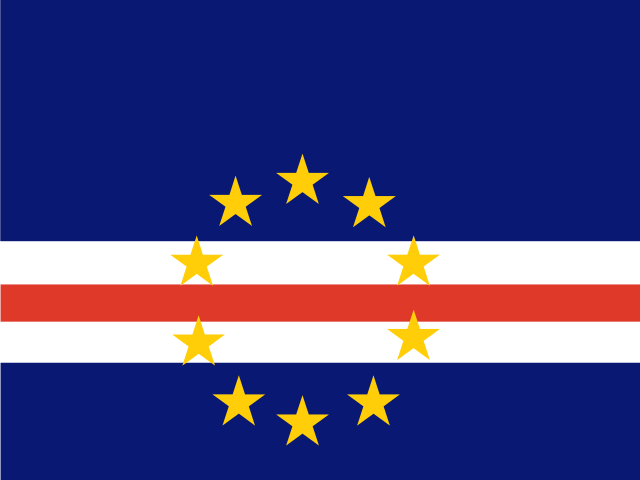
- Nicknamed Os Tubarões Azuis (the Blue Sharks) and Os Crioulos (the Creoles), the team plays in blue home shirts with white change kits, drawn directly from the national flag.
- The 2026 FIFA World Cup will be Cape Verde’s first ever appearance at a World Cup — qualification was sealed on 13 October 2025 with a 3–0 home win over Eswatini in Praia, with goals from Dailon Livramento (48’), Willy Semedo (54’) and Stopira (stoppage time).
- Cape Verde topped CAF Group D with 23 points (7W-2D-1L, GD +8) ahead of Cameroon, who had been heavy pre-qualification favourites.
- With a population of approximately 525,000 and a land area of roughly 4,033 km², Cape Verde became the smallest country by land area to qualify for a World Cup, although Curaçao surpassed that record five weeks later (per ESPN match-report).
- Pedro Leitão Brito, known as “Bubista”, has been head coach since 2020 and previously served two assistant-coach spells with the national team.
- Cape Verde’s archipelago location — 10 inhabited islands roughly 600 km off the coast of Senegal — makes the squad heavily dependent on diaspora-eligible players from Portugal, the Netherlands and France via Cape Verdean ancestry.
- Captain Ryan Mendes — a forward born in São Vicente — is also the team’s most-capped player (96 appearances) and joint-record top scorer (22 goals),.
- AFCON appearances: four — in 2013 (quarter-finalists in their debut), 2015, 2021 and 2023; the team reached the quarter-finals again in the 2023 AFCON (held in 2024).
- Cape Verde were drawn into Group H of the 2026 World Cup alongside Spain, Uruguay and Saudi Arabia — a route that requires a top-two finish for the round of 32.
- The Cape Verdean government declared a half-day public holiday on the day of the 13 October 2025 qualification clash so citizens could watch — described in ESPN’s match-report and contextualised against the country’s 50th independence anniversary commemorations.
Cabo Verde World Cup Vital Statistics
| Metric | Value |
|---|---|
| First international | 19 April 1978 vs Guinea (lost 0–1) |
| FIFA member | 1986 |
| FIFA World Cup appearances | 1 (2026 — debut) |
| AFCON appearances | 4 (2013, 2015, 2021, 2023) |
| Best AFCON result | Quarter-finals (2013, 2023) |
| Most caps | Ryan Mendes (96) |
| All-time top scorer | Ryan Mendes (22) |
| FIFA ranking | 69 |
| Head coach | Bubista (Pedro Leitão Brito) |
| Captain | Ryan Mendes |
| Home stadium | Estádio Nacional de Cabo Verde, Praia |
| 2026 WC qualification (CAF) | Group D winners — 23 pts (7W-2D-1L) |
| 2026 WC finals group | Group H vs Spain, Uruguay, Saudi Arabia |
Cabo Verde at the World Cup — History And Profile
Cape Verde’s national football team — Os Tubarões Azuis, the Blue Sharks — has produced one of the more remarkable stories in recent World Cup history, qualifying for the 2026 FIFA World Cup as the smallest country by land area ever to reach the tournament. With a national population of approximately 525,000 across an archipelago of 10 inhabited islands roughly 600 km off the coast of Senegal, Cape Verde’s appearance in Group H alongside Spain, Uruguay and Saudi Arabia in 2026 will be only the country’s first World Cup, 38 years after its FIFA affiliation in 1986.
The Federação Caboverdiana de Futebol (FCF) was founded in the years following independence from Portugal in 1975. The first FIFA-recognised international was a 0–1 home defeat to Guinea on 19 April 1978. Throughout the 1980s and 1990s, Cape Verde played intermittent regional fixtures with little continental impact, before a sustained programme of player recruitment from the global Cape Verdean diaspora — particularly in Portugal, the Netherlands and France — gradually changed the technical baseline of the squad in the 2000s.
The breakthrough at continental level came at the 2013 Africa Cup of Nations in South Africa, the team’s tournament debut. Cape Verde reached the quarter-finals — a result repeated a decade later at the 2023 AFCON (held in 2024) — and confirmed the country as a fixture on the African football map. Subsequent AFCON qualifications followed in 2015 and 2021, and the team returned to the AFCON quarter-finals in 2024 with wins over Mauritania, Mozambique and AFCON title-holders.
The transformative moment came on 13 October 2025 in Praia. With a 3–0 home win over Eswatini at the Estádio Nacional de Cabo Verde — goals from Dailon Livramento (48’), Willy Semedo (54’) and Stopira in stoppage time — Cape Verde sealed first place in CAF Group D and a debut World Cup berth. The campaign produced 23 points from 10 fixtures (seven wins, two draws, one defeat, goal difference +8) and finished four points clear of Cameroon, who had been the pre-qualification favourites. ESPN’s match-report described the moment as historic; the Cape Verdean government declared a half-day national holiday so citizens could watch.
Pedro Leitão Brito, universally known as “Bubista”, has been head coach since 2020 after two earlier spells as assistant. The squad has been built around the captain and longest-serving player Ryan Mendes — born in São Vicente — who is also the team’s most-capped player and joint-record top scorer (each 22 goals). Around Mendes, Bubista has integrated a generation including forward Bebé (formerly Manchester United and Rayo Vallecano), playmaker Kévin Lenini, defender Stopira (Roland Fernandes), Dailon Livramento and Willy Semedo, leveraging dual eligibility through Cape Verdean ancestry to add Portuguese-system technique to the squad’s profile.
The 2026 World Cup draw placed Cape Verde into Group H with reigning European champions Spain, two-time world champions Uruguay and Asian-route side Saudi Arabia. The pathway to a round-of-32 berth in the new 48-team format is open at the second-placed slot of each group, alongside the four best third-placed teams across the 12 groups, but Cape Verde face a sterner opening test than most CAF debutants.
The qualification’s symbolic weight has been amplified by Cape Verde’s 50-year independence celebrations: the country marked half a century since independence from Portugal in 2025, and Bubista publicly framed the World Cup qualification as a sporting reflection of the political and cultural milestone. FIFA President Gianni Infantino, in a statement reported by ESPN and Olympics.com, described the moment as “historic” and “deserved”, with FIFA confirming Cape Verde’s appearance is the smallest by land area in tournament history (a record subsequently surpassed by Curaçao).
The team plays its primary home internationals at the Estádio Nacional de Cabo Verde in Praia (capacity approximately 15,000), with select fixtures at the Estádio Municipal Adérito Sena in Mindelo when the venue’s capacity is sufficient. The geographic challenge — players based in Europe travelling 6+ hours for home fixtures — has long shaped the FCF’s match-scheduling and acclimatisation practice.
Looking forward, Cape Verde’s outlook is centred on a deep World Cup performance that consolidates the country as a continental fixture and on AFCON 2025 (held later in 2025–26), where the federation hopes to convert the qualifying-campaign momentum into a first major continental medal. Generational succession from Mendes to Livramento, Semedo and the next wave of diaspora-eligible talent is already under way and will be the principal determinant of whether the 2026 debut becomes a one-off or the foundation of an extended era of competitiveness across both World Cup and AFCON cycles.
Detailed Profile
Crest, Colours & Kit Evolution
Cape Verde’s home shirt is blue with white trim, mirroring the blue and white of the national flag. The Blue Sharks crest features a stylised shark over the FCF acronym. Modern kit suppliers have included Lacatoni, with kit-supplier transitions documented in regional press; the 2026 World Cup cycle features a kit-supplier deal that World Soccer Talk has covered in detail.
Stadium & Premises History
Home internationals are played principally at the Estádio Nacional de Cabo Verde in Praia, capacity approximately 15,000, which serves as the FCF’s main venue. The Estádio Municipal Adérito Sena in Mindelo on São Vicente has hosted select fixtures.
Iconic Players
- 2000s: Hélder Cabral, Fock, Nivaldo Santos.
- 2010s: Heldon, Marco Soares, Babanco, Ryan Mendes (captain, record holder), Stopira.
- 2020s and 2026 cycle: Ryan Mendes, Bebé, Dailon Livramento, Willy Semedo, Stopira, Kévin Lenini, Garry Rodrigues, Logan Costa.
Coaches & Managers Legacy
Modern lineage includes Lúcio Antunes (2010–2014, 2013 AFCON quarter-finals), Rui Águas (Brazilian, mid-2010s), and Bubista (Pedro Leitão Brito) since 2020. Bubista’s tenure has produced two AFCON quarter-final runs (2024) and the 2026 World Cup qualification.
Trophies & Honours
- AFCON: best result quarter-finals (2013, 2023 [held in 2024]).
- 2026 FIFA World Cup qualification — first in country history.
- Amílcar Cabral Cup (regional CEDEAO/Lusophone tournament): multiple appearances.
Peak Eras
- 2013 AFCON: tournament debut, quarter-finals, generated international attention for the FCF programme.
- 2023 AFCON (held 2024): quarter-finals, the run that anchored the 2026 World Cup qualification campaign.
- 2025 World Cup qualifying: 23-point campaign, Group D winners, debut World Cup berth.
Rivalries
Cape Verde does not have a single classical rivalry. Most-frequent fixtures are with regional neighbours Senegal, Mauritania and the West African Lusophone diaspora opposition (Guinea-Bissau, Angola). The proximity to Senegal makes that the most regularly played fixture.
Public Image — Bad PR / Controversies
The FCF has periodically been the subject of governance debates over diaspora-eligibility standards, but the 2026 cycle has been free of major public controversy. The half-day public holiday on the qualification day produced unanimous national support across Cape Verde’s political spectrum.
Australia Connection
No documented Australia connection. Australia’s senior men’s team has not played Cape Verde in any FIFA-listed match’s Socceroos head-to-head archive.
Potential Future Trajectory
The 2026 World Cup is the first chapter rather than the destination. With Bubista contracted through the cycle, generational succession underway from Mendes to a younger frontline (Livramento, Semedo) and a continued diaspora-recruitment programme through the Portuguese-language football network, Cape Verde’s outlook is “consolidator”: establish the World Cup as an achievable target every cycle and convert AFCON 2025 momentum into a first medal.
More World Cup 2026 Reading
WC 2026 context: See Cabo Verde's WC 2026 group-stage form, squad and opponents →
 Best Betting Sites
 Best Online Casinos
 Blackjack Sites
 Online Pokies
 Fast Payout Casinos
 PayID Casinos
 New Casinos 2026