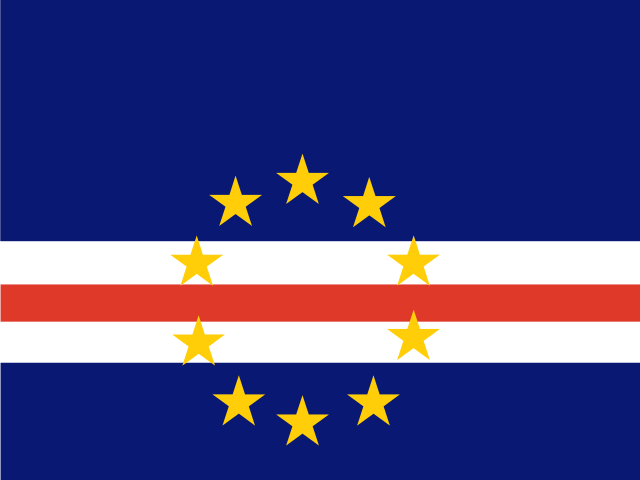
 Cape Verde — WC 2026 Group H
Data as of: 2026-05-20





Recent Form
| Date | Opponent | Score | Result | Competition |
|---|---|---|---|---|
| 2025-10-13 | Eswatini | 3-0 | W | CAF WC 2026 Qualifier — Group D (Praia, qualification sealed) |
Group H Opponents (2026)
Spain
First competitive meeting between the two nations. Cape Verde's compact mid-block versus the world's #2 ranked side — the steepest test in the group.
Saudi Arabia
The most evenly-matched fixture in Group H on FIFA ranking; the realistic three-point target for both debutant-tier sides and likely the best-third-placed decider.
Uruguay
Cape Verde's first competitive fixture against a two-time World Cup champion. Set-pieces and counter-attacks are the Blue Sharks' best hope of a result.
Key Players for 2026
- Ryan Mendes · FW
Captain and most-capped player (96 caps), joint-record top scorer (22 goals). The face of the World Cup debut campaign and the team's experienced game-decider.
- Dailon Livramento · FW
Scored the opener in the 3-0 qualification-sealing win over Eswatini — the post-Mendes goal-scoring future and the most direct attacking outlet.
- Willy Semedo · FW
Scored Cape Verde's second goal on qualification night; a versatile attacking option Bubista has built around alongside Livramento.
- Stopira · DF
Long-serving central defender whose stoppage-time goal v Eswatini also makes him a set-piece threat — Cape Verde's defensive anchor.
- Bebé · FW
Former Manchester United and Rayo Vallecano forward with senior European experience; the most-known name in the squad outside the Portuguese-language football world.
Cape Verde — Os Tubarões Azuis, the Blue Sharks — arrive at the 2026 FIFA World Cup as the smallest country by land area ever to qualify for the men’s tournament, and one of the great qualifying-cycle stories of the modern era. An archipelago of 10 inhabited islands roughly 600 km off the coast of Senegal, with a national population of approximately 525,000, the Federação Caboverdiana de Futebol joined FIFA in 1986; 40 years later, the Blue Sharks take the field at their first ever World Cup in Group H, against reigning European champions Spain, two-time world champions Uruguay, and Asian Cup three-time champions Saudi Arabia.
A Federation Built on the Diaspora Pathway
Cape Verde’s first FIFA-recognised international was a 0-1 home defeat to Guinea on 19 April 1978, three years after independence from Portugal in 1975. Through the 1980s and 1990s the team played intermittent regional fixtures with little continental impact. The transformation came in the 2000s and 2010s through a sustained programme of player recruitment from the global Cape Verdean diaspora — particularly in Portugal, the Netherlands and France — that gradually changed the technical baseline of the squad.
The continental breakthrough came at the 2013 Africa Cup of Nations in South Africa, the team’s tournament debut. Cape Verde reached the quarter-finals — a result repeated a decade later at the 2023 AFCON (held in 2024) — and confirmed the country as a fixture on the African football map. Subsequent AFCON qualifications followed in 2015 and 2021. The 2024 AFCON quarter-final run, with wins over Mauritania and Mozambique among the tournament fixtures, anchored the squad chemistry that would carry the 2026 World Cup qualifying campaign.
Honours at a Glance
- 2026 FIFA World Cup qualification — first in country history.
- Africa Cup of Nations: best result quarter-finals (2013, 2023 [held in 2024]); also qualified 2015 and 2021.
- Amílcar Cabral Cup (regional CEDEAO/Lusophone tournament): multiple appearances.
The all-time leading scorer is captain Ryan Mendes (22 goals, joint-record), who is also the team’s most-capped player at 96 appearances. The first FIFA-recognised international was a 0-1 home defeat to Guinea on 19 April 1978. FCF joined FIFA in 1986. The home stadium is the Estádio Nacional de Cabo Verde in Praia (capacity approximately 15,000).
Current Form (Last 12 Months)
The qualification campaign rewrote the country’s footballing history. Cape Verde topped CAF Group D with 23 points across 10 fixtures — seven wins, two draws, one defeat, goal difference +8 — finishing four points clear of Cameroon, who had been the pre-qualification favourites. The decisive fixture came on 13 October 2025 at the Estádio Nacional de Cabo Verde in Praia, where a 3-0 home win over Eswatini sealed the World Cup berth with goals from Dailon Livramento (48’), Willy Semedo (54’) and the long-serving central defender Stopira in stoppage time.
The Cape Verdean government declared a half-day public holiday so citizens could watch. ESPN’s match-report described the moment as historic, and FIFA President Gianni Infantino called the qualification “deserved” — the kind of phrasing reserved for moments that genuinely change a federation’s profile. The 50-year independence anniversary commemorations that ran across 2025 added symbolic weight to the sporting milestone.
In the months between qualification and the May 2026 tournament window, Bubista’s side has been preparing for the dual challenge of AFCON 2025 (held later in the 2025–26 calendar) and the World Cup. The team’s FIFA ranking sat at 69th in April 2026 — the highest sustained position in federation history.
Pedro Leitão Brito — universally known as Bubista — has been head coach since 2020 after two earlier spells as assistant. The Bubista tenure has now delivered two AFCON quarter-final runs and the country’s first World Cup qualification, the longest sustained era of competitiveness in Cape Verdean football. His contract runs through the 2026 cycle, with the 2025 AFCON and the World Cup operating as parallel proving grounds.
The 2026 Squad: Diaspora and Debut
The squad is built around two structural realities. First, Cape Verde’s archipelago location means home internationals require 6+ hours of travel for the European-based players who make up the bulk of the senior pool; the federation’s match-scheduling and acclimatisation practice has long been built around that. Second, the senior squad relies heavily on diaspora-eligible players from Portugal, the Netherlands and France via Cape Verdean ancestry — a structural feature that has gradually upgraded the squad’s technical baseline through the 2010s and 2020s.
Captain Ryan Mendes, born in São Vicente, is the squad’s most-capped player (96 appearances) and joint-record top scorer (22 goals). Around him, Bubista has integrated Bebé — the former Manchester United and Rayo Vallecano forward, the most-recognised name on the team-sheet outside Lusophone football — alongside playmaker Kévin Lenini, defender Stopira (Roland Fernandes), Dailon Livramento, Willy Semedo, Garry Rodrigues and the rising centre-back Logan Costa.
The collective is the team. Cape Verde do not produce single-star match-winners in the Yamal or Núñez mould; they produce a coherent defensive structure, disciplined transitions and set-piece organisation. The 2024 AFCON quarter-final run was built on those traits; the qualification campaign extended them.
How Group H Plays Out
Group H is the tournament’s headline group on paper and the steepest possible draw for a debutant. Spain are joint pre-tournament favourites; Uruguay are deep-stage contenders; Cape Verde and Saudi Arabia fight for the best-third-placed lifeline that the new 48-team format opens up.
- vs Spain. The steepest test of the campaign. Cape Verde’s compact mid-block has finished four points clear of Cameroon in CAF qualifying — but Spain are the world’s most efficient mid-block-breaking side. The realistic target is a low-conceded scoreline that keeps the goal-difference column alive for the third-place chase.
- vs Saudi Arabia. The most evenly-matched fixture in Group H on FIFA ranking and the realistic three-point target for both sides. Both nations are debutant-tier on the world stage; both rely on collective organisation rather than star power. This match likely decides which of the two has a route to the best-third placing.
- vs Uruguay. First competitive meeting between the two nations. Bielsa’s Uruguay press hard and play vertically — exactly the profile Cape Verde’s organised mid-block is built to absorb on the counter. Set-pieces and Stopira’s aerial presence are the Blue Sharks’ best route to a result.
Win against Saudi Arabia, hold the score against Spain and Uruguay, and Cape Verde could finish on 3-4 points and chase a best-third-placed slot. Even a single draw across the three matches would be a historic World Cup result for the country.
Key Players to Watch
Watch Mendes in possession — Cape Verde’s most experienced ball-progressor and the player most likely to relieve pressure in the tight phases. Watch Livramento’s runs in behind; the qualification-clinching opener against Eswatini is the goal-scoring template. Watch Stopira at set-pieces — Cape Verde’s biggest single goal threat from a dead ball. Watch Logan Costa, the rising centre-back whose ceiling is the most interesting medium-term question in the squad. And watch Bebé from the bench; a late-game flair option that no opponent’s analytics team can ignore.
What Cape Verde Need to Advance
Realistically: 3-4 points and a best-third-placed slot. The path to the round of 32 in the 48-team format runs via the four best third-placed teams across the 12 groups, and Cape Verde’s defensive-organisation profile is exactly the kind that can grind out the goal-difference column needed to qualify under that route. A win over Saudi Arabia is the campaign’s central must-have; a draw against Spain or Uruguay would be the equivalent of the 2022 Argentina-Saudi Arabia shock at a federation level.
The bigger picture: just reaching the World Cup is itself a historic achievement. The 2026 cycle is the first chapter rather than the destination — with Bubista contracted through the cycle and generational succession underway from Mendes to Livramento, Semedo and the next wave of diaspora-eligible talent, the federation’s outlook is “consolidator”. Establish the World Cup as an achievable target every cycle. Convert AFCON momentum into a first major continental medal.
Rivalries and Regional Context
Cape Verde does not have a single classical rivalry in the European or South American sense. Most-frequent fixtures are with regional neighbours Senegal, Mauritania and the West African Lusophone-diaspora opposition — Guinea-Bissau, Angola — that shares the football pathway of post-colonial Portuguese-speaking football. The proximity to Senegal makes that the most regularly played fixture, with the Senegalese side’s continental clout (2022 AFCON champions) the natural sporting yardstick against which Cape Verde measures progress.
The 2026 qualifying campaign also produced a defining beat-the-favourite moment: finishing four points clear of Cameroon in CAF Group D, with the five-time AFCON champions failing to qualify directly. That result has shifted the recognition baseline for what a Cape Verde football side can plausibly target — and it sits alongside the 2024 AFCON quarter-final run as the foundation the federation’s medium-term planning is built on.
Home Ground and Symbolic Weight
The team plays its primary home internationals at the Estádio Nacional de Cabo Verde in Praia (capacity approximately 15,000), with select fixtures at the Estádio Municipal Adérito Sena in Mindelo on São Vicente. The geographic reality — European-based players travelling 6+ hours for home fixtures — has long shaped the FCF’s match-scheduling and acclimatisation practice. The home shirt is blue with white trim, mirroring the blue and white of the national flag; the Blue Sharks crest features a stylised shark over the FCF acronym.
The qualification’s symbolic weight has been amplified by Cape Verde’s 50-year independence celebrations. The country marked half a century since independence from Portugal in 2025, and Bubista publicly framed the World Cup qualification as a sporting reflection of the political and cultural milestone. FIFA President Gianni Infantino, in a statement reported by ESPN and Olympics.com, described the moment as “historic” and “deserved”, with FIFA confirming Cape Verde’s appearance as the smallest by land area in tournament history (a record subsequently surpassed by Curaçao five weeks later).
Australia Connection
No documented Australia connection. Australia’s senior men’s team has not played Cape Verde in any FIFA-listed match per Wikipedia’s Socceroos head-to-head archive. The two nations sit at opposite ends of the world-football scale of recognition — one a six-time World Cup participant, the other a debutant — but the qualification narratives have unusual resonance, with both federations having travelled long roads from genuine outside-looking-in obscurity to repeat-tournament credibility within a single generation.
Aussie Viewing
Cape Verde and Australia have never met at senior level, but the qualification story mirrors the Socceroos’ own long road to 2006 — the dark years before genuine World Cup competitiveness gave way to a single tournament that changed everything. Australian supporters who remember 1997 against Iran, or the Sydney penalty shoot-out against Uruguay in 2005, understand exactly what this tournament means to the Blue Sharks and their fans.
All Group H kickoff times and AEST conversions will publish in the WC 2026 schedule in AEST hub as FIFA confirms broadcast windows. Cape Verde are the longest-shot side in Group H by every market quote and the most likely under-the-radar side to produce a single match that lives in tournament memory — exactly the kind of fixture the new 48-team format was built to enable, and exactly the kind of moment Australian punters tracking the WC 2026 outright odds and best-third-placed markets will be watching.
The Geographic and Logistical Reality
One overlooked feature of Cape Verde’s 2026 campaign is the squad’s logistical baseline. The team’s European-based players — drawn from clubs in Portugal, the Netherlands, France, Belgium and the lower divisions of multiple European leagues — fly between 6 and 9 hours to reach Praia for any home international. The federation’s match-scheduling and acclimatisation practice has been built around that constraint for years. Travel to the US, Canada and Mexico for the 2026 World Cup actually shortens the journey for many squad members compared to a typical home cycle.
The other geographic note is the time-zone profile. Cape Verde sits on UTC-1 (one hour behind Greenwich), narrowing to standard European summer-time alignment in the months leading into the tournament. Players moving from European clubs to a US-Canada-Mexico tournament window will face the same time-zone shift as their continental peers — but without the home-soil acclimatisation reset that European federations build into their pre-tournament friendly windows.
Storylines to Track Through the Group
Three storylines define Cape Verde’s tournament narrative. The first is the simple historic achievement of being there — every minute the Blue Sharks play in Group H is the first time the country has played at this level of the sport, and that storyline carries the campaign regardless of result. The half-day national holiday on 13 October 2025 — declared by the Cape Verdean government so citizens could watch the qualification-sealing match against Eswatini — is the operating cultural baseline.
The second is the diaspora-pathway proof point. Cape Verde’s squad construction model — built around Portuguese-system technique brought in via Cape Verdean ancestry, anchored by domestic-pathway captain Ryan Mendes — is a template several other small-population federations would copy if the 2026 cycle validates it. The post-Mendes generation (Livramento, Semedo, Logan Costa) is the visible continuation of that pipeline.
The third is the best-third-placed scoreline question. The 48-team format opens a path to the round of 32 that did not exist under the 32-team brackets, and Cape Verde’s defensive-organisation profile is exactly the kind that can grind out the goal-difference and discipline column needed to qualify under that route. The Saudi Arabia fixture is the central must-have; even a single point against Spain or Uruguay then becomes the campaign’s defining single moment.
More Cape Verde + WC 2026 Reading
All-time history: See Cape Verde's full World Cup history (all tournaments) →
 Best Betting Sites
 Best Online Casinos
 Blackjack Sites
 Online Pokies
 Fast Payout Casinos
 PayID Casinos
 New Casinos 2026