 Curaçao at the World Cup — Full History
Key Facts
- The Curaçao national football team is the senior representative side of the Caribbean island of Curaçao, a constituent country of the Kingdom of the Netherlands; it is governed by the Federashon Futbòl Kòrsou (FFK).
- The team’s institutional lineage runs through the Territory of Curaçao football team (1921–1958) and the Netherlands Antilles team (1958–2010); after the dissolution of the Netherlands Antilles on 10 October 2010, Curaçao assumed the predecessor’s FIFA membership and historical records.
- Curaçao qualified for the 2026 FIFA World Cup on 18 November 2025 with a 0–0 draw against Jamaica in Kingston, becoming the smallest nation by both population (around 156,000) and area to ever qualify for a men’s FIFA World Cup.
- The 2026 World Cup is Curaçao’s debut at the senior FIFA World Cup; CONCACAF announced the team had topped its third-round qualifying group ahead of Jamaica, Trinidad and Tobago and Bermuda.
- Veteran Dutch manager Dick Advocaat — capped at 1994 Netherlands World Cup quarter-finals and 2006 South Korea — managed the qualification campaign and would have become the oldest head coach to ever manage at a FIFA World Cup, but resigned on 23 February 2026 for personal/family reasons.
- Fred Rutten, the former PSV Eindhoven, FC Twente and Schalke 04 head coach, was appointed Curaçao head coach on 23 February 2026 to lead the team through the 2026 World Cup finals.
- Captain Leandro Bacuna and goalkeeper Eloy Room are jointly the most-capped players in Curaçao national-team history (70 appearances each as of qualification).
- All-time top scorer Rangelo Janga has 21 goals; key squad members for the 2026 World Cup include Tahith Chong (Sheffield United), Cuco Martina, Juninho Bacuna and Roshon van Eijma.
- Curaçao won the Caribbean Cup in 2017 (its first major continental title since the Netherlands Antilles era) and reached the CONCACAF Gold Cup quarter-finals in 2019.
- Home matches are played at the Ergilio Hato Stadium in Willemstad, capacity around 10,000; the FIFA April 2026 ranking placed Curaçao 82nd in the world, the highest position in the team’s history.
Curaçao World Cup Vital Statistics
| Metric | Value |
|---|---|
| Federation | Federashon Futbòl Kòrsou (FFK) |
| Predecessor sides | Curaçao territory (1921–1958); Netherlands Antilles (1958–2010) |
| FIFA World Cup appearances | 1 (2026, debut) |
| 2026 World Cup qualification date | 18 November 2025, 0–0 vs Jamaica in Kingston |
| Caribbean Cup titles (Curaçao era) | 1 (2017) |
| Best CONCACAF Gold Cup finish | Quarter-finals (2019) |
| FIFA ranking (April 2026) | 82 (highest in team history) |
| Most-capped players | Leandro Bacuna and Eloy Room (70 each) |
| All-time top scorer | Rangelo Janga (21) |
| Head coach | Fred Rutten (since 23 February 2026) |
| Predecessor coach for qualification | Dick Advocaat (resigned 23 February 2026) |
| Captain | Leandro Bacuna |
| Home venue | Ergilio Hato Stadium, Willemstad |
Curaçao at the World Cup — History And Profile
The Curaçao national football team represents the constituent Kingdom of the Netherlands country of Curaçao, the Caribbean island of around 156,000 inhabitants and 444 square kilometres. It is governed by the Federashon Futbòl Kòrsou (FFK) and competes in CONCACAF. The team’s institutional lineage is older than the modern country: a Territory of Curaçao representative side existed from 1921, played at the Caribbean and Pan-American level through 1958, and was then succeeded by the Netherlands Antilles national team, which represented Curaçao alongside Aruba, Bonaire, Sint Maarten, Sint Eustatius and Saba until the constitutional dissolution of the Netherlands Antilles on 10 October 2010. After dissolution, FIFA permitted Curaçao to assume the Netherlands Antilles membership and historical records — so the modern team’s record traces back through the Antillean side’s 1957 Pan-American Games appearance, its 1963 CONCACAF Championship third-place finish and its long Caribbean Cup history.
In November 2025 Curaçao secured the most consequential result in the team’s century of football: a 0–0 draw away to Jamaica in Kingston on 18 November 2025 confirmed Curaçao as group winners in the third round of CONCACAF qualifying for the 2026 FIFA World Cup. The result made Curaçao the smallest nation, by both population (around 156,000) and area, ever to qualify for a men’s FIFA World Cup — eclipsing the previous record held by Iceland (population ~330,000, qualified for the 2018 World Cup). The 2026 World Cup is the team’s debut at the senior global tournament. CNN, FIFA and CONCACAF all framed the qualification as a watershed for small-island football nations.
The qualification campaign was managed by Dick Advocaat, the 78-year-old Dutch coach who had previously taken Netherlands to the 1994 World Cup quarter-finals and South Korea to the 2006 World Cup. Had Advocaat remained in post for the 2026 finals, he would have become the oldest head coach in World Cup history. On 23 February 2026, however, Advocaat announced his resignation for personal/family reasons. The FFK confirmed Fred Rutten — the former PSV Eindhoven (Eredivisie 2007–08), FC Twente, Feyenoord and Schalke 04 head coach — as his successor on the same day, with a brief through the 2026 World Cup finals.
The squad is built around the Bacuna brothers — captain Leandro Bacuna (Cardiff City, formerly Aston Villa, Reading and Birmingham) and Juninho Bacuna — alongside goalkeeper Eloy Room, who together with Leandro shares the team appearance record on 70 caps. Tahith Chong, the former Manchester United and current Sheffield United midfielder, is the most prominent attacking player; Cuco Martina (formerly of Southampton, Everton and Stoke City) and Roshon van Eijma round out the experienced European-based core. Rangelo Janga, with 21 international goals, is the all-time top scorer. The recruitment policy has actively pursued Dutch-born players of Curaçaoan ancestry through Eredivisie and Championship pathways since the 2010 transition.
The team’s continental record is creditable for an island the size of Curaçao. The Antillean predecessor finished third at the 1963 CONCACAF Championship; under the modern Curaçao identity, the team won the 2017 Caribbean Cup (defeating Jamaica 2–1 in the final in Martinique) and reached the CONCACAF Gold Cup quarter-finals in 2019, the team’s best result at the regional flagship tournament. Curaçao’s FIFA ranking, which sat in the high 100s through most of the 2010s, climbed steadily through the qualifying campaign and reached 82 in April 2026 — the highest position in team history.
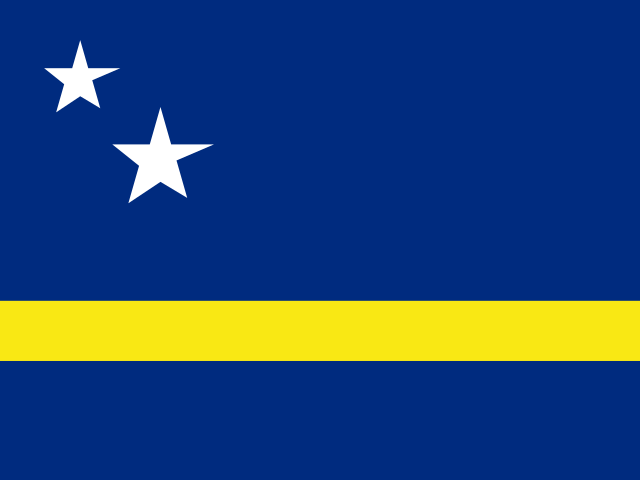
Curaçao plays in royal blue with yellow accents (matching the colours of the national flag), and is most commonly nicknamed The Blue Wave. The Federashon Futbòl Kòrsou crest features a stylised wave motif. Home matches are played at the Ergilio Hato Stadium in Willemstad, the modest 10,000-capacity national stadium named after the Curaçaoan goalkeeping legend Ergilio Hato (1928–2003), one of the Netherlands Antilles’ longest-serving internationals. Supporter culture coalesces around the local merengue and tumba musical traditions and the bilingual chants in Papiamento and Dutch.
FIFA’s 2025 draw record places Curaçao in Group E of the 2026 finals alongside Germany, Côte d’Ivoire and Ecuador. The Australia connection is essentially nonexistent: there is no documented senior international fixture between Curaçao and Australia, and no AFC dual-national featured in the qualifying squad. The medium-term outlook is dominated by the 2026 World Cup itself: Curaçao’s group draw and finals fixtures (with Group D opposition reported by various secondary sources during research) will be the team’s first ever appearance at a senior FIFA tournament. Beyond 2026, the FFK’s institutional priorities are youth-development pathways via the Eredivisie and Belgian/French academies, succession around the Bacuna-Room generation, and converting the historic qualification into sustained CONCACAF top-tier status.
Detailed Profile
Founding & Origins
A representative Curaçao football team has existed since 1921, when the Territory of Curaçao football side played its earliest recorded fixtures. From 1958 to 2010 the federated Netherlands Antilles team represented Curaçao alongside Aruba, Bonaire, Sint Maarten, Saba and Sint Eustatius. The constitutional dissolution of the Netherlands Antilles on 10 October 2010 led FIFA to recognise Curaçao as the legal successor with continuity of historical records.
Crest, Colours & Kit Evolution
Curaçao plays in royal blue shirts with yellow trim, white shorts and blue socks; the change strip is white. The FFK crest features a stylised wave; the kit has been manufactured by various suppliers, with locally-branded jerseys for major fixtures.
Stadium & Premises History
Home matches are played at the Ergilio Hato Stadium in Willemstad — a modest 10,000-capacity national stadium named after the Curaçaoan goalkeeping legend Ergilio “Maradei” Hato (1928–2003). The FFK training base is on the same complex.
Historical Key Players
Pre-2010 Antillean era: Ergilio Hato (long-serving goalkeeper through 1950s–60s). Modern Curaçao era: Cuco Martina (Southampton, Everton, Stoke City), Brandley Kuwas, Gevaro Nepomuceno, Leandro Bacuna (current captain, 70 caps), Juninho Bacuna, Eloy Room (joint appearance record on 70 caps), Rangelo Janga (top scorer with 21 goals), Tahith Chong (Sheffield United), Roshon van Eijma.
Coaches & Managers Legacy
Recent head coaches in the post-2010 era include Étienne Silié, Patrick Kluivert (2015–2016, who took the team into the 2017 Caribbean Cup-winning campaign), Remko Bicentini (2016–2021, the 2017 Caribbean Cup title and 2019 Gold Cup quarter-final), Guus Hiddink (briefly, 2021), Dick Advocaat (2024–February 2026, the historic World Cup qualification), and Fred Rutten (from 23 February 2026).
Trophies & Honours
- FIFA World Cup: debut 2026
- Caribbean Cup: champions 2017
- CONCACAF Gold Cup: quarter-finals 2019 (best result)
- ABCS Tournament: multiple titles (regional ABCS islands competition with Aruba, Bonaire, Suriname)
Peak Eras
2017 Caribbean Cup victory under Patrick Kluivert / Remko Bicentini was the first major regional title of the modern Curaçao era. The 2024–2025 third-round CONCACAF qualifying campaign under Dick Advocaat — culminating in the historic 0–0 draw at Jamaica on 18 November 2025 — is the team’s defining peak.
Rivalries
The principal regional rivalry is with Aruba (the Curaçao-Aruba derby), reflecting the political and footballing separation of the two islands during and after the Netherlands Antilles era. Wider Caribbean rivalries with Jamaica, Trinidad and Tobago and Haiti have been built through Caribbean Cup and CONCACAF qualifying fixtures.
Supporters Culture, Flags & Chants
Supporters travel in modest numbers given the island’s population, but matchday culture in Willemstad and at away fixtures coalesces around blue-yellow flags, Papiamento-language chants and the local tumba and merengue musical traditions. The 2025 qualification produced street celebrations across Willemstad. [CNN]
Public Image — Bad PR / Controversies
The principal off-field issue around the 2026 cycle was the Advocaat resignation on 23 February 2026, four months before the finals, citing personal/family reasons. The FFK’s swift appointment of Fred Rutten on the same day was widely framed as orderly succession rather than crisis.
Charity & Community
The FFK runs grassroots and youth-development programmes across the island; the historic qualification has prompted federation-led community-engagement campaigns aimed at youth recruitment.
Australia Connection
No documented senior-level Australia connection. There is no known senior international fixture between Curaçao (or its Netherlands Antilles predecessor) and Australia, and no AFC dual-national featured in the 2026 World Cup qualifying squad.
Connections to Other Clubs / Sports / Celebrity Figures
The strongest current ties are through the Eredivisie pathway: most of the senior squad has played either in Dutch professional football or in English Championship/Premier League sides through Dutch academies. Patrick Kluivert (former Ajax, Barcelona and Netherlands striker, born to a Curaçaoan father) was the coach who initiated the modern Curaçao identity in 2015.
Potential Future Trajectory
The defining short-term objective is performance at the 2026 World Cup under Fred Rutten — Curaçao’s first senior FIFA finals appearance. Beyond 2026, the FFK’s stated priorities are sustained CONCACAF top-tier status, youth-development pathways via Dutch and Belgian academies, and succession around the Bacuna-Room-Janga generation. The team’s trajectory will likely depend heavily on continued recruitment of Dutch-born players of Curaçaoan ancestry.
More World Cup 2026 Reading
WC 2026 context: See Curaçao's WC 2026 group-stage form, squad and opponents →
 Best Betting Sites
 Best Online Casinos
 Blackjack Sites
 Online Pokies
 Fast Payout Casinos
 PayID Casinos
 New Casinos 2026