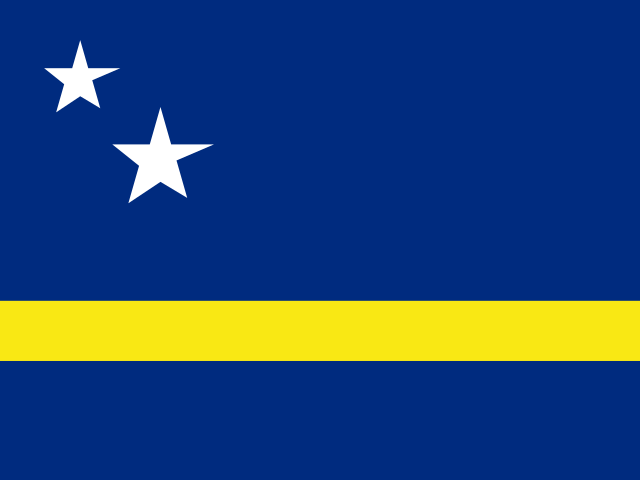
 Curaçao — WC 2026 Group E
Data as of: 2026-05-20





Group E Opponents (2026)
Côte d'Ivoire
First meeting in senior international football between Curaçao and reigning African champions Côte d'Ivoire.
Germany
First meeting in senior international football between Curaçao and four-time World Cup winners Germany.
Ecuador
First meeting in senior international football between Curaçao and Ecuador.
Key Players for 2026
- Leandro Bacuna · MF
Cardiff City captain, joint all-time appearance record (70 caps) — the on-pitch leader of the historic qualification.
- Eloy Room · GK
Joint all-time appearance record holder (70 caps), the senior goalkeeper who kept the clean sheet at Jamaica that sealed qualification.
- Tahith Chong · MF
Sheffield United and former Manchester United attacking midfielder — the squad's most prominent technical player.
- Juninho Bacuna · MF
Birmingham City midfielder and Leandro's younger brother, central to the engine room throughout qualifying.
- Rangelo Janga · FW
All-time top scorer with 21 international goals — the experienced senior forward in the qualifying squad.
Curaçao arrive at the 2026 World Cup as the story of the tournament before a ball has even been kicked. The Caribbean island of around 156,000 inhabitants and 444 square kilometres became, on 18 November 2025 in Kingston, the smallest nation by both population and area ever to qualify for a men’s FIFA World Cup — breaking the record previously held by Iceland (population around 330,000 at the 2018 World Cup). Group E places The Blue Wave alongside Germany, Côte d’Ivoire and Ecuador. Three of those four are World Cup veterans; Curaçao are debutants playing for history.
Current Form and the Historic Qualification
The result that changed Curaçaoan football was a 0–0 draw at Jamaica’s National Stadium on 18 November 2025. The point was enough to confirm Curaçao as winners of their CONCACAF third-round qualifying group ahead of Jamaica, Trinidad and Tobago, and Bermuda. CNN, FIFA and CONCACAF all framed the night as a watershed for small-island football. Street celebrations across Willemstad ran into the morning; the FIFA April 2026 ranking placed Curaçao 82nd in the world — the highest position in the team’s history.
The qualification campaign was managed by Dick Advocaat, the 78-year-old Dutch coach who had previously taken the Netherlands to the 1994 World Cup quarter-finals and South Korea to the 2006 World Cup. Had Advocaat remained in post for the 2026 finals, he would have become the oldest head coach in World Cup history. On 23 February 2026, however, Advocaat announced his resignation for personal and family reasons. On the same day, the Federashon Futbòl Kòrsou confirmed Fred Rutten — former PSV Eindhoven (Eredivisie champion 2007–08), FC Twente, Feyenoord and Schalke 04 head coach — as Advocaat’s successor on a brief through the 2026 finals.
The 2026 Squad
The squad is built around the Bacuna brothers and a deep Dutch-football recruitment pathway. Captain Leandro Bacuna (Cardiff City, formerly Aston Villa, Reading and Birmingham) and goalkeeper Eloy Room jointly hold the team appearance record at 70 caps each — the spine of every meaningful Curaçao matchday squad of the last decade. Juninho Bacuna, Leandro’s younger brother (Birmingham City), runs alongside in midfield.
Tahith Chong, the former Manchester United and current Sheffield United attacking midfielder, is the most prominent technical player in the pool. Cuco Martina — formerly of Southampton, Everton and Stoke City — adds Premier League experience in defence. Rangelo Janga, the all-time top scorer with 21 international goals, is the senior forward; Roshon van Eijma rounds out the experienced European-based core. The recruitment policy has actively pursued Dutch-born players of Curaçaoan ancestry through Eredivisie and Championship pathways since the 2010 transition from Netherlands Antilles to Curaçao identity — the same pipeline that produced the AFCON-style “diaspora plus domestic” squad construction used across the post-colonial Caribbean.
The institutional lineage is older than the modern country. A representative Curaçao territory side existed from 1921; from 1958 to 2010 the federated Netherlands Antilles team represented Curaçao alongside Aruba, Bonaire, Sint Maarten, Saba and Sint Eustatius; the constitutional dissolution of the Netherlands Antilles on 10 October 2010 led FIFA to recognise Curaçao as the legal successor with continuity of historical records. The Antillean predecessor finished third at the 1963 CONCACAF Championship. The modern Curaçao identity won the 2017 Caribbean Cup under Patrick Kluivert and Remko Bicentini (a 2–1 final defeat of Jamaica in Martinique), and reached the CONCACAF Gold Cup quarter-finals in 2019 — both prior peaks now eclipsed.
Group E — How It Plays Out
The draw placed Curaçao in Group E with Germany, Côte d’Ivoire and Ecuador. The schedule, per the December 2025 draw, includes a 25 June fixture against Côte d’Ivoire in Philadelphia. The competitive realism is honest: every other team in the group is ranked materially higher and carries more World Cup experience. Curaçao are the heaviest underdogs in the group on any reasonable model.
- vs Côte d’Ivoire (25 June, Philadelphia) — Reigning African champions and unbeaten CAF qualifiers (10 matches, +25 goal difference). Côte d’Ivoire’s Premier League and Serie A core — Kessié, Ndicka, Haller, Amad Diallo, Pépé — represents the kind of squad depth Curaçao haven’t faced in qualifying.
- vs Germany — Four-time World Cup winners, Julian Nagelsmann’s rebuild, the Kimmich-Wirtz-Musiala spine, and the institutional weight of eight World Cup final appearances. The fixture is the kind of opportunity that defines national-team folklore, regardless of outcome.
- vs Ecuador — The most defensively organised opponent in the group. Sebastián Beccacece’s side conceded only five goals across 18 CONMEBOL qualifying matches; breaking that low block is the toughest tactical assignment Curaçao have ever faced.
Under the new 48-team format, third place in a four-team group can still progress as one of the best third-placed sides across the 12 groups. The expanded path is the only realistic route to a round-of-32 berth — but even that requires at least a point against one of the three group opponents.
Key Players to Watch
Watch Eloy Room’s distribution under pressure — Curaçao’s transition game starts with the senior goalkeeper. Watch Leandro Bacuna in central-channel one-versus-one situations against Wirtz and Musiala — the captain’s discipline will define how long Curaçao keep games competitive. Watch Tahith Chong in attacking transition — the squad’s most likely source of an X-factor moment. Watch Cuco Martina at full-back against Côte d’Ivoire’s wide creators; that’s the duel that decides the most winnable fixture of the group. And watch Rutten’s substitutions — the former Eredivisie title-winning head coach has a brief that’s as much about managing the occasion as it is about the result.
What Curaçao Need
The honest framing is that 2026 is a tournament Curaçao have already won by getting to. The federation is the smallest by population and area in World Cup history; Advocaat and Rutten between them represent the deepest Dutch coaching pedigree any debutant nation has ever brought to a finals; the FIF’s institutional priorities for the cycle have already been stated as sustained CONCACAF top-tier status and Dutch-academy succession around the Bacuna-Room-Janga generation.
A point in the group stage — against any of Germany, Côte d’Ivoire or Ecuador — would be the result of a generation. A goal in any fixture would be the team’s first at a senior FIFA World Cup. The medium-term project is the next four years: youth-development pathways via Dutch and Belgian academies, succession at captain and goalkeeper, and converting the historic 2026 qualification into a sustained CONCACAF presence rather than a one-cycle outlier.
More Curaçao + WC 2026 Reading
All-time history: See Curaçao's full World Cup history (all tournaments) →
 Best Betting Sites
 Best Online Casinos
 Blackjack Sites
 Online Pokies
 Fast Payout Casinos
 PayID Casinos
 New Casinos 2026