 Ecuador at the World Cup — Full History
Key Facts
- The Federación Ecuatoriana de Fútbol (FEF) was founded on 30 May 1925 in Guayaquil; Ecuador was admitted to FIFA in 1926 and to CONMEBOL in 1927.
- Ecuador’s first official international was a 1–1 draw with Bolivia on 8 August 1938, played in Bogotá during the inaugural Bolivarian Games.
- Ecuador has appeared at five FIFA World Cups (2002, 2006, 2014, 2022, 2026); the team’s best result was the round of 16 at the 2006 World Cup in Germany under Luis Fernando Suárez.
- Ecuador finished 2nd in the CONMEBOL 2026 World Cup qualifying round-robin with 29 points (W7-D8-L3) — the federation’s best-ever finish — qualifying directly for the 2026 finals.
- Sebastián Beccacece, the Argentine coach previously of Independiente and Racing Club, was appointed Ecuador head coach in August 2024 and oversaw a 17-match unbeaten run plus 13 clean sheets in the qualifying cycle.
- Iván Hurtado holds the team caps record at 168 appearances (1992–2014); Enner Valencia is the all-time leading scorer with 49 goals and the team’s current captain.
- The Estadio Olímpico Atahualpa in Quito (altitude 2,815 m above sea level), opened 1951, is the FEF’s principal home ground; the altitude has historically given Ecuador a meaningful CONMEBOL-qualifying advantage at home.
- Ecuador’s 2022 World Cup campaign in Qatar opened with a 2–0 win over hosts Qatar (the tournament’s opening match) — Enner Valencia scored both goals.
- The team’s golden generation under coach Hernán Darío “Bolillo” Gómez secured the first World Cup qualification in 2002 — historically pivotal for Ecuadorian football.
- Ecuador’s heaviest defeat is 0–12 to Argentina (22 January 1942, Montevideo), the same fixture that produced Argentina’s largest international win.
- Marathon Sports has supplied Ecuador’s kit since 1994 — the longest unbroken kit-supply relationship of any senior CONMEBOL national team.
- Ecuador is ranked 23rd in the FIFA Men’s Ranking as of April 2026.
Ecuador World Cup Vital Statistics
| Metric | Value |
|---|---|
| FEF founded | 30 May 1925 |
| First international | 8 August 1938 vs Bolivia (drew 1–1, Bogotá) |
| FIFA World Cup appearances | 5 (2002, 2006, 2014, 2022, 2026) |
| Best World Cup finish | Round of 16 (2006) |
| Copa América best finish | 4th (1959, 1993) |
| 2026 World Cup qualifying finish | 2nd in CONMEBOL, 29 points |
| Most caps | Iván Hurtado (168) |
| Top scorer | Enner Valencia (49) |
| Largest win | 6–0 vs Peru (Quito) |
| Heaviest defeat | 0–12 vs Argentina (Montevideo) |
| Current head coach | Sebastián Beccacece (since August 2024) |
| Captain | Enner Valencia |
| FIFA Men’s Ranking | 23rd |
| Confederation | CONMEBOL |
| Kit supplier | Marathon Sports (since 1994) |
Ecuador at the World Cup — History And Profile
The Ecuador national football team — La Tri, La Tricolor — is administered by the Federación Ecuatoriana de Fútbol (FEF), founded on 30 May 1925 in Guayaquil. Ecuador joined FIFA in 1926 and CONMEBOL in 1927. The team’s first international was a 1–1 draw with Bolivia on 8 August 1938 in Bogotá during the inaugural Bolivarian Games. For most of its early history Ecuador was the smaller of the CONMEBOL nations: defeats by 0–12 to Argentina (1942) and 0–7 to Peru and others stamped the team’s reputation as a regional makeweight through the mid-20th century. Ecuador’s first Copa América semi-final-bracket appearances (4th place 1959 and 1993) and the country’s 2002 FIFA World Cup qualification under coach Hernán Darío “Bolillo” Gómez marked the start of a generational lift that has continued through the 21st century.
Ecuador qualified for the 2002 World Cup in Korea/Japan after finishing 2nd in CONMEBOL qualifying — a historic outcome led by the playmaker Álex Aguinaga, captain Iván Hurtado and forward Agustín Delgado. The team exited Group G in 2002 (a single win, 1–0 over Croatia) but returned to the World Cup in 2006 in Germany under Luis Fernando Suárez and reached the round of 16 — Ecuador’s best-ever finish — losing 0–1 to England (David Beckham free-kick). Ecuador’s 2014 (Brazil) and 2022 (Qatar) campaigns also ended at the group stage; the 2022 tournament opened with Ecuador 2 Qatar 0 in Al Khor (Enner Valencia 16’, 31’), with Valencia scoring the first goal of the tournament. Ecuador’s strongest Copa América finishes are the 4th-place results in 1959 and 1993 (both as host).
Ecuador’s home ground is the Estadio Olímpico Atahualpa in Quito (altitude 2,815 metres), opened in 1951 and used for senior internationals since the 1960s. The high altitude, generally regarded as the most demanding regular CONMEBOL qualifier venue, has been a meaningful competitive factor. The FEF training centre at the Casa de la Selección in Guayaquil was opened in 2002. Other regular venues include the Estadio Monumental Banco Pichincha (Guayaquil) and the Estadio George Capwell (Guayaquil). Marathon Sports — Ecuador’s domestic sportswear company — has supplied the kit since 1994, the longest unbroken kit supplier relationship of any senior CONMEBOL national team.
The Sebastián Beccacece era began in August 2024 after Argentine-born former U-20 coach Félix Sánchez’s brief tenure. Beccacece, previously of Independiente, Racing Club and assistant to Jorge Sampaoli at multiple clubs, oversaw an unbeaten 17-match run across the qualifying cycle and a CONMEBOL-leading 13 clean sheets across qualifiers. Ecuador finished 2nd in CONMEBOL with 29 points (W7-D8-L3, GD +12), the federation’s best-ever performance — albeit aided by a three-point deduction imposed in 2023 for an unrelated CONMEBOL eligibility ruling against Byron Castillo (the deduction was applied during the previous cycle and historic record-keeping varies). Ecuador qualified for the 2026 World Cup well clear of seventh place.
The 2026 squad is captained by Enner Valencia (Internacional, Brazil), with Chelsea midfielder Moisés Caicedo, Brighton forward Pervis Estupiñán, Manchester United defender Willy Pacho-style centre-back Piero Hincapié (Bayer Leverkusen / Arsenal), goalkeeper Hernán Galíndez, and emerging forwards Kendry Páez (Chelsea / Strasbourg) and Gonzalo Plata. Ecuador was drawn into Group E of the 2026 finals alongside Germany, Côte d’Ivoire and Curaçao; the group is widely treated as moderately demanding, with Ecuador third-favourite to advance.
Ecuador’s principal rivalries are with Colombia and Peru (Andean derbies), with Argentina (recurring qualifying meetings, including the 1942 0–12 fixture) and historically with Chile and Bolivia. Public-image controversies have included the Byron Castillo eligibility case in the 2022 cycle (CONMEBOL admitted Ecuador after a partial appeal; FIFA upheld qualification but imposed a sanction including a 3-point deduction for the next CONMEBOL cycle and a fine to the FEF), and the death of striker Christian “Chucho” Benítez in July 2013 at age 27, an event that prompted national mourning and a state funeral.
Ecuador enters the 2026 World Cup as a credible round-of-32 contender. With Beccacece’s defensive structure, the squad’s young attacking pool around Caicedo, Páez, Plata and Hincapié, and Valencia’s continuing leadership, the FEF’s stated medium-term objective is consistent World Cup-knockout-round qualification. Beyond 2026, succession at goalkeeper and captain (Valencia is in his mid-30s) and the integration of the 2024–25 U-20 cohort will be the dominant editorial line.
FourFourTwo’s 2026 squad watch records that Ecuador lost only twice in CONMEBOL qualifying — both to Argentina and Brazil — and conceded just five goals across 18 matches, the smallest concession total in the qualifying round-robin. Goal.com and ESPN previews cite Beccacece’s low-block, transition-orientated structure as the principal reason for that defensive resilience.
Detailed Profile
Crest, Colours & Kit Evolution
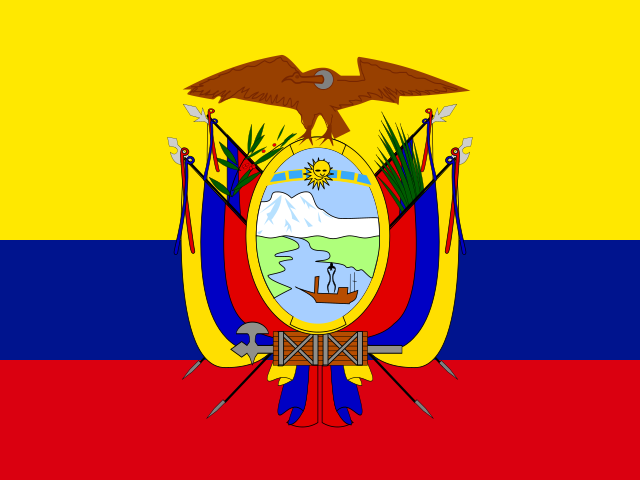
The Ecuador kit features the national flag colours: yellow shirts, blue shorts and red socks. The kit has been supplied by Marathon Sports — Ecuador’s domestic apparel manufacturer based in Quito — since 1994, the longest unbroken supplier deal in CONMEBOL national-team football. The FEF crest carries the national shield with a stylised Andean condor.
Stadium & Venue History
The Estadio Olímpico Atahualpa in Quito (altitude 2,815 m above sea level), opened 1951 and used by both Ecuador’s senior team and Liga Deportiva Universitaria de Quito (LDU), is the principal home ground. The Estadio Monumental Banco Pichincha (capacity ~57,000, home of Barcelona SC of Guayaquil) is the most-used coastal venue. Other Ecuador venues include the Estadio George Capwell (Guayaquil) and the Estadio Christian Benítez Betancourt (Guayaquil). The FEF training centre is the Casa de la Selección in Guayaquil.
Coaches & Managers Legacy
- Pre-2000: José Gomes Nogueira, Roberto Resquin, Carlos Sevilla, Dušan Drašković.
- Hernán Darío “Bolillo” Gómez (1999–2004): first World Cup qualification (2002).
- Luis Fernando Suárez (2004–2008): 2006 World Cup round of 16.
- Reinaldo Rueda (2010–2014): 2014 World Cup; later Honduras and Chile and Colombia head coach.
- Gustavo Quinteros (2014–2017), Jordi Cruyff (2018), Hernán Darío Gómez (second spell).
- Gustavo Alfaro (2020–2022): 2022 World Cup qualification and group-stage performance — Alfaro is now Paraguay head coach.
- Félix Sánchez (2023–2024): brief interim spell.
- Sebastián Beccacece (since August 2024): 2026 World Cup qualification, CONMEBOL clean-sheet leader.
Iconic Players (long-serving / influential)
- 1990s–2000s: Álex Aguinaga (Mexico-based playmaker), Iván Hurtado (168 caps record), Agustín Delgado (first Ecuadorian World Cup goal), Iván Kaviedes, Antonio Valencia (later Manchester United).
- 2010s: Antonio Valencia, Enner Valencia (49-goal record), Cristhian Noboa, Felipe Caicedo, Christian “Chucho” Benítez (deceased 2013), Walter Ayoví, Frickson Erazo.
- Modern: Enner Valencia (captain), Moisés Caicedo (Chelsea), Pervis Estupiñán (Brighton/AC Milan), Piero Hincapié (Bayer Leverkusen / Arsenal), Hernán Galíndez, Kendry Páez (Chelsea), Gonzalo Plata, Willian Pacho (Paris Saint-Germain).
Trophies & Honours
- FIFA World Cup: best finish round of 16 (2006).
- Copa América: best finish 4th (1959, 1993).
- South American U-20 Championship: champions 2017, 2019.
- FIFA U-20 World Cup: third place 2019.
- Bolivarian Games (multi-sport): multiple football titles.
Peak Eras
- 2001–2006: First two World Cup qualifications and round of 16 in 2006 under Bolillo Gómez and Luis Fernando Suárez.
- 2014–2017: South American U-20 dominance and senior CONMEBOL home advantage at altitude.
- 2024–present: Beccacece era — 2nd-placed CONMEBOL qualifying, defensive identity, 2026 World Cup squad.
Rivalries
- Colombia: Andean derby contested in CONMEBOL qualifiers and Copa América.
- Peru: closely contested CONMEBOL fixtures since the 1930s.
- Argentina: high-altitude qualifiers in Quito have produced multiple Ecuador wins, including a 2–0 in 2017 qualifiers.
- Chile: regular qualifying meetings.
Public Image — Bad PR / Controversies
- Byron Castillo eligibility (2022 World Cup cycle): CONMEBOL referred case to FIFA; FIFA upheld Ecuador’s qualification but imposed a 3-point deduction at the start of the 2026 cycle and a fine.
- Christian “Chucho” Benítez death in July 2013 at age 27 — a national mourning event with a state funeral.
- 2008 Otto Pequeño departure scandal.
- Various match-fixing allegations against domestic Serie A clubs in the 2010s; FEF imposed bans.
Australia Connection
No documented Australia connection exists in the senior international fixtures record between Ecuador and the Australia Socceroos as of 2026-05-07. Both teams have played at the FIFA World Cup but not against each other; no Trans-Pacific friendly has been recorded by either federation.
Connections to Other Sports / Wider Football
The FEF also runs Ecuador’s women’s, U-23, U-20, U-17 and futsal national programmes. The U-20 team won the South American U-20 Championship in 2017 and 2019 and finished third at the 2019 FIFA U-20 World Cup in Poland. Most senior squad members play in Europe (Premier League, Serie A, Bundesliga, La Liga) and Mexico’s Liga MX, with the domestic Serie A acting as the principal feeder.
Potential Future Trajectory
Ecuador enters the 2026 World Cup as a credible round-of-32 dark horse, with the deepest squad in the federation’s history and a defensively organised structure under Beccacece. The medium-term outlook is “first-ever World Cup quarter-final contender” rather than title contender, with depth at goalkeeper, central defence and central midfield enabling Beccacece’s preferred low-block / counter-attack scheme. Beyond 2026, the integration of the 2024–25 U-20 cohort and succession at captain (currently Enner Valencia, mid-30s) will be the editorial focus.
More World Cup 2026 Reading
WC 2026 context: See Ecuador's WC 2026 group-stage form, squad and opponents →
 Best Betting Sites
 Best Online Casinos
 Blackjack Sites
 Online Pokies
 Fast Payout Casinos
 PayID Casinos
 New Casinos 2026