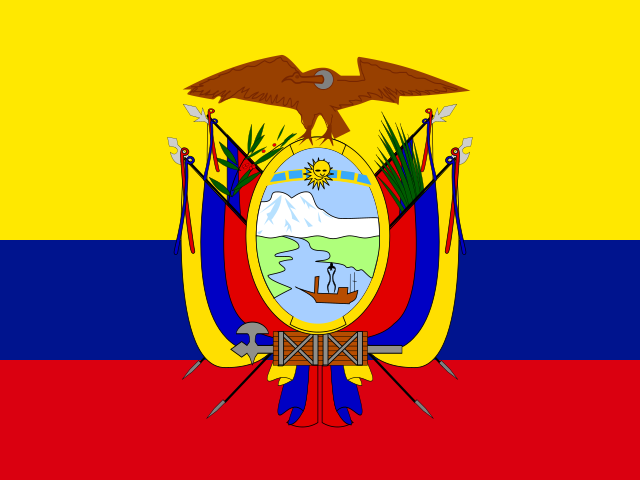
 Ecuador — WC 2026 Group E
Data as of: 2026-05-20





Group E Opponents (2026)
Côte d'Ivoire
Germany
Rare opponents at senior level; no meaningful tournament history between Die Mannschaft and La Tri.
Curaçao
First meeting in senior international football — Curaçao are debutants at the 2026 World Cup.
Key Players for 2026
- Enner Valencia · FW
All-time top scorer (49 goals), captain, and the man who scored both goals in the 2022 World Cup opener vs hosts Qatar.
- Moisés Caicedo · MF
Chelsea midfielder, the engine and ball-winner around whom Beccacece has built his low-block, counter-attack structure.
- Piero Hincapié · DF
Bayer Leverkusen / Arsenal-linked centre-back, the technical and physical anchor of the joint-CONMEBOL-best defence.
- Pervis Estupiñán · DF
Brighton left-back providing the principal attacking width in transition — a defining piece of Beccacece's setup.
- Kendry Páez · MF
Chelsea-owned teenage attacking midfielder, the squad's most-watched emerging talent and the bench X-factor.
Ecuador arrive at the 2026 World Cup with the deepest squad in the federation’s history, the most defensively organised structure La Tri have ever fielded, and a head coach hired specifically to deliver the first knockout-round appearance since 2006. Group E — Germany, Côte d’Ivoire, Curaçao — is the kind of draw a CONMEBOL second-placed finisher is expected to navigate, but Sebastián Beccacece’s side carries a tactical identity that makes it dangerous to anyone, including the four-time world champions in their group.
Current Form and the Beccacece Era
The Argentine head coach was appointed in August 2024 after a brief Félix Sánchez tenure, and the cycle that followed re-established Ecuador as a CONMEBOL force. Beccacece — formerly of Independiente, Racing Club, and a long-time assistant to Jorge Sampaoli — installed a low-block, transition-oriented structure built around defensive solidity and quick vertical attacks. The data is the headline: Ecuador went 17 matches unbeaten across the qualifying cycle, conceded only five goals across 18 qualifying matches (the smallest concession total in the CONMEBOL round-robin), and registered a CONMEBOL-leading 13 clean sheets.
The final qualifying table read: 2nd place, 29 points (7W-8D-3L, GD +12), the federation’s best-ever performance. The only two defeats came against Argentina and Brazil. Ecuador qualified well clear of seventh — the intercontinental playoff spot — and arrives in North America with the cleanest preparation of any La Tri World Cup squad to date.
The institutional context matters. Ecuador’s first World Cup qualification under Hernán Darío “Bolillo” Gómez in 2002 launched the federation’s modern era; Luis Fernando Suárez’s 2006 round-of-16 finish in Germany remains the team’s best World Cup result. The Byron Castillo eligibility case in the 2022 cycle (CONMEBOL referred to FIFA; FIFA upheld qualification but imposed a 3-point deduction at the start of the 2026 cycle and a fine) is a closed chapter — but it makes Beccacece’s 29-point finish all the more impressive.
The 2026 Squad
The spine is European-based and exceptionally young. Moisés Caicedo at Chelsea is the central midfielder and ball-winner Beccacece’s system relies on. Piero Hincapié — Bayer Leverkusen, recurrently linked to Arsenal — is the centre-back who carries both physical and technical authority in the joint-CONMEBOL-best defence. Pervis Estupiñán at Brighton provides the principal attacking width from left-back. Willian Pacho at Paris Saint-Germain is the most positionally versatile defender in the pool. Hernán Galíndez has the senior goalkeeper shirt.
The attacking pool is the deepest the federation has produced. Captain Enner Valencia (Internacional) is in his mid-30s but remains the all-time top scorer with 49 goals — and the man who scored both goals in the 2022 World Cup opener, a 2–0 win over hosts Qatar that produced the tournament’s first goal. Kendry Páez — the Chelsea-owned attacking midfielder — is the most-watched emerging talent in the squad and a tactical release valve from the bench. Gonzalo Plata adds wide depth.
Ecuador’s all-time numbers anchor the conversation: five World Cup appearances (2002, 2006, 2014, 2022, 2026); best finish round of 16 in 2006 (a 0–1 loss to England on a David Beckham free-kick); Iván Hurtado’s 168-cap appearance record (1992–2014); Enner Valencia’s 49 goals. The heaviest defeat in the federation’s history is the 0–12 loss to Argentina on 22 January 1942 in Montevideo — the same fixture that produced Argentina’s largest international win, and a reminder of how far the federation has come.
Group E — How It Plays Out
The draw places Ecuador in Group E with Germany, Côte d’Ivoire and Curaçao. Group E sits as moderately demanding in the bookmakers’ framing; Ecuador are third-favourite to advance behind Germany and Côte d’Ivoire, but Beccacece’s defensive structure makes the team a difficult fixture for any opposition.
- vs Côte d’Ivoire (14 June, Philadelphia) — The pivotal match of the group. Côte d’Ivoire are reigning African champions and went 10 unbeaten through CAF qualifying (26 points, +25 GD, the best in CAF). The Ecuador-Côte d’Ivoire fixture is a classic style mismatch: African physical-and-wide creativity (Amad Diallo, Pépé) against South American defensive structure (Hincapié, Pacho, Caicedo). The winner of this match is the team most likely to finish second.
- vs Germany — Four-time World Cup winners, the most institutionally weighted opponent in the group. Ecuador’s only realistic plan is the plan Beccacece has run all cycle: deep block, fast transitions, Caicedo and Hincapié absorbing pressure, Páez and Plata threatening in counter. A draw would be a defining tournament result; a win would re-rank the entire group.
- vs Curaçao — Curaçao qualified on 18 November 2025, the smallest nation by population ever to reach a men’s FIFA World Cup. Dick Advocaat managed the qualification and stepped down in February 2026; Fred Rutten leads them at the finals. Ecuador are expected to win this fixture; the question is by how many goals — and whether the result lets Beccacece rest minutes for the knockout rounds.
Key Players to Watch
Watch Caicedo’s first 15 minutes — the indicator of whether Ecuador are pressing or absorbing. Watch Hincapié in central-channel one-versus-one situations against Sébastien Haller and Kai Havertz. Watch Estupiñán in transition; the Brighton full-back’s overlap is Ecuador’s principal attacking width. Watch Valencia at set pieces — at his age, he’s no longer the on-the-ball creator but he remains the squad’s most reliable aerial threat. And watch Páez when Beccacece introduces him from the bench in the 60th minute — that’s the moment the structure shifts.
What Ecuador Need
The medium-term FEF objective is sustained World Cup knockout-round qualification. The immediate 2026 target is the round of 32 — a result that would match the 2006 round-of-16 high water mark in the expanded format. Realistically: a draw or narrow loss to Germany, a result against Côte d’Ivoire, and a routine win over Curaçao puts Ecuador through.
Beyond 2026, the federation’s editorial focus is succession at captain (Valencia is in his mid-30s) and the integration of the 2024–25 U-20 cohort (Ecuador won the South American U-20 Championship in 2017 and 2019 and finished third at the 2019 FIFA U-20 World Cup, the same pipeline that produced Caicedo and Páez). The 2026 World Cup is the cleanest test yet of whether Beccacece’s defensive structure can convert qualifying solidity into knockout-round football.
More Ecuador + WC 2026 Reading
All-time history: See Ecuador's full World Cup history (all tournaments) →
 Best Betting Sites
 Best Online Casinos
 Blackjack Sites
 Online Pokies
 Fast Payout Casinos
 PayID Casinos
 New Casinos 2026