 Côte d'Ivoire at the World Cup — Full History
Key Facts
- The team is administered by the Fédération Ivoirienne de Football (FIF) and is nicknamed Les Éléphants (the Elephants); the FIF FIFA code is CIV.
- The first international was a 3–2 win over Dahomey (now Benin) on 13 April 1960, the year of independence from France.
- Ivory Coast have won the Africa Cup of Nations three times — 1992 (Senegal), 2015 (Equatorial Guinea) and 2023 (held at home in 2024) — placing them among the modern elite of African football.
- The 2024 AFCON title — won as hosts after a tournament that included a group-stage exit scare — was the first time in the trophy’s history that a coaching change mid-tournament produced an eventual champion: Emerse Faé took over from Jean-Louis Gasset.
- The 2026 FIFA World Cup will be Ivory Coast’s fourth tournament appearance (2006, 2010, 2014, 2026); the team has yet to advance beyond the group stage.
- Ivory Coast topped CAF Group F in 2026 qualification with 26 points (8W-2D-0L, GD +25 — the best in CAF).
- Emerse Faé, formerly of the U-23 national team, was confirmed as permanent head coach after lifting AFCON 2023 as interim coach in February 2024 — described by FIF as the first manager in AFCON history to be appointed mid-tournament and win the title.
- Forward Didier Drogba is the all-time top scorer with 65 goals in 105 matches; midfielder Didier Zokora holds the all-time appearance record with 123 caps.
- The 2026 World Cup draw placed Ivory Coast into Group E alongside Germany, Ecuador and Curaçao — a tactically demanding group with a clear top-two pathway.
- Captain Franck Kessié (Al-Ahli, formerly Milan and Barcelona) leads a squad anchored by defender Évan Ndicka (Roma), forwards Sébastien Haller (Borussia Dortmund) and Amad Diallo (Manchester United), and Nicolas Pépé.
- Home matches are primarily played at the Alassane Ouattara Stadium in Abidjan (capacity 60,000), opened ahead of AFCON 2024.
- Ivory Coast’s golden generation — Drogba, the Touré brothers, Zokora, Eboué, Tioté — reached three World Cups (2006, 2010, 2014) without progressing beyond the group stage despite being among CAF’s strongest squads of that era.
Côte d’Ivoire World Cup Vital Statistics
| Metric | Value |
|---|---|
| First international | 13 April 1960 vs Dahomey (won 3–2) |
| Federation founded | 1960 (FIF) |
| FIFA World Cup appearances | 4 (2006, 2010, 2014, 2026) |
| Best FIFA World Cup result | Group stage |
| Africa Cup of Nations titles | 3 (1992, 2015, 2023) |
| Most caps | Didier Zokora (123) |
| All-time top scorer | Didier Drogba (65 in 105) |
| FIFA ranking | 34 |
| Head coach | Emerse Faé |
| Captain | Franck Kessié |
| 2026 WC qualification (CAF) | Group F winners — 26 pts (8W-2D-0L, GD +25) |
| 2026 WC finals group | Group E vs Germany, Ecuador, Curaçao |
Côte d’Ivoire at the World Cup — History And Profile
The Ivory Coast national football team — Les Éléphants — has spent the past two decades transitioning from “tournament-strong but unfortunate” to back-to-back-cycle champions of the African continent. Administered by the Fédération Ivoirienne de Football (FIF), the team played its first international on 13 April 1960 (a 3–2 win over Dahomey) in the year of independence from France, and has built two distinct golden eras: the Didier Drogba generation of the 2000s, and the post-2024 AFCON-winning side under Emerse Faé.
Ivory Coast have won the Africa Cup of Nations three times. The first title came in 1992 in Senegal under coach Yeo Martial, with a remarkable 11–10 penalty shootout win over Ghana in the final. The second came in 2015 in Equatorial Guinea — the climax of the Drogba-era squad — under coach Hervé Renard, with a 9–8 penalty shootout win over Ghana in the final. The third, and most recent, came in 2023 (held in 2024) at home in Ivory Coast under exceptional circumstances. The hosts had been on the brink of group-stage elimination, requiring favourable results elsewhere to qualify as a best-third side; the team then defeated Senegal, Mali and DR Congo in the knockout rounds before beating Nigeria 2–1 in the Abidjan final. Coach Jean-Louis Gasset had been dismissed during the group stage; assistant Emerse Faé — a former Ivory Coast international and U-23 head coach — took over as interim and lifted the trophy. Faé was confirmed as permanent head coach immediately after the tournament, the first such mid-tournament-promotion title in AFCON history.
The 2026 World Cup qualifying campaign in CAF Group F was the most-decorated of any 2026 finalist: 26 points from 10 matches, eight wins, two draws and no defeats, with a goal difference of +25 — the best in CAF. The opposition included Gabon, Kenya, Gambia, Burundi and Seychelles. Faé’s principal qualification credit, articulated through the campaign, has been “absolute solidarity and love for the jersey” — a cultural rebuild that consolidated the AFCON 2024 squad spine.
The team’s three previous World Cup appearances — 2006 (Germany), 2010 (South Africa) and 2014 (Brazil) — produced three group-stage exits despite a generation that included Didier Drogba, Yaya Touré, Kolo Touré, Salomon Kalou, Emmanuel Eboué, Cheick Tioté, Gervinho and Wilfried Bony. The 2014 group, with Greece, Colombia and Japan, was the closest to advancement: Ivory Coast led Greece in the final group game with three minutes remaining before a stoppage-time penalty cost them the round-of-16 berth. The 2026 World Cup is the team’s fourth attempt and the first under Faé.
The 2026 World Cup draw placed Ivory Coast into Group E with Germany, Ecuador and Curaçao. Schedule highlights include 14 June (vs Ecuador in Philadelphia), 20 June (vs Germany in Toronto) and 25 June (vs Curaçao in Philadelphia). Group E is widely seen as more navigable than Groups L (England) or J (Argentina), with a real prospect of round-of-32 progression. The squad’s modern axis is captain Franck Kessié — a key figure in the 2024 AFCON-winning side, scorer of the decisive penalty in the final — alongside centre-back Évan Ndicka (Roma), forwards Sébastien Haller (Borussia Dortmund) and Amad Diallo (Manchester United), winger Nicolas Pépé, and goalkeeper Yahia Fofana.
Home internationals are played principally at the Alassane Ouattara Stadium in Abidjan (capacity 60,000), opened in October 2020 and serving as the centrepiece venue of AFCON 2024. The Stade de la Paix in Bouaké is a secondary venue. Didier Drogba — record goalscorer with 65 goals in 105 matches — and Didier Zokora — 123 caps — anchor the historical record. The team’s all-time top three goalscorers also include Salomon Kalou (33) and Yaya Touré (19, also four African Footballer of the Year awards 2011–2014).
Ivory Coast’s principal football rivalries are with Ghana (the West African heavyweight contests, including AFCON finals 1992 and 2015), Nigeria (AFCON 2024 final), Senegal (AFCON 2024 round of 16), Mali (AFCON 2024 quarter-final), and continental crossover with Cameroon and Egypt. The Drogba era (2002–2014) defined a generation of West African football: Drogba scored a famous Wembley double that won Chelsea the 2007 FA Cup and the 2012 Champions League final, embedding Ivory Coast’s national-team profile in European football consciousness.
Looking forward, Ivory Coast’s outlook is “favourite to advance” rather than “favourite to win”. Faé’s brief continues through the 2027 AFCON cycle. Generational succession from Drogba and the Touré brothers to Kessié, Ndicka, Haller, Amad Diallo and Pépé is now complete. The 2026 World Cup is the principal sporting target, with the FIF publicly framing the cycle as a chance to convert two AFCON titles in three cycles into the country’s first World Cup knockout-round appearance.
Detailed Profile
Crest, Colours & Kit Evolution
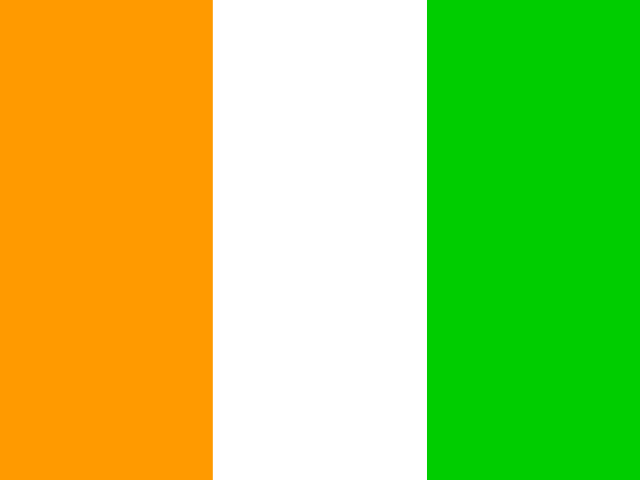
Ivory Coast’s home shirt is orange with white and green trim — the three colours of the national flag. The Elephant motif on the crest dates from the early 1960s and has been retained across decades. Modern kit suppliers have rotated through Puma and Le Coq Sportif. The 2024 AFCON-winning kit, designed in collaboration with the FIF and Puma, became one of the highest-selling national-team kits of 2024 in West Africa per regional retail reporting.
Stadium & Premises History
The Alassane Ouattara Stadium in Ebimpé, Abidjan, opened in October 2020 with a capacity of 60,000, was the principal AFCON 2024 venue and is now Ivory Coast’s primary home internationals stadium. The Stade Félix Houphouët-Boigny in Abidjan and Stade de la Paix in Bouaké are secondary venues.
Iconic Players
- 1990s: Abdoulaye Traoré “Ben Badi”, Joël Tiéhi, Aboubacar Sidick Conté.
- 2000s–2014: Didier Drogba (record goalscorer, 65 goals), Yaya Touré (four-time African Footballer of the Year), Kolo Touré, Didier Zokora (record caps, 123), Salomon Kalou, Emmanuel Eboué, Cheick Tioté, Gervinho.
- 2015–2024: Wilfried Bony, Serge Aurier, Eric Bailly, Wilfried Zaha (briefly), Sébastien Haller (cancer-recovery comeback story 2023), Franck Kessié, Nicolas Pépé.
- 2024 AFCON-winning side and 2026 cycle: Franck Kessié (captain), Évan Ndicka, Sébastien Haller, Nicolas Pépé, Amad Diallo, Yahia Fofana, Simon Adingra, Ibrahim Sangaré.
Coaches & Managers Legacy
Modern lineage includes Yeo Martial (1992 AFCON title), Henri Stambouli, Henri Michel (2006 World Cup), Vahid Halilhodžić, Sven-Göran Eriksson, François Zahoui, Sabri Lamouchi (2014 World Cup), Hervé Renard (2015 AFCON title), Marc Wilmots, Jean-Louis Gasset (group-stage AFCON 2023) and Emerse Faé (since February 2024, AFCON 2023 title). Faé’s appointment was historic — the first manager appointed mid-AFCON to win the title.
Trophies & Honours
- AFCON: champions 1992, 2015, 2023; runners-up 2006, 2012.
- 2026 FIFA World Cup qualification — Group F winners.
- All-Africa Games champions 1985.
Peak Eras
- 1992: first AFCON title under Yeo Martial.
- 2006–2014: Drogba-era golden generation, three consecutive World Cups.
- 2015: Renard’s AFCON title.
- 2024: Faé’s home-soil AFCON title and the 2026 World Cup unbeaten qualifying campaign.
Rivalries
- Ghana: 1992 and 2015 AFCON finals — both decided on penalties.
- Nigeria: 2024 AFCON final.
- Senegal: 2024 AFCON round of 16.
- Mali: 2024 AFCON quarter-final, regional rivalry.
- Cameroon: continental fixtures.
Public Image — Bad PR / Controversies
The 2024 AFCON-hosting group-stage 4–0 defeat to Equatorial Guinea — a result that nearly eliminated Ivory Coast on home soil — produced national crisis coverage and led directly to coach Gasset’s dismissal. The subsequent title win recast the moment as part of a redemption story, but the FIF’s handling of the dismissal drew criticism. The Drogba-era 2010 World Cup squad complaints around scheduling and the 2012 AFCON final loss to Zambia have remained narrative threads in modern coverage.
Australia Connection
No documented Australia connection. Australia’s senior men’s team has not played Ivory Coast in any FIFA-listed match’s Socceroos head-to-head archive.
Potential Future Trajectory
Faé’s contract extends through the 2027 AFCON cycle. The 2026 World Cup is the principal sporting target. Generational succession from the Drogba era is complete; the next phase is converting an AFCON-winning core into a knockout-round World Cup unit.
More World Cup 2026 Reading
WC 2026 context: See Côte d'Ivoire's WC 2026 group-stage form, squad and opponents →
 Best Betting Sites
 Best Online Casinos
 Blackjack Sites
 Online Pokies
 Fast Payout Casinos
 PayID Casinos
 New Casinos 2026