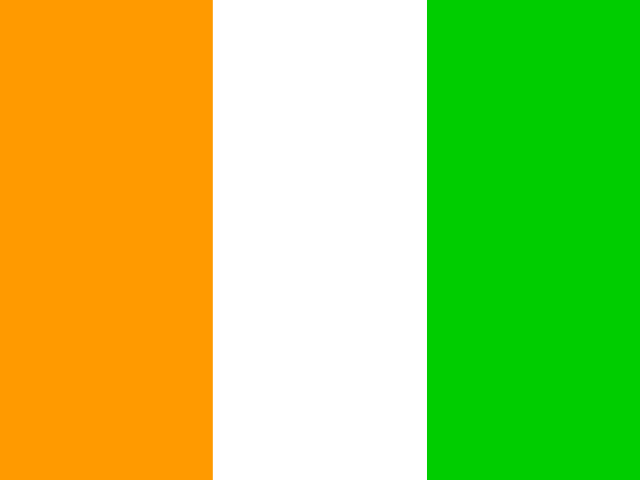
 Côte d'Ivoire — WC 2026 Group E
Data as of: 2026-05-20





Group E Opponents (2026)
Ecuador
Germany
No senior World Cup meeting on record between the two sides — a first competitive fixture in 2026.
Curaçao
First meeting in senior international football — Curaçao are debutants at the 2026 World Cup.
Key Players for 2026
- Franck Kessié · MF
Al-Ahli captain, scorer of the decisive penalty in the AFCON 2023 final, and the on-pitch leader of the Faé rebuild.
- Évan Ndicka · DF
Roma centre-back, the defensive anchor of the AFCON-winning side and the most consistent Serie A starter in the squad.
- Sébastien Haller · FW
Borussia Dortmund forward whose 2023 cancer-recovery return is one of the modern game's defining comeback stories.
- Amad Diallo · FW
Manchester United winger, the most direct attacking threat in the squad and the player most likely to unlock low blocks.
- Nicolas Pépé · FW
Former Arsenal winger, still an X-factor on the right and the squad's most experienced wide creator.
Côte d’Ivoire arrive at the 2026 World Cup as African champions for the third time, as the unbeaten winners of CAF qualifying, and — for the first time in the federation’s history — as a team carrying genuine tournament momentum rather than just a famous squad list. Les Éléphants are still chasing a maiden World Cup knockout-round appearance, but the team under Emerse Faé looks structurally different from the Drogba-era sides that exited the group stage in 2006, 2010 and 2014.
Current Form and the Faé Era
The defining moment of the cycle remains February 2024. As hosts of AFCON 2023, Côte d’Ivoire had been on the brink of group-stage elimination after a 4–0 defeat to Equatorial Guinea — the kind of result that ended coaching careers and federation cycles. Head coach Jean-Louis Gasset was dismissed mid-tournament; assistant Emerse Faé, formerly of the U-23 national team and a former senior Ivory Coast international, took over as interim. He then led the team past Senegal in the round of 16, Mali in the quarter-final and DR Congo in the semi-final before beating Nigeria 2–1 in the Abidjan final — the first manager in AFCON history appointed mid-tournament to win the title. The FIF confirmed Faé as permanent head coach immediately after the trophy lift.
The 2026 qualifying campaign that followed validated the appointment in a way only data can. CAF Group F: 10 matches, eight wins, two draws, no defeats, 26 points, goal difference +25 — the best in CAF. The opposition included Gabon, Kenya, Gambia, Burundi and Seychelles; Côte d’Ivoire didn’t lose. African Football’s qualification report and FIF technical-staff briefings framed the cycle as a cultural rebuild — “absolute solidarity and love for the jersey” — as much as a tactical one.
The 2026 Squad
The spine is European and experienced. Captain Franck Kessié, formerly of Milan and Barcelona and now at Al-Ahli, is the on-pitch leader and scorer of the decisive penalty in the AFCON 2023 final. Évan Ndicka at Roma anchors central defence with the kind of Serie A pedigree Ivory Coast lacked in the post-Touré decade. Sébastien Haller at Borussia Dortmund — whose 2023 cancer recovery and goal-scoring return is one of the modern game’s defining stories — is the senior No. 9.
The wide and attacking pool is the deepest the federation has produced. Amad Diallo at Manchester United has emerged as the most direct attacking threat in the squad. Nicolas Pépé, formerly of Arsenal, remains an experienced wide creator. Simon Adingra and Ibrahim Sangaré provide the engine-room depth. Yahia Fofana has settled in as senior goalkeeper. The Drogba-Touré generation that reached three World Cups without progressing is fully retired; the AFCON-winning core is now in its peak window.
Historically, the team’s record stays anchored in the Drogba era. Didier Drogba is the all-time top scorer with 65 goals in 105 matches; Didier Zokora holds the caps record on 123 appearances. The honours list — three Africa Cup of Nations titles (1992, 2015, 2023, the last won at home in 2024) — places Côte d’Ivoire among the modern elite of African football. The continental rivalry list is dense: 1992 and 2015 AFCON finals against Ghana (both decided on penalties), the 2024 AFCON final against Nigeria, and the round-of-16 fixture against Senegal that nearly ended the home tournament before it really began.
Group E — How It Plays Out
The draw places Côte d’Ivoire in Group E with Germany, Ecuador and Curaçao. The schedule, per the December 2025 draw, runs 14 June (vs Ecuador in Philadelphia), 20 June (vs Germany in Toronto), 25 June (vs Curaçao in Philadelphia). The shape of the group is clear enough: Germany are favourites to top it, Curaçao are debutants playing for history rather than progression, and the second qualifying place runs through the Côte d’Ivoire vs Ecuador opener on 14 June.
- vs Ecuador (14 June, Philadelphia) — The pivotal match of the group. Ecuador finished 2nd in CONMEBOL qualifying with 29 points and the joint-best defence in the cycle (just five goals conceded across 18 matches, 13 clean sheets). Sebastián Beccacece’s side is a low-block, transition-oriented unit built to frustrate; Côte d’Ivoire’s wide creativity through Amad Diallo and Pépé is the principal counter. The team that wins this fixture is the team most likely to finish second.
- vs Germany (20 June, Toronto) — The Bundesliga connection is real and helpful: Haller plays his club football at Borussia Dortmund and the squad’s European core knows the German game. Realistically, Germany are favourites by some margin — four-time World Cup winners with Kimmich, Wirtz and Musiala at the spine of the squad — but Faé’s side has the physical and tactical depth to make any complacent fixture punishing.
- vs Curaçao (25 June, Philadelphia) — Curaçao qualified on 18 November 2025 with a 0–0 draw at Jamaica in Kingston, becoming the smallest nation by population (around 156,000) ever to qualify for a men’s FIFA World Cup. Dick Advocaat managed the qualification campaign and stepped down on 23 February 2026; Fred Rutten leads them at the finals. Côte d’Ivoire are expected to win; how comfortably is the editorial question.
The expanded 48-team format helps — third place in a four-team group can still progress as one of the best third-placed sides across the 12 groups. Win the opener, navigate Germany, beat Curaçao, and Faé’s side advances. Lose the opener and the path narrows immediately.
Key Players to Watch
Watch Kessié’s set-piece deliveries — Côte d’Ivoire’s most efficient secondary goal source. Watch Ndicka in aerial second-ball situations against Havertz and Haller-style centre-forwards. Watch Amad Diallo’s first 30 minutes against tiring Ecuadorean full-backs — that’s the window where the second-place game gets decided. Watch Haller in central-channel hold-up play; if he’s connecting to Pépé and Adingra, Côte d’Ivoire are in their preferred shape. And watch Faé’s substitutions — the head coach who won AFCON 2023 with a mid-tournament rotation toolkit will lean on the same instincts in the group stage.
What Côte d’Ivoire Need
The federation’s stated objective is the first World Cup knockout-round appearance in the team’s history. Beating Ecuador in the opener is the cleanest path to it. A point against Germany and a routine win over Curaçao puts Côte d’Ivoire through more often than not under the new 48-team maths; topping the group would require beating Germany, which is the kind of result that defines a tournament.
Beyond 2026, Faé’s brief extends through the 2027 AFCON cycle. Generational succession from the Drogba era is complete. The 2026 World Cup is the principal sporting target — and, the FIF acknowledges, the test of whether two AFCON titles in three cycles converts into the federation’s first World Cup knockout-round appearance.
More Côte d’Ivoire + WC 2026 Reading
All-time history: See Côte d'Ivoire's full World Cup history (all tournaments) →
 Best Betting Sites
 Best Online Casinos
 Blackjack Sites
 Online Pokies
 Fast Payout Casinos
 PayID Casinos
 New Casinos 2026