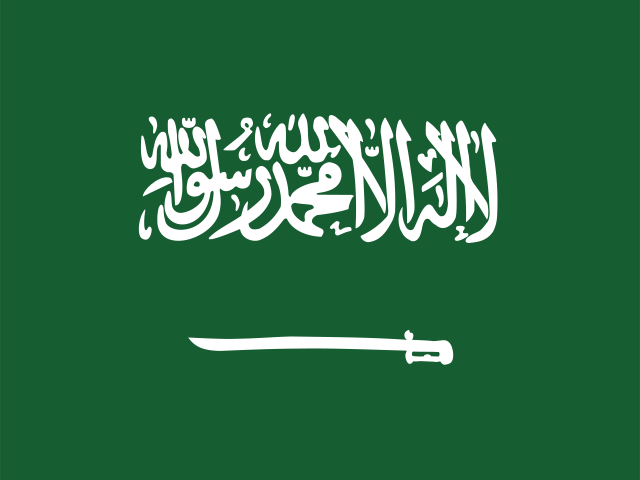
 Saudi Arabia at the World Cup — Full History
Key Facts
- The Saudi Arabian Football Federation (SAFF) was founded in 1956; informal national-team activity dates to 1951 fixtures, with FIFA membership in 1956 and AFC affiliation since 1972.
- Saudi Arabia has appeared at seven FIFA World Cups — 1994 (debut), 1998, 2002, 2006, 2018, 2022 and 2026 — with 2026 marking a third consecutive finals appearance after the 2022 Qatar tournament.
- Saudi Arabia’s best FIFA World Cup result was a round-of-16 finish at USA 1994 under coach Jorge Solari, after group-stage wins over Belgium (1–0, with Saeed Al-Owairan’s celebrated 75-yard solo goal) and Morocco (2–1).
- Saudi Arabia has won the AFC Asian Cup three times — 1984, 1988 and 1996 — and reached six finals (also runners-up 1992, 2000, 2007), trailing only Japan (4) and Iran (3) on the all-time AFC honours table.
- The Green Falcons confirmed 2026 FIFA World Cup qualification on 14 October 2025 with a 0–0 draw against Iraq in Jeddah, topping AFC fourth-round Group A on goal difference; the team had previously sealed third-round advancement through the same group as Australia and Japan.
- French coach Hervé Renard returned for a second spell at the end of 2024 but was sacked by SAFF on 17 April 2026, less than two months before the 2026 World Cup; the head-coach position was vacant at the time of the May 2026 research cut, with SAFF actively recruiting a successor.
- Renard’s first spell (2019–2023) included Saudi Arabia’s 2–1 group-stage win over Argentina at the 2022 Qatar World Cup — a result widely cited as one of the biggest shocks in tournament history; Argentina went on to win the 2022 World Cup.
- At the 5 December 2025 FIFA World Cup draw in Washington, D.C., Saudi Arabia was placed in Group H for the 2026 finals alongside Spain, Uruguay and World Cup debutants Cape Verde.
- Saudi Arabia was confirmed as the host nation of the 2034 FIFA World Cup by acclamation at the 11 December 2024 FIFA Congress in Zürich, following an uncontested bidding process after Football Australia opted out and three-continent 2030 rules limited eligibility to Asia and Oceania.
- Captain Salem Al-Dawsari (Al Hilal) — scorer of Saudi Arabia’s winning goal against Argentina at Qatar 2022 — leads the senior squad alongside long-serving central midfielder Salman Al-Faraj and goalkeeper Mohammed Al-Owais; the modern playing core is overwhelmingly drawn from Saudi Pro League clubs Al Hilal, Al Nassr, Al Ittihad and Al Ahli.
- Saudi Arabia and Australia share the AFC’s most-played intra-confederation rivalry of the modern era, with multiple FIFA World Cup qualifying meetings since Australia’s 2006 confederation transfer; the 2026 qualifying campaign included a third-round group with both nations alongside Japan, with Australia clinching qualification via a 2–1 win over Saudi Arabia at the close of the group cycle.
- The King Fahd International Stadium in Riyadh (capacity 68,752, opened 1987) is Saudi Arabia’s principal home venue; the federation announced multi-billion-dollar 2034 World Cup stadium development across Riyadh, Jeddah, Al Khobar, NEOM and selected secondary cities.
Saudi Arabia World Cup Vital Statistics
| Metric | Value |
|---|---|
| Federation founded | 1956 (SAFF, Riyadh) |
| FIFA / AFC membership | FIFA 1956 / AFC 1972 |
| FIFA World Cup appearances | 7 (incl. 2026) — 1994, 1998, 2002, 2006, 2018, 2022, 2026 |
| Best FIFA World Cup finish | Round of 16 — USA 1994 |
| AFC Asian Cup titles | 3 — 1984, 1988, 1996 |
| AFC Asian Cup finals reached | 6 — 1984, 1988, 1992, 1996, 2000, 2007 |
| Current captain | Salem Al-Dawsari (Al Hilal) |
| Current head coach | Vacant (Hervé Renard sacked 17 Apr 2026) |
| 2026 WC qualification | AFC fourth-round Group A — confirmed 14 Oct 2025 vs Iraq (0-0) |
| 2026 WC finals group | Group H — Spain, Uruguay, Cape Verde |
| 2034 FIFA World Cup host | Confirmed by acclamation, FIFA Congress Zürich, 11 Dec 2024 |
| Home stadium | King Fahd International Stadium, Riyadh (68,752) |
Saudi Arabia at the World Cup — History And Profile
The Saudi Arabia national football team — known across the Arabic-speaking world as Al-Akhdar (“the Green One”) and in English-language media as the Green Falcons — is the senior men’s side of the Saudi Arabian Football Federation (SAFF), a body founded in 1956 and admitted to FIFA in the same year and to the AFC in 1972. The federation governs a national programme that has lifted the AFC Asian Cup three times, qualified for seven FIFA World Cups, and in December 2024 became the host of the 2034 FIFA World Cup by uncontested acclamation at the FIFA Congress in Zürich.
The team’s first international era opened in the 1970s as Gulf football began to professionalise. Saudi Arabia’s continental breakthrough came at the 1984 AFC Asian Cup in Singapore, where the Green Falcons lifted their first title. The 1988 Asian Cup in Qatar and the 1996 edition in the United Arab Emirates produced two further titles, with Saudi Arabia reaching six of the eight finals between 1984 and 2007 — a level of consistency at the continent’s senior tournament unmatched in the period. The 1996 Asian Cup remains Saudi Arabia’s most recent continental crown.
The 1994 FIFA World Cup in the United States was the team’s debut at the sport’s senior tournament and produced its best finish to date. Coached by the Argentine Jorge Solari, Saudi Arabia advanced from a group containing the Netherlands, Belgium, Morocco and Saudi Arabia courtesy of group-stage wins over Belgium (1–0) and Morocco (2–1). The 1–0 win over Belgium at RFK Stadium in Washington, D.C., featured Saeed Al-Owairan’s 75-yard solo goal, a sequence widely cited in lists of the all-time great World Cup goals. Saudi Arabia exited at the round of 16 to Sweden but had established the country’s modern football identity in a single tournament. Subsequent appearances at France 1998, Korea/Japan 2002, Germany 2006, Russia 2018 and Qatar 2022 produced group-stage exits, with the standout single result a 2–1 group-stage win over eventual champions Argentina at the 2022 Qatar World Cup under French head coach Hervé Renard.
The Renard tenure (2019–2023) produced the country’s most-cited single result in modern men’s football. On 22 November 2022, Saudi Arabia defeated Argentina 2–1 at Lusail Iconic Stadium, with goals from Saleh Al-Shehri and Salem Al-Dawsari overturning a Lionel Messi penalty; Argentina recovered to win the tournament. Renard was succeeded by Roberto Mancini for the 2023 cycle, but the Italian’s tenure ended in October 2024 after a poor start to the 2026 World Cup qualifying campaign and Renard returned in late 2024 for a second spell. Renard’s second tenure delivered 2026 World Cup qualification — confirmed on 14 October 2025 with a 0–0 draw against Iraq in Jeddah, after Saudi Arabia topped AFC fourth-round Group A on goal difference — but ended on 17 April 2026 when SAFF dismissed him less than two months before the 2026 finals. The head-coach position was vacant at the time of this research cut, with SAFF publicly indicating an active search and several Spanish, Italian and Portuguese candidates linked in the football media.
The 2026 World Cup draw in Washington, D.C., on 5 December 2025 placed Saudi Arabia in Group H alongside Spain, Uruguay and the World Cup debutants Cape Verde. The senior squad in 2026 is led by captain Salem Al-Dawsari (Al Hilal) — scorer of the Argentina-game winner — alongside Al Hilal midfielder Salman Al-Faraj, goalkeeper Mohammed Al-Owais, central defender Ali Al-Bulayhi and strikers Saleh Al-Shehri and Firas Al-Buraikan. The Saudi Pro League’s high-profile foreign-player imports of 2023 onwards — including Cristiano Ronaldo, Karim Benzema, Neymar and Sadio Mané at Al Nassr, Al Ittihad and Al Hilal — operate alongside but separately from the national-team core, which remains overwhelmingly Saudi-passport players.
The federation’s principal current strategic context is the 2034 FIFA World Cup. SAFF’s bid was confirmed by FIFA Congress acclamation on 11 December 2024 in Zürich after the FIFA Council unanimously proposed Saudi Arabia and three-continent 2030 hosting rules limited 2034 eligibility to Asia and Oceania. Football Australia decided against bidding, leaving Saudi Arabia as the only candidate. The 2034 hosting commitment includes multi-billion-dollar stadium and infrastructure development across Riyadh, Jeddah, Al Khobar, NEOM and selected secondary cities, alongside the country’s existing 2027 AFC Asian Cup hosting commitment. Amnesty International’s December 2024 statement and subsequent reporting by Human Rights Watch have raised migrant-worker, freedom-of-expression and women’s-rights concerns regarding the 2034 hosting; SAFF and the Saudi 2034 Higher Authority have pointed to the country’s Vision 2030 reform programme and ongoing labour-law amendments as evidence of progress, while critics including FIFPRO and several international media outlets continue to monitor the rights framework. The 2026 World Cup performance and the 2027 Asian Cup hosting cycle will operate as the federation’s principal short-term proving ground heading into the 2034 finals.
Detailed Profile
Crest, Colours & Kit Evolution
Saudi Arabia plays in green shirts and white shorts at home, reversing for away kits, with the SAFF crest carrying the national flag’s shahada and a stylised palm tree and crossed swords. Recent kit suppliers include Adidas, Nike (the long-running historical partner) and currently Adidas under the 2024 cycle.
Stadium History
The King Fahd International Stadium in Riyadh, opened in 1987 with a current capacity of 68,752 and a distinctive tent-style fabric roof, is Saudi Arabia’s principal home venue. King Abdullah Sports City Stadium in Jeddah (62,345 capacity, opened 2014) hosts a growing share of senior fixtures. The 2034 World Cup stadium plan includes new and upgraded venues across Riyadh (King Salman International Stadium, planned 92,000 capacity), Jeddah, Al Khobar, NEOM and Abha.
Coaches & Managers Legacy
Notable head coaches: Khalil Ibrahim Al-Zayani (1984 Asian Cup-winning coach), Carlos Alberto Parreira (1996 Asian Cup), Jorge Solari (1994 World Cup round of 16), Nasser Al-Johar (multiple spells), Hervé Renard (2019–2023, 2024–2026 — Saudi Arabia 2–1 Argentina at Qatar 2022), Roberto Mancini (2023–2024, dismissed October 2024). Position vacant at May 2026 research cut.
Iconic Players
1980s–1990s: Majed Abdullah (the all-time top scorer with 72 goals across 139 caps, retired 1994), Mohamed Al-Deayea (record-cap goalkeeper with over 170 international appearances), Sami Al-Jaber, Saeed Al-Owairan (1994 World Cup goal). 2000s–2010s: Yasser Al-Qahtani (2007 AFC Asian Cup top scorer), Mohammad Al-Sahlawi. Modern era: Salem Al-Dawsari, Salman Al-Faraj, Mohammed Al-Owais, Saleh Al-Shehri, Firas Al-Buraikan.
Trophies & Honours
- AFC Asian Cup: champions 1984, 1988, 1996; runners-up 1992, 2000, 2007.
- Arabian Gulf Cup: 3 titles — 1994, 2002, 2003-04.
- WAFF Championship: 2002.
- FIFA Confederations Cup: 1992 host, 1995 host (no titles; bronze in selected editions).
- FIFA World Cup: round of 16 USA 1994; group stage 1998, 2002, 2006, 2018, 2022, 2026 (qualified).
Peak Eras
- 1984–1996 Asian Cup three titles.
- 1994 USA World Cup round-of-16 generation under Jorge Solari with Al-Owairan, Al-Deayea and Sami Al-Jaber.
- 2018–2022 Renard era: Qatar 2022 Argentina win, regional dominance through the 2024 World Cup qualifying cycle.
Rivalries
- Australia: the AFC’s most-played modern intra-confederation fixture since Australia’s 2006 confederation transfer, with multiple World Cup qualifying group meetings.
- United Arab Emirates: a top-of-table Gulf rivalry with multiple Asian Cup and Gulf Cup meetings.
- Iraq: the 2007 AFC Asian Cup final and a long history of qualifying-cycle meetings.
- Iran: the AFC’s two highest-profile West Asian sides, contested across qualifying and Asian Cup competitions.
Supporters Culture
Saudi Arabia’s home support concentrates on the King Fahd International Stadium in Riyadh and on the King Abdullah Sports City Stadium in Jeddah, with the federation operating a fan-engagement programme through SAFF’s national-team channels. The 2022 Qatar World Cup saw the largest single-match Saudi away support of the modern era, with extensive coverage by Saudi Pro League broadcasters MBC and SSC.
Public Image — Bad PR / Controversies
The 2034 FIFA World Cup host designation has drawn criticism from Amnesty International and other human-rights organisations regarding migrant-worker conditions, freedom of expression and women’s rights, with Amnesty’s December 2024 statement that the host designation “puts many lives at risk”. FIFA confirmed the bid by acclamation under its standard 2030/2034 rotation framework. The Renard sacking on 17 April 2026, less than two months before the 2026 World Cup finals, generated substantial negative coverage in international football media. These items are presented neutrally with FIFA, Amnesty and federation citations rather than as editorial commentary.
Charity & Community
SAFF runs a youth-development programme through the Saudi Pro League clubs and supports a national grass-roots programme connected to the country’s broader Vision 2030 sport-investment programme. Saudi national-team players are featured in regional disaster-relief and refugee-support campaigns including Yemen and Syrian crisis-related initiatives.
Australia Connection
Saudi Arabia and Australia share the AFC’s most-played intra-confederation rivalry of the modern era, dating to Australia’s 2006 confederation transfer from the OFC. The two sides have met multiple times in 2018, 2022 and 2026 World Cup qualifying cycles. The 2026 qualifying campaign included a third-round group with both nations alongside Japan, with Australia clinching qualification via a 2–1 win over Saudi Arabia at the close of the group cycle (goals from Mitchell Duke and Connor Metcalfe). The fixture is widely cited as one of the AFC’s premier modern men’s rivalries and has produced multiple high-stakes group-stage and knockout meetings across qualifying and Gulf-tournament cycles.
Connections to Other Federations / Celebrity Figures
The Saudi Pro League’s 2023-onwards foreign-player imports — Cristiano Ronaldo (Al Nassr), Karim Benzema (Al Ittihad), Neymar and Sadio Mané (Al Hilal) — operate alongside but separately from the national-team programme. SAFF maintains technical-cooperation memoranda with Sweden, Spain and Italy through coaching-development frameworks, and is the principal sponsor of the 2027 AFC Asian Cup as host federation.
Potential Future Trajectory
The federation’s medium-term outlook centres on (a) the immediate 2026 World Cup performance in Group H against Spain, Uruguay and Cape Verde under a head coach to be appointed, (b) the 2027 AFC Asian Cup as hosts, and (c) the 2034 FIFA World Cup hosting cycle and the multi-billion-dollar stadium and infrastructure development that supports it. The Renard sacking has created near-term operational uncertainty heading into the 2026 finals, but the longer-term federation trajectory is anchored by the confirmed 2027 and 2034 hosting commitments.
More World Cup 2026 Reading
WC 2026 context: See Saudi Arabia's WC 2026 group-stage form, squad and opponents →
 Best Betting Sites
 Best Online Casinos
 Blackjack Sites
 Online Pokies
 Fast Payout Casinos
 PayID Casinos
 New Casinos 2026