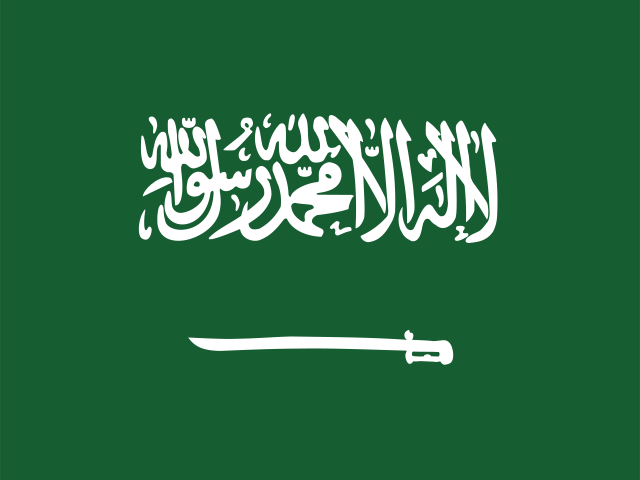
 Saudi Arabia — WC 2026 Group H
Data as of: 2026-05-20





Recent Form
| Date | Opponent | Score | Result | Competition |
|---|---|---|---|---|
| 2025-10-14 | Iraq | 0-0 | D | AFC WC 2026 Qualifier — fourth round (Jeddah, qualification sealed) |
| 2025-06-10 | Australia | 1-2 | L | AFC WC 2026 Qualifier — third round (Jeddah) |
Group H Opponents (2026)
Spain
Saudi Arabia's 2022 Argentina-style ambush is the template — but Spain's possession game is the worst stylistic matchup for Renard-era counter-attacking tactics.
Cape Verde
The most evenly-matched fixture in Group H on FIFA ranking and the most likely point-grabber for both AFC and CAF debutant-tier sides.
Uruguay
Bielsa's vertical-pressing Uruguay is the tactical heir to the South American powers Saudi Arabia have historically struggled against; the likely 2nd-place decider for both sides.
Key Players for 2026
- Salem Al-Dawsari · FW
Captain, Al Hilal forward and the scorer of the 2022 winner vs Argentina — Saudi Arabia's most direct goal threat and creative outlet.
- Salman Al-Faraj · MF
Al Hilal long-serving central midfielder — the team's experienced game-manager when the head-coach search ends and Saudi Arabia needs on-field continuity.
- Saleh Al-Shehri · FW
Scored the opening goal in the 2-1 win over Argentina at Qatar 2022; remains a starter for the goal-scoring profile Saudi Arabia lack in midfield.
- Firas Al-Buraikan · FW
Younger striker option blooded through the qualifying cycle; the bench-impact player Saudi Arabia have built around as the post-Qatar generation rolls in.
Saudi Arabia arrive at the 2026 FIFA World Cup as the AFC’s most-credentialled side after Japan — three-time AFC Asian Cup champions, makers of one of the great World Cup upsets at Qatar 2022, and the host nation of the 2034 FIFA World Cup confirmed in December 2024. They also arrive without a head coach. Hervé Renard’s sacking on 17 April 2026, less than two months before the tournament, has thrown a federation that prided itself on continuity into a recruit-by-kickoff scramble. Group H — Spain, Cape Verde, Uruguay — is no place to be working through tactical induction.
A Federation Built on the 1984-1996 Asian Cup Cycle
Saudi Arabia’s modern football identity was forged on the continent in the 1980s and 1990s. The Green Falcons won the AFC Asian Cup three times — 1984 in Singapore, 1988 in Qatar, and 1996 in the United Arab Emirates — and reached six finals between 1984 and 2007, a level of continental consistency unmatched in the period. The 1996 Asian Cup remains the country’s most recent continental crown, with runners-up finishes in 1992, 2000 and 2007 adding to the all-time honours list.
The first World Cup arrived in 1994. Coached by the Argentine Jorge Solari, Saudi Arabia advanced from a group containing the Netherlands, Belgium and Morocco courtesy of wins over Belgium (1-0) and Morocco (2-1). The Belgium win at RFK Stadium in Washington, D.C., featured Saeed Al-Owairan’s 75-yard solo goal — a sequence routinely cited in lists of the all-time great World Cup goals. Saudi Arabia exited at the round of 16 to Sweden, but the tournament established the country’s modern football identity in a single fortnight. Subsequent appearances at France 1998, Korea/Japan 2002, Germany 2006, Russia 2018 and Qatar 2022 produced group-stage exits, with the 2-1 win over eventual champions Argentina at Lusail Iconic Stadium on 22 November 2022 the standout single result.
Honours at a Glance
- AFC Asian Cup: champions 1984, 1988, 1996; runners-up 1992, 2000, 2007.
- Arabian Gulf Cup: 3 titles — 1994, 2002, 2003-04.
- WAFF Championship: 2002.
- FIFA World Cup: round of 16 USA 1994; group stage 1998, 2002, 2006, 2018, 2022, 2026 (qualified).
- FIFA Confederations Cup: 1992 and 1995 hosts.
The all-time leading scorer is Majed Abdullah (72 goals across 139 caps, retired 1994). The record-cap goalkeeper is Mohamed Al-Deayea with over 170 international appearances. The federation joined FIFA in 1956 and the AFC in 1972; the SAFF is headquartered in Riyadh.
Current Form (Last 12 Months)
The 2026 qualifying campaign was the cycle that broke the federation’s patience with Roberto Mancini. After the Italian’s tenure ended in October 2024 following a slow start to the AFC third round, Renard returned for a second spell — his first stint (2019–2023) including the 2-1 Qatar 2022 ambush of Argentina that remains the most-cited single result in modern Saudi men’s football.
Renard’s second tenure delivered the qualification. Saudi Arabia topped AFC fourth-round Group A on goal difference, sealing the World Cup berth on 14 October 2025 with a 0-0 draw against Iraq in Jeddah. The third round had included the AFC’s premier modern rivalry fixture against Australia, with the Socceroos winning 2-1 in Jeddah at the close of the group cycle to clinch direct qualification (goals from Mitchell Duke and Connor Metcalfe). Saudi Arabia advanced through the fourth-round route.
Then on 17 April 2026 — six weeks before the World Cup squad lock — SAFF dismissed Renard. The federation’s public messaging at the May 2026 cut indicated an active search with Spanish, Italian and Portuguese candidates linked in football media. Whoever takes the role will inherit a settled spine of players and a fortnight or less of training-camp time before the tournament opener.
The third round of qualifying also produced one of the AFC’s most-played modern rivalry fixtures: Saudi Arabia versus Australia, the headline intra-confederation matchup since the Socceroos’ 2006 confederation transfer. Australia clinched direct qualification with a 2-1 win in Jeddah at the close of the third-round group cycle (goals from Mitchell Duke and Connor Metcalfe); Saudi Arabia advanced through the fourth-round playoff path the Australian result helped force.
The 2026 Squad: Domestic Core, Late-Cycle Uncertainty
The senior squad is overwhelmingly drawn from the Saudi Pro League — Al Hilal, Al Nassr, Al Ittihad and Al Ahli — a stylistic continuity that has helped Saudi Arabia weather the coaching change better than most federations would. Captain Salem Al-Dawsari (Al Hilal) is the scorer of the Qatar 2022 winner against Argentina and remains the team’s most direct attacking threat. Central midfielder Salman Al-Faraj, also Al Hilal, is the long-serving game-manager. Goalkeeper Mohammed Al-Owais is first-choice. Central defender Ali Al-Bulayhi anchors the back four.
Up top, Saleh Al-Shehri — the scorer of the opener against Argentina — partners Firas Al-Buraikan in the rotation. The Saudi Pro League’s 2023-onwards foreign-player influx (Cristiano Ronaldo at Al Nassr, Karim Benzema at Al Ittihad, Neymar at Al Hilal) operates alongside but separately from the national team; the federation’s playing core remains overwhelmingly Saudi-passport.
What’s missing is a head coach with the runway to install a new system. Renard’s pragmatic 4-4-2 / 4-5-1 — high lines that catch opponents offside, organised defensive structure, transition-led attack — is the system the squad knows. Whoever arrives in the next four weeks has the choice of inheriting that template or trying to remake it on the eve of the tournament.
How Group H Plays Out
Group H is brutal on paper. Spain are joint pre-tournament favourites; Uruguay are deep-stage contenders; Saudi Arabia and Cape Verde fight for the best-third-placed lifeline that the 48-team format opens up.
- vs Spain. Saudi Arabia’s only chance is the 2022 Argentina template — high defensive line, ruthless offside trap, ride the chaos. But Spain’s possession-and-positional system is the worst possible stylistic matchup for that approach: Yamal, Williams and Pedri play between the lines, not behind them, and Rodri’s pressing-resistance kills the transition triggers.
- vs Cape Verde. The most evenly-matched fixture in Group H on the FIFA ranking and the realistic three-point target for the Green Falcons. Both nations are debutant-tier on the world stage; both rely on collective organisation rather than star power. The match likely decides which of the two has a route to the best-third placing.
- vs Uruguay. Bielsa’s vertical-pressing Uruguay is the tactical heir to the South American powers Saudi Arabia have historically struggled against — but Uruguay’s post-Suárez/Cavani forward line is younger and less proven than the squads of 2010 or 2014, and a stalemate is conceivable.
Win against Cape Verde, draw against Uruguay, hold the score against Spain, and Saudi Arabia could finish on 4 points — enough to chase a best-third-placed slot under the new maths. Drop the Cape Verde match and the tournament is functionally over.
Key Players to Watch
Watch Al-Dawsari’s left-foot deliveries from the right half-space — Saudi Arabia’s biggest single goal threat is a repeat of the 2022 Argentina-game finish. Watch Al-Faraj’s game management with whichever new head coach arrives; the federation’s continuity will run through his on-field decisions. Watch Al-Bulayhi against Yamal — the most one-sided individual matchup in the group and the one that will define how badly the Spain fixture goes. Watch Al-Buraikan from the bench; Saudi Arabia’s only realistic late-game equaliser archetype.
What Saudi Arabia Need to Advance
Realistically: 4 points and a best-third-placed slot. Saudi Arabia almost certainly need to beat Cape Verde and pick up at least a draw against Uruguay or Spain. Topping or finishing second in the group is functionally off the table on talent grounds; the path to the round of 32 is via the four best third-placed teams across the 12 groups. The 2022 World Cup is the cautionary tale — that campaign collapsed after the Argentina win, with defeats to Poland and Mexico ending the run; consistency, not capability, is the perennial Saudi challenge.
The bigger picture: Saudi football is in the middle of a generational investment cycle anchored by the 2027 AFC Asian Cup hosting and the 2034 FIFA World Cup hosting. The 2026 finals are the proving ground heading into both — and the most exposed coaching change in the federation’s modern history is the immediate operational problem.
Rivalries and Continental Context
Saudi Arabia’s continental profile is anchored by four principal rivalries. Australia is the AFC’s most-played intra-confederation modern fixture (detailed below). The United Arab Emirates is the top-of-table Gulf rivalry with multiple Asian Cup and Gulf Cup meetings. Iraq — the 2007 AFC Asian Cup final opponent — is the most emotionally weighted West Asian fixture, with a long history of qualifying-cycle clashes. Iran completes the continent’s two-highest-profile West Asian sides, contested across qualifying and Asian Cup competitions.
The 1994 World Cup squad — Saeed Al-Owairan, Mohamed Al-Deayea, Sami Al-Jaber, and the Jorge Solari coaching staff — remains the cultural touchstone for the country’s football identity. The 2000s and 2010s produced Yasser Al-Qahtani (2007 AFC Asian Cup top scorer) and Mohammad Al-Sahlawi. The modern era’s identity is carried by Al-Dawsari and the Al Hilal core. The 2022 Argentina win — captured in a single iconic Salem Al-Dawsari left-foot finish — sits in the country’s footballing memory alongside Al-Owairan’s 1994 solo goal as the two defining single-match moments.
Beyond 2026: The 2027 Asian Cup and 2034 World Cup Horizon
Saudi football’s medium-term outlook is anchored by two confirmed hosting commitments. The 2027 AFC Asian Cup — the federation’s first hosting of the continental tournament since the modern era — operates as the immediate strategic priority. The 2034 FIFA World Cup, confirmed by acclamation at the 11 December 2024 FIFA Congress in Zürich after an uncontested bidding process, is the longer-horizon target. Both hosting cycles drive a multi-billion-dollar stadium and infrastructure programme across Riyadh (including the planned King Salman International Stadium, projected 92,000 capacity), Jeddah, Al Khobar, NEOM and selected secondary cities.
The Saudi Pro League’s 2023-onwards foreign-player imports — Cristiano Ronaldo at Al Nassr, Karim Benzema at Al Ittihad, Neymar and Sadio Mané at Al Hilal — sit alongside but separately from the national-team programme. The international standards committee debate around the 2034 hosting (Amnesty International’s December 2024 statement, ongoing Human Rights Watch and FIFPRO reporting) is the public-affairs context the federation will manage through the 2026 and 2027 cycles heading into the home World Cup.
Australia Connection
Saudi Arabia and Australia share the AFC’s most-played intra-confederation rivalry of the modern era, dating to Australia’s 2006 confederation transfer from the OFC. The two sides have met multiple times across the 2018, 2022 and 2026 World Cup qualifying cycles. The 2026 qualifying campaign included a third-round group with both nations alongside Japan, with Australia clinching qualification via a 2-1 win over Saudi Arabia at the close of the group cycle in Jeddah (goals from Mitchell Duke and Connor Metcalfe). The fixture is widely cited as one of the AFC’s premier modern men’s rivalries and has produced multiple high-stakes group-stage and knockout meetings across qualifying and Gulf-tournament cycles.
Both federations also share a mutual interest in the AFC’s wider performance at the 2026 World Cup — Asia goes into the tournament with six confederation-qualified sides for the first time in tournament history, and a strong Saudi Arabia + Australia + Japan + Iran + Korea Republic + Uzbekistan showing remains the AFC’s central public-facing goal heading into the 2027 Asian Cup hosted by Saudi Arabia.
Aussie Viewing
Saudi Arabia is the AFC’s most-played intra-confederation rivalry for the Socceroos in the modern era; Australian fans following the World Cup with one eye on Asia’s wider 2026 performance will track the Green Falcons closely. The June 2025 Jeddah qualifier — Australia 2-1 Saudi Arabia, the result that clinched the Socceroos’ direct qualification — is the immediate context for any Australian-eye view of the Green Falcons’ 2026 cycle.
All Group H kickoff times and AEST conversions will publish in the WC 2026 schedule in AEST hub as FIFA confirms broadcast windows. The Saudi Arabia vs Cape Verde fixture is likely the most consequential for the AFC’s overall 2026 narrative — a Saudi win against the CAF debutants would mark the second AFC nation (after Australia) to bank a group-stage win in the new 48-team format.
Kit, Crest and the Vision 2030 Backdrop
Saudi Arabia plays in green shirts and white shorts at home, reversing for away kits. The SAFF crest carries the national flag’s shahada inscription and a stylised palm tree and crossed swords. Recent kit suppliers have included Adidas, Nike (the long-running historical partner) and currently Adidas under the 2024 cycle. The federation operates from Riyadh, with the youth-development programme running through Saudi Pro League clubs and connected to the country’s wider Vision 2030 sport-investment programme.
The Vision 2030 backdrop matters for the 2026 tournament narrative. The federation’s three confirmed mega-cycle commitments — 2026 World Cup participation, 2027 Asian Cup hosting, 2034 World Cup hosting — operate as a single integrated sport-policy strategy alongside the Saudi Pro League’s transformation from regional competition to globally-monitored top-tier (Ronaldo, Benzema, Neymar and Mané all signing in the 2023-2024 window). The 2026 cycle is the first major international tournament where the SAFF is operating with the public scrutiny that comes with the 2034 hosting confirmation.
Storylines to Track Through the Group
Three storylines define Saudi Arabia’s tournament narrative. The first is the head-coach search. Whoever the SAFF appoints in the four weeks before the squad lock takes on the most-exposed late-cycle coaching debut in modern World Cup history — Renard’s sacking on 17 April 2026 left less than two months of camp time, the kind of window that historically produces either a galvanising rallying point or a tactically incoherent first match.
The second is the Salem Al-Dawsari ceiling. The Al Hilal captain scored the 2022 Argentina-game winner and remains the team’s single most-cited match-changing presence. Whether the 2026 generation can produce a comparable individual moment is the campaign’s standout single-player question.
The third is the federation’s 2034 pre-positioning. The 2026 World Cup performance feeds directly into the public-affairs narrative for the home tournament eight years on. A respectable group stage — even with a single best-third-placed advancement — keeps the federation’s medium-term sporting credibility aligned with the multi-billion-dollar infrastructure programme. A heavy group-stage collapse would amplify the human-rights and governance scrutiny that already surrounds the 2034 cycle.
More Saudi Arabia + WC 2026 Reading
All-time history: See Saudi Arabia's full World Cup history (all tournaments) →
 Best Betting Sites
 Best Online Casinos
 Blackjack Sites
 Online Pokies
 Fast Payout Casinos
 PayID Casinos
 New Casinos 2026