 Sweden at the World Cup — Full History
Key Facts
- The Swedish Football Association (Svenska Fotbollförbundet, SvFF) was founded in 1904 and is one of the oldest national football federations in continental Europe; Sweden was a founder member of FIFA in 1904.
- Sweden has appeared at twelve FIFA World Cup tournaments, with a runner-up finish at the home 1958 tournament — losing the final 2–5 to Brazil at Solna’s Råsunda Stadium — and third-place finishes in 1950 and 1994.
- Sweden won the men’s football gold medal at the 1948 London Olympic Games under coach George Raynor; the Olympic squad included the renowned Milan-bound trio “Gre-No-Li” of Gunnar Gren, Gunnar Nordahl and Nils Liedholm.
- Zlatan Ibrahimović is Sweden’s all-time top scorer with 62 international goals; Anders Svensson is the all-time most-capped player with 148 appearances.
- Graham Potter was appointed head coach in October 2025, becoming only the second foreign manager in Swedish national-team history; the senior captain is Manchester United defender Victor Lindelöf.
- Sweden failed to qualify for UEFA Euro 2024 and went winless in the 2026 World Cup qualifying group stage but progressed to the European playoffs via UEFA Nations League ranking.
- In the March 2026 European playoffs, Sweden defeated Ukraine 3–1 in the semi-final at a neutral venue in Spain — Viktor Gyökeres scoring a hat-trick with Alexander Isak (ankle) and Dejan Kulusevski (knee) injured — before beating Poland 3–2 at Strawberry Arena in Solna in the final on 31 March 2026 to qualify for the 2026 World Cup.
- Sweden’s 2026 World Cup final-tournament group placement is Group F alongside the Netherlands, Japan and Tunisia, per the December 2025 draw.
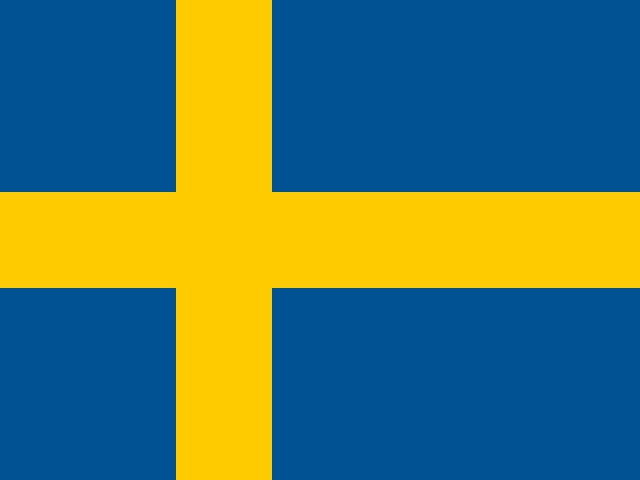
- Sweden plays in yellow shirts and blue shorts mirroring the Swedish flag; the national-team nickname “Blågult” translates as “Blue-and-Yellow.”
- The senior men’s home ground is the 50,000-capacity Strawberry Arena (formerly Friends Arena) in Solna, just outside Stockholm; the federation also uses the Ullevi in Gothenburg.
- Sweden and Australia have met multiple times in men’s senior international football, including in the early 1990s; FBref records the head-to-head as a long-running fixture concentrated around friendlies and tournament warm-ups.
- The 1958 home World Cup final — held at the Råsunda Stadium in Solna, the predecessor venue to Strawberry Arena — remains the team’s most-watched single fixture and produced the famous Pelé-vs-Sweden goal in the 17-year-old Brazilian’s breakthrough tournament.
Sweden men’s World Cup Vital Statistics
| Metric | Value |
|---|---|
| Federation founded | 1904 (SvFF) |
| FIFA World Cup appearances | 13 (incl. 2026) |
| Best FIFA World Cup finish | Runners-up, 1958 (host); third place 1950, 1994 |
| 1948 Olympic Games | Gold medal — football |
| Most caps (all-time) | Anders Svensson — 148 |
| Top scorer (all-time) | Zlatan Ibrahimović — 62 |
| Current head coach | Graham Potter (appointed October 2025) |
| Captain | Victor Lindelöf |
| 2026 WC qualifying path | Group winless; entered playoffs via UEFA Nations League rank |
| 2026 WC playoff results | Sweden 3–1 Ukraine (SF, Spain); Sweden 3–2 Poland (F, Solna, 31 March 2026) |
| 2026 WC final-tournament group | Group F — Netherlands, Japan, Tunisia |
| Home venue | Strawberry Arena (formerly Friends Arena), Solna — capacity 50,000 |
Sweden men’s at the World Cup — History And Profile
The Sweden men’s national football team — known domestically as “Blågult” (the Blue-and-Yellow) and historically as one of Europe’s most consistent intermediate powers — is the senior men’s representative side of the Swedish Football Association (Svenska Fotbollförbundet, SvFF). The federation was founded in 1904 and was a founder member of FIFA the same year; Sweden’s first official international was a 1908 fixture against Norway. Across the post-war era Sweden has built a national-team culture characterised by intermittent peaks at major tournaments, a long export pipeline of forwards into Italian and English club football, and a domestic structure that has repeatedly punched above its population weight.
The team’s defining tournament arrived in 1958 when Sweden hosted the FIFA World Cup. Coached by George Raynor — the same Englishman who had led Sweden to gold at the 1948 London Olympic Games — and built around Milan-trained imports including Gunnar Gren and Nils Liedholm, the host nation reached the final at the Råsunda Stadium in Solna. Sweden lost 2–5 to a Brazil side featuring 17-year-old Pelé, but the runner-up finish remains the team’s best ever World Cup result. Sweden also finished third at the 1950 World Cup in Brazil — again under Raynor — and third at USA 1994, where Tomas Brolin, Henrik Larsson, Martin Dahlin and Kennet Andersson produced a generation-defining campaign under Tommy Svensson. The 1948 Olympic gold and “Gre-No-Li” Milan trio (Gren, Gunnar Nordahl, Liedholm) remain the most cited references to the immediate post-war era.
The 1990s through the 2000s produced repeat tournament qualification but few semi-final runs. Sweden reached the round of 16 at the 2002 World Cup in Korea/Japan, the round of 16 again at the 2006 World Cup in Germany, and the round of 16 at Euro 2004. The next era was largely defined by Zlatan Ibrahimović — the Malmö-born forward who captained Sweden across multiple major tournaments and finished as the team’s all-time leading scorer with 62 international goals. Ibrahimović’s overhead kick against England at the opening of the new Friends Arena in November 2012 remains the most-replayed individual moment in the team’s modern history. Sweden reached the quarter-finals of the 2018 World Cup in Russia, losing 0–2 to England, before exiting Euro 2020 in the round of 16 and missing Qatar 2022 entirely.
A long downturn followed. Sweden failed to qualify for Euro 2024 after a difficult campaign, with then head coach Janne Andersson stepping down in November 2023. Jon Dahl Tomasson was appointed his successor in early 2024 but the federation made the rare call to replace its national-team head coach mid-cycle: Graham Potter, the Solna-born former Östersund FK, Brighton, Chelsea and West Ham United manager, was appointed in October 2025. He became only the second foreign coach in Swedish national-team history (after George Raynor) and was tasked with a single immediate goal — qualifying for the 2026 FIFA World Cup despite a winless group-stage record. Sweden entered the European playoffs via UEFA Nations League ranking. In the March 2026 cycle, Sweden defeated Ukraine 3–1 in the semi-final at a neutral venue in Spain — Viktor Gyökeres (then of Arsenal) scoring a hat-trick with Alexander Isak and Dejan Kulusevski both injured — before defeating Poland 3–2 at Strawberry Arena in Solna in the final on 31 March 2026, with Gyökeres scoring an 88th-minute winner to confirm Sweden’s first World Cup appearance since 2018.
The current senior squad is built around captain Victor Lindelöf (Manchester United), forward duo Alexander Isak (Newcastle United) and Viktor Gyökeres (Arsenal, the £63m post-Sporting Lisbon transfer of summer 2025), midfield drivers Dejan Kulusevski (Tottenham), Anthony Elanga and Albin Ekdal-era successor Mattias Svanberg, and a defensive line that mixes Lindelöf with Hjalmar Ekdal, Gabriel Gudmundsson and Alexander Bernhardsson. Goalkeeping continuity has come via Robin Olsen and the rising Viktor Johansson.
The senior men’s home stadium is the 50,000-capacity Strawberry Arena (formerly Friends Arena) in Solna, just outside Stockholm, opened in 2012 on the site of the demolished Råsunda Stadium. Selected qualifiers and friendlies are also played at the 43,000-capacity Ullevi in Gothenburg. The team plays in yellow shirts, blue shorts and yellow socks, drawing on the Swedish flag’s colour palette; “Blågult” — “Blue-and-Yellow” — is the universal national-team shorthand. Per FBref’s head-to-head records, Sweden has met Australia in men’s senior international football on multiple occasions across the modern era, with the bilateral concentrated around friendlies and pre-tournament fixtures rather than competitive ties. Beyond the playoff path, the SvFF’s 2026 cycle marked the federation’s first appointment of a non-Scandinavian foreign head coach since the George Raynor era and the first Swedish men’s senior World Cup return since the 2018 quarter-final exit to England under Janne Andersson.
Detailed Profile
Crest, Colours & Kit Evolution
Sweden plays in yellow shirts, blue shorts and yellow socks, the colour palette derived from the Swedish flag. The crest carries the SvFF logo. Adidas has been the long-term kit supplier across the modern era, with several iconic shirt designs — including the 1994 USA tournament strip and the 2018 Russia retro-cut design — cited by collectors.
Stadium History
The senior men’s primary home venue is the 50,000-capacity Strawberry Arena (formerly Friends Arena) in Solna, opened in 2012 on the site of the demolished Råsunda Stadium — the venue of the 1958 World Cup final. Selected qualifiers and friendlies are also played at the Ullevi in Gothenburg (43,000) and Malmö’s Eleda Stadion. The Råsunda hosted the 1958 World Cup final between Sweden and Brazil and was Sweden’s primary national stadium through to 2012.
Coaches & Managers Legacy
George Raynor (English) coached Sweden to the 1948 Olympic gold and the 1950 and 1958 World Cup podium results. Domestic-era successors include Lars Lagerbäck (1998–2009, the longest tenure of any Sweden coach), Tommy Svensson (1991–1997, third place 1994 World Cup), Erik Hamrén (2009–2016), Janne Andersson (2016–2023), Jon Dahl Tomasson (2024–2025) and Graham Potter (since October 2025). Potter is only the second foreign coach in Swedish national-team history.
Iconic Players
Pre-1960s: Gunnar Gren, Gunnar Nordahl, Nils Liedholm (the “Gre-No-Li” Milan trio), Sven Rydell. 1970s: Bo Larsson, Ralf Edström. 1990s: Tomas Brolin, Henrik Larsson, Martin Dahlin, Kennet Andersson, Stefan Schwarz, Patrik Andersson. 2000s–2010s: Zlatan Ibrahimović, Olof Mellberg, Anders Svensson (148 caps), Andreas Isaksson, Sebastian Larsson. Modern era: Victor Lindelöf, Alexander Isak, Viktor Gyökeres, Dejan Kulusevski, Anthony Elanga, Robin Olsen.
Trophies & Honours
- 1948 London Olympic Games: gold medal (men’s football).
- 1950 FIFA World Cup, Brazil: third place.
- 1958 FIFA World Cup, Sweden (host): runners-up.
- 1992 UEFA European Championship, Sweden (host): semi-finalists.
- 1994 FIFA World Cup, USA: third place.
- 2018 FIFA World Cup, Russia: quarter-finalists.
Peak Eras
- 1948–1958 Raynor / Gre-No-Li era (Olympic gold; 1950 third place; 1958 runners-up).
- 1992–1994 Tommy Svensson generation (Euro 1992 semi-finals, 1994 World Cup third place).
- 2000s–2010s Zlatan Ibrahimović cycle (Euro 2004, 2008, 2012, 2016; World Cup 2002, 2006).
- 2018 World Cup quarter-final under Janne Andersson.
Rivalries
Sweden’s principal rivalries are regional. The “Scandinavian derby” against Denmark is the most-cited fixture; recent meetings include the Euro 2024 qualifying cycle. The Norway fixture is similarly long-standing, with multiple Friends Arena meetings. Outside Scandinavia, Sweden’s recent qualifying cycles have been defined by repeated meetings with Spain, Greece and Poland; the 31 March 2026 playoff final win over Poland in Solna is now the most consequential fixture between the two federations.
Supporters Culture
Sweden’s home support is concentrated at Strawberry Arena, with the supporters’ group “Camp Sweden” travelling in volume to major tournaments. The Friends Arena / Strawberry Arena opening in 2012 — and Zlatan Ibrahimović’s overhead kick against England in the inaugural fixture — is widely cited as a key reference point for the modern fan-culture cycle.
Public Image — Bad PR / Controversies
The 2023 Euro 2024 qualifying campaign — Sweden’s first failure to qualify for the European Championship since 2008 — drew sustained domestic criticism, leading to the November 2023 departure of Janne Andersson. Sweden’s 2025 World Cup qualifying group performance produced what FourFourTwo described as a “qualifying catastrophe” before Graham Potter’s October 2025 appointment and the playoff route to qualification.
Charity & Community
The SvFF runs grassroots and community-football programmes through its 24 district associations, including the long-running “Skånecupen” and other regional youth tournaments. Senior players including Henrik Larsson and Zlatan Ibrahimović have led federation-affiliated community-visit programmes. Several SvFF programmes target equity-of-access in Stockholm, Gothenburg and Malmö suburbs with high migrant populations.
Australia Connection
Per FBref’s head-to-head records, Sweden has played Australia in men’s senior international football on multiple occasions across the modern era, including a recorded fixture in the early 1990s. The bilateral has been concentrated around friendlies and pre-tournament warm-up matches rather than competitive ties. The most-watched recent Australia–Sweden fixture is the senior women’s 2023 FIFA Women’s World Cup third-place play-off in Brisbane on 19 August 2023, which Sweden won 2–0 — a women’s-team match outside the men’s roster but indicative of the long-running bilateral. No senior men’s Australia-vs-Sweden fixture has been announced for the 2026 World Cup tournament window.
Connections to Other Federations / Celebrity Figures
The SvFF maintains close technical relationships with neighbouring Nordic federations (Denmark, Norway, Finland, Iceland) and has long-standing pathways to Italian (Milan, Inter, Roma), English (Manchester United, Newcastle, Arsenal, Tottenham, Chelsea) and German club football. Graham Potter — Solna-born from his Östersund FK years and an East Midlands native by birth — is the highest-profile current example of cross-federation Anglo-Swedish coaching connectivity.
Potential Future Trajectory
With qualification for the 2026 FIFA World Cup confirmed via the Solna playoff win over Poland on 31 March 2026 and Group F (Netherlands, Japan, Tunisia) drawn at the December 2025 finals draw, Sweden’s medium-term outlook centres on (a) Graham Potter’s contract terms beyond the 2026 finals, (b) the integration of the Isak–Gyökeres forward pairing alongside Lindelöf’s defensive captaincy, and (c) the federation’s pathway from a near-miss qualifying cycle into a settled major-tournament rotation. Euro 2028 (United Kingdom and Ireland) opens immediately after the 2026 finals.
More World Cup 2026 Reading
WC 2026 context: See Sweden's WC 2026 group-stage form, squad and opponents →
 Best Betting Sites
 Best Online Casinos
 Blackjack Sites
 Online Pokies
 Fast Payout Casinos
 PayID Casinos
 New Casinos 2026