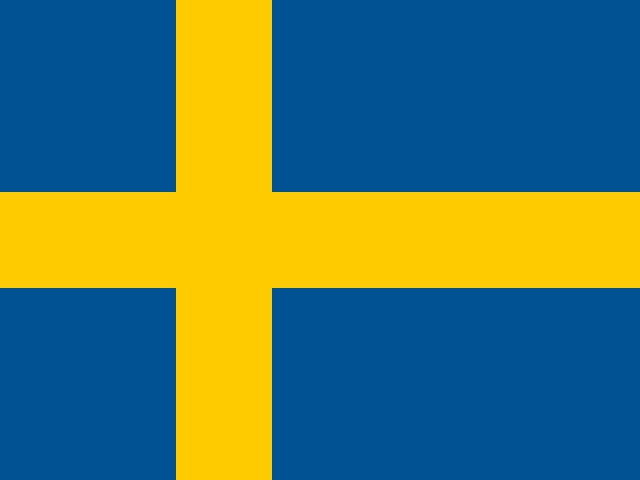
 Sweden — WC 2026 Group F
Data as of: 2026-05-20





Recent Form
| Date | Opponent | Score | Result | Competition |
|---|---|---|---|---|
| 2026-03-31 | Poland | 3-2 | W | UEFA WC 2026 Playoff Final (Strawberry Arena, Solna) |
| 2026-03-26 | Ukraine | 3-1 | W | UEFA WC 2026 Playoff Semi-Final (neutral venue, Spain) |
Group F Opponents (2026)
Netherlands
Long-running European fixture across qualifying and friendlies; the Netherlands have generally led the modern head-to-head.
Japan
Sporadic friendly fixtures across the past 25 years; no recent competitive meeting between the federations.
Tunisia
Sporadic friendly fixtures across the modern era; the two federations have not met in a competitive WC or qualifying tie.
Key Players for 2026
- Viktor Gyökeres · FW
Arsenal striker — scored a hat-trick in the playoff semi vs Ukraine and the 88th-minute winner vs Poland in the final. Sweden's most decisive 2026-cycle goalscorer.
- Alexander Isak · FW
Newcastle United forward and the alternate striker option alongside Gyökeres — when both are fit, the most dangerous partnership in Group F.
- Victor Lindelöf · DF
Manchester United defender and captain — the spine of the back four and the on-field voice through the Potter reset.
- Dejan Kulusevski · MF
Tottenham midfielder providing the creative link between Lindelöf's buildup and the Isak-Gyökeres front two.
- Anthony Elanga · FW
Wide forward whose pace stretched Poland in the playoff final — the third forward option Potter rotates into the matchday squad.
Blågult — the Blue-and-Yellow — head to the 2026 FIFA World Cup the hard way: through a UEFA playoff bracket they had to enter via Nations League ranking, with an English manager hired mid-cycle, a striker pairing finally healthy at the same time, and a defining 88th-minute winner against Poland on home soil in Solna. Group F — Netherlands, Japan, Tunisia — is the kind of tournament draw Sweden have not seen since the 2018 World Cup quarter-final run: a seeded UEFA opponent, an unfamiliar AFC test and a CAF side built for low-blocks. The story of the 2026 cycle so far is that Sweden are tournament-ready in spite of, not because of, the qualifying group.
Current Form (Last 12 Months)
The 2025 qualifying group stage was, by FourFourTwo’s framing, a “qualifying catastrophe.” Sweden went winless across the group phase and — for the second consecutive cycle of UEFA tournament qualifying — relied on a secondary route to progress. The federation took the rare step of replacing its national-team head coach mid-cycle: Graham Potter, the Solna-connected former Östersund FK, Brighton, Chelsea and West Ham United manager, was appointed in October 2025, becoming only the second foreign coach in Swedish national-team history (after George Raynor in the late 1940s and 1950s).
The Nations League ranking opened the European playoff bracket. In the 26 March 2026 semi-final at a neutral venue in Spain, Sweden defeated Ukraine 3–1 with Viktor Gyökeres scoring a hat-trick — and with Alexander Isak (ankle) and Dejan Kulusevski (knee) both injured. Five days later, at Strawberry Arena in Solna on 31 March 2026, Sweden defeated Poland 3–2 in the playoff final, Gyökeres scoring an 88th-minute winner to confirm a first World Cup appearance since the 2018 quarter-final exit to England. Potter’s reset was vindicated in the fastest possible window.
The 2026 Squad: Striker Pairing Finally Healthy
The squad is built around three categories of player: the European-club spine, the rebuilt striker pairing, and the academy talent Potter has accelerated.
The spine runs through captain Victor Lindelöf (Manchester United) at centre-back, goalkeeping continuity via Robin Olsen and rising No. 1 candidate Viktor Johansson, and Dejan Kulusevski (Tottenham) as the creative link in midfield. Mattias Svanberg and Hjalmar Ekdal hold the additional midfield-defence cohort.
The forward line is the headline. Alexander Isak at Newcastle United and Viktor Gyökeres — the £63m post-Sporting Lisbon transfer of summer 2025, now at Arsenal — are both at peak age in the same cycle. When both are fit, they are arguably the most dangerous striker pairing in Group F. Anthony Elanga adds the wide-forward profile that stretched Poland in the playoff final. Gabriel Gudmundsson and Alexander Bernhardsson round out the additional attacking options.
The historical references still anchor the dressing room. Zlatan Ibrahimović — Sweden’s all-time top scorer with 62 international goals — is the most-cited modern figure; Anders Svensson holds the appearance record at 148 caps. The “Gre-No-Li” Milan trio (Gunnar Gren, Gunnar Nordahl, Nils Liedholm) of the 1948 Olympic gold side remain the foundational reference point.
Historical Context
The Swedish Football Association (Svenska Fotbollförbundet, SvFF) was founded in 1904 and was a founder member of FIFA the same year — one of the oldest national football federations in continental Europe. Sweden has appeared at twelve previous FIFA World Cup tournaments (now thirteen with the 2026 inclusion), with a runner-up finish at the home 1958 tournament — losing the final 2–5 to Brazil at Solna’s Råsunda Stadium — and third-place finishes at 1950 and 1994. Sweden also won the men’s football gold medal at the 1948 London Olympic Games under coach George Raynor, with the Olympic squad including the renowned Milan-bound trio “Gre-No-Li” — Gunnar Gren, Gunnar Nordahl and Nils Liedholm.
The team’s defining tournament arrived in 1958. Coached by George Raynor — the same Englishman who had led Sweden to gold at the 1948 London Olympic Games — and built around Milan-trained imports including Gren and Liedholm, the host nation reached the final at the Råsunda Stadium. Sweden lost 2–5 to a Brazil side featuring 17-year-old Pelé, but the runner-up finish remains the team’s best ever World Cup result. The 1994 World Cup in the United States produced the country’s third-place finish under Tommy Svensson with Tomas Brolin, Henrik Larsson, Martin Dahlin and Kennet Andersson. The next era was defined by Zlatan Ibrahimović — the Malmö-born forward who captained Sweden across multiple major tournaments and finished as the team’s all-time leading scorer with 62 international goals. Sweden reached the quarter-finals of the 2018 World Cup in Russia, losing 0–2 to England, before exiting Euro 2020 in the round of 16 and missing Qatar 2022 entirely.
The senior men’s primary home venue is the 50,000-capacity Strawberry Arena (formerly Friends Arena) in Solna, opened in 2012 on the site of the demolished Råsunda Stadium. Selected qualifiers and friendlies are also played at the 43,000-capacity Ullevi in Gothenburg and Malmö’s Eleda Stadion. Sweden plays in yellow shirts, blue shorts and yellow socks; “Blågult” — “Blue-and-Yellow” — is the universal national-team shorthand. The principal rivalries are the “Scandinavian derby” against Denmark and the long-standing Norway fixture, with the 31 March 2026 playoff final win over Poland in Solna now the most consequential fixture between Sweden and Poland.
Coach Lineage
George Raynor (English) coached Sweden to the 1948 Olympic gold and the 1950 and 1958 World Cup podium results. Domestic-era successors include Lars Lagerbäck (1998-2009, the longest tenure of any Sweden coach), Tommy Svensson (1991-1997, third place 1994 World Cup), Erik Hamrén (2009-2016), Janne Andersson (2016-2023) and Jon Dahl Tomasson (2024-2025). Graham Potter — Solna-born during his Östersund FK years and an East Midlands native by birth — was appointed in October 2025, becoming only the second foreign coach in Swedish national-team history after Raynor. His contract terms beyond the 2026 finals remain an open federation question; Euro 2028 (United Kingdom and Ireland) opens immediately after the World Cup.
How Group F Plays Out
The Group F draw — Netherlands (seeded), Japan, Tunisia, Sweden — places Blågult in a four-team grouping where the gap between first and fourth is genuinely narrow. Each opponent forces a different shape:
- vs Netherlands — the seeded UEFA side and Euro 2024 semi-finalists. Sweden’s pressing intensity and the Isak-Gyökeres counter-attack are the realistic route to a result against a top-7 FIFA-ranked nation.
- vs Japan — the highest-ranked AFC nation, just back from a 1–0 win over England at Wembley. The matchup of Kaoru Mitoma against Sweden’s right side is the genuine concern; the matchup of Sweden’s set-piece delivery against Japan’s six-foot back line is the realistic Swedish advantage.
- vs Tunisia — the Eagles of Carthage qualified without conceding a goal across 10 fixtures. Sweden’s most winnable game on paper, and the matchday where the Isak-Gyökeres partnership is most likely to break a low-block.
The expanded 48-team format means second place advances comfortably and a strong third is in play via the best-third-placed pathway. For a side that has spent two cycles cycling through qualifying near-misses, the realistic 2026 target is a return to the round of 16 — replicating the 2018 World Cup baseline.
Key Players to Watch
Watch Gyökeres in the opening 20 minutes of the Tunisia game — historically he is the player who breaks low-blocks for Sweden. Watch Lindelöf’s positioning against the Netherlands’ Cody Gakpo; if the captain can keep the Liverpool forward outside the channel, Sweden’s defensive shape holds. Watch Kulusevski’s first-half set-piece deliveries against Japan. And watch Elanga’s late-half pace as the second-half release valve Potter has used since taking the job in October.
Aussie Viewing Windows
Specific kickoff times for Group F’s six matches have not been released by FIFA at the time of publication. Aussie supporters should expect a mix of overnight (early-morning AEST) and afternoon AEST windows depending on the host city assigned to each fixture. We will update this page once the official Group F match schedule is confirmed.
Australia Connection
Per FBref’s head-to-head records, Sweden and Australia have met multiple times in senior men’s international football across the modern era, including a recorded fixture in the early 1990s. The bilateral has been concentrated around friendlies and pre-tournament warm-ups rather than competitive ties. The most-watched recent Australia–Sweden fixture is the senior women’s 2023 FIFA Women’s World Cup third-place play-off in Brisbane on 19 August 2023, which Sweden won 2–0 over the Matildas — a women’s-team match outside the men’s roster but indicative of the long-running bilateral. No senior men’s Australia-vs-Sweden fixture has been announced for the 2026 World Cup tournament window.
What Sweden Need to Advance
Realistically: 5 points. A win over Tunisia, a draw against Japan, and a result against the Netherlands gives Sweden a second-place finish and a manageable round of 32 draw. The path to topping the group runs through stealing a result from the Dutch in the matchday Potter most needs Isak and Gyökeres fit at the same time.
The bigger picture: this is the first Sweden World Cup squad in nearly a decade with both a settled striker pairing and a coach hired to make the team younger and more tactical. Potter’s contract terms beyond the 2026 finals are the open federation question. Euro 2028 — hosted by the UK and Ireland — opens immediately after the World Cup, and the SvFF’s medium-term path runs through whether the Solna playoff win was the bottom of the cycle or just a corrective.
More Reading
All-time history: See Sweden's full World Cup history (all tournaments) →
 Best Betting Sites
 Best Online Casinos
 Blackjack Sites
 Online Pokies
 Fast Payout Casinos
 PayID Casinos
 New Casinos 2026