 Tunisia at the World Cup — Full History
Key Facts
- The team is administered by the Fédération Tunisienne de Football (FTF), founded in 1957 in the year following independence from France.
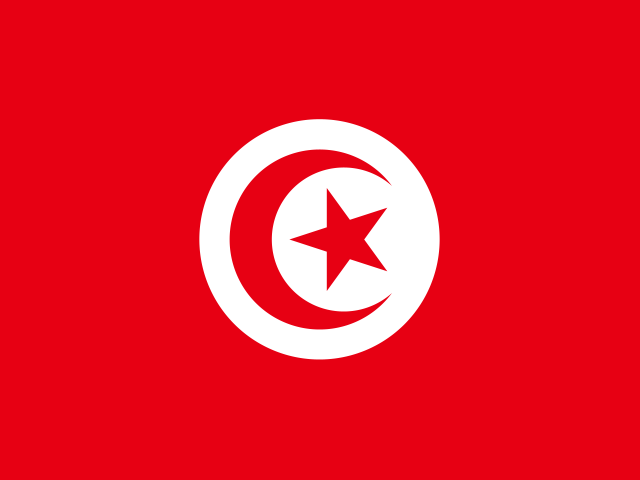
- Nicknamed the Aigles de Carthage (Eagles of Carthage, in reference to the ancient civilisation centred on modern Tunisia), the team plays in white home shirts and red change kits — drawn directly from the national flag.
- Tunisia won the Africa Cup of Nations in 2004 as hosts, defeating Morocco 2–1 in the Radès final under coach Roger Lemerre — the country’s only major continental trophy.
- Tunisia have finished AFCON runners-up twice (1965, 1996) and third place four times.
- The 2026 FIFA World Cup will be Tunisia’s seventh tournament appearance (1978, 1998, 2002, 2006, 2018, 2022, 2026); the team has yet to advance beyond the group stage.
- In 1978 Tunisia became the first African and Arab team to win a FIFA World Cup match, defeating Mexico 3–1 in Rosario.
- Tunisia’s 2026 qualification campaign was historic: the Eagles of Carthage became the first team in FIFA World Cup history to qualify without conceding a goal — 9 wins, 1 draw, 0 losses across 10 group fixtures, GD +22.
- Qualification was sealed on 8 September 2025 with a 1–0 win over hosts Equatorial Guinea in Malabo (Mohamed Ali Ben Romdhane, 94’).
- Sami Trabelsi led the team through qualification, but resigned after a round-of-16 AFCON 2025 elimination by Mali; French-Tunisian coach Sabri Lamouchi was appointed on a 2.5-year deal in 2026.
- Captain Ellyes Skhiri (Eintracht Frankfurt) leads a squad that includes goalkeeper Aymen Dahmen, midfielder Hannibal Mejbri (Manchester United loanee) and Ali Abdi.
- Most-capped player Radhi Jaïdi (105 caps, former Bolton and Birmingham City defender) holds the appearance record; striker Issam Jemâa is the all-time top scorer with 36 goals.
- Home internationals are played principally at the Hammadi Agrebi Stadium (Stade Olympique de Radès) in Radès, capacity 60,000, opened in 2001.
Tunisia World Cup Vital Statistics
| Metric | Value |
|---|---|
| Federation founded | 1957 (FTF) |
| FIFA member | 1960 |
| FIFA World Cup appearances | 7 (1978, 1998, 2002, 2006, 2018, 2022, 2026) |
| Best FIFA World Cup result | Group stage |
| Africa Cup of Nations titles | 1 (2004) |
| AFCON runners-up | 2 (1965, 1996) |
| Most caps | Radhi Jaïdi (105) |
| All-time top scorer | Issam Jemâa (36) |
| FIFA ranking | 44 |
| Head coach | Sabri Lamouchi |
| Previous head coach | Sami Trabelsi (qualification campaign) |
| Captain | Ellyes Skhiri |
| Home stadium | Hammadi Agrebi Stadium (Radès), capacity 60,000 |
| 2026 WC qualification (CAF) | Group H winners — 28 pts (9W-1D-0L, GD +22, no goals conceded) |
| 2026 WC finals group | TBC at time of writing — to be drawn |
Tunisia at the World Cup — History And Profile
Tunisia’s national football team — the Aigles de Carthage, Eagles of Carthage — is one of the longest-established and most consistently competitive North African sides on the FIFA stage. Administered by the Fédération Tunisienne de Football (FTF), founded in 1957 in the year following independence from France, the team has competed in seven FIFA World Cups and is one of just three African nations to have won an AFCON title in the 21st century. The team plays in white home shirts and red change kits, drawn directly from the white-and-red national flag.
Tunisia’s first FIFA World Cup appearance came at Argentina 1978, when the team defeated Mexico 3–1 in Rosario — making Tunisia the first African and Arab team to win a FIFA World Cup match. The team then drew 0–0 with reigning champions Poland and lost 0–1 to defending champions West Germany in the next two group fixtures, finishing the tournament with three points (a then-creditable Africa-zone result). Tunisia did not return to the World Cup until France 1998, but has since been a regular tournament presence: 2002 (South Korea/Japan), 2006 (Germany), 2018 (Russia), 2022 (Qatar) and now 2026 — one of the longest cumulative World Cup résumés of any African nation.
The defining continental moment came at the 2004 Africa Cup of Nations, hosted by Tunisia. Coached by Roger Lemerre — formerly France’s Euro 2000-winning manager — and led by playmaker Mehdi Nafti and goalkeeper Ali Boumnijel, Tunisia defeated Morocco 2–1 in the Radès final to win the country’s first and only major continental trophy. Earlier finals appearances came in 1965 (lost 2–3 to Ghana on home soil) and 1996 (lost 0–2 to South Africa). The 2004 title remains the high-water mark of Tunisian football.
The 2026 FIFA World Cup qualifying campaign was the most decorated of any African nation: Tunisia became the first team in FIFA World Cup history to qualify without conceding a single goal. The Eagles of Carthage finished CAF Group H with 28 points from 30 possible (nine wins, one draw, no defeats), a goal difference of +22, and a clean-sheet record across all 10 fixtures — described by CAF Online as a defensive feat “underlining the side’s solidity and consistency”. Qualification was sealed on 8 September 2025 with a 1–0 win over hosts Equatorial Guinea in Malabo, midfielder Mohamed Ali Ben Romdhane scoring in the 94th minute from a Firas Chaouat assist. The opposition included Namibia, Liberia, Equatorial Guinea, Malawi and São Tomé and Príncipe.
Sami Trabelsi — a former Tunisia centre-back who captained the country at the 1998 World Cup — led the team through the qualifying campaign. After Tunisia’s round-of-16 AFCON 2025 elimination by Mali, Trabelsi resigned. The FTF appointed Sabri Lamouchi — French-Tunisian, formerly of Côte d’Ivoire (2014 World Cup), Stade Rennais, Nottingham Forest and Cardiff City — on a 2.5-year deal, with the 2026 World Cup as the immediate target. The Foot Africa report indicated Lamouchi will announce his preliminary squad on 15 May 2026.
The squad’s core combines European-based experience with a younger axis: captain Ellyes Skhiri (Eintracht Frankfurt), goalkeeper Aymen Dahmen, defenders Ali Abdi and Yan Valery, midfielders Aïssa Laïdouni and Hannibal Mejbri (Manchester United loanee), forwards Wahbi Khazri, Ferjani Sassi and Naïm Sliti. Most-capped player Radhi Jaïdi (105 caps, the former Bolton Wanderers and Birmingham City centre-back) and record goalscorer Issam Jemâa (36 goals) anchor the historical record.
Home internationals are played principally at the Hammadi Agrebi Stadium — the Stade Olympique de Radès — in Radès, opened in 2001 with a capacity of 60,000 and named in 2022 after Tunisian football administrator Hamadi Agrebi. The Stade Olympique de Sousse and the Stade de Radès complex have been secondary venues. The 2004 AFCON final was hosted at the Radès stadium.
Tunisia’s principal football rivalries are with Algeria (the most-played fixture on the calendar — frequent AFCON and friendly meetings), Morocco (2004 AFCON final), Egypt (regional crossover, AFCON title-deciders) and Libya (regional derby). Cross-border supporter culture across Algeria, Morocco and Egypt makes Tunisia matches significant North African sporting events, supplemented by the cultural weight of the pan-Arab fixture network.
Looking forward, Tunisia’s outlook centres on Lamouchi’s reset and a first knockout-stage World Cup appearance — the principal long-running unfinished target in Tunisian football, given seven previous group-stage exits across nearly five decades. Lamouchi’s contract runs through 2028 and into the 2027 AFCON cycle. Generational succession from Khazri and Jemâa to Skhiri, Mejbri and the next wave of European-based academy products is the strategic axis. The 2026 World Cup is the principal sporting target.
Detailed Profile
Crest, Colours & Kit Evolution
Tunisia plays in white home shirts and red change shirts, drawn directly from the white-and-red national flag (which features the Islamic crescent and star). The FTF crest features a stylised eagle in reference to the ancient civilisation of Carthage. Modern kit suppliers have included Burrda, Uhlsport, Adidas and the current cycle’s manufacturer.
Stadium & Premises History
The Hammadi Agrebi Stadium (Stade Olympique de Radès), opened in 2001 for the Mediterranean Games, has a capacity of 60,000 and is the principal national venue. Earlier home internationals were played at the Stade Olympique d’El Menzah in Tunis. Secondary venues include the Stade Olympique de Sousse.
Iconic Players
- 1970s–1980s: Tarek Dhiab (Onze Mondial-recognised African Footballer of the Year 1977), Mokhtar Dhouib, Témime Lahzami.
- 1990s: Adel Sellimi, Sirajeddine Chihi.
- 2004 AFCON-winning generation: Ali Boumnijel (goalkeeper), Mehdi Nafti, Hatem Trabelsi, Khaled Badra, Karim Saidi, Ziad Jaziri, Francileudo Santos.
- 2000s–2010s: Issam Jemâa (record goalscorer), Radhi Jaïdi (record caps), Yassine Chikhaoui, Wahbi Khazri.
- 2026 cycle: Ellyes Skhiri (captain), Aymen Dahmen, Hannibal Mejbri, Aïssa Laïdouni, Ali Abdi, Mohamed Ali Ben Romdhane, Ferjani Sassi.
Coaches & Managers Legacy
Modern lineage includes Mokhtar Tlili, Henryk Kasperczak (multiple spells), Roger Lemerre (2004 AFCON title), Hatem Missaoui, Nabil Maâloul, Mondher Kebaier (2022 World Cup), Jalel Kadri, Sami Trabelsi (2026 World Cup qualification — perfect campaign) and Sabri Lamouchi (since 2026). The Trabelsi-to-Lamouchi handover after AFCON 2025 elimination is the most prominent coaching transition of the modern era.
Trophies & Honours
- AFCON: champions 2004; runners-up 1965, 1996; third 1962, 1978.
- 2026 FIFA World Cup qualification — Group H winners (perfect defensive record).
- All-Africa Games champions 1971.
Peak Eras
- 1978: first World Cup, first African win at the tournament (vs Mexico).
- 2004: AFCON title at home — the highest single peak in Tunisian football.
- 2026 World Cup qualifying: perfect defensive campaign — first team in WC history to qualify without conceding.
Rivalries
- Algeria: most-played fixture on the calendar.
- Morocco: 2004 AFCON final.
- Egypt: AFCON title-deciders.
- Libya: regional derby.
- Nigeria: AFCON quarter-final and World Cup cycle opposition.
Public Image — Bad PR / Controversies
The 2002 AFCON player-pay dispute ahead of the tournament drew significant Tunisian media coverage. The 2010 AFCON squad’s group-stage exit and the 2024 AFCON 2025 round-of-16 elimination by Mali — the latter triggering Trabelsi’s resignation — produced public criticism. The Lamouchi appointment in early 2026 was framed as a corrective.
Australia Connection
Australia and Tunisia met at the 2022 FIFA World Cup group stage in Qatar, with Australia winning 1–0 (Mitchell Duke goal) on 26 November 2022 — a result that helped Australia advance to the round of 16. The two countries have not met in another FIFA-listed senior fixture’s Socceroos head-to-head archive.
Potential Future Trajectory
Lamouchi’s contract extends through 2028. The 2026 World Cup is the principal sporting target. Generational succession from Khazri to Skhiri, Mejbri and a younger axis is well advanced.
More World Cup 2026 Reading
WC 2026 context: See Tunisia's WC 2026 group-stage form, squad and opponents →
 Best Betting Sites
 Best Online Casinos
 Blackjack Sites
 Online Pokies
 Fast Payout Casinos
 PayID Casinos
 New Casinos 2026